How to Choose a Shop Vacuum Filter: HEPA vs Standard
Choose a HEPA shop vacuum filter for fine dust like drywall and sanding dust only if the vacuum seals well and airflow stays usable; for general cleanup and many woodworking tasks, a good Standard filter is often the better value. A poor choice leaves fine dust in the air, clogs faster, and drives up replacement and cleanup time. This guide compares HEPA and Standard filters by dust size, seal quality, airflow, and maintenance cost so you can pick the right setup.
| Decision factor | HEPA | Standard | Winner |
|---|---|---|---|
| Fine dust capture | Built for fine particles, including drywall and sanding dust, with true HEPA ratings tied to 0.3 micron performance. | Better for larger debris; smaller particles can pass back into the air more easily. | HEPA |
| Airflow and clog risk | More restriction from pleated media, so airflow can drop sooner as dust loads up. | Usually less restrictive, so it often stays usable longer on mixed debris. | Standard |
| Seal sensitivity | Needs a sealed vacuum system to deliver real performance. | Still benefits from a good seal, but it is less dependent on near-perfect bypass control. | Standard |
| Maintenance cost | Higher ongoing cost if you replace it on schedule and clean it more often. | Usually lower cost for general cleanup and rough debris. | Standard |
| Best fit use case | Allergy cleanup, drywall dust, and fine sanding dust. | Wood chips, general debris, wet/dry cleanup, and renovation rubble. | Tie |
How particle size guides your filter choice
Fine dust is the dividing line
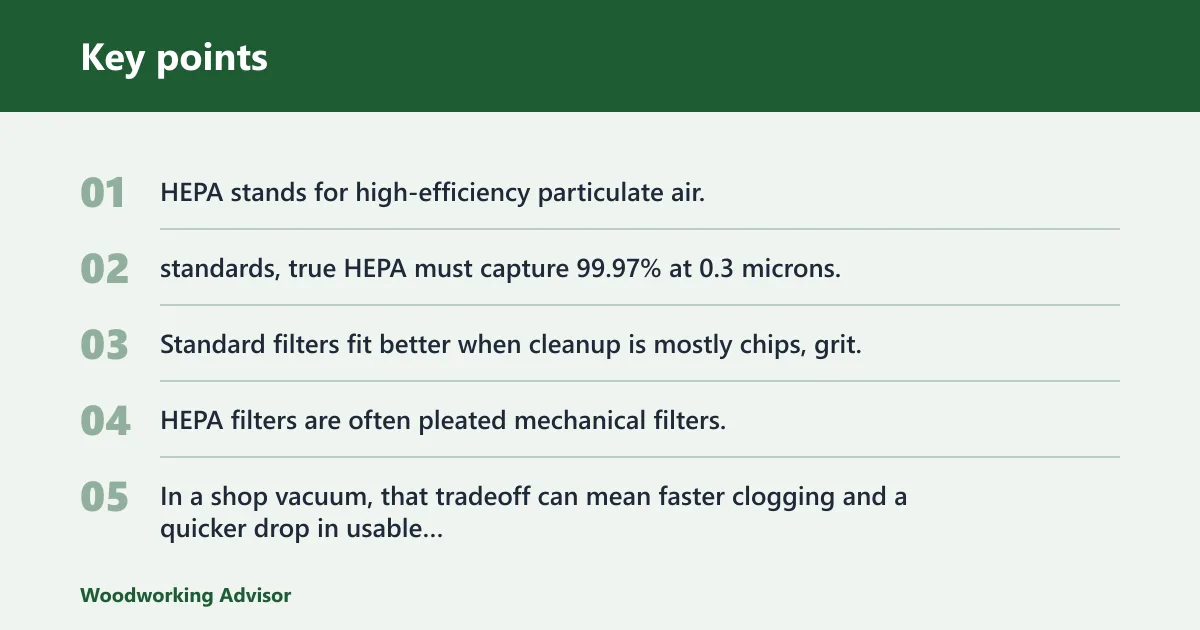
HEPA stands for high-efficiency particulate air. In U.S. standards, true HEPA must capture 99.97% at 0.3 microns, the benchmark used to compare particle filtration. Standard filters fit better when cleanup is mostly chips, grit, and larger debris rather than airborne fine dust.
HEPA filters are often pleated mechanical filters, which gives them a lot of surface area but also more resistance to airflow. In a shop vacuum, that tradeoff can mean faster clogging and a quicker drop in usable suction.
Why particle size changes the choice
Particle size should guide the purchase more than the label on the box. Fine sanding dust, drywall dust, pollen, mold spores, and pet dander are exactly where HEPA earns its place. Larger shavings, nails, saw chips, and workshop debris usually do not need that level of filtration.
Standard filters can let smaller particles recirculate, but they are often practical for rough cleanup where clog resistance matters more than capturing the smallest dust. A vacuum filter is only as good as the seals around it, so even a strong filter cannot make up for bypass leaks.
When standard filtration is enough
Use Standard when the vacuum will mostly handle general shop sweep-up, garage debris, vehicle cleanup, or wet/dry pickup with larger particles. In those jobs, a simpler filter often keeps airflow steadier and replacement costs lower over the year.
Say your bench cleanup is mostly planing shavings and sawdust chunks after a cut list day. A Standard filter is usually the sensible choice because the job loads the filter less aggressively than drywall sanding dust, and the extra HEPA restriction may not buy you much.
Does your shop vacuum need HEPA?
Choose HEPA only when the dust is fine enough to stay airborne and the vacuum can hold a seal. For woodworking dust, drywall dust, and allergy-sensitive cleanup, HEPA can make a real difference. For heavy debris and rough cleanup, Standard usually wins on convenience and maintenance.
Woodworking dust
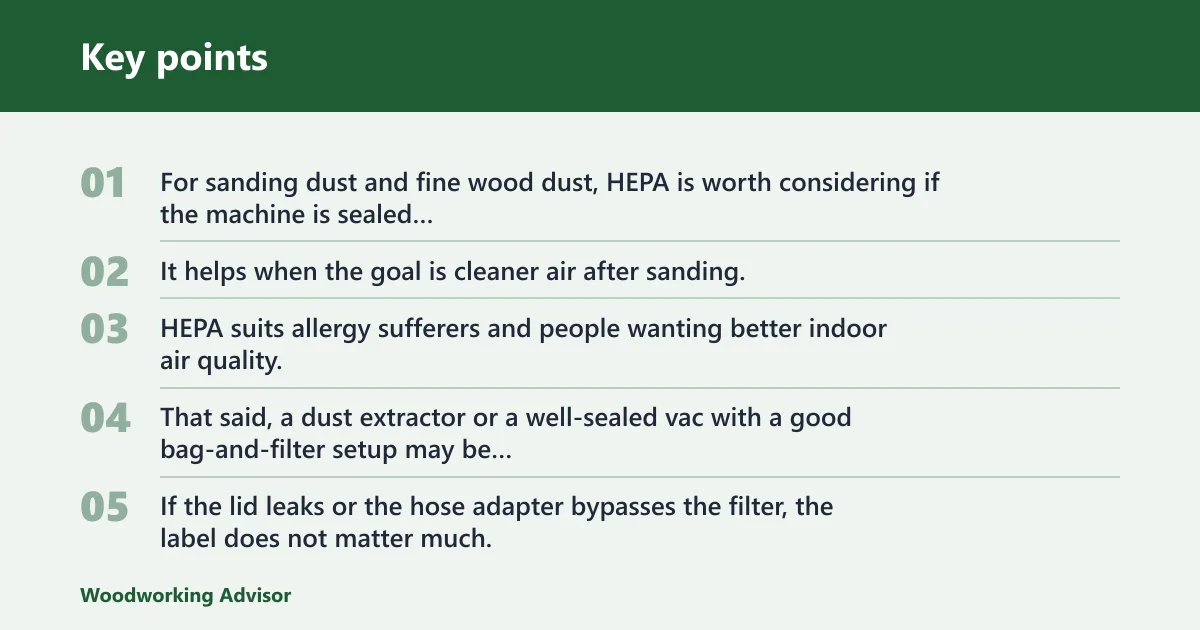
For sanding dust and fine wood dust, HEPA is worth considering if the machine is sealed well and the filter stays serviceable. It helps when the goal is cleaner air after sanding, not just collecting chips off the floor. HEPA suits allergy sufferers and people wanting better indoor air quality.
That said, a dust extractor or a well-sealed vac with a good bag-and-filter setup may be more practical than a loose-fitting HEPA upgrade on an ordinary machine. If the lid leaks or the hose adapter bypasses the filter, the label does not matter much.
Drywall dust
Drywall dust is one of the clearest cases for HEPA because the particles are so fine and clog-prone. Standard filtration can load up fast and send finer dust back into the room. For this job, the higher filtration level usually justifies the extra attention to seal quality and filter maintenance.
Suppose you are cleaning up joint compound dust after a 12-foot hallway patch. A HEPA filter makes sense if the vacuum lid, gasket, hose, and adapter all fit tightly, because the dust is fine enough to find every weak point in the system.
General cleanup and renovation debris
For broken plaster, fastener scraps, wood chunks, and mixed renovation debris, Standard is often the better default. HEPA can still work, but the restriction and clog risk are usually unnecessary unless fine dust is the main problem. Mixed debris favors simpler filtration and easier maintenance.
Sealed system and filter fit
A HEPA shop vacuum needs a sealed vacuum system to perform as rated. If air can bypass around the filter through a bad lid fit, a loose gasket, a poor hose connection, or the wrong adapter, the machine may still move air but it will not filter the air the way HEPA claims suggest.
Why gasket leaks defeat HEPA performance
HEPA performance depends on forcing air through the media, not around it. Even a true HEPA filter cannot compensate for bypass leakage around the canister, cartridge frame, or lid. That is why the whole machine matters, not just the filter element.
Lid fit, hose joints, and adapter leaks
Check the lid latch, foam or rubber gasket, hose cuffs, and any reducer or adapter you plan to use. Small gaps can undo the benefit of a true HEPA cartridge. In practice, a vacuum filter is only as good as the seals around it.
What to check before you buy
- Confirm the vac is designed for the filter style you want.
- Verify the lid closes squarely and compresses the gasket evenly.
- Check that the hose and any adapter seat without wobble.
- Look for true HEPA labeling, not HEPA-style or HEPA-like wording.
- Plan for replacement or cleaning based on dust load, not just calendar time.
HEPA filter buying table
| Use case | Dust type | Clog risk | Airflow tradeoff | Seal requirement | Replacement cadence | Best choice |
|---|---|---|---|---|---|---|
| Wood dust cleanup | Fine sanding dust and sawdust | Moderate | HEPA can restrict airflow more as dust loads up | High | About 6 to 12 months, depending on use | HEPA |
| Drywall dust | Very fine joint compound dust | High | HEPA is worth the restriction if the seal holds | High | Often sooner in heavy renovation work | HEPA |
| Allergy cleanup | Pollen, pet dander, fine household dust | Low to moderate | Moderate, but worthwhile for cleaner air | High | About 6 to 12 months | HEPA |
| Wet and dry debris | Mixed debris, spills, larger particles | Low | Standard stays freer flowing | Medium | Replace when loaded or damaged | Standard |
| Smoke and odor cleanup | Smoke particles plus odors | Moderate | HEPA filters particles; carbon handles odors | High | HEPA about 6 to 12 months; carbon per manufacturer guidance | HEPA plus activated carbon stage |
| Budget maintenance | General shop debris | Low | Standard usually preserves airflow better | Medium | Lower ongoing cost over a year | Standard |
Wood dust: ANBOO VF6000 replacement filter

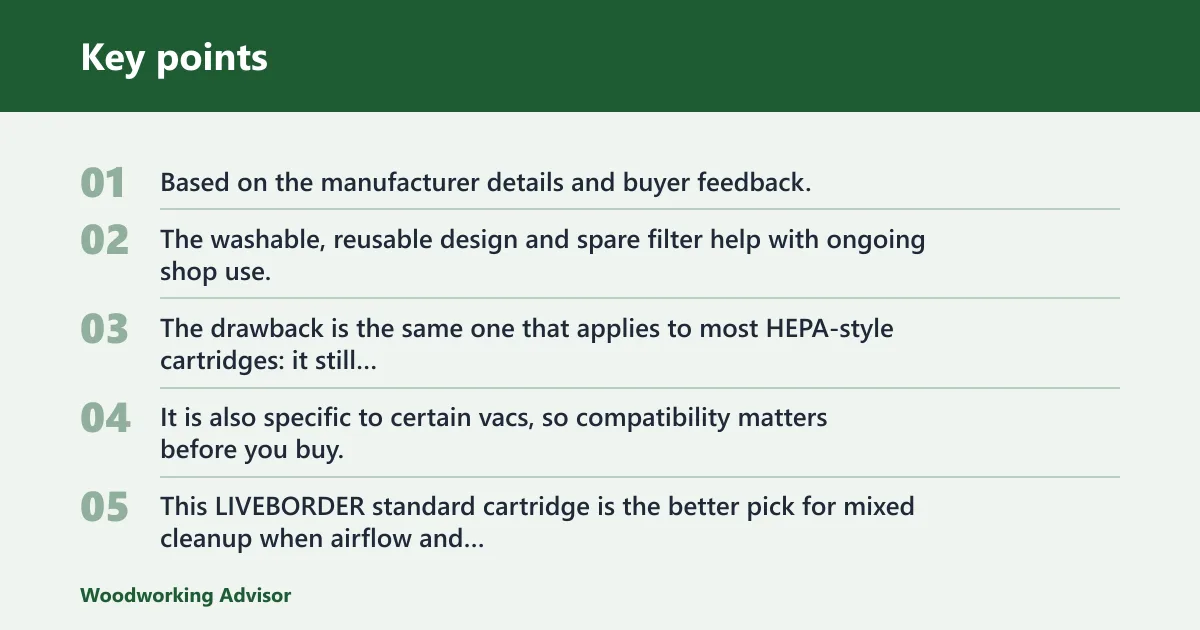
Based on the manufacturer details and buyer feedback, this ANBOO 2-pack is the better fit when you want a HEPA-rated cartridge for fine dust control on compatible Ridgid and Husky wet/dry vacs. The washable, reusable design and spare filter help with ongoing shop use.
The drawback is the same one that applies to most HEPA-style cartridges: it still depends on a tight seal, and washable filters can lose convenience if you wait too long between cleanings. It is also specific to certain vacs, so compatibility matters before you buy.
Budget maintenance: LIVEBORDER standard cartridge filter

This LIVEBORDER standard cartridge is the better pick for mixed cleanup when airflow and lower maintenance matter more than fine-dust filtration. The pleated design supports dry pickup, and the included foam sleeve adds wet pickup flexibility on compatible vacuums.
The drawback is that it is not a HEPA solution, so smaller particles can pass back into the air more easily. It is the practical choice for general debris, not for fine drywall dust or allergy-focused cleanup.
Our picks by need
Best for woodworking dust: ANBOO VF6000 replacement filter
Choose this when the job is sanding dust, fine sawdust, or other dusty shop cleanup that benefits from HEPA-rated filtration. The two-pack is useful if you want one filter in service and one ready as a spare, which can help keep maintenance predictable over time.
The tradeoff is airflow restriction and filter care. A HEPA cartridge is not the best answer for every shop task, and it should not replace a sealed machine or a good dust collection setup.
Best for mixed cleanup jobs: LIVEBORDER standard cartridge filter
Choose this when your vacuum sees more chips, grit, and everyday debris than fine dust. Standard filtration is easier to live with for rough cleanup, especially when you want less clogging and a simpler replacement routine.
The drawback is filtration depth. If the job turns into drywall sanding or allergy cleanup, a Standard filter is the weaker choice and may let finer dust recirculate more easily.
Mistakes to avoid
Do not buy HEPA just because the label sounds better. If the vacuum is not sealed, the filter cannot do its job. Do not use a HEPA-type or HEPA-like phrase as proof of true performance, and do not assume a loose adapter or bad lid fit will be harmless.
Buying HEPA without a sealed system
This is the biggest failure case. A true HEPA filter can still underperform if air slips around the cartridge or through a poor connection. Before paying more for filtration, check the machine’s gasket fit, lid closure, and hose path.
Choosing HEPA for every cleanup job
HEPA is not the default answer for every shop vacuum task. Standard is often better for bulky debris, wet pickup, and jobs that clog filters quickly. Use HEPA when the dust is fine enough to justify the extra restriction and maintenance.
Ignoring replacement cost and clogging
HEPA filters usually need replacing every 6 to 12 months, but dust load can shorten that interval. Washable filters may save money if they are maintained correctly, yet they still need cleaning and eventually wear out. Budget for the full year, not just the purchase price.
Bottom line
Choose HEPA if you are dealing with fine dust, especially drywall dust, sanding dust, allergy cleanup, or a shop where cleaner air matters more than maximum airflow. Choose Standard if your vacuum is mostly handling chips, debris, wet pickup, and general cleanup where clog resistance and lower maintenance cost matter more.
For smoke or odor complaints, remember the split: HEPA captures particulate smoke, but it does not remove gases, odors, or VOCs by itself. If odor control matters, look for an activated carbon stage alongside HEPA, not HEPA alone.
Frequently asked questions
What is a HEPA vacuum filter?
A HEPA vacuum filter is a high-efficiency particulate air filter designed to capture very fine particles. In U.S. standards, true HEPA must capture 99.97% at 0.3 microns. It is useful for dust, pollen, mold spores, and pet dander, but it does not remove odors or gases on its own.
HEPA filter vs regular filter: what’s the difference?
HEPA filters capture much finer particles than Standard filters, which is why they are better for drywall dust, sanding dust, and allergy cleanup. Standard filters are usually better for larger debris and lower clog risk. The tradeoff is airflow and maintenance, especially in a shop vacuum.
Is a HEPA filter vacuum worth it for a shop vac?
Yes, if you are cleaning fine dust and the vacuum has a sealed system that can support real HEPA performance. If your main jobs are chips, rough debris, and wet pickup, Standard is usually the more practical choice because it clogs less and costs less to keep running.
Does a HEPA shop vacuum need a sealed system?
Yes. A HEPA filter only works as intended when the vacuum forces air through the filter instead of around it. Gasket leaks, bad lid fit, hose gaps, and loose adapters can defeat the benefit, which is why seal quality matters as much as the filter media itself.
How often should I replace a HEPA vacuum filter?
A common replacement interval is every 6 to 12 months, but dust load and usage can shorten that. Heavy drywall sanding may require earlier replacement, while lighter shop use may allow longer service. Washable filters can reduce replacement frequency, but they still need cleaning and eventual replacement.
Can a shop vacuum with a HEPA filter remove smoke or odors?
It can remove smoke particles, but not smoke odor by itself. HEPA filters capture particulate matter; odors, gases, and VOCs need a separate activated carbon stage. If odor control matters, look for a vacuum setup that combines HEPA with carbon filtration.
Sponsored / affiliate links. As an Amazon Associate I earn from qualifying purchases. I may earn additional commission from eligible campaigns.