How Much Does a Wood Router Cost?
A wood router typically costs $80 to $250 for a usable corded model, about $250 to $600 for higher-end or plunge routers, and about $150 to $400 for a decent cordless kit. Sticker price alone can hide weak collets, missing guides, and a total bill that rises fast. This guide breaks down router prices by type, the accessories that change the real cost, and where cheap tools become expensive later.
Wood router price ranges
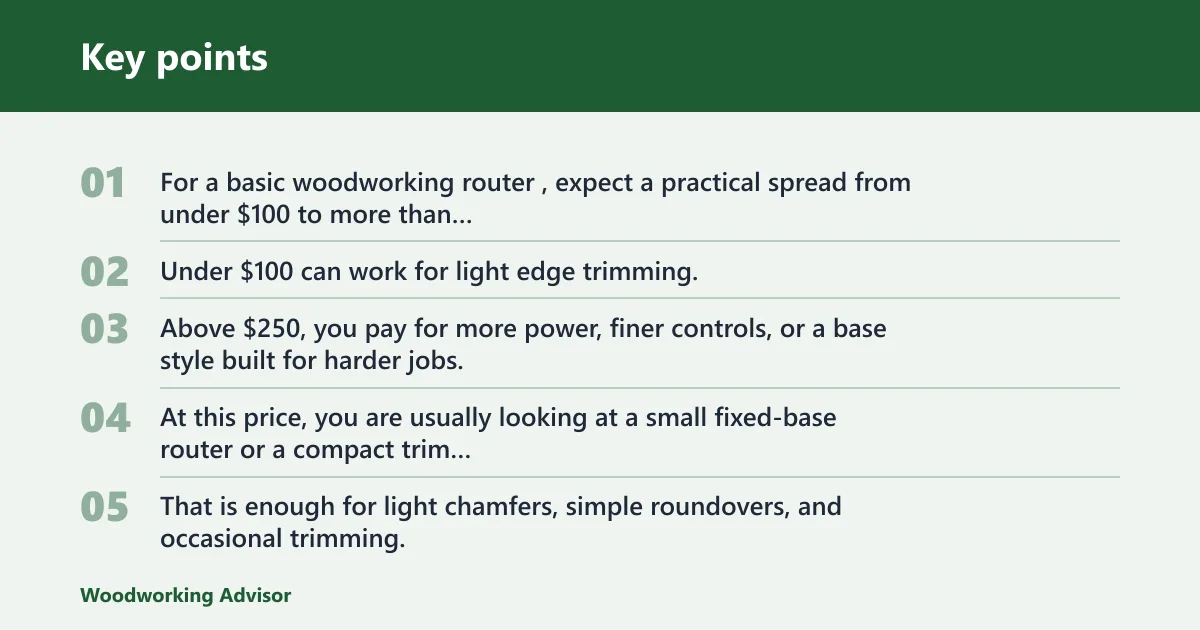


For a basic woodworking router, expect a practical spread from under $100 to more than $500, with the strongest value usually in the middle. Under $100 can work for light edge trimming, while $100 to $250 covers many useful corded routers. Above $250, you pay for more power, finer controls, or a base style built for harder jobs.
Under $100: what you can expect
At this price, you are usually looking at a small fixed-base router or a compact trim router with limited accessory support. That is enough for light chamfers, simple roundovers, and occasional trimming. It is not the right tier for deep cuts, large panel work, or router-table use that depends on stable power and solid bit control.
$100 to $250: the common sweet spot
This bracket covers many of the best first routers and a lot of dependable upgrade choices. Small routers with 1 to 1-3/4 HP typically cost $100-$200, and compact or trim routers cost $100-$250. This is also where you start seeing better depth adjustment, better collets, and more useful accessory packages.
$250 to $500 and up: when you pay more
Once you move past $250, you are usually paying for plunge capability, larger motors, better speed control, or higher-duty construction. Mid-size routers with 2 to 2-1/4 HP typically cost $200-$300, while large routers with 3 to 3-1/4 HP are listed at $350+. Professional models can exceed $500 when the base, electronics, and accessory fit are built for heavier use.
📊 Family Handyman lists a wood router project cost of $101-$250. Source: Familyhandyman.
Which router type fits your job?
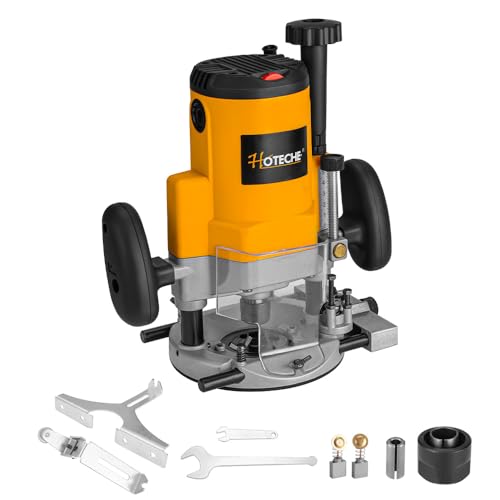
The router type should follow the cut you need, not the lowest sticker price. A fixed-base router is usually the least expensive full-size choice, a plunge router costs more but handles interior cuts better, and a compact router suits edge work and light trim. Combo kits cost more up front, but they cover more jobs without forcing a second purchase later.
Fixed-base router
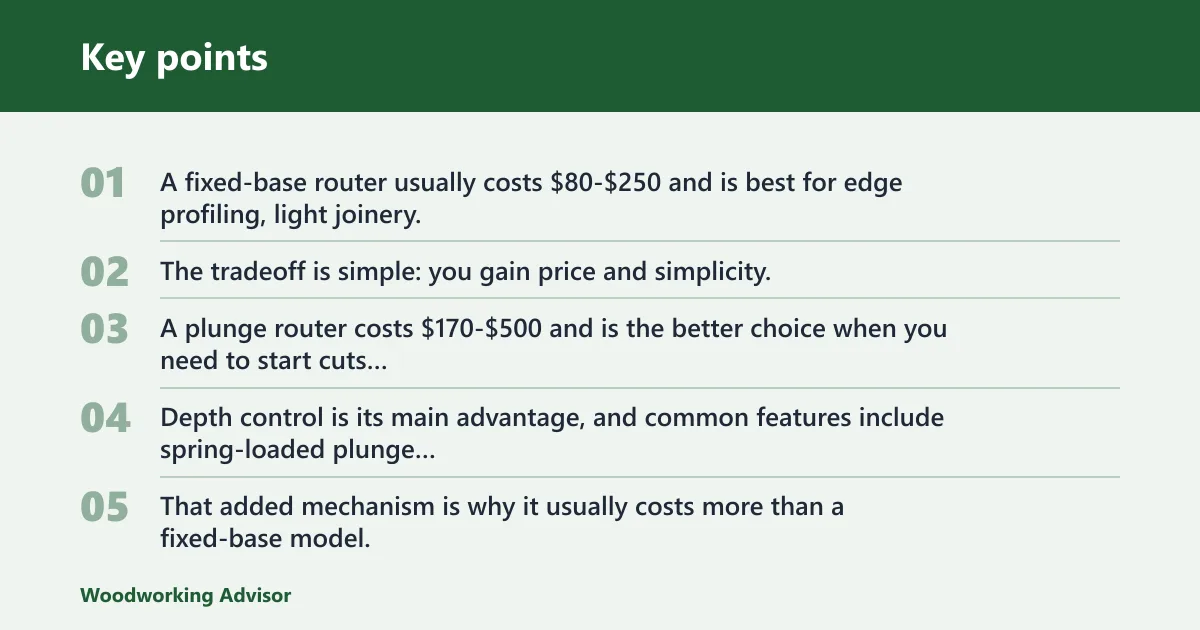
A fixed-base router usually costs $80-$250 and is best for edge profiling, light joinery, and router-table use when set height matters more than plunge access. Most models sit in the 1 to 1-3/4 HP range. The tradeoff is simple: you gain price and simplicity, but you give up plunge cuts and some of the flexibility that wider routing tasks need.
Plunge router
A plunge router costs $170-$500 and is the better choice when you need to start cuts inside a board, cut mortises, or work from a template with controlled entry and exit points. Depth control is its main advantage, and common features include spring-loaded plunge action, depth stops, and micro-adjustment. That added mechanism is why it usually costs more than a fixed-base model.
Compact/trim router
A compact or trim router costs $100-$250 and is designed to stay small and light, which makes it easier to control with one hand on edge work. Power is lower, but that is the point: it is meant for light trimming, laminate flush cutting, and small roundovers rather than heavy stock removal. This is the right size when portability matters more than raw cutting capacity.
Combo router kit
A combo kit costs $170-$350 and includes both fixed and plunge bases on one motor. That raises the price, but it also expands what you can do without buying a second router later. The value tradeoff is storage space, weight, and a higher starting cost in exchange for more versatility and fewer tool gaps.
Router cost matrix by woodworking job
The real budget answer depends on the job you need to do. A router for edge profiling does not need the same budget as a router for joinery or a router-table setup. The table below ties five common woodworking jobs to the minimum sensible router type, the expected price band, the accessory cost you should not ignore, and the most common mistake buyers make.
| Woodworking job | Minimum sensible router type | Expected price band | Required accessories | Most common buying mistake |
|---|---|---|---|---|
| Edge profiling | Compact/trim router or fixed-base router | $100-$250 | Edge guide, 1/4-inch collet, roundover or chamfer bits | Buying too much motor and forgetting a guide |
| Template routing | Plunge router | $170-$500 | Template guide bushing, plunge base, pattern bit | Choosing a fixed-base router that cannot start in the middle of a panel |
| Joinery cuts | Mid-size fixed-base or plunge router | $200-$350 | Straight bits, edge guide or fence, dust collection if available | Underbuying power for dados, mortises, or wider cutters |
| Router table work | Fixed-base router or benchtop router setup | $150-$500+ | Router table, insert plate, fence, lift or above-table adjustment if needed | Buying a light trim router for work that needs stable mounted power |
| CNC wood routing | Desktop CNC wood router | $2,000-$4,000 | Machine, spindle or trim router mount, software, dust collection, tooling | Mixing hobby router pricing with CNC machine pricing |
Say your first project is a bookshelf edge treatment and a few face-frame parts. A compact router with a roundover bit can cover that work cheaply. Suppose the next project is a mortise for a table apron; a plunge router becomes the better buy because the cut starts inside the board, not at an edge.
What makes a router cost more?
Price climbs when the router does more work with more control. Horsepower matters, but so do variable speed, soft start, and the ease of changing bits. A cheap router can be fine for light duty, yet the cost jumps once you add the controls that keep larger bits, denser wood, and frequent setup changes under control.
Horsepower and motor size
Motor size tracks closely with price. More power helps with larger bits and deeper cuts, but it should match the job, not just the budget ceiling.
Variable speed control
Variable speed routers can run from about 10,000 to 25,000 RPM, which matters because larger bits and denser woods often need slower settings than small edge-banding or trim work. That control adds cost, but it also lowers the chance of burning, chatter, or unsafe bit speeds. It is one of the most useful upgrades once you move beyond light-duty work.
Soft start and electronics
Soft start helps the motor ramp up instead of jerking at full force the moment you switch it on. That makes the tool easier to hold and easier on the gears and motor. It adds cost because the router needs more electronics, and that is part of why better models price higher than bare-bones units.
Bit change and depth adjustment
Spindle lock or tool-free bit change systems save time when you swap bits often, especially during pattern work or multi-step joinery. That convenience usually costs more than a simple wrench-based setup. Fine depth adjustment also adds value, and it matters more on plunge routers and router-table setups where repeatable settings save time and reduce errors.
Fixed-base, plunge, and trim router prices
The base style often decides whether a router feels cheap or expensive in actual use. Fixed-base models cost less and are simple to set, plunge routers cost more because of the added mechanism, and trim routers cost less because they are smaller and lighter. The best value depends on whether you need edge work, interior cuts, or mounting in a table.
Fixed-base router cost and limits
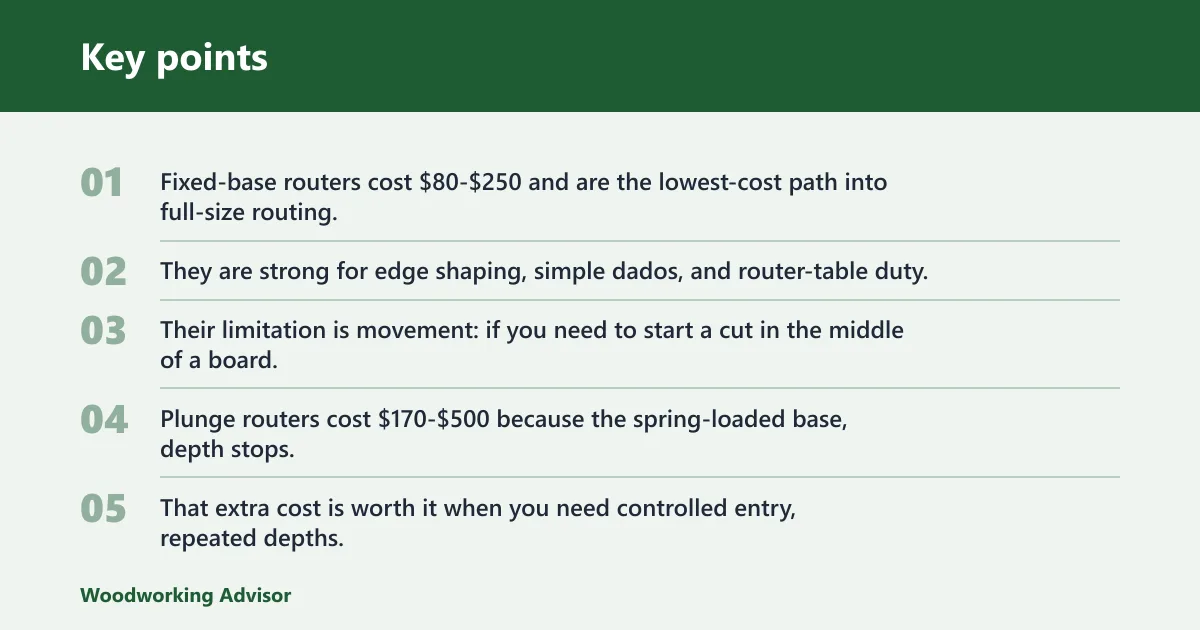
Fixed-base routers cost $80-$250 and are the lowest-cost path into full-size routing. They are strong for edge shaping, simple dados, and router-table duty. Their limitation is movement: if you need to start a cut in the middle of a board, a fixed base is the wrong tool unless you add another base style later.
Plunge router cost and depth control
Plunge routers cost $170-$500 because the spring-loaded base, depth stops, and locking system add hardware and precision. That extra cost is worth it when you need controlled entry, repeated depths, or template work that begins away from an edge. If your work is mostly edge profiling, the extra spend may not pay back fast enough.
Compact router cost and portability
Compact or trim routers cost $100-$250 and stay small enough for one-handed edge work and light trimming tasks. Their lighter size reduces fatigue, but it also limits their usefulness with larger bits or heavier cuts. This is often the best buy for occasional use, but not for table mounting or deep joinery.
Which base style gives the best value?
For many beginners, fixed-base routers offer the best value if the work is mostly edge treatment and simple guide-based cuts. If your projects include template routing, mortises, or any cut that starts inside a panel, a plunge router is worth the extra cost. A combo kit is the strongest value when you know you will use both styles enough to justify the higher buy-in.
How much does a router for wood cost to use fully?
The router itself is only part of the first-year budget. Bits, collets, an edge guide, and table accessories can change a cheap purchase into a much larger one. If you plan only for the tool, you may end up with a router that is technically affordable but still incomplete for the job you had in mind.
Router bits and collets
Bits are a recurring cost because the router is useless without them. A practical starter set should match the work you plan to do, such as straight bits for joinery, roundovers for edges, and a pattern bit for template work. Extra collets matter too, especially if you move between 1/4-inch and 1/2-inch shanks.
Edge guides and fences
An edge guide can turn a basic router into a much more useful tool for dados, grooves, and repeatable edge cuts. Fences matter even more in a router table. If the router you buy does not include these parts, the real cost rises fast because you still need a way to guide the bit accurately.
Router table and insert plate
A router table changes the tool from handheld to stationary, which is useful for small parts, repeated shaping, and safer control of certain cuts. Benchtop or stationary routers cost $150-$500+, and the support gear adds more. A table, insert plate, and fence can cost as much as the router itself if you buy quality parts.
What these extras add to the first-year budget
A common first-timer mistake is buying a $120 router and assuming the job is covered. Add a $40 to $100 starter bit set, a guide, and table accessories, and the total climbs quickly. Family Handyman lists a wood router project cost of $101-$250, which is a useful reminder that project cost and tool cost are not the same thing.
CNC and benchtop router costs
Benchtop and CNC machines belong in separate budget buckets from handheld routers. A benchtop router is still a router tool in a table or mounted setup, while a CNC wood router is a machine system with motion control, software, and a much larger starting price. Do not compare them as if they were substitutes at the same price.
Benchtop router tables
Benchtop or stationary routers cost $150-$500+ and are used for controlled, mounted work. Power usually matters here because the router has to keep pace while fixed in a table, especially with larger bits and repeated cuts. A compact router is usually too limited for this role, while a mid-size router often fits better.
Entry-level CNC wood routers
CNC desktop wood router units start in the $2,000-$4,000 range. That is entry-level for CNC, not for handheld routing. At this tier, bed size, motion hardware, software, setup time, and support matter as much as spindle power because you are buying a production system, not a hand tool.
Production CNC wood routers
Production CNC wood routers cost far more than desktop systems, and the price climbs with larger beds, stronger spindles, better rigidity, and service support. This is a different category from consumer routers. It belongs to shops that need repeatable output and can justify the machine, tooling, and maintenance budget.
Power, bed size, and support costs
The bigger the machine, the more the cost shifts from the spindle to the whole platform. Bed size controls the work envelope, spindle power affects cutting speed and material removal, and support costs matter because setup and downtime have real price tags. CNC routing should be budgeted as a system purchase, not as a larger version of a hand router.
Frequently asked questions
How much does a woodworking router cost?
If you add bits, guides, or a table, the real total rises quickly, so compare the full setup rather than the base tool alone.
How much should a router cost for a beginner?
Most beginners should budget around $100 to $250 for a corded router that includes the basics and enough power for common tasks. That range usually gives you a fixed-base or compact model with better value than the lowest-priced options. If your projects include template work, a plunge router may be worth stretching for.
How much does a CNC wood router cost?
CNC desktop wood router units start in the $2,000-$4,000 range. Production machines cost much more because they add bed size, spindle power, motion hardware, and support requirements. That price level is far beyond handheld router pricing, so it should be treated as a separate machine budget.
What features make a wood router more expensive?
Horsepower, variable speed, soft start, plunge hardware, and easier bit changes all add cost.
Is a plunge router worth the extra cost?
Yes, if you need interior starts, mortises, or template work that depends on controlled entry. Plunge routers cost $170-$500, which is more than fixed-base models, but the added depth control can prevent buying a second tool later. If you only shape edges, the extra cost may not pay off.
What is the difference between a trim router and a full-size router?
A trim router is smaller, lighter, and usually costs $100-$250, which makes it better for edge work and light trimming. A full-size router offers more power, more stable table use, and better performance with larger bits. If your work includes joinery or heavy stock removal, the full-size tool is the better fit.
Sponsored / affiliate links. As an Amazon Associate I earn from qualifying purchases. I may earn additional commission from eligible campaigns.