5 Best Wood Routers for Beginners: research shows
For most beginners, a good wood router is often a fixed-base model in roughly the 1.5 to 2.25 HP range, with soft start, variable speed, and both 1/4-inch and 1/2-inch collets, because it can handle edge profiles, dados, and template work without adding much setup risk. Picking the wrong router can lead to tearout, burned edges, and a tool that feels hard to control. This guide breaks down the right router by project type, base style, and setup confidence so you can buy once and start with cleaner cuts.
This guide is part of our Woodworking saws: tools, types, and uses series.
Quick comparison
| Product | Badge | Best for | Price | ||
|---|---|---|---|---|---|
 |
DEWALT Router, Fixed and Plunge Base Kit, Soft Start,DEWALT | Our pick | 12-Amp · 24,000 RPM · Fixed & Plunge | $269.00
Price as of 11 Oct 2026
|
View |
 |
BOSCH PR20EVS Colt 1.0 HP Variable-Speed Palm Router,Bosch | Budget pick | 1.0 HP · 35,000 RPM · Palm Router | $113.54
Price as of 11 Oct 2026
|
View |
 |
Makita RT0701C 1-1/4 HP Compact Router, Fixed BaseMakita | Also great | 1-1/4 HP · Fixed Base · Variable Speed | $159.00
Price as of 11 Oct 2026
|
View |
 |
WEN 20V Max Cordless Brushless Compact Trim Router withWEN | Upgrade pick | 20V Brushless · Cordless · 4Ah Battery | $92.50
Price as of 11 Oct 2026
|
View |
 |
Cordless Router compatible with DeWalt 20V Battery, 800WYEARTOP | Pair with it | 800W Brushless · 5-Speed · DeWalt Compatible | $49.99
Price as of 11 Oct 2026
|
View |
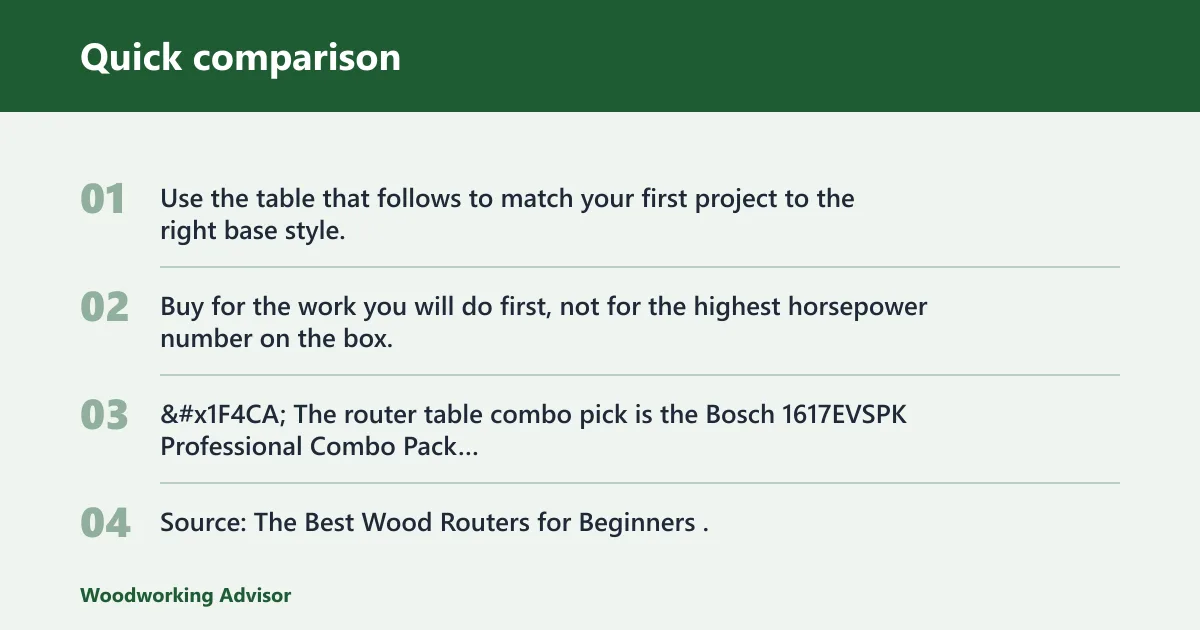
Use the table that follows to match your first project to the right base style, collet size, and accessory list. Buy for the work you will do first, not for the highest horsepower number on the box.
📊 The router table combo pick is the Bosch 1617EVSPK Professional Combo Pack Routers. Source: The Best Wood Routers for Beginners.
How we chose
The guide’s top pick comes from a field that included 8 routers and 120 linear feet of router cutting, with attention on edge profiling, dado cutting, and pattern cutting. Selection favored project fit, setup simplicity, control features such as soft start and variable speed, and beginner-relevant details like collet choice, dust collection, and visibility.
We also weighted accessory value. A router that seems affordable can become expensive once you add bits, an edge guide, clamps, and dust extraction. Beginners need the total starter cost, not just the tool price.
Finally, the picks below match different first-use needs. A furniture builder, a trim installer, and a small-shop hobbyist do not need the same router shape.
Best overall pick for beginners: DEWALT router combo kit
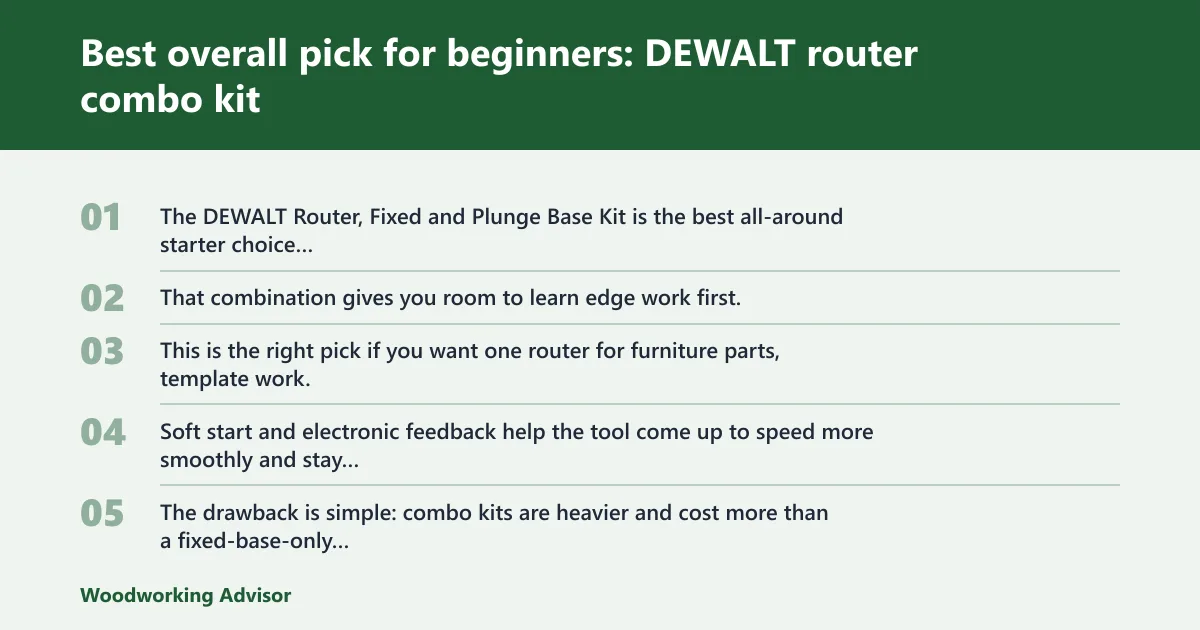
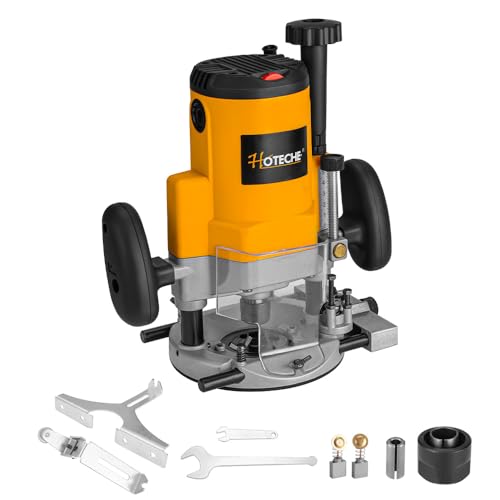
The DEWALT Router, Fixed and Plunge Base Kit is the best all-around starter choice because it includes both base styles, 1/4-inch and 1/2-inch collets, and a 2 1/4 hp motor with 8,000 to 24,000 RPM. That combination gives you room to learn edge work first, then move into stopped cuts and joinery without buying a second router right away.
This is the right pick if you want one router for furniture parts, template work, and future joinery. Soft start and electronic feedback help the tool come up to speed more smoothly and stay steadier under load, which matters when you are still learning feed rate and bit control.
The drawback is simple: combo kits are heavier and cost more than a fixed-base-only router. If you know you will mostly round over table edges or trim laminate, a compact or fixed-base tool may feel easier to handle.
Best compact router for beginners: Makita RT0701C compact router, which is often recommended as a versatile small-router option.
The Makita RT0701C 1-1/4 HP Compact Router fits beginners who want a lighter tool for edge trimming, small roundovers, and template work on smaller parts. Its slim body and variable speed make it easier to control than a full-size router when you are working close to a cabinet door, drawer part, or narrow workpiece.
It is a strong choice for light-duty tasks where a full-size router feels awkward. The rack-and-pinion depth system and quick-release cam lock help with setup, which matters when you are learning how to sneak up on a final depth.
The tradeoff is capacity. A compact router is less comfortable for large bits, deep cuts, or long sessions of heavy edge profiling. It is a good second router later, but for a first tool it works best when your projects stay small.
Best cordless pick for beginners: WEN 20V Max cordless compact trim router
The WEN 20V Max Cordless Brushless Compact Trim Router is best for beginners who value mobility, quick setup, and light trim work where a cord would get in the way. The cordless format helps on stair trim, field repairs, and short edge passes when outlet access is poor.
A brushless motor and transparent baseplate are helpful beginner features. The clear base improves bit visibility, which makes it easier to watch your line and keep the bearing or guide where it belongs.
The drawback is the usual cordless tradeoff: battery dependence. Cordless routers are rarely the first recommendation for a new woodworker who needs long runtime, full-size bits, or the most stable setup for a first tool.
Best budget pick for beginners: YEARTOP cordless brushless router
The YEARTOP cordless brushless wood router is the lowest-cost option in this guide and makes sense for a beginner who already owns DeWalt 20V batteries and wants a basic trim router for light work. The five-speed range and included bits make it attractive as a starter tool for quick jobs.
It can fit simple edge cleanup, small chamfers, and short routing tasks where a compact cordless tool is enough. If your first projects are occasional and you already have compatible batteries, the value proposition is obvious.
The drawback is support and long-term confidence. Tool-only cordless routers can be attractive on paper, but beginners still need to budget for bits, guides, and clamps. Lower purchase price does not remove setup learning.
Best palm router for beginners: Bosch PR20EVS Colt palm router
The Bosch PR20EVS Colt 1.0 HP Variable-Speed Palm Router is the easiest style to control for very small work, especially trim detail, edge easing, and light routing on narrow parts. Its quick-clamp depth system is a practical beginner feature because it shortens setup time.
Palm routers work well when you are near the edge of a board and do not need the mass or reach of a full-size machine. High RPM is useful for tiny bits and fine detail work, where a larger router can feel like too much tool.
The limitation is power and bit size. A palm router is not the right first choice for larger bits, deeper cuts, or many joinery tasks, so it should be matched to small-project use only.
What should you buy first?
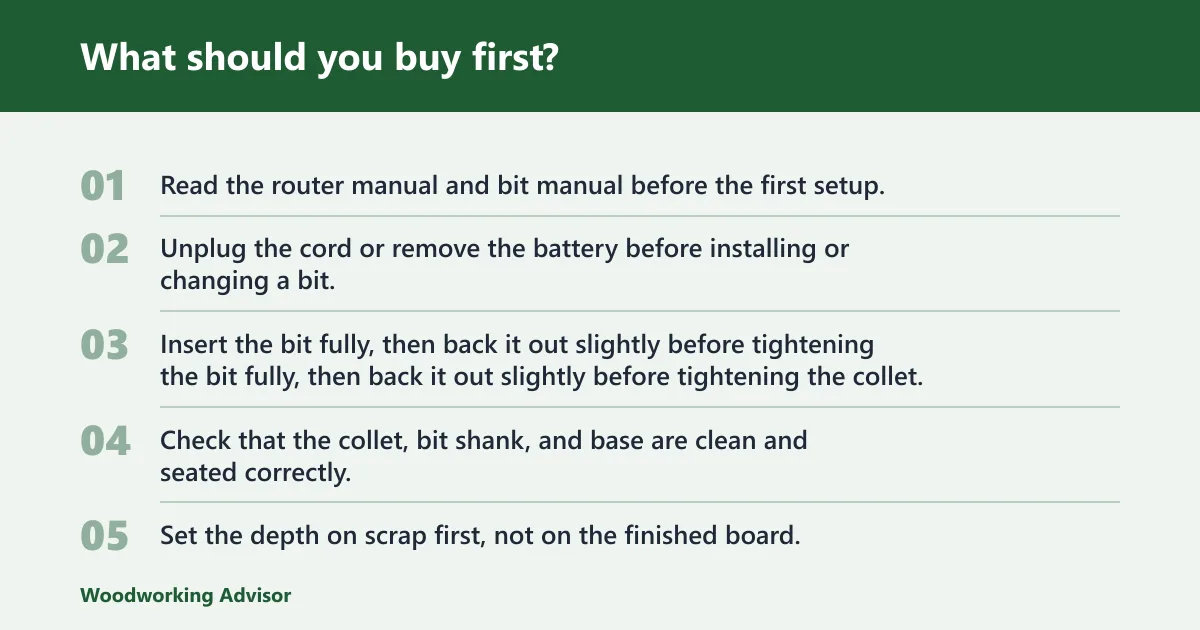
The best first router depends on your first three projects, not your ideal future shop. Edge profiling points you toward a fixed base, stopped cuts and dadoes point you toward a plunge base, and small trim work points toward a compact or palm router. If you want one tool that covers all three, a combo kit is the safest long-term buy.
Beginner router decision matrix
| First project | Best base type | Collet size | Power range | Must-buy accessories |
|---|---|---|---|---|
| Edge profiling on shelves, tabletops, and picture frames | Fixed base | 1/4-inch for small roundovers; 1/2-inch if you plan larger edge bits | About 1.5 to 2.25 HP | Edge guide, roundover bits, dust extraction, clamps |
| Template work and flush trimming | Fixed base or compact router | 1/4-inch is common; 1/2-inch helps with rigidity on larger bits | About 1.0 to 2.25 HP | Flush-trim bit, pattern bit, double-sided tape or clamps, dust collection |
| Dadoes, stopped grooves, and mortise-like cuts | Plunge router | 1/2-inch preferred for stability | About 2.0 to 2.25 HP or more | Edge guide, straight bits, stop block, clamps, dust extraction |
| Trim, chamfers, and small parts | Palm router / compact router | 1/4-inch | About 1.0 to 1.25 HP | Small roundover bit, edge guide, sacrificial backer, vacuum hose adapter |
| Router-table use | Fixed base or router-table-ready combo kit | 1/2-inch preferred | About 1.5 to 2.25 HP | Table insert plate, fence, featherboards, push blocks, dust collection |
Fixed base vs plunge base vs combo kit
A fixed-base router is best for edge profiling and repeatable setup. Depth adjustment is simpler, and once you set the bit height, it stays put. That makes it the easiest starting point for beginners who want fewer moving parts.
A plunge router uses a spring-loaded mechanism that lets you lower the bit into the work. That matters for stopped cuts, dadoes, and pattern cuts where the bit cannot enter from the edge. It is more versatile for joinery, but the moving base can feel less straightforward at first.
A combo kit gives you both. It costs more and usually weighs more, but it is the best value if you want one motor that can move between light edge work and deeper joinery tasks.
1/4-inch vs 1/2-inch collets
A 1/4-inch collet fits smaller bits and is common on compact routers. It works well for light edge shaping, trim work, and beginner projects, but smaller shank bits flex more easily under load than 1/2-inch bits.
A 1/2-inch collet is the better choice when you want more rigidity, especially with larger bits or longer cuts. That extra stiffness helps reduce chatter and gives you more confidence on a full-size fixed or plunge router. If your router offers both, that is a major buying advantage.
Why variable speed matters
Variable speed helps you match RPM to bit diameter and material. Larger bits generally need lower speed than small detail bits, and harder woods often respond better when you slow the cut down enough to avoid burning and tear-out.
A router that runs only one speed limits what you can do safely. Beginner-friendly variable speed lets you start with smaller bits at higher RPM and move down when the bit diameter grows.
Soft start, electronic feedback, and dust collection
Soft start reduces the sudden jerk at startup. Electronic feedback helps the router maintain speed under load instead of bogging down in the cut. Those features make a router easier to control, especially when you are still learning to keep a steady feed rate.
Dust collection matters because it keeps the cut line visible and the work area cleaner. That is more than a cleanup benefit. Better visibility makes it easier to follow a mark, keep the base flat, and spot problems before they become mistakes.
Say your first project is a set of 3/4-inch cabinet shelves with 1/4-inch roundovers on the front edges. A fixed-base router with a 1/4-inch collet and an edge guide is the simplest path. Use a small roundover bit first, then move to larger profiles later.
Suppose you are cutting stopped dados for a small bookcase side. A plunge router gives you a controlled way to enter and exit the cut without starting from the edge. That is the kind of task where a fixed-base-only tool becomes frustrating.
Starter accessories and total ownership cost
The router is only part of the starter budget. Plan for a basic bit set, at least one edge guide, clamps, and some form of dust extraction. A modest tool can cost more once you add the parts needed to use it well.
For a first-time buyer, a practical starter pile includes a straight bit, a roundover bit, a flush-trim bit, an edge guide, and two or four solid clamps. If you plan to use a router table later, add table-ready hardware rather than buying a router twice.
Router-table readiness versus handheld use
Handheld routers are the most natural starting point. They teach bit control, direction, and feed rate with less setup. Router-table use is useful later for small parts and repeat cuts, but it adds fence setup, bit height adjustments from below, and more attention to guarding.
If you know a router table is part of your plan, pick a fixed-base or combo kit with a motor and base that mount cleanly. Beginners often do better starting handheld and moving to table work only after they understand bit behavior.
First-10-cuts safety and setup checklist
- Read the router manual and bit manual before the first setup.
- Unplug the cord or remove the battery before installing or changing a bit.
- Insert the bit fully, then back it out slightly before tightening the collet.
- Check that the collet, bit shank, and base are clean and seated correctly.
- Set the depth on scrap first, not on the finished board.
- Lock the base and confirm the bit clears the work before starting.
- Start the router before the bit contacts the wood.
- Feed against the bit rotation, not with it.
- Make one shallow test cut and inspect the edge for burn marks or tear-out.
- Use eye protection, hearing protection, and dust extraction or a vacuum whenever possible.
How to use a wood router for beginners
Start with a shallow cut, secure the workpiece with clamps, and move the router against the bit’s rotation so the tool does not run away from you. Keep the base flat on the wood, let the bit reach full speed before contact, and stop to test depth on scrap before cutting the real part.
The most common beginner mistakes are rushed setup, too much depth in one pass, and feeding in the wrong direction. You get cleaner results by taking lighter passes and checking the edge after each change.
How much power does a beginner wood router need
Most beginners do well with a router in the 1.0 to 2.25 HP range, depending on the project. Small trim work can live in the lower end of that range, while edge profiling, dados, and router-table use are easier with more power and a stiffer 1/2-inch collet.
More power is not always better. An oversized router can be harder to control on small parts, and beginners often benefit more from variable speed, soft start, and a base that feels balanced in the hand.
Should a beginner buy a fixed base or plunge router
Buy a fixed base first if you plan to do edge profiling, roundovers, and repetitive setup work. Buy a plunge router first if your earliest projects involve stopped cuts, dadoes, or joinery that starts away from the edge. A combo kit makes sense if you want both jobs covered from day one.
For most first-time buyers, fixed base is the easier entry point. The depth adjustment is simpler, and that simplicity helps you learn bit behavior without juggling the plunge mechanism at the same time.
Do I need a 1/4-inch or 1/2-inch collet router
You need a 1/4-inch collet if your work is mostly light trim, small profiles, and compact router tasks. You need a 1/2-inch collet if you want more rigidity, larger bits, and more confidence for edge work, template work, and router-table use. A router that accepts both is the most flexible choice.
If you are choosing only one, 1/2-inch compatibility is usually the better long-term decision for a first full-size router. It supports a wider range of bits and feels steadier under load.
Is a cordless router good for beginners
A cordless router can be good for beginners who need mobility and short setup times, especially for light trim or field work. It is usually not the best default choice for a first router because battery runtime, power delivery, and bit size limits matter more once you start doing larger cuts.
If your projects are small and you already own compatible batteries, cordless can be practical. If you want the broadest beginner range, a corded fixed-base or combo kit is still the safer first buy.
What can I do with my first wood router
Your first router can edge-profile shelves, round over tabletops, trim laminate, flush-trim template work, cut decorative details, and handle some joinery. The exact range depends on base type, collet size, and power. A fixed base handles edges well; a plunge base opens the door to stopped cuts and dados.
Begin with one bit and one task. That keeps setup simple and helps you learn how the router reacts before you move on to more demanding cuts.
What size router is best for beginners
For most beginners, a mid-size corded router is the best starting size because it balances control and capability. Compact routers are easier to manage for trim and small parts, while full-size fixed or combo routers are better when you need more bit choices and better stability for common furniture and cabinet work.
If you are unsure, choose the size that matches your largest likely first project, not the smallest. That usually means a full-size fixed base or combo kit rather than a tiny trim-only tool.
Frequently asked questions
what is the best wood router for beginners
For most beginners, the best wood router is a fixed-base model with soft start, variable speed, and both 1/4-inch and 1/2-inch collets. That setup covers the widest set of starter projects with the fewest control surprises. If you know you need stopped cuts, move up to a combo kit.
Sponsored / affiliate links. As an Amazon Associate I earn from qualifying purchases. I may earn additional commission from eligible campaigns.