Best Drill Presses for Woodworking (2026): we compared
Best drill press for woodworking: choose a 10–12 inch benchtop model for small-shop joinery and hardware work, or a 12–15 inch floor model if you need taller capacity and steadier drilling in thicker stock. A poor match leads to torn-out holes, limited spindle travel, and wasted time resetting fences or workpieces. This guide translates swing, quill stroke, speed control, table support, and runout into clear picks for common shop tasks.
This guide is part of our Woodworking saws: tools, types, and uses series.
Quick comparison
| Product | Badge | Best for | Price | ||
|---|---|---|---|---|---|
 |
Powermatic 18-Inch Floor Drill Press, Variable Speed, 1 HP,Powermatic | Upgrade pick | 18 in · 1 HP · Variable speed | $2,449.00
Price as of 14 Oct 2026
|
View |
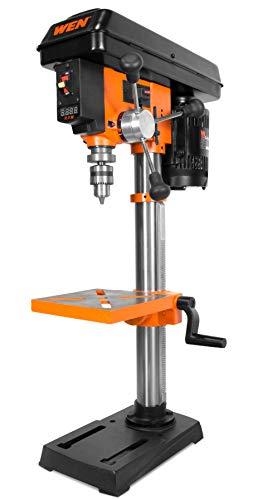 |
WEN 10-Inch Benchtop Drill Press, 6.2-Amp Variable SpeedWEN | Budget pick | 10 in · 6.2A · Variable speed | $203.98
Price as of 14 Oct 2026
|
View |
 |
JET 12-Inch Variable-Speed Benchtop Drill Press, 1/2 HP,Jet | Our pick | 12 in · 1/2 HP · Variable speed | $788.37
Price as of 14 Oct 2026
|
View |
 |
SKIL 6.2 Amp 10 In. 5-Speed Benchtop Drill Press with LaserSkil | Also great | 10 in · 6.2A · 5-speed | $219.00
Price as of 14 Oct 2026
|
View |
 |
VEVOR 12-Inch Benchtop Drill Press, 6.2 Amp, 1 HP BenchVEVOR | Pair with it | 12 in · 1 HP · Variable speed | $319.90
Price as of 14 Oct 2026
|
View |
Use this section to compare capacity first, not brand names. For woodworking, swing and spindle travel usually matter more than a long feature list.
Benchtop models suit small shops and hobby work because they save floor space and still handle shelf pins, dowels, and light mortising. Floor models make more sense when you drill larger furniture parts, thicker stock, or repeated holes all day.
How we chose these drill presses
The best woodworking drill press should fit the task you do most often, not the largest bit you might use once a year. The main filters here are swing, spindle travel, speed range, chuck capacity, and table adjustability.
Stability matters too. A heavier base, better fence support, and a table that does not flex reduce chatter, wandering bits, and tear-out on face frames, shelves, and joinery parts.
Hidden accessory costs count. A fence, a quality vise, a drill press table, and better lighting can change the real price by a meaningful amount.
JET 12-inch benchtop drill press: best for repeatable small-shop setups
The JET JWDP-12 fits woodworkers who want a compact 12-inch bench model with enough reach for most home-shop tasks. WoodnBits lists it as a top pick for repeatable bench setups, and its 85-pound weight points to a steadier platform than many light benchtop machines.
Its 12-inch swing gives more reach than 8- and 10-inch options, which helps when you are drilling shelf-pin rows, cabinet parts, or dowel holes on wider workpieces. The included LED work light and X-shaped XACTA laser can help with alignment on setup-heavy jobs.
The drawback is cost. This class often lands above entry-level benchtop machines, and a good fence or table upgrade can push the total higher.
WEN 10-inch benchtop drill press: best for budget-minded small shops
The WEN 4212T is a strong fit if you want a compact 10-inch benchtop drill press with real woodworking speed control. It has a 4.5 Amp motor and variable speeds from 530 to 3100 RPM, which makes it more useful than fixed-speed budget presses for large brad-point bits and harder species.
It suits shelf pins, small mortises, dowel holes, and general cabinet drilling where space is tight. The digital speed readout is helpful when you swap between small pilot holes and larger Forstner bits.
The limitation is reach. A 10-inch swing works for many shop tasks, but wider panels and some fence-and-casework layouts can feel cramped compared with a 12-inch machine.
WEN 10-inch benchtop drill press: best for variable-speed value
The SKIL DP9505-00 is a budget-friendly 10-inch benchtop option for woodworkers who want laser alignment and a work light without moving up to a larger footprint. Its 6.2 amp motor and 5-speed system from 610 to 2800 RPM give more flexibility than a single-speed entry model.
That speed spread helps with common woodworking bits, especially when you need slower speeds for larger cutters and cleaner control on hardwood. For a first drill press, the laser and light can make setup faster for shelf pins and repetitive layout work.
The tradeoff is refinement. A 5-speed machine is less convenient than a true variable-speed press, and the lighter build usually means you should expect to spend more time dialing in fence support and workholding.
VEVOR 12-inch benchtop drill press: best for more travel in a bench size
The VEVOR 12-inch benchtop drill press is aimed at woodworkers who want more reach and a claimed 1 HP motor without moving to a floor-standing machine. Its variable speed range of 530 to 3140 RPM and 0-45° tilting worktable make it flexible for angled holes and general shop drilling.
This size is useful when a 10-inch press feels tight but a floor model would crowd a small shop. The digital readout and X-laser positioning can help with repeatable setups, especially for cabinet parts and face-frame drilling.
The drawback is that a larger spec sheet does not automatically mean better support or less chatter. On benchtop machines, the fence, table flatness, and accessory quality matter a great deal.
Powermatic 18-inch floor drill press: best for larger furniture parts
The Powermatic PM2800B is the clear heavy-duty option here. It is an 18-inch floor drill press with a 1 HP motor, variable speed control across a broad range, and a cast iron base for stability.
This type of machine suits larger tabletops, thicker stock, and production-style repetitive drilling where weight and stability pay off. The laser guides also help with tool-point alignment on layout-critical joinery.
The obvious drawback is price and footprint. It costs far more than a benchtop unit, and it is only sensible if you regularly need the capacity and stability that a larger floor machine provides.
What size drill press do you need?
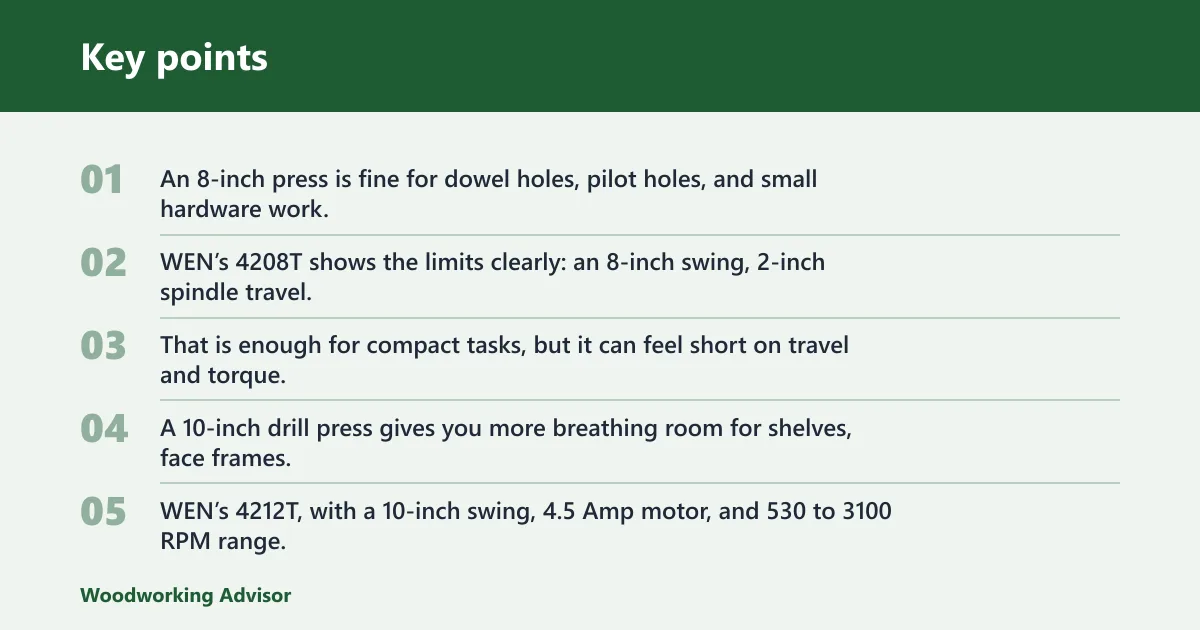
Most home workshops do well with a 10-inch or 12-inch press. An 8-inch model works for light-duty holes and small parts, while 17-inch and larger machines make more sense for bigger panels, thicker stock, and furniture work that demands extra reach and stability.
8-inch and 10-inch models for light duty
An 8-inch press is fine for dowel holes, pilot holes, and small hardware work. WEN’s 4208T shows the limits clearly: an 8-inch swing, 2-inch spindle travel, and a 2.3-Amp motor. That is enough for compact tasks, but it can feel short on travel and torque.
A 10-inch drill press gives you more breathing room for shelves, face frames, and light mortising. WEN’s 4212T, with a 10-inch swing, 4.5 Amp motor, and 530 to 3100 RPM range, is a better fit when you want one machine to cover many common small-shop jobs.
12-inch models for most home workshops
A 12-inch swing is the practical middle ground for many woodworkers. It reaches farther than 8- and 10-inch machines, which helps with wider cabinet parts and jig-based drilling, while still staying compact enough for a garage or basement shop.
This size usually works best if you drill shelf-pin rows, dowel joinery, hardware holes, and medium-size Forstner-bit work on a regular basis. WoodnBits also notes a 12-inch swing as a real step up in reach.
17-inch and larger models for bigger panels and furniture parts
A 17-inch or larger floor drill press becomes useful when you drill large tabletops, thick legs, or repeated holes in wide assemblies. The extra swing and heavier base help reduce movement and flex during deeper cuts.
Jet’s JDP-17 is presented as a 17-inch floor-standing model for serious woodworkers. That class is usually the right answer when the shop regularly handles furniture-scale parts and a smaller machine would force awkward repositioning.
Which features matter most for woodworking?
For woodworking, the most useful features are variable speed, enough spindle travel, a chuck that accepts the bits you actually own, and a table that tilts and supports fixtures well. Laser guides, worklights, and depth stops help with setup and repeatability, but they are secondary to capacity and rigidity.
Variable speed for large bits and hardwoods
Variable speed matters because larger Forstner bits and hardwoods usually need lower RPM than small brad-point holes. Common ranges such as 530 to 3100 RPM or 350 to 3000 RPM let you slow down for big cutters and speed up for smaller bits without changing pulleys as often.
Fixed-speed presses can still work, but they are less forgiving. If you regularly switch between shelf pins and 2-inch Forstner bits, speed control saves time and can reduce burning and tear-out.
Spindle travel for mortising and deep holes
Spindle travel is the vertical drilling depth the press allows in one stroke. A 2-inch stroke can be enough for shallow holes and lighter hardware work, while 2-3/8 inches or 3-1/8 inches gives more room for mortising, deep peg holes, and thicker stock.
More travel does not replace good technique, but it reduces reset work when drilling deeper holes. Bilt Hard’s 12-Inch model is listed with 3 ⅛-Inch spindle travel, which is a useful benchmark for woodworking tasks that need more depth.
Chuck capacity, table tilt, and motor power
A half-inch chuck covers many common woodworking bits, but a 5/8-inch chuck gives you more room for larger shank sizes on heavier cutters. That matters when you use larger Forstner bits or specialty hole-cutting accessories.
Table tilt helps with angled holes. A 45-degree bevel capability is useful for chair parts, jigs, and angled joinery. Left/right tilt can matter if your workholding or fence is set up for one direction more naturally than the other.
Motor power affects how steadily the press keeps spinning under load. Examples range from 2.3A and 4.5A up to 5A and 6.2A on bench machines, while floor units may be listed at 1/2 HP, 3/4 HP, or 1.5 HP. More power usually helps with torque in hardwoods and larger bits.
Laser guides, worklights, and depth stops
Laser guides and digital readouts help with alignment and setup speed, especially for beginners or repeated cabinet work. A worklight makes it easier to see the layout line and bit tip before you start the cut.
A depth stop is one of the most useful repeatability features for shelf pins, dowels, and hardware holes. It keeps every hole at the same depth, which matters more than a laser once the work is set up correctly.
Woodworking drill press decision matrix
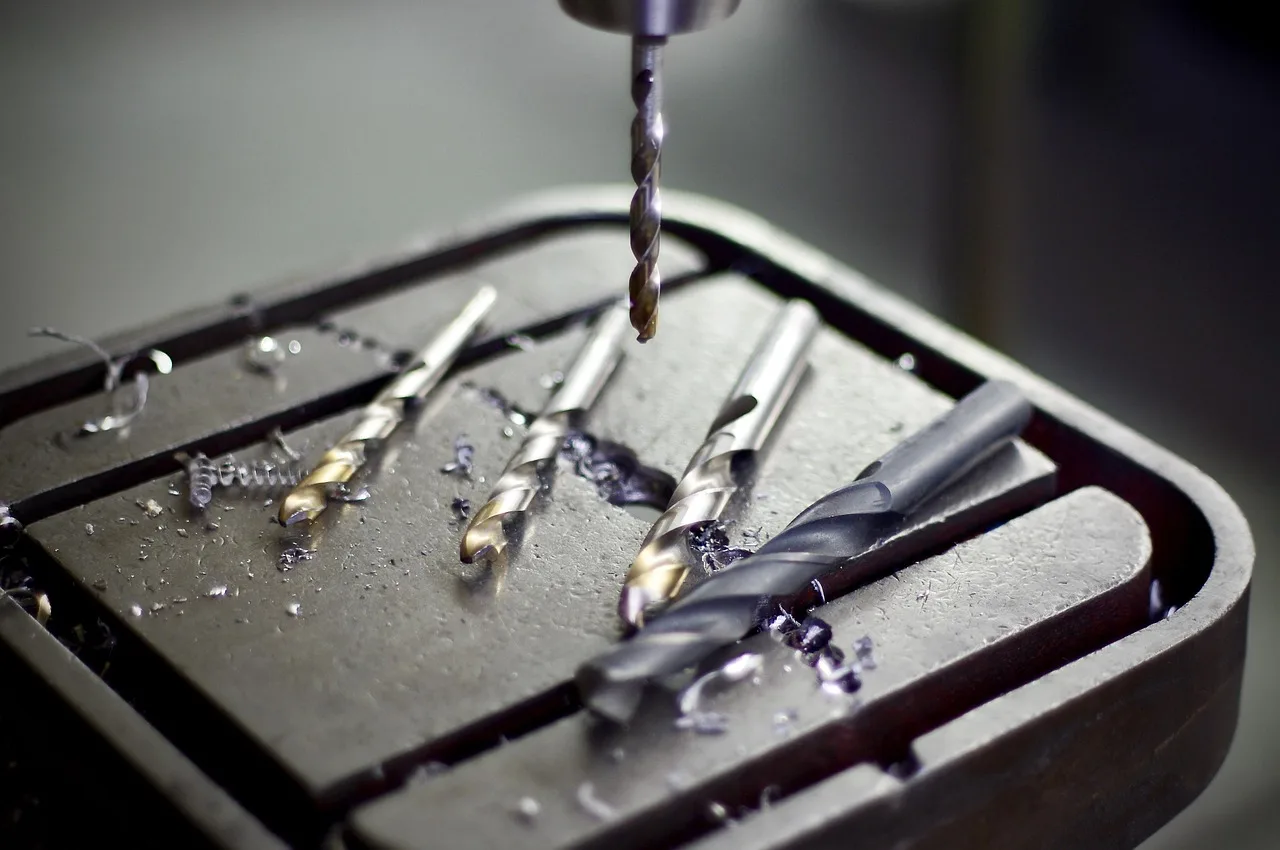
This matrix turns specifications into task-based choices. It also shows where the real cost can move beyond the machine price, because a vise, fence, and table often determine how well the press works in practice.
| Woodworking task | Suggested swing | Spindle travel | Motor / speed target | Accessory cost to plan for |
|---|---|---|---|---|
| Dowel holes in face frames | 8-10 inch | 2 inches or more | Variable speed, lower RPM for cleaner entry | Fence and simple stop block |
| Shelf-pin rows | 10-12 inch | 2 inches to 2-3/8 inches | Moderate power, steady speed control | Fence, worklight, depth stop |
| Mortising in hardwood | 12 inch or larger | 2-3/8 inches to 3-1/8 inches | Stronger motor, slower RPM range | Vise and rigid table support |
| Large Forstner-bit work | 12-17 inch | 3 inches or more | Higher torque, wide variable speed range | Fence, clamp set, possibly a better table |
| Thicker furniture parts | 17 inch and larger | 3 inches or more | Floor model, better stability, stronger motor | Delivery, floor space, accessory upgrades |
Say your shop builds cabinet carcasses and you drill shelf-pin lines every week. A 10-inch press can do the job, but a 12-inch model with a good fence reduces awkward repositioning and keeps rows aligned across long panels.
Suppose you need a 1-inch Forstner hole in oak. A low-RPM setting, enough spindle travel, and a stable table matter more than a laser. If the press stalls or chatters, the bit size is too demanding for the machine or the setup is too loose.
Which one should you buy?
Choose the smallest press that still covers your actual work. For a tight footprint and beginner shop, a 10-inch benchtop model is the practical starting point. For cabinet work and repeatable joinery, a 12-inch benchtop machine is the better all-around choice.
If you want a small-shop pick, the WEN 4212T is the budget-friendly route, while the JET JWDP-12 is the stronger choice for repeatable bench setups. If you want a floor machine, the Powermatic PM2800B is the high-end answer for bigger parts and long-term stability.
For large Forstner bits, thicker stock, or furniture-scale work, move up to a 17-inch class machine such as the JET JDP-17. If you want room to grow, a 12-inch or 17-inch floor model gives more headroom than a compact benchtop press.
Frequently asked questions
What is the best drill press for woodworking?
The best drill press for woodworking is usually a 10- to 12-inch benchtop model for small shops, or a 12- to 17-inch floor model when you need more stability and taller capacity. The right pick depends on swing, spindle travel, and how often you drill larger bits in hardwood.
Do I need a drill press for woodworking?
You do not need one for every project, but a drill press becomes very useful when you want straight, repeatable holes for dowels, shelf pins, and hardware. It also reduces bit wander and makes depth control easier than a hand drill, especially on repeated cabinet work.
Who makes the best drill press?
There is no single best brand for every shop, but Jet, Powermatic, and WEN all offer woodworking-relevant models at different price levels. Look at stability, swing, spindle travel, speed control, warranty, and parts support before you choose a brand.
What swing size do I need for woodworking?
An 8-inch swing works for light tasks, a 10-inch swing fits many small-shop jobs, and a 12-inch swing is the most flexible for home woodworking. Move to 17 inches or larger if you regularly drill large panels, wide assemblies, or thick furniture parts.
What features matter most in a woodworking drill press?
Variable speed, spindle travel, chuck capacity, and a stable table matter most. After that, a fence, depth stop, and good workholding improve repeatability. Laser guides and lights help setup, but they should not replace enough power or a rigid machine.
Sponsored / affiliate links. As an Amazon Associate I earn from qualifying purchases. I may earn additional commission from eligible campaigns.