Cedar Siding vs Fiber Cement Siding
Fiber cement siding is often the better all-around choice for homeowners who want lower maintenance and a lower 10-year cost. Cedar siding fits buyers who want real wood grain and are willing to keep up with regular care, especially in dry climates. Pick poorly and you can pay more for repainting, repairs, rot, or early replacement. This guide compares cost, durability, maintenance, appearance, climate fit, and long-term value to help you choose the right siding for your home.
| Decision factor | Cedar Siding | Fiber Cement Siding | Winner |
|---|---|---|---|
| Appearance up close | Natural grain, warm texture, authentic wood character | Wood-like grain and profiles, but still reads like composite at close range | Cedar Siding |
| Moisture and rot resistance | Susceptible to water-related wear over time | Resists moisture absorption, swelling, and rotting | Fiber Cement Siding |
| Fire resistance | Wood may need flame-retardant treatment | Naturally flame retardant without extra chemicals | Fiber Cement Siding |
| Maintenance burden | Periodic washing, restaining or repainting, and repair checks | Less frequent washing and repainting, with fewer finish cycles | Fiber Cement Siding |
| 10-year cost outlook | Higher finishing and upkeep costs can add up | Lower lifecycle cost in most maintenance-heavy climates | Fiber Cement Siding |
How do they compare on appearance?
Cedar Siding is the better choice if you want true wood grain, softer color shifts, and a finish that reads as natural from the curb and at arm’s length. Fiber Cement Siding can mimic wood well for many homes, but close inspection usually shows a manufactured surface.
Natural grain and profile options
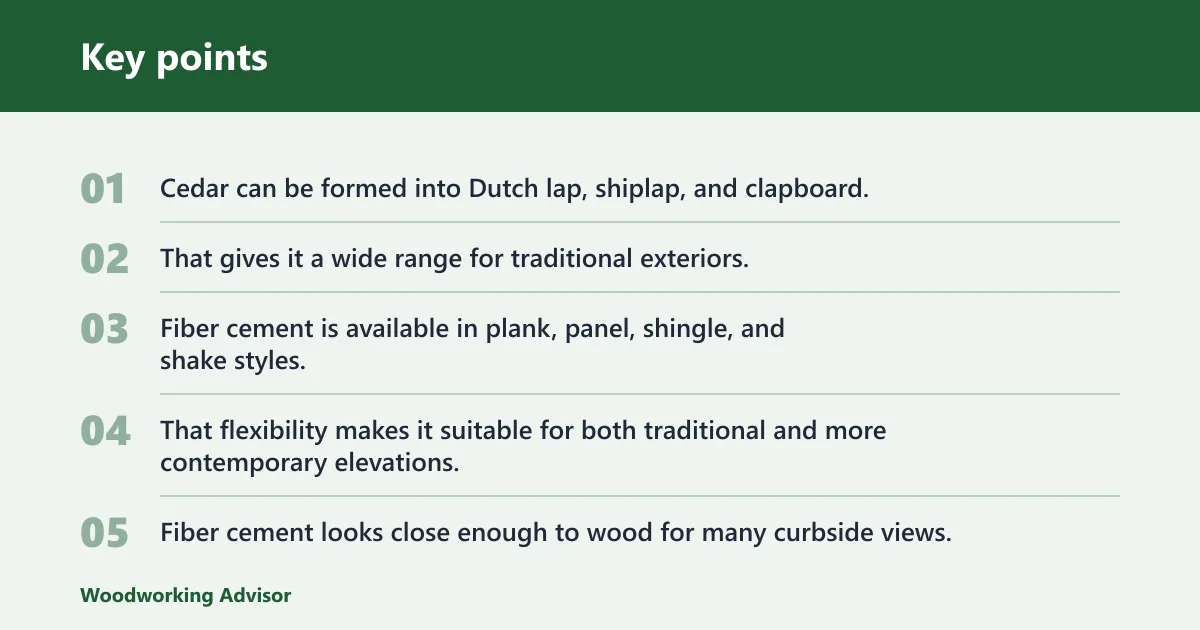
Cedar can be formed into Dutch lap, shiplap, and clapboard, and it also comes as shingles and handhewn shakes. That gives it a wide range for traditional exteriors, especially when you want a textured façade that looks like real wood.
Fiber cement is available in plank, panel, shingle, and shake styles, and it can also be installed in Dutch lap, shiplap, and board and batten patterns. That flexibility makes it suitable for both traditional and more contemporary elevations.
How close fiber cement gets to wood
Fiber cement looks close enough to wood for many curbside views, especially in plank and shingle forms with a painted finish. Up close, though, it usually lacks the same depth of grain and warm irregularities that make cedar feel more natural.
Suppose a homeowner is replacing 1,800 square feet on a street-facing colonial. From across the street, either material can read well. At the porch and side entry, cedar’s texture usually feels more authentic.
What reads better on traditional versus modern homes
Cedar generally suits historic-correct, craftsman, cottage, and restoration work where wood is part of the home’s visual logic. Fiber cement works better when the goal is a crisp painted finish, a clean board pattern, or a low-maintenance exterior that still nods to wood.
📊 Cedars are a genus with 1-3 species of coniferous trees. Source: Cedrus.
Which lasts longer?
Fiber Cement Siding usually lasts longer in wet, variable, or fire-prone settings because it resists moisture absorption, swelling, rotting, insects, and fire. Cedar Siding can last a long time too, but its service life depends more on exposure, finishing quality, and how quickly you address water intrusion.
Moisture, rot, and insects
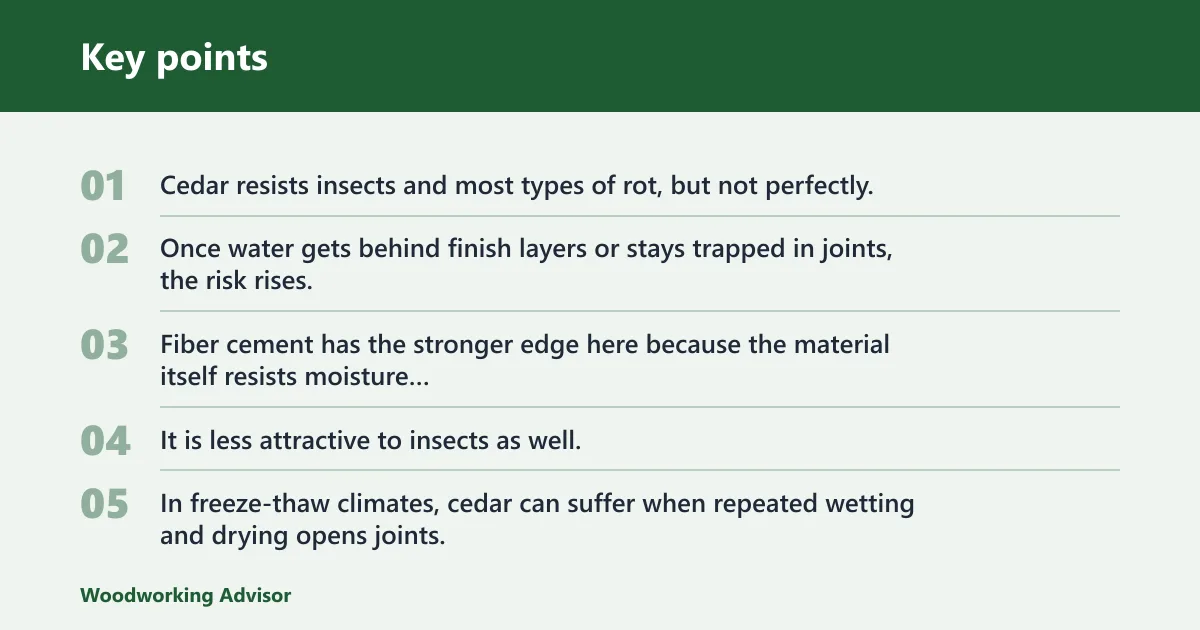
Cedar resists insects and most types of rot, but not perfectly. Once water gets behind finish layers or stays trapped in joints, the risk rises, especially on shaded walls, low rooflines, and areas that stay damp after rain.
Fiber cement has the stronger edge here because the material itself resists moisture absorption, swelling, and rotting. It is less attractive to insects as well, so the finish and caulk lines matter more than decay of the substrate.
Freeze-thaw, wind-driven rain, and coastal exposure
In freeze-thaw climates, cedar can suffer when repeated wetting and drying opens joints, lifts coatings, or encourages checking. In coastal humidity or wind-driven rain, it needs tighter upkeep because salt air, moisture, and persistent dampness speed finish breakdown.
Fiber cement generally handles those conditions better, but it is not maintenance-free. Water can still get into joints, unsealed cut edges, or failed caulk lines, so installation quality remains important.
Impact damage and repair risk
Cedar dents and splinters more easily, but individual boards or shakes can often be patched or replaced without disturbing large areas. Fiber cement is harder and more impact resistant, yet it can crack if mishandled during installation or struck hard enough after installation.
A common first-timer mistake is assuming a harder siding always means fewer repair headaches. Fiber cement reduces decay-related repairs, but a cracked plank, poor cut, or failed joint can still create a visible fix.
What maintenance does each need?
Cedar Siding needs more frequent washing, closer inspection, and periodic refinishing than Fiber Cement Siding. Fiber cement still needs paint care, caulk checks, and moisture control, but its maintenance cycle is usually less demanding over a 10-year span.
Washing and inspection intervals
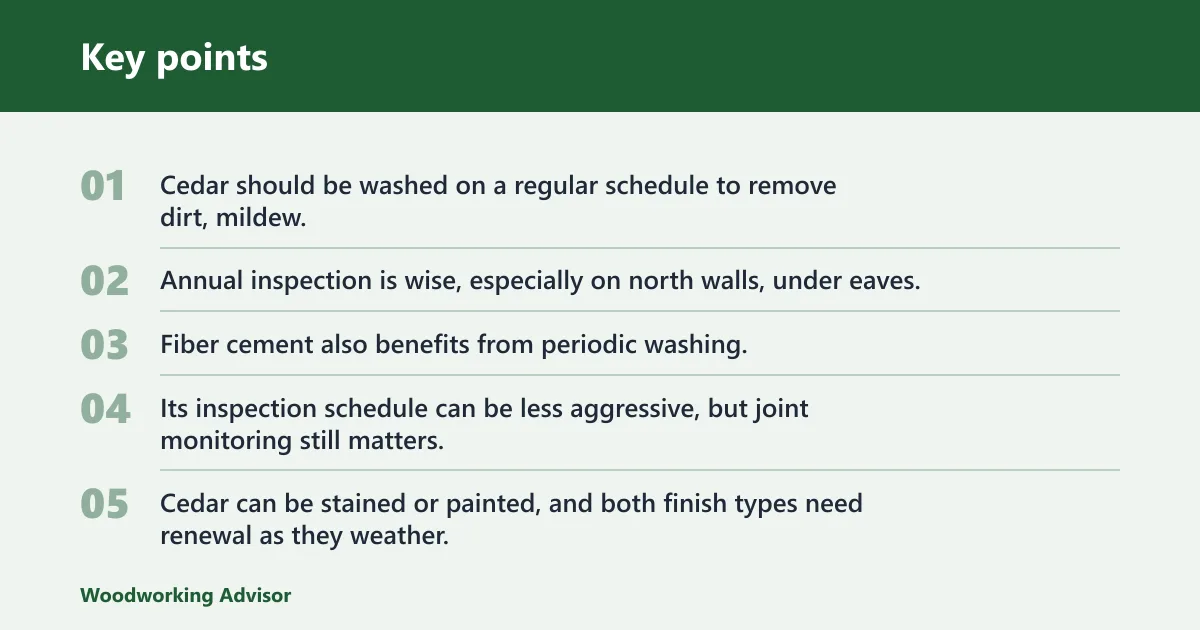
Cedar should be washed on a regular schedule to remove dirt, mildew, and debris that hold moisture against the surface. Annual inspection is wise, especially on north walls, under eaves, and near grade where splashback can keep boards damp.
Fiber cement also benefits from periodic washing, mainly to keep mildew and grime from building up and to spot failed caulk or cracked finish early. Its inspection schedule can be less aggressive, but joint monitoring still matters.
Repainting or restaining schedules
Cedar can be stained or painted, and both finish types need renewal as they weather. In practical terms, stain usually needs earlier attention than paint, while full repainting often becomes necessary when the coating begins to chalk, peel, or open at edges.
Fiber cement can be precolored or painted. Precolored products reduce repainting pressure, while painted products still need a long-cycle refresh when the finish starts to fade or break down.
Patch repairs, caulking, and mildew control
Cedar needs more attention at cuts, end grain, and any spot where water can enter and stay trapped. Soft spots, cupped boards, and finish failure should be addressed quickly because damage can spread into adjacent pieces.
Fiber cement demands careful caulking and properly sealed joints. It also needs dust control during cutting and clean, accurate fastening, because poor installation can create future repair points even when the board itself is durable.
Cost per square foot and 10-year cost
Fiber Cement Siding is usually cheaper over the life of the project, but the answer changes when installation complexity, finish choice, and maintenance tolerance are included. Cedar may look similar at the start of a project, yet its finishing and upkeep often raise the 10-year total.
Material-only ranges
Allura states Cedar Siding typically runs around $3 to $6 a square foot. The same source states Fiber Cement Siding usually costs between $1.85 and $2.65 per square foot. On material price alone, fiber cement starts lower in most projects.
Installed cost drivers
Installed cost is shaped by more than board price. Fiber cement is heavier and harder to install than vinyl, so labor, lifting, cutting, fastening, PPE, caulking, and dust control can raise the bill. Cedar is easier to handle, but finish prep and detailing still add labor.
Paint or precolor choices matter too. A painted cedar project can cost more up front than raw material implies, and a fiber cement project without factory color may need a paint step that changes the total.
Finishing, repainting, and replacement over time
Cedar’s 10-year cost often rises because of washing, refinishing, and selective board replacement. If moisture gets past the finish, repair work can move from surface care to partial replacement more quickly than many owners expect.
Fiber cement usually stays ahead on total cost because it needs fewer finish cycles and has less rot-related replacement risk. Over about 10 years, that maintenance gap often matters more than the initial material spread.
Installation differences that change the bill
Fiber cement installation usually costs more in labor because the boards are heavier, harder to handle, and more dependent on specialized tools and PPE. Cedar is less physically demanding to install, but it still needs careful flashing, fastening, and sealing if you want it to last.
Weight and handling
Fiber cement panels and planks are cumbersome enough that one-person handling is limited on many jobs. That affects staging, cuts, and labor time, especially on second-story walls or long elevations.
Cedar is lighter and easier to maneuver, which can simplify layout and reduce strain. That does not eliminate labor costs, but it does change how quickly crews can move around the exterior.
Tools, PPE, and cutting dust
Fiber cement calls for specialized cutting methods and protective gear because the dust from cementitious cutting needs careful control. The job also demands attention to edge treatment and fastening patterns so the siding performs as intended.
Cedar does not create the same dust issue, but it still needs accurate cutting, weather-smart detailing, and proper sealing at vulnerable edges. The simpler tool list can help, yet installation quality still drives long-term results.
Fasteners, joints, and caulk lines
Fiber cement depends heavily on straight joints, consistent gaps, and well-managed caulk lines. Bad detailing is more expensive later because moisture can enter around the seams even though the board material itself resists rot.
Cedar also needs sound joints, but its wood nature makes finish and water management more central to the outcome. On either product, sloppy installation shortens service life faster than most buyers expect.
Choose Cedar Siding if… / Choose Fiber Cement Siding if…
Choose Cedar Siding if your project rewards natural grain, traditional character, or restoration accuracy, and you are willing to wash, refinish, and inspect it on a regular schedule. Choose Fiber Cement Siding if you want a lower-maintenance exterior, better moisture and fire resistance, and stronger 10-year value in exposed climates.
Budget-first scenario
Choose Fiber Cement Siding if the decision starts with 10-year cost and you want to keep maintenance spending predictable. Choose Cedar Siding only if the lower-maintenance benefits of fiber cement are outweighed by a specific appearance goal or historic requirement.
Historic-correct scenario
Choose Cedar Siding when the home’s architecture depends on wood texture, traditional profiles, or a period-correct finish. Cedar also makes sense when nearby trim, porch details, and rooflines look wrong with a more manufactured surface.
Low-maintenance scenario
Choose Fiber Cement Siding if you want fewer repaint cycles, less rot risk, and less time spent on washing and patching. That choice is especially strong for owners who plan to hold the house for years without wanting to manage constant exterior upkeep.
High-humidity or wildfire-prone scenario
Choose Fiber Cement Siding in coastal humidity, wind-driven rain, or wildfire-prone areas because it resists moisture and is naturally flame retardant without extra chemicals. Cedar can work in dry climates, but it needs more careful finishing and, in fire-sensitive zones, may require flame-retardant treatment.
Cedar siding decision matrix
| Scenario | Recommended material | Main reason | Key tradeoff | Maintenance cadence |
|---|---|---|---|---|
| Budget-first | Fiber Cement Siding | Lower material price and lower 10-year cost in most cases | Heavier install and more careful cutting, fastening, and caulking | Wash periodically; inspect caulk and finish yearly; repaint on a long cycle |
| Historic-correct | Cedar Siding | Authentic grain and traditional profiles suit period homes | Higher upkeep and more exposure to water-related wear | Wash regularly; inspect annually; restain or repaint as finish breaks down |
| Low-maintenance | Fiber Cement Siding | Less frequent refinishing and better resistance to rot and insects | Less natural look up close | Wash as needed; inspect joints yearly; repair caulk and paint only when required |
| High-humidity or wildfire-prone | Fiber Cement Siding | Moisture resistance and natural flame retardance | Higher install complexity than cedar | Wash periodically; inspect after storms; keep joints sealed and finish intact |
Say your home sits in a rainy coastal town with salt air and wind-driven rain on the west wall. Fiber Cement Siding is the safer long-hold choice because the material is less likely to swell or rot, while cedar would need faster refinishing and closer inspection after wet seasons.
Picture a bungalow from the early 20th century with front-gable clapboards and exposed porch columns. Cedar Siding is usually the better visual match because the grain, profile, and repairability fit a traditional exterior more naturally than a composite substitute.
Frequently asked questions
Which lasts longer cedar or fiber cement siding?
Fiber Cement Siding usually lasts longer in wet, windy, or fire-prone climates because it resists moisture absorption, swelling, rot, insects, and fire. Cedar can also last a long time, but its lifespan depends more on finish maintenance, exposure, and how quickly water-related damage gets repaired.
Which is cheaper cedar siding or fiber cement siding?
Fiber Cement Siding is usually cheaper on material price, with Allura listing it between $1.85 and $2.65 per square foot versus cedar at around $3 to $6 per square foot. Installed cost can still shift the total, so labor, finishing, and future repainting should be included before you decide.
Does fiber cement look like cedar?
Fiber Cement Siding can mimic cedar’s grain and come in shingle, shake, plank, and board-style profiles, so it works well from the curb. Up close, though, it usually reads as manufactured rather than truly wood, especially next to real cedar trim, porch parts, or closely viewed wall sections.
How much maintenance does cedar siding need?
Cedar Siding needs periodic washing, annual inspection, and refinishing on a regular schedule to stay in good shape. Stain usually needs attention sooner than paint, and any spots with failing finish, open joints, or trapped moisture should be repaired quickly to reduce the chance of rot or mildew.
Is fiber cement siding fire resistant?
Yes. Fiber Cement Siding is naturally flame retardant without extra chemicals, which gives it a clear edge in wildfire-prone areas. That does not make the wall assembly fireproof, but it does mean the siding material itself offers better fire resistance than untreated wood siding.
Is cedar siding rot resistant?
Cedar resists insects and most types of rot, but not perfectly. It can still decay when moisture stays trapped behind finish layers, in shaded areas, or around poor joints, so regular washing, prompt repairs, and sound detailing matter if you want it to last.
Sponsored / affiliate links. As an Amazon Associate I earn from qualifying purchases. I may earn additional commission from eligible campaigns.