Corded vs Cordless Circular Saw: Specs Compared (2026)
Choose a corded circular saw if you cut near an outlet most days; choose cordless if you work away from power and already own the battery platform. The maker spec sheets for DeWalt and Makita show very similar blade size, depth and speed, so the real differences are weight with battery, total cost and runtime. This guide compares them with sourced numbers and a decision table. For model picks, see our best circular saw roundup.
Short Answer: Corded or Cordless Circular Saw?
Best Corded Circular Saw Pick
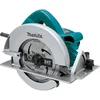 |
Makita 5007F 7-1/4" Circular Saw, $159.00 A 15-amp corded saw with a maker-listed 5,800 RPM and 2-3/8 inch depth at 90 degrees, the corded half of the Makita pair compared in the spec table below.
|
As an Amazon Associate we earn from qualifying purchases.
Plugged in, the saw never slows because of a drained pack, and the price covers the tool and nothing else. Cordless trades that for freedom of movement: no cord to drag across a roof, a driveway or a sheet of plywood, and no outlet hunting. Which one wins depends on three measurable things, covered in the sections below: what the spec sheets actually say, what the whole setup costs, and how much the saw weighs once the battery is clipped on.
One honest note about this page: it is a spec-based comparison built from maker pages and manuals, not a hands-on test. We have not run these saws, so we do not claim cut counts or runtime figures of our own. Where a maker publishes a runtime claim, we label it as the maker’s claim.
Corded vs Cordless Circular Saw Specs Side by Side
The table pairs one corded and one cordless 7-1/4 inch saw from each of two brands. Every figure comes from the maker’s own product page or spec sheet, read on October 8, 2026. A dash means the maker page did not list that number.
| Model | Type | Power | No-load speed | Depth at 90 deg | Bevel | Weight |
|---|---|---|---|---|---|---|
| DeWalt DWE575 | Corded | 15 amp | Not listed on page | 2-9/16 in | 57 deg | 8.8 lb |
| DeWalt DCS578B | Cordless, tool only | 60V MAX (battery sold separately) | 5,800 rpm | 2-9/16 in | 57 deg | Not listed |
| Makita 5007F | Corded | 15 amp | 5,800 rpm | 2-3/8 in | 0-45 deg | 11.1 lb |
| Makita XSH08Z / XSH08PT | Cordless, two 18V batteries | 36V (2 x 18V LXT) | 6,000 rpm | 2-3/8 in | 0-48 deg, stop at 45 | 11.3 lb with batteries |
Sources: DeWalt product pages for the DWE575 and DCS578B; Makita product page for the 5007F and Makita spec sheet for the XSH08 kit. Makita also lists 1-3/4 inch (5007F) and 1-11/16 inch (XSH08) depth at 45 degrees.
What the table actually shows
- Depth of cut is a tie within each brand. DeWalt lists 2-9/16 inches for both its corded and 60V saw; Makita lists 2-3/8 inches for both of its. Going cordless did not cost cutting depth in either pair.
- Speed is a tie or a slight cordless edge. Makita lists 5,800 rpm corded and 6,000 rpm cordless. DeWalt’s 60V saw is listed at 5,800 rpm, and its corded page does not publish a figure.
- Weight is where the story gets interesting. See the next section, because the common belief that cordless saws are lighter does not hold for this Makita pair.
Weight With the Battery On: The Myth That Cordless Is Lighter
Many buyers assume dropping the cord means dropping weight. The Makita numbers say otherwise: the corded 5007F is listed at 11.1 lb, and the cordless XSH08 is listed at 11.3 lb with its two batteries installed. That is a 0.2 lb difference, which you would not feel in the hand. The bigger spread is between brands and models, not power types: the corded DeWalt DWE575 is listed at 8.8 lb, which is 2.3 lb lighter than either Makita.
For DeWalt’s 60V saw, the page lists no weight at all, tool only or with a battery. That matters because the battery is a large share of the total weight of any cordless saw. If weight on a ladder or overhead is your concern, find the with-battery number from the maker before you buy, and compare it against the corded model in your price range.

If you are choosing between blade sizes rather than power sources, our 6-1/2 vs 7-1/4 circular saw comparison covers the weight-versus-depth trade, and our 7-1/4 blade guide covers tooth count and arbor size.
What Each Setup Really Costs (Prices Checked October 8, 2026)
A cordless saw sold as “tool only” is not a working saw until you add a battery and a charger. These prices come from the Amazon Creators API on October 8, 2026 and change often, so treat them as a snapshot.
| Setup | What you buy | Price on Oct 8, 2026 |
|---|---|---|
| Corded DeWalt DWE575 | Saw only; plug in | $129.00 |
| Corded Makita 5007F | Saw only; plug in | $159.00 |
| Cordless DeWalt DCS578B | Tool only, 60V MAX | $196.17 |
| DeWalt DCB606 battery | 6.0Ah FLEXVOLT 20V/60V MAX | $131.66 |
| DCS578B plus one DCB606 | Saw plus one battery, before a charger | $327.83 |
The arithmetic is simple but easy to overlook: the 60V tool-only price is $37.17 above the corded Makita, and adding one battery brings the cordless setup to $327.83, roughly twice the corded saw. A charger is extra unless it comes in a kit. Makita sells its XSH08PT as a kit with two 5.0Ah batteries and a dual-port charger according to its spec sheet, but we did not pull a current kit price, so we leave it out of the table.
The cost picture flips if you already own batteries. A cordless tool-only saw that fits a pack you have from a drill or impact driver costs only the tool, which is why platform ownership often decides this choice. Our battery-powered circular saw guide and cordless handheld circular saw buying guide go deeper on picking a platform.
Runtime: What Makers Claim and What They Do Not
A corded saw has no runtime limit beyond the length and rating of your cord and your own endurance. For cordless saws, runtime depends on battery capacity, blade, material and how hard you push the saw, so honest numbers are hard to find.
Makita is the only brand in our table that publishes a figure on the sheet we read: its spec sheet claims up to 610 crosscuts per charge in 2×4 SPF lumber and up to 320 crosscuts per charge in 2×10 SPF lumber, using two 5.0Ah batteries. That is a maker claim made under maker test conditions, not our measurement. DeWalt’s page for the DCS578B lists no runtime number, and we will not invent one.
The practical takeaway is to treat any cut-count claim as a best case. If you rip full sheets of plywood back to back or run the saw most of the day, plan on a second battery or accept that the corded saw suits that workload better.
Safety: Cord, Battery, Guard and Kickback
Power source changes a few safety habits, but the core hazards are identical. The points below come from the Milwaukee circular saw operator manual (catalog number 2732-20), which covers both power types in its general instructions. This is general guidance, not a substitute for your own saw’s manual.
- Before changing a blade or making an adjustment: the manual says to disconnect the plug from the power source and/or remove the battery pack, if detachable, before making any adjustments or changing accessories. This applies to both corded and cordless saws.
- Lower guard: the manual says to check the lower guard for proper closing before each use, to not operate the saw if the guard does not move freely and close instantly, and never to clamp or tie the guard open.
- Kickback: the manual describes kickback as a sudden reaction to a pinched, jammed or misaligned blade, and says to keep a firm grip with both hands and keep your body to either side of the blade, not in line with it.
- If the blade binds: release the trigger and hold the saw motionless in the material until the blade comes to a complete stop, rather than pulling the saw backward while the blade is moving.
- Setting the saw down: the manual warns that an unprotected, coasting blade can make the saw walk backwards, so make sure the lower guard is covering the blade before putting the saw on a bench or the floor.
A blade brake shortens that coasting time on saws that have one, which is the subject of our circular saw brake guide. For technique, see how to use a circular saw.
Decision Table: When Corded or Cordless Wins
| Factor | Corded wins when | Cordless wins when |
|---|---|---|
| Runtime | You cut for hours near an outlet; there is no battery to run down | Your cuts are short bursts spread across a site |
| Power | You want the listed amp rating on every cut without managing batteries | Maker speeds are near corded levels (5,800 to 6,000 rpm listed) and the saw suits your material |
| Weight | You can pick a light model such as the 8.8 lb DWE575 | You have checked the with-battery weight and it suits overhead or ladder work |
| Cost | You own no battery platform: the saw alone was $129.00 to $159.00 here | You already own compatible batteries, so only the tool is a new cost |
| Mobility | Outlets are everywhere in your shop or garage | You cut on roofs, in yards or anywhere an extension cord is a trip hazard |
Where This Fits Among Our Other Saw Guides
This page answers one question: corded or cordless? If you already know you want cordless, the cordless handheld circular saws buying guide narrows models and our Makita 36V vs 40V comparison explains what the voltage numbers mean. If you are weighing a different saw design entirely, see worm gear saw vs circular saw. Cabinet and sheet-good cutting in a fixed shop is a different job again, covered in our woodworking tools and saws guide and in what a Unisaw is.
Frequently Asked Questions
Is a cordless circular saw as powerful as a corded one?
On paper the gap is small. DeWalt lists the corded DWE575 at 15 amps and the 60V MAX DCS578B at 5,800 rpm with the same 2-9/16 inch depth of cut, and Makita lists 5,800 rpm for its corded 5007F and 6,000 rpm for its two-battery cordless saw. Sustained cutting is where a cord still has the edge, because it never runs down.
How much more does a cordless circular saw really cost?
Tool-only, it costs more, and the battery is the bigger gap. On October 8, 2026 Amazon listed the corded Makita 5007F at $159.00, the DeWalt DCS578B 60V MAX tool at $196.17 and a DeWalt 6.0Ah FLEXVOLT battery at $131.66, so the cordless setup runs about $327.83 before a charger.
Do I need to unplug or remove the battery to change a circular saw blade?
Yes. The Milwaukee operator manual says to disconnect the plug from the power source and/or remove the battery pack before making adjustments or changing accessories, which reduces the risk of starting the tool accidentally. Always check your own saw’s manual for the exact steps.
Is a cordless circular saw heavier than a corded one?
Not always. Makita lists the corded 5007F at 11.1 lb and the cordless XSH08 at 11.3 lb with batteries installed, only 0.2 lb apart. DeWalt lists the corded DWE575 at 8.8 lb, and does not publish a with-battery weight for the DCS578B on its page, so compare weights with your chosen battery fitted.
Sources
- DeWalt DWE575 product page
- DeWalt DCS578B product page
- Makita 5007F product page
- Makita XSH08PT spec sheet
- Milwaukee 2732-20 operator manual
Sponsored / affiliate links. As an Amazon Associate I earn from qualifying purchases. I may earn additional commission from eligible campaigns.