Cutting Board Warping: Causes and How to Fix It
A warped wood cutting board is often fixable if the bow is shallow, around 1/8 inch or less across the board; dry it flat, then clamp or recondition the cupped side. If you ignore it, the board can rock during chopping, trap moisture, and crack or grow mold faster. This guide shows how to diagnose the warp, decide between drying, clamping, or conditioning, and know when replacement is safest.
Moisture shifts and construction traits behind board warp
Wood swells and shrinks as moisture content changes. When one face takes on or loses water faster than the other, the board bends, cups, curls, or starts to rock on a flat surface. Heat increases that movement, and a heat-related change can remain after the board cools. (Wood-database)
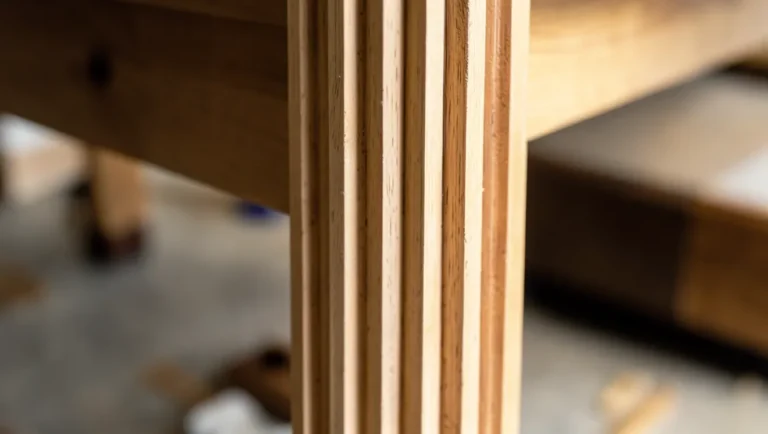
The usual cause is uneven moisture content. One side may dry faster on a counter, while the other stays damp from sink water, a wet cloth, or trapped steam. Seasonal humidity swings can add more movement, especially in a dry winter kitchen or a damp summer one.
Construction matters too. End grain boards usually move differently than edge grain boards because the grain is oriented differently through the glue-up. A well-built end grain board has balanced growth-ring direction, which reduces movement risk, but it still is not immune.
What you’ll need
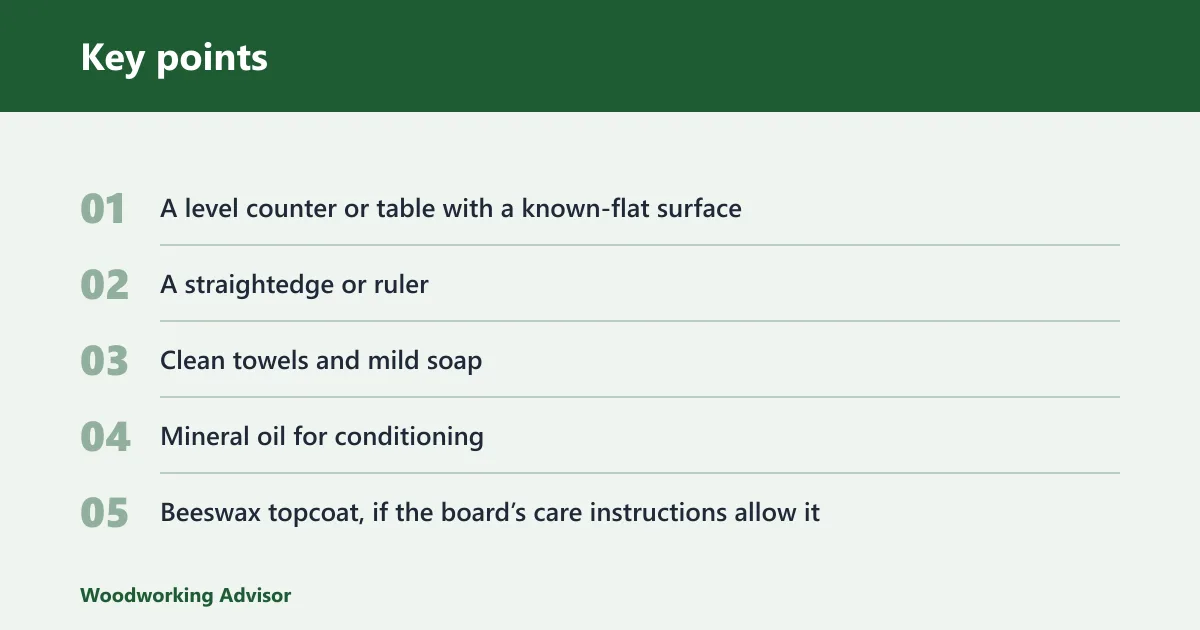
- A level counter or table with a known-flat surface
- A straightedge or ruler
- Clean towels and mild soap
- Mineral oil for conditioning
- Beeswax topcoat, if the board’s care instructions allow it
- Clamps or a flat weight, only for mild warp and only if permitted
How to tell whether the board is the problem
First, confirm that the counter is not the issue. Test the board on more than one known-flat surface, because a crooked counter can mimic warp. A stable cutting board should not rock during knife use.
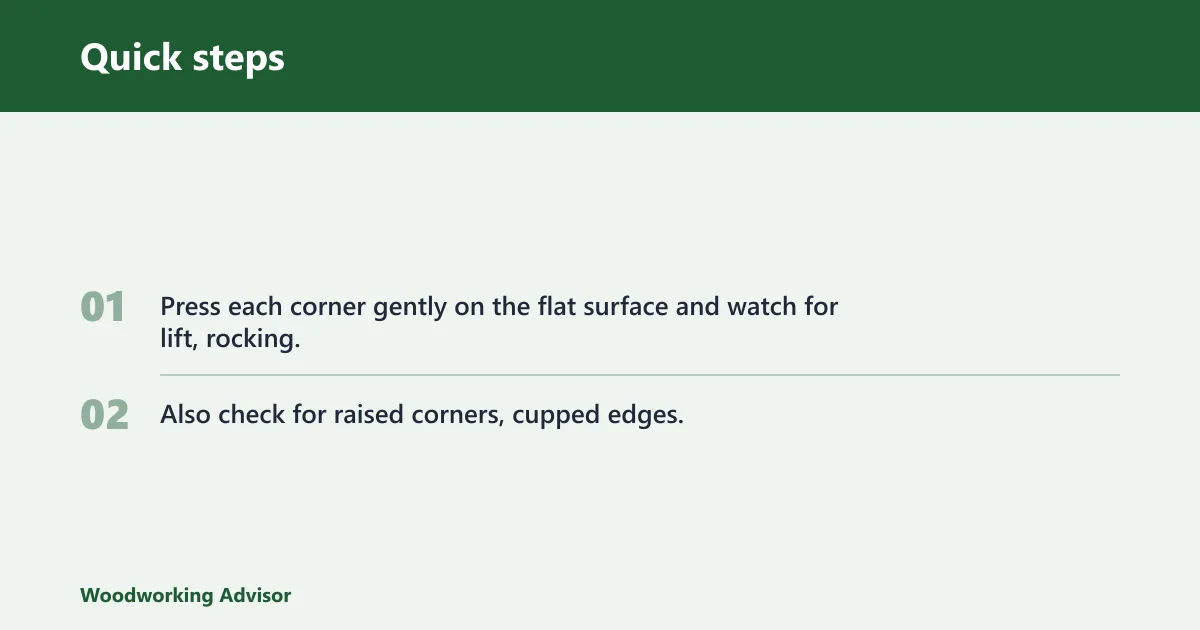
Then use the corner rock test. Press each corner gently on the flat surface and watch for lift, rocking, or a gap under one edge. Also check for raised corners, cupped edges, or grooves that can trap residue and make the board unsafe.
Cutting board warp diagnosis table
| Scenario | Visible symptom | Likely cause | Safe check | Recommended fix | Replace-now threshold |
|---|---|---|---|---|---|
| Dish-warped boards | Ends lift after a hot wash; board may still feel warm | Dishwasher heat and unsupported drying while hot can contribute to warping. | Set it on two known-flat surfaces and check for rock after it cools | Dry flat, then follow top-rack or hand-wash guidance only if the maker allows it | Replace if the warp remains after full drying or if it rocks during cutting |
| Sink-soaked boards | One face swells, edges curl, or the board feels heavy and damp | Soaking, standing water, or wet cloth contact | Dry fully, then recheck on a flat reference surface | Air-dry flat with both faces exposed; condition only after stable | Replace if cracks, splits, or edge lift do not settle after drying |
| Thin boards | Small moisture changes create obvious bowing | Low thickness gives less resistance to movement | Compare flatness before and after drying on a second surface | Dry flat and store correctly; repair attempts often fail | Replace if the board moves during cutting or lifts enough to shift food |
| End grain boards | Localized humps or dips near glue lines | Uneven glue-up balance or grain orientation, often after moisture imbalance | Check both faces and both diagonals on a known-flat table | Dry thoroughly, then only rework if the glue-up is still sound | Replace if glue lines open, sections separate, or sanitation gaps appear |
| Boards with cupping | Center rises while edges touch, or the reverse | Uneven drying across the two faces | Lay a straightedge across the face and look for a gap | Dry flat with the cupped side treated as the side that needs correction | Replace if the cup is deep enough to create unstable knife contact |
| Boards that rock only on one counter | Board feels unstable in one spot, flat in another | The counter is uneven, not the board | Test on more than one known-flat surface | No board repair needed if the board stays flat elsewhere | Replace only if it also rocks on a known-flat surface |
Dry the board fully first. Temporary movement can settle once moisture evens out. Store it flat or on edge only after it is fully dry, and recheck it on a known-flat surface before doing anything else.
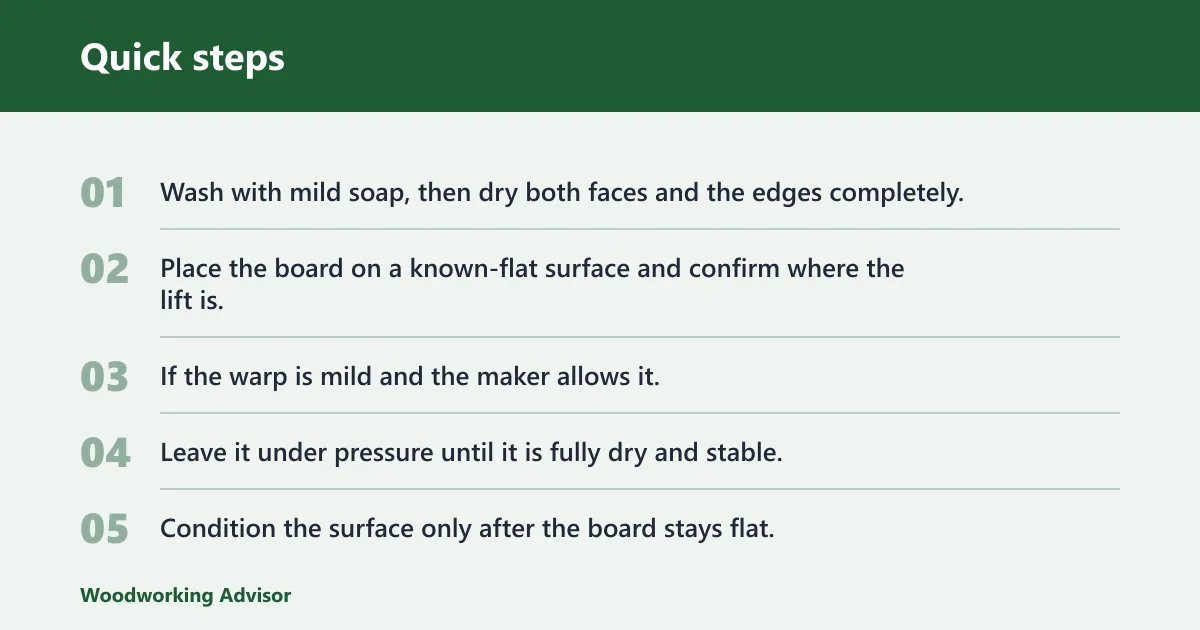
- Wash with mild soap, then dry both faces and the edges completely.
- Place the board on a known-flat surface and confirm where the lift is.
- If the warp is mild and the maker allows it, clamp or weight the board flat with even pressure across the full face.
- Leave it under pressure until it is fully dry and stable; a longer dry-down is better than a rushed one.
- Condition the surface only after the board stays flat, using mineral oil first and a beeswax topcoat if approved.
For a shallow warp, adjust it gradually. Add pressure in one pass, then recheck after the board dries fully instead of forcing flatness with a single heavy clamp. A damp towel can help a flat board resist sliding, but it will not correct severe bowing.
When repair is not safe
Replace the board if it moves during cutting. That is a safety threshold, not a cosmetic one. Raised edges, grooves, or a pronounced cup can trap residue, and that turns a flatness issue into a sanitation problem.
Replacement is also the safer choice when the board stays warped after full drying, when glue lines open, or when the warp is deep enough that a knife no longer lands steadily. Manufacturer care instructions control the decision if they give a documented repair method or a specific replacement rule.
Do not rely on heat tricks. The guidance warns against using an oven to soften a warped board, ironing a warped board, or pouring boiling water over cold plastic. For wood, high heat can make the shape worse, not better.
How do you stop warping again?
Wash by hand unless the manufacturer explicitly allows otherwise. Follow top-rack or hand-wash guidance when it is provided, and dry the board fully before storage. Keep moisture exposure even on both faces so the board dries at about the same rate.
Avoid soaking, dishwasher heat, and long contact with wet towels. Dishwasher heat can be a major risk because high-heat drying and leaving a board unsupported while hot can cause a permanent change. That deformation can persist after cooling.
Store the board flat or on edge only when it is fully dry. Maintain the finish on a normal schedule with mineral oil, and add beeswax topcoat only as a surface moisture barrier. Those products help with resistance, but they do not correct structural warp.
A common first-timer mistake is oiling a visibly bowed board and expecting it to flatten. Oil slows moisture exchange. It does not pull a warped board back into shape.
Frequently asked questions
Why is my wood cutting board warping?
Uneven moisture is the usual reason. One face may dry faster than the other, or one side may absorb more water from washing, soaking, or a wet cloth. Heat can add more movement, especially after dishwasher drying, and that change may remain after the board cools.
Can you flatten a warped cutting board at home?
Yes, if the warp is mild and the board is still structurally sound. Dry it fully, then use even pressure on a flat surface and recheck after it stabilizes. If it rocks during cutting, or if the warp is deep, replacement is usually the safer choice.
Is a warped cutting board still safe to use?
Only if it sits stable and does not move during knife use. A board that rocks can shift food, strain your knife control, and trap residue along lifted edges or grooves. If the movement is noticeable on a known-flat surface, stop using it for prep.
What causes a cutting board to warp after washing?
Water and heat are the main causes. Hot dishwasher cycles, top-heavy loading, sink soaking, and drying only one face can bend the board unevenly. The problem is worse when the board is put away before it is fully dry.
How do you stop a wooden cutting board from warping again?
Hand-wash it, dry both faces fully, and store it only after it is completely dry. Keep it away from high-heat drying cycles and long soaking. Use mineral oil for maintenance, and follow any board-specific care instructions from the manufacturer.
When should I replace a warped cutting board instead of fixing it?
Replace it if it rocks during cutting, stays warped after full drying, develops open glue lines, or traps residue in lifted edges or grooves. If the board is too thin or the warp is deep enough to affect knife stability, repair is usually not worth the risk.
Does dishwasher heat warp wood cutting boards?
Yes. High-heat drying and the unsupported board while hot can deform wood, and that change can remain after the board cools. Unless the manufacturer specifically allows machine washing and drying, use hand washing and dry the board fully before storage.
Sponsored / affiliate links. As an Amazon Associate I earn from qualifying purchases. I may earn additional commission from eligible campaigns.