Best Feet for Cutting Boards (2026): Research Shows
Granite and quartz need the strongest grip, so silicone or rubber feet are often the fastest fix. Reversible boards and thin prep boards work better with low-profile feet, while butcher blocks do better with screw-on hardware and enough lift for drying air.
Quick comparison
| Product | Badge | Best for | Price | ||
|---|---|---|---|---|---|
 |
YUEBOSUL 8 Pcs Cutting Board Feet with Stainless SteelYUEBOSUL | Our pick | 1/2" · 8-pack · screw-on | $4.49
Price as of 29 Oct 2026
|
View |
 |
WALRUS OIL Cutting Board Feet, Black, 1/2", 8-Pack | RubberWalrus Oil | Also great | 1/2" · 8-pack · screw-on | $9.99
Price as of 29 Oct 2026
|
View |
 |
32 Pcs Rubber Bumpers Self Adhesive 3/4" Cabinet DoorFdcZeyxior | Pair with it | 3/4" · 32-pack · peel-and-stick | $9.49
Price as of 29 Oct 2026
|
View |
 |
Gluposti Cutting Board Feet Non-Slip, 25 Soft Rubber FeetGluposti | Also great | 1/2" · 25-pack · screw-on | $13.99
Price as of 29 Oct 2026
|
View |
How we chose
The comparison below uses manufacturer specs, listing details, and published buyer feedback. The main filters were grip on smooth counters, mounting method, foot height, cleaning convenience, and whether the hardware fits a board that gets washed often.
We also weighed food-contact materials and scratch protection. A quality cutting board should help prevent cross-contamination by separating foods, so the feet should support safe cleaning without getting in the way.
YUEBOSUL rubber feet: best for everyday grip
Choose these for a lighter to medium wood or bamboo board that needs basic traction on a counter that tends to let boards move. The screw-on build and included stainless steel screws make them a practical fit when you want a simple, non-slip rubber base with countertop scratch protection.
The main drawback is height: at 1/2 inch, they raise the board more than the typical 1/4-inch to 3/8-inch range many people want for a low-profile prep setup. That extra lift helps airflow, but it can also make a board feel less settled if the board is already thin or narrow.
Walrus Oil cutting board feet: best for scratch protection
These suit wood boards that live on polished counters and need a dedicated cutting-board fit rather than a generic furniture bumper. The 1/2-inch rubber feet and stainless screws point to a sturdier, purpose-built setup that should keep the board steady while protecting the counter surface.
The tradeoff is the same fixed height. If you flip the board for use on both sides, the raised feet may get in the way, and if the board is too thin, screw-in hardware can leave little margin for safe mounting.
FdcZeyxior rubber bumpers: best for lightweight boards
Pick these when you want a no-drill option for a light prep board, tray-style board, or other surface that needs a quick grip upgrade. The peel-and-stick format is easy to place, and the clear pads are less visually intrusive on mixed-material counters.
The drawback is permanence. Adhesive pads are less secure than screw-on hardware, and on a board that gets washed often, the bond can weaken over time. They are also a better fit for boards that do not need frequent flipping.
Gluposti rubber feet: best for permanent installs
This is the strongest match when you want a screw-on solution for a butcher block or another wood board that benefits from lasting grip. The included stainless screws and the nitrile-rubber feet make it a sound choice when stability matters more than a low profile.
The drawback is the installation step. You need to drill, and you need to size the pilot holes and screws correctly for the board thickness. That extra work is worth it only if the board is thick enough and the underside will not be exposed to constant soaking.
Which one should you buy?
If you want the quickest grip fix for a light board, choose the FdcZeyxior peel-and-stick pads. If you want the most secure long-term mount for a wood board, choose the Gluposti screw-on feet or one of the other screw-on rubber sets. If drying airflow matters most, the higher 1/2-inch rubber feet are the better fit.
For granite, quartz, and other low-friction counters, silicone or rubber wins more often than a bare board. For reversible boards, choose adhesive only if the board is light and you do not need to flip it during prep. For butcher blocks, screw-on hardware is usually the cleaner answer.
Which cutting board feet fit your board?
The best foot is the one that matches board thickness, counter surface, and wash frequency. As a rule, thin boards need lighter hardware, thick butcher blocks can take screw-on feet, and reversible boards usually need the lowest-profile option that still prevents sliding.
| Board thickness | Foot type | Mounting method | Recommended foot height | Best use | Do not use |
|---|---|---|---|---|---|
| Under 1/2 inch | Silicone pad or adhesive rubber | Self-adhesive | About 1/8 to 1/4 inch | Light prep boards, temporary grip | Screw-in feet, wet undersides, boards that flex a lot |
| 1/2 to 3/4 inch | Low-profile rubber or silicone feet | Adhesive or short screw-in hardware | About 1/4 to 3/8 inch | Everyday boards on granite, quartz, or marble | Deep screws, high feet that increase wobble |
| 3/4 to 1 inch | Rubber feet | Screw-in hardware | About 1/4 to 1/2 inch | Medium to heavy boards, better airflow | Adhesive-only pads if the board is washed often |
| Over 1 inch | Screw-on rubber feet | Screws with washers or inserts | 1/2 inch or similar | Butcher blocks and thick prep stations | Thin adhesive pads that can shear off |
Decision matrix for your counter and board style
| Situation | Best choice | Why it fits | Do not use |
|---|---|---|---|
| Granite or quartz counter | Silicone or rubber feet | Better grip on smooth, low-friction surfaces | Bare board on polished stone |
| Marble counter | Silicone pads or rubber feet with soft contact points | Grip and scratch protection both matter | Hard feet that can mark the stone |
| Sealed wood counter | Rubber feet or a silicone mat under the board | Adds traction without relying on moisture | Damp towel as a long-term fix |
| Reversible board | Low-profile adhesive pads only if the board stays on one face most of the time | Less lift means less wobble | Tall screw-on feet that block flipping |
| Butcher block | Screw-on rubber feet | More secure than adhesive and better for weight | Thin adhesive pads on a heavy board |
Do not use cases
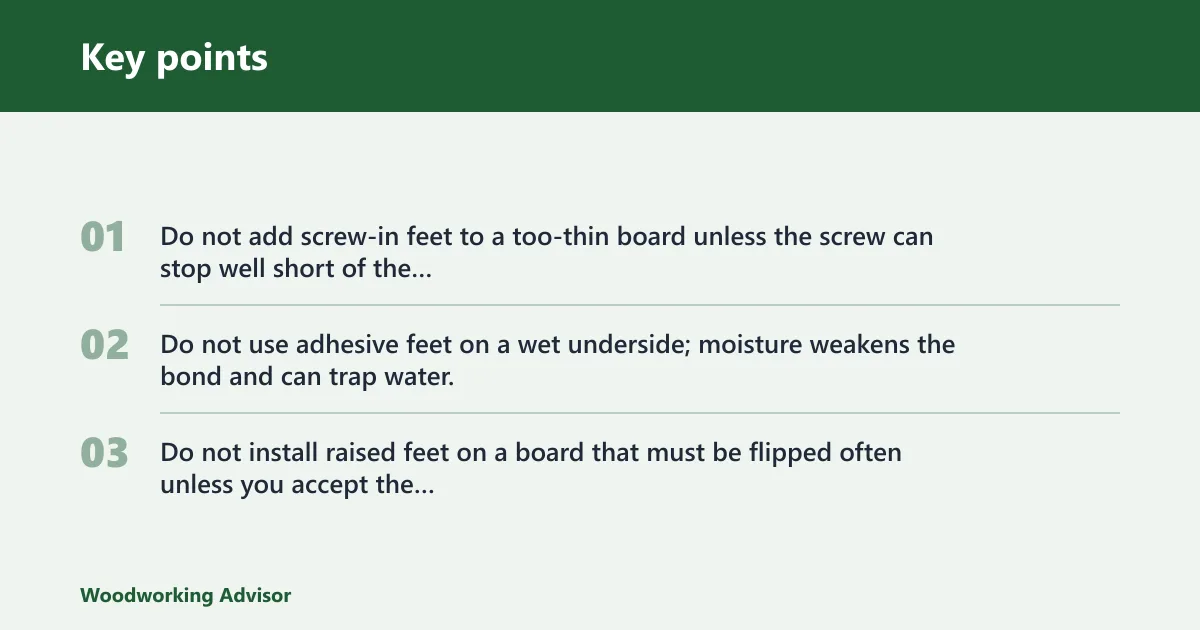
- Do not add screw-in feet to a too-thin board unless the screw can stop well short of the top face.
- Do not use adhesive feet on a wet underside; moisture weakens the bond and can trap water.
- Do not install raised feet on a board that must be flipped often unless you accept the added wobble.
How do you install feet safely?
Start with placement and thickness, not the screw box. The board must stay level, the pilot hole must match the screw, and the underside must be dry before you mount anything. If the board is too thin for a safe screw bite, skip screw-in feet and use adhesive pads or a temporary mat instead.
What you’ll need
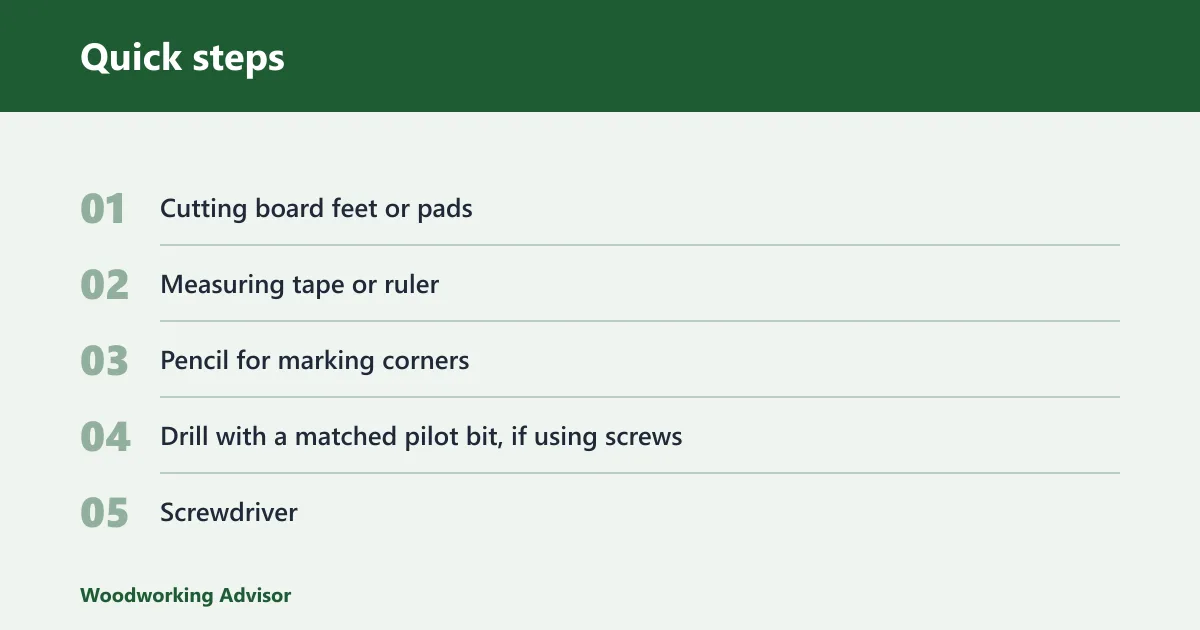
- Cutting board feet or pads
- Measuring tape or ruler
- Pencil for marking corners
- Drill with a matched pilot bit, if using screws
- Screwdriver
- Clean cloth
- Rubbing alcohol or mild cleaner for the underside
- Mark four corner points so the board stays level and the feet sit in from the edge.
- Dry the underside completely; do not mount onto a wet or oily surface.
- Use adhesive only on light boards that do not need to be flipped often.
- For screw-in feet, drill a pilot hole that matches the screw shank, then stop before the bit breaks through the top face.
- Use the shortest screw that still holds firmly; if the board is thin, choose a different mounting method.
- Install the feet, set the board on the counter, and check for wobble before loading it with food.
If that did not work, add a thin silicone mat or shelf liner under the board instead of raising the feet further. Say your 3/4-inch maple board still creeps on quartz after foot installation; a low-profile silicone mat usually adds grip without changing the board height again.
Common mistakes
- Using feet that are too tall for a thin board, which increases wobble.
- Drilling too deep and breaking through the cutting face.
- Mounting adhesive feet on a damp underside.
- Putting screw-on feet on a board that gets flipped for both sides of prep.
- Ignoring airflow under the board, which can leave moisture trapped and encourage warping.
What the height does
Higher feet improve airflow and help the underside dry faster, which can limit warping on wooden boards. The tradeoff is stability: the more you lift the board, the more important board weight and base friction become.
Picture a light 1/2-inch prep board on polished granite. A low-profile silicone pad may stop the slide with less wobble than tall feet, while a heavy butcher block usually benefits from screw-on rubber feet that keep it planted during chopping.
Frequently asked questions
What are the best cutting board feet?
The best all-around choice is a low-profile rubber foot with stainless screws for a wood board that is thick enough to support drilling. For smooth counters, silicone or rubber gives the best grip. For lightweight boards, adhesive pads are the easiest option.
Are silicone feet for cutting board better than screw-in feet?
Silicone is better when you want grip on a smooth counter and a washable, reusable pad. Screw-in feet are better when the board is heavy, washed often, or expected to stay mounted for the long term. The safer choice depends on board thickness.
How do you install feet on a cutting board?
Mark the corners, dry the underside, and use pilot holes for screw-in feet. Keep the screw short enough that it does not reach the top face. If the board is thin or wet, switch to adhesive pads or a temporary non-slip mat.
What height should cutting board feet be?
For most boards, 1/4 inch to 3/8 inch is the practical range. Choose more height only when you need extra drying airflow or have a heavy board that stays stable with more lift. Reversible boards usually do better with the lowest profile possible.
Sponsored / affiliate links. As an Amazon Associate I earn from qualifying purchases. I may earn additional commission from eligible campaigns.