Fence Post Leaning After a Few Years: Causes and Fixes
If a fence post started leaning years after installation, fix the cause: replace rotten or loose footings, reset posts that moved, and use braces only as a temporary support. Leaving it alone lets the lean grow, stresses rails and panels, and can turn one bad post into a failed section. This guide shows how to tell settlement, rot, soil movement, and hardware failure apart, then match each one to the repair that actually lasts.
What you’ll need
- Spirit level
- Tape measure
- Shovel or digging bar
- Hand saw or reciprocating saw for cutting damaged post material
- 4-ton bottle jack
- Wooden braces or stakes
- Clamps or screw clamps
- Work gloves
- Eye protection
- Hearing protection if cutting concrete
- Gravel for the bottom of the hole
- Concrete mix for a reset footing
- Helper for stabilizing the fence while you lift it
Diagnosis and fix matrix
| Failure mode | Common symptoms | Quick test | Safe temporary action | Permanent fix | Replace the post when |
|---|---|---|---|---|---|
| Rot | Soft wood at ground line, dark crumble, loose base | Poke the base with an awl or screwdriver | Brace it only long enough to make it safe | Replace the post and footing | The base has lost structural soundness |
| Frost heave | Repeat seasonal lifting, lean after freeze-thaw cycles | Check whether the post rises each winter | Stake it to reduce movement | Full pull and reset below frost line | It keeps lifting after reset |
| Shallow set | Post moves under wind load, no obvious rot | Measure depth against local frost depth | Brace until reset | Reset deeper with proper compaction | The hole is too shallow for the site |
| Concrete failure | Cracking, spalling, tilt at the base | Look for broken concrete around the post | Brace and limit loading | Remove bad concrete, then repour after repositioning | The footing has split or loosened badly |
| Wind load | Lean on long runs, windward-side posts, gate-end posts | Check whether the same side takes the strongest wind | Stake the post and cut sail area if possible | Reset the post with deeper support and sound footing | The post has already moved out of plumb more than about 2 inches |
| Saturated soil | Soft ground, slow drainage, post rocks after rain | Press the soil around the base; if it gives, drainage is suspect | Brace until the area dries enough for repair | Reset with better drainage, compacted fill, and gravel below the post | The hole wall has collapsed or the base keeps loosening |
How do you tell what caused the lean?
Start with movement, not angle. A leaning post that rocks at the ground line points to a footing problem, while a post that is still tight but out of plumb may have shifted after soil movement. Check the post with a spirit level before reinforcing it, then inspect the ground line for rot, rust, cracking, or heave.
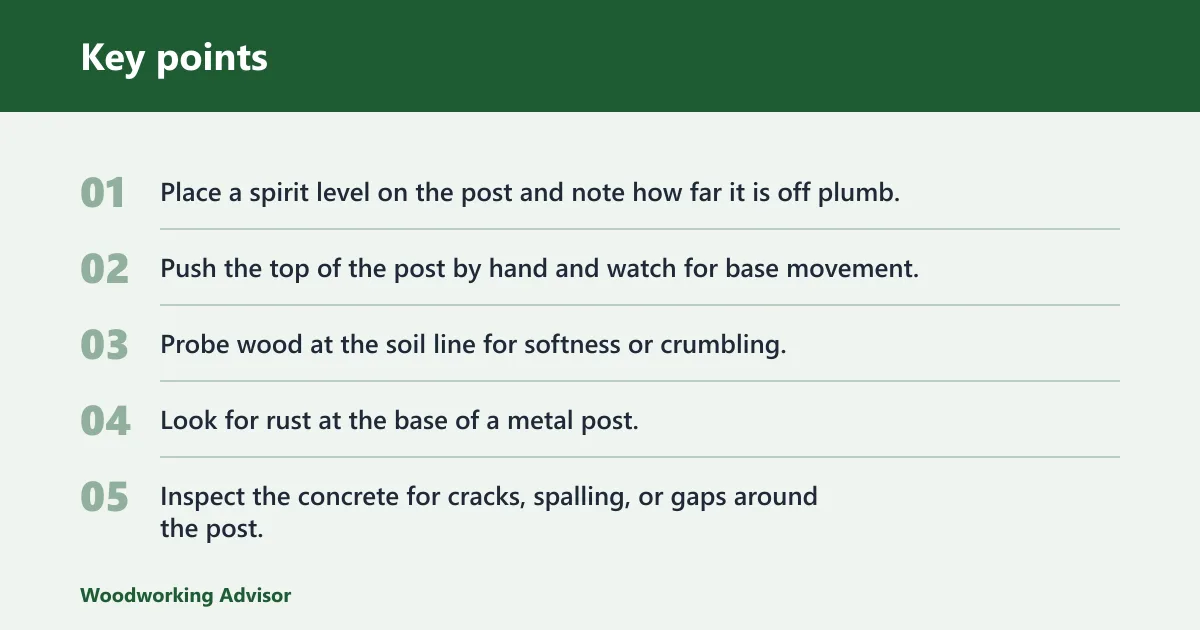
Check the line and the base
- Place a spirit level on the post and note how far it is off plumb.
- Push the top of the post by hand and watch for base movement.
- Probe wood at the soil line for softness or crumbling.
- Look for rust at the base of a metal post.
- Inspect the concrete for cracks, spalling, or gaps around the post.
Say your 6-foot wooden corner post leans after a wet winter and the soil at the base feels soft. That points more toward saturated soil or a weak footing than toward panel weight alone. Suppose the same post lifts a little every cold season and settles unevenly in spring; frost heave is the stronger match.
Watch the high-risk spots
Windward runs and gate-end posts fail sooner because they carry more load. Gates add weight and movement, so a loose gate post often reveals a footing problem before the rest of the line shows one. Low spots that stay wet also fail early because soil loses compaction there.
How do you straighten a leaning post?
Install wooden braces or stakes to hold the fence section steady before you lift it, then move the post back in controlled steps. A 4-ton bottle jack can help lift a sound post back to plumb, but it should move the post only after you know the base is worth saving. Use quarter-inch lifts and recheck often.
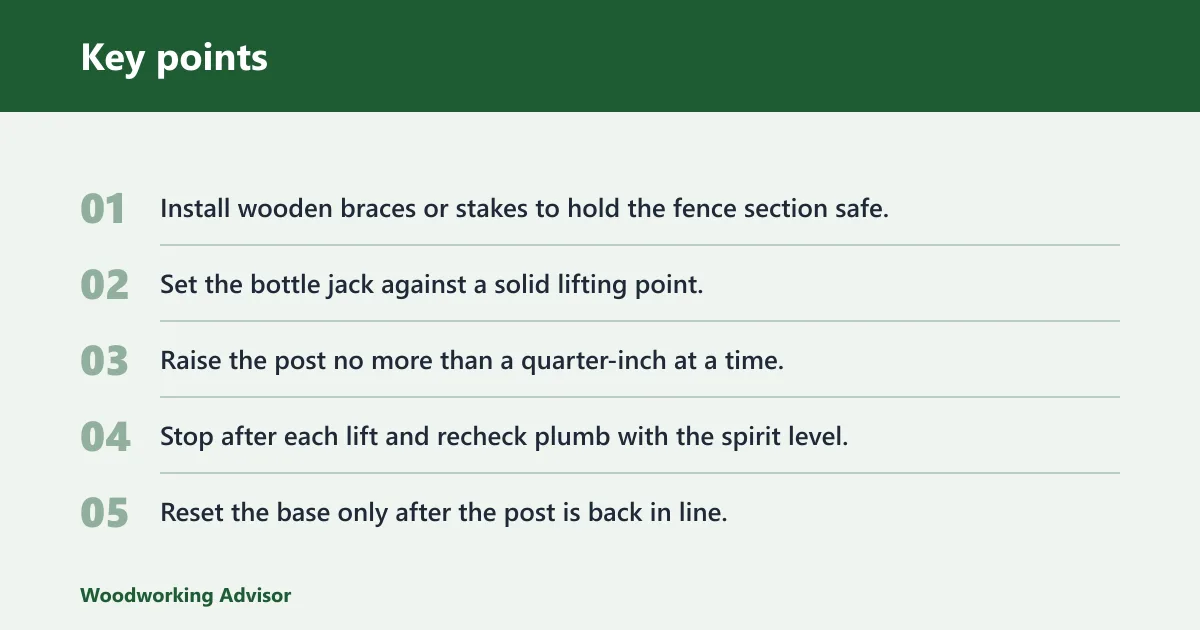
Lift and reset in order
- Install wooden braces or stakes to hold the fence section safe.
- Set the bottle jack against a solid lifting point.
- Raise the post no more than a quarter-inch at a time.
- Stop after each lift and recheck plumb with the spirit level.
- Reset the base only after the post is back in line.
If that didn’t work, stop and clear the footing. A lean that returns as soon as pressure is removed usually means the base has failed, the hole was too shallow, or the soil is still moving. At that point, a cosmetic straightening only hides the problem.
Choose the real repair
One repair approach is to fill the hole with concrete after repositioning the post. That works only when the post is sound, the hole is stable, and the old footing is removed enough to let the new concrete bind correctly. For a reset that uses compacted backfill, do not pour concrete around the post; compact the fill instead. For a concrete-set reset, repour after the bad material comes out.
Can a leaning fence be fixed without replacing the whole thing?
Yes, if the post is sound and the lean is modest. Some steel post anchors can provide temporary stabilization for a small lean, depending on the product, soil, and fence load, but they are not a footing cure. Once the post base is rotten, rusted through, or loose enough to move, replacement is usually the lasting fix.
Use anchors only in narrow cases
- Check that the lean is small.
- Confirm the post is structurally sound at the base.
- Set the steel post anchor as a brace, not a substitute footing.
- Recheck plumb after the post is secured.
Picture a fence post that tilts slightly after a windy season, but the base stays firm and dry. A temporary anchor can buy time there. A gate post with cracked concrete and soft wood at the soil line needs more than an anchor; it needs a reset or replacement.
When should you replace the post instead of repairing it?
Replace the post when rot, rust, or repeated movement has weakened the base. A post that has lost material at the ground line, or one that keeps leaning after a reset, is usually beyond a safe repair. If the top has shifted enough that it no longer resets cleanly, replacement is usually the cleaner choice.
Use replacement for these cases
- Remove any post with clear rot at the soil line.
- Replace metal posts with base rust that has eaten into the section.
- Replace posts that keep rising from frost heave after a full reset.
- Replace posts that still drift after new concrete cures.
If that didn’t work, do not keep adding more brace time. A recurring lean means the load path is still wrong. A new post with correct depth and drainage is safer than chasing the same failure again.
How do you keep it from leaning again?
Set the post deep enough for local frost conditions, direct water away from the hole, and compact the base before concrete goes in. Frost heave and saturated soil both move posts when the hole is shallow or poorly drained. The fix lasts only when the base is built to resist that movement.
Build the footing correctly
- Dig deep enough to reach below the frost line for your area.
- Place about 4 inches of gravel at the hole bottom and compact it well.
- Set the post plumb and brace it.
- Pour concrete after repositioning the post.
- Crown the concrete surface so it sheds water.
- Leave braces in place for 7 days.
- Wait 28 days before full load.
A 12-inch hole at 36 inches deep needs about 0.1 cubic yards of concrete. That kind of footing only helps if the hole is sound and the bottom is compacted first. Remove failed concrete instead of pouring around it, or the new footing will inherit the same weakness.
Common mistakes
Using a steel post anchor as a permanent fix hides movement for a while, but it does not cure a bad footing. The same problem happens when a rotten post is left in place and boxed in with fresh concrete. The base still fails.
Another mistake is pouring new concrete around cracked old concrete. That leaves the broken footing in place and traps water against the post. Poor drainage and loose fill around the hole also let the same lean return after the next wet season.
Frequently asked questions
Why is my fence leaning after a few years?
Long-term leaning usually means the post base has failed, the hole was too shallow, or the soil has shifted around the footing. Check for rot, rust, cracking, and seasonal movement first. Then match the repair to the cause instead of straightening the top and hoping it stays put.
How do I tell if a leaning fence post is rotten?
Probe the wood at the soil line with a screwdriver or awl. Soft, spongy, or crumbling wood points to rot, and that damage is structural. If the base gives way under probing, replace the post rather than trying to stiffen it with concrete or an anchor.
Is frost heave causing my fence post to lean?
It often shows up when the post rises and tilts after freeze-thaw cycles, then drops or shifts again in spring. That pattern usually means the post was not set below frost depth. The lasting fix is a full pull and reset with proper depth and drainage.
What do I do if the concrete footing cracked or failed?
Remove the damaged concrete before resetting the post. Cracking, spalling, and gaps at the base mean the footing has lost strength. A repour works only after the old material is out and the post is held plumb with braces during cure.
How deep should a fence post go to stop it leaning again?
Set it below the local frost line, not just at a generic depth. Shallow holes fail again because frost and wet soil can move the base. A 4-inch gravel layer at the bottom, plus compacted backfill for a dry-set reset or concrete for a concrete-set reset, helps the new setting stay put.
Sponsored / affiliate links. As an Amazon Associate I earn from qualifying purchases. I may earn additional commission from eligible campaigns.