Fence Post Depth Chart by Fence Height and Soil Type
For most fences, a common rule of thumb is to bury posts about one-third of the above-ground height, with a minimum of about 24 inches for many 4- to 6-foot fences, and add about 6 to 12 inches in loose or frost-prone soil. Too shallow, and posts lean, heave, or fail under wind and gate loads. This guide gives a fence post depth chart by fence height, soil type, and post category, and separates buried depth from total hole depth.
Fence post depth basics
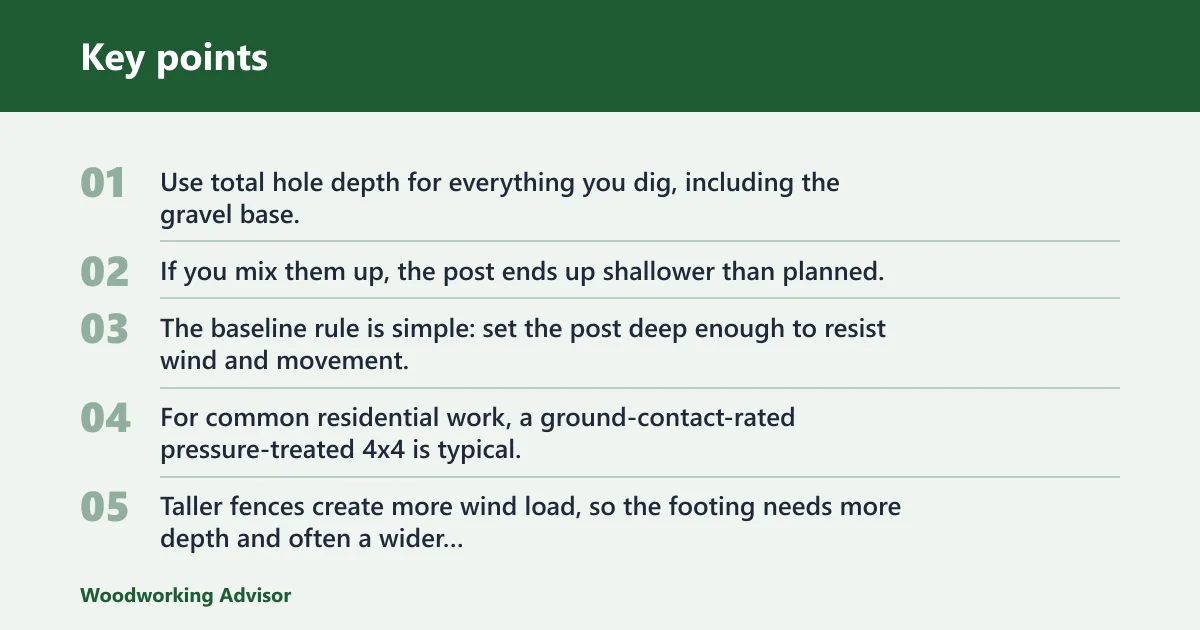


Use buried depth for the wood below grade. Use total hole depth for everything you dig, including the gravel base. Those are not the same number. If you mix them up, the post ends up shallower than planned, which is where many fence failures start.
The baseline rule is simple: set the post deep enough to resist wind and movement, then add drainage space below it. For common residential work, a ground-contact-rated pressure-treated 4×4 is typical, and the post length must exceed the visible fence height. Taller fences create more wind load, so the footing needs more depth and often a wider hole.
Think of it this way: buried depth is the wood under grade. Total hole depth is buried depth plus gravel and any extra allowance for soil. A 6-inch gravel base is common because it helps drainage and keeps end grain out of standing water.
Fence post depth chart
This chart keeps the categories separate. Line posts use the baseline depth. Corner posts and gate posts carry more load than line posts, so they need the deeper end of the range, and gate posts usually need an extra 4 to 6 inches at minimum. In sandy or loose soil, add 6 inches over the baseline. In clay and wet soil, keep drainage in mind and use the gravel base already included in the hole depth.
| Fence height | Line post buried depth | Corner post buried depth | Gate post buried depth | Total hole depth with 6-inch gravel base | Soil add-on |
|---|---|---|---|---|---|
| 3 ft | 24 in | 30 in | 34 to 36 in | 30 in | Add 6 in in sandy soil; add 4 to 6 in gravel in clay or wet soil; go deeper than local frost depth where required |
| 4 ft | 24 to 30 in | 30 to 34 in | 34 to 38 in | 30 to 36 in | Add 6 in in sandy soil; add 4 to 6 in gravel in clay or wet soil; go deeper than local frost depth where required |
| 5 ft | 30 in | 34 to 36 in | 36 to 40 in | 36 in | Add 6 in in sandy soil; add 4 to 6 in gravel in clay or wet soil; go deeper than local frost depth where required |
| 6 ft | 30 to 36 in | 36 to 40 in | 40 to 44 in | 36 to 42 in | Add 6 in in sandy soil; add 4 to 6 in gravel in clay or wet soil; go deeper than local frost depth where required |
| 8 ft | 36 to 48 in | 42 to 48 in | 46 to 54 in | 42 to 54 in | Add 6 in in sandy soil; add 4 to 6 in gravel in clay or wet soil; go deeper than local frost depth where required |
This guide uses the baseline figures and the load split between post types. For example, a 6-foot fence needs a post roughly 9 feet long set 30 to 36 inches into the ground. The same 6-foot fence can use 1 to 2 bags of fast-setting concrete per hole when the footing calls for concrete.
Say your yard gets steady wind and you are building a 6-foot privacy run. A line post can follow the 30- to 36-inch buried range, but a gate post at the opening should go deeper and get a stronger footing so hinge stress does not work the post loose.
Does frost line override?
In freezing climates, local frost depth overrides a generic chart. Use whichever is deeper: the chart depth or the frost-based depth.
That rule matters because frost heave can push a shallow post upward even when the fence looked solid at first. If your local frost depth is 30 inches, the post needs to go to at least 36 inches below grade. If the chart already calls for more than that, follow the deeper number.
A practical method is this: check the local frost depth, compare that result with the chart depth for your fence height and post type, and use the deeper number.
How to use the deeper number
- Pick the fence height from the chart.
- Choose the post category: line, corner, or gate.
- Check the local frost depth.
- Add 6 inches to that frost depth.
- Use the deeper value as the buried depth.
- Add the 6-inch gravel base to get total hole depth.
How soil type changes the hole
Sandy or loose soil needs deeper holes and often a wider footing because the post can shift more easily. Add 6 inches over the baseline in sandy or loose soil. Clay and wet soil need drainage attention, so the hole needs gravel and careful backfill. Rocky ground can stop the auger early, which may force a wider hole, a different location, or a different footing plan.
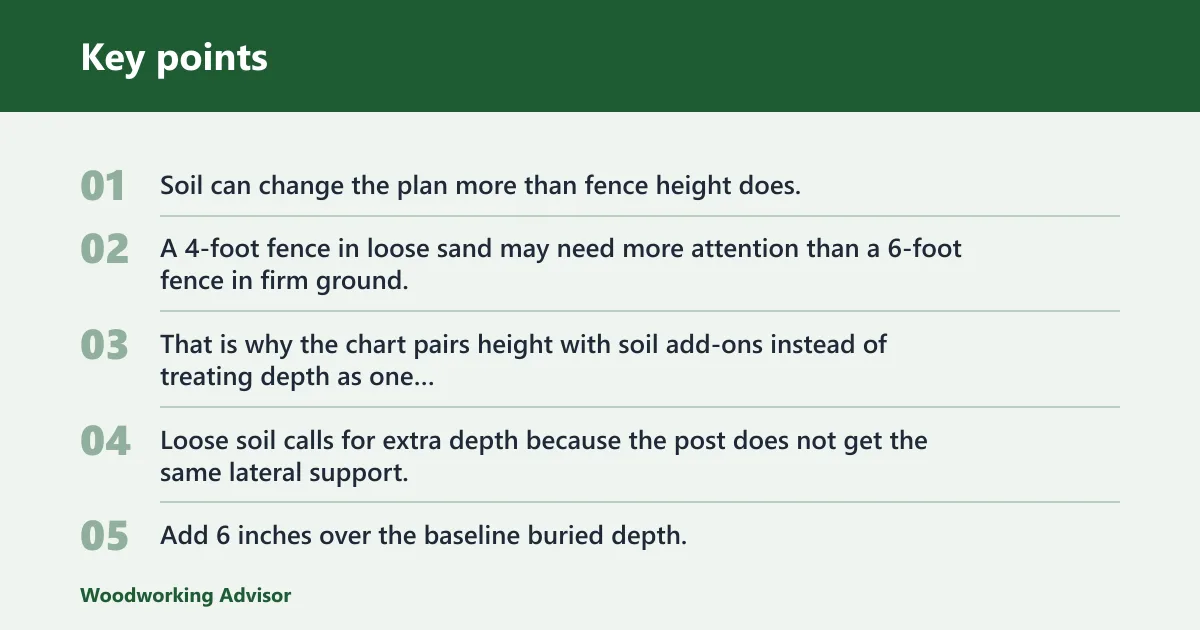
Soil can change the plan more than fence height does. A 4-foot fence in loose sand may need more attention than a 6-foot fence in firm ground. That is why the chart pairs height with soil add-ons instead of treating depth as one fixed number.
Sandy or loose soil
Loose soil calls for extra depth because the post does not get the same lateral support. Add 6 inches over the baseline buried depth, and widen the hole enough to compact the footing properly. If the fence is tall or the post is a gate post, concrete footing often makes more sense than tamped earth alone.
Clay or wet soil
Clay holds water, so drainage matters. Keep the 6-inch gravel base, and slope the top of any concrete footing so water sheds away from the post. That helps reduce rot at the transition from buried wood to air.
Rocky ground and shallow refusals
Rock can stop a hole before it reaches the planned depth. If you hit rock, do not guess and stop short without adjusting the design. A wider hole, a shifted post location, or a concrete footing may be needed. If the refusal is severe and the post cannot reach the needed depth, the safer answer is often to relocate the post rather than leave it shallow.
How deep should gate posts be?
Gate posts should be deeper than line posts because they carry more load. Gate posts should be set 4 to 6 inches deeper than line posts at minimum, and in practice many gate openings need the deeper end of the range. That extra depth helps resist hinge stress and gate sag.
Concrete footing makes sense for many gate posts, especially on tall fences, in loose soil, or where the gate is wide and heavy. Keep the top of the concrete sloped so water runs off. Fast-setting concrete is commonly used for this kind of work.
Suppose a 6-foot fence uses 32 inches for a line post in firm soil. The gate post should not copy that number. It should go at least 4 to 6 inches deeper, and the hole should be sized to support the load instead of just holding the wood upright.
What hole size should you dig?
The hole diameter should usually be about 8 to 12 inches for a 4×4 post. Taller fences may need the wider end of that range. A 6-foot fence commonly uses a 10- to 12-inch diameter hole, while a 3-foot fence can use an 8-inch diameter hole.
Hole size matters because depth alone does not stop leaning. Wider holes give you room for a proper footing, especially when the fence is tall or the soil is weak. This guide also uses a hole diameter of about 3 times the post width, which is a practical starting point for residential 4×4 posts.
Where gravel fits in the hole
Gravel goes at the bottom of the hole as a drainage layer. It counts toward total hole depth, not buried wood depth. If you plan 30 inches of buried post and add a 6-inch gravel base, the hole must be 36 inches deep before any concrete or backfill is added.
What happens if posts are too shallow?
Too-shallow posts tend to lean, heave, or loosen over time. Wind loads hit tall fences harder, and gate loads magnify movement at the opening. A shallow post may look fine after installation, then start to rack, tilt, or pump in wet ground after a season of weather changes.
The fix depends on how much support the post lost. A slightly under-depth line post may be reinforced with a deeper set or added footing if the surrounding fence is still sound. A badly under-depth gate post often needs replacement rather than a patch, because hinge stress keeps working on the weak point.
For a repair that does not require rebuilding the whole run, check whether the post can be dug deeper in place, sleeved, or re-set with concrete. If the post is already moving at the base or the fence has started to lean through several bays, replacement is usually the cleaner choice.
Frequently asked questions
How deep should fence posts be for a 6-foot fence?
A 6-foot fence typically needs a post roughly 9 feet long set 30 to 36 inches into the ground. That is the buried depth for line posts in common conditions. If frost, loose soil, or a gate opening is involved, go deeper and treat the chart as the starting point rather than the final answer.
How deep should fence posts be in clay soil?
In clay or wet soil, use the baseline depth, then focus on drainage. Add 4 to 6 inches of gravel at the bottom of the hole, and slope the top of any concrete footing so water sheds away from the post. Clay does not always demand a much deeper hole, but it does demand better drainage.
How deep should fence posts be in sandy soil?
In sandy or loose soil, add 6 inches over the baseline depth. The post needs more embedment because the soil gives less lateral resistance. Wider holes help too, especially for taller fences, corner posts, and gate posts that need a stronger footing.
Should fence posts go below the frost line?
Yes. In freezing climates, the frost line overrides a generic depth chart. Use the deeper of the chart depth or the local frost depth. That reduces frost heave and helps keep the fence straight through seasonal freeze-thaw cycles.
How deep should gate posts be compared with line posts?
Gate posts should be set 4 to 6 inches deeper than line posts at minimum because they carry more load than line posts. A gate also creates repeated hinge stress, so the footing often needs concrete and a slightly wider hole. For tall or heavy gates, choose the deeper end of the range.
Does gravel count as post depth?
No. Gravel counts toward total hole depth, not buried post depth. If you add a 6-inch gravel base, the hole must be dug 6 inches deeper than the buried wood measurement. That is why the chart separates the two numbers.
Sponsored / affiliate links. As an Amazon Associate I earn from qualifying purchases. I may earn additional commission from eligible campaigns.
 Girftong Fence Post Cover For 4X4 Wood Posts, PP Plastic With Screws, Waterproof Anti-Cracking Deck Pole Protectors For Garden Yard Outdoor Use, Black-Finish,(32pcs)
 4.21" x 3.94"U Shape Fence Post Holder,1 Pack Concrete Post Base Anchor Bracket,Heavy Duty Wood Post Support for Deck Railing,Fence,Pergola,Mailbox,Ground Mount Pole Construction (1, 4.21" x 3.94")