Heavy Duty vs Standard Duty Drill: Which Rating Do You Need?
Choose Standard Duty for light fastening, small pilot holes, and occasional home use. Pick Heavy Duty when you drill large bits, cut hard materials, or work in long sessions. A tool that is too light can stall, run hot, and chew through batteries or bits. This guide compares load, material, bit size, and use frequency so you can match the drill to the job.
| Decision factor | Heavy Duty | Standard Duty | Winner |
|---|---|---|---|
| Torque under load | Higher torque, better stall resistance on large bits and long screws | Enough torque for light fastening and small bits | Heavy Duty |
| Weight and overhead comfort | Usually heavier, especially with larger batteries and 1/2-inch chucks | Lighter and easier to hold above shoulder height | Standard Duty |
| Heat handling in long sessions | Better cooling and sustained output for repeated drilling | More likely to warm up under repeated heavy cuts | Heavy Duty |
| Bit and fastener capacity | Better fit for hole saws, spade bits, auger bits, and lag screws | Best for twist bits, pilot holes, pocket holes, and trim screws | Heavy Duty |
| Occasional home use value | Can be more tool than needed | Usually the better value for light, infrequent work | Standard Duty |
What does duty rating mean on a drill?
Duty rating is a manufacturer’s workload label, not a universal standard. It usually signals how much sustained work the drill is built to handle, which is why it often lines up with motor size, gearing, cooling, and chuck capacity rather than one fixed specification.
Why the label matters less than the task
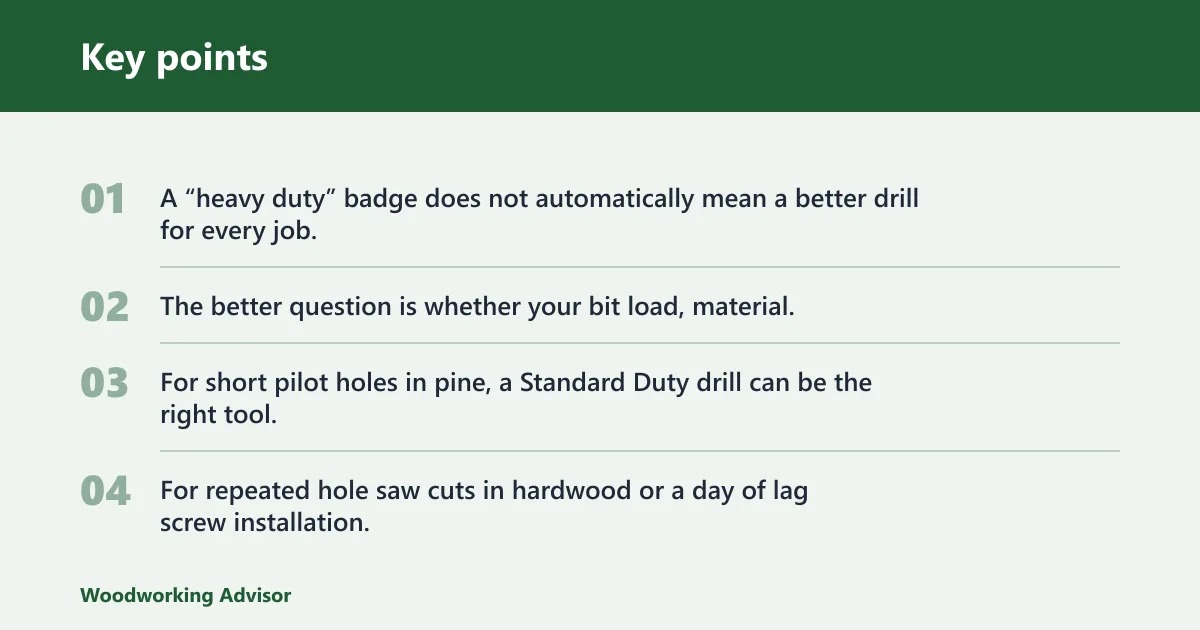
A “heavy duty” badge does not automatically mean a better drill for every job. The better question is whether your bit load, material, and session length need more torque and heat management than a lighter model can provide.
For short pilot holes in pine, a Standard Duty drill can be the right tool. For repeated hole saw cuts in hardwood or a day of lag screw installation, Heavy Duty usually makes more sense because the load stays high for longer.
Standard duty vs heavy duty
Standard Duty drills are built for light to moderate fastening, smaller bits, and occasional use. Heavy Duty drills are built for higher torque output, more sustained drilling, and tougher materials, so they tend to use larger motors, stronger gearboxes, and better cooling.
| Feature | Heavy Duty | Standard Duty | Winner |
|---|---|---|---|
| Typical torque band | Usually higher, often in the range used for larger bits and long fasteners | Lower, but adequate for light drilling and driving | Heavy Duty |
| Voltage class | Often 18V/20V Max or corded | Often 12V, though some 18V models exist | Heavy Duty |
| Chuck size | 1/2-inch is common | 3/8-inch is common | Heavy Duty |
| Motor type | Brushless is common on higher-end models | Brushed or lower-output brushless models are common | Heavy Duty |
| Overhead handling | Less comfortable for long overhead work | Easier to control above shoulder height | Standard Duty |
Torque and stall resistance
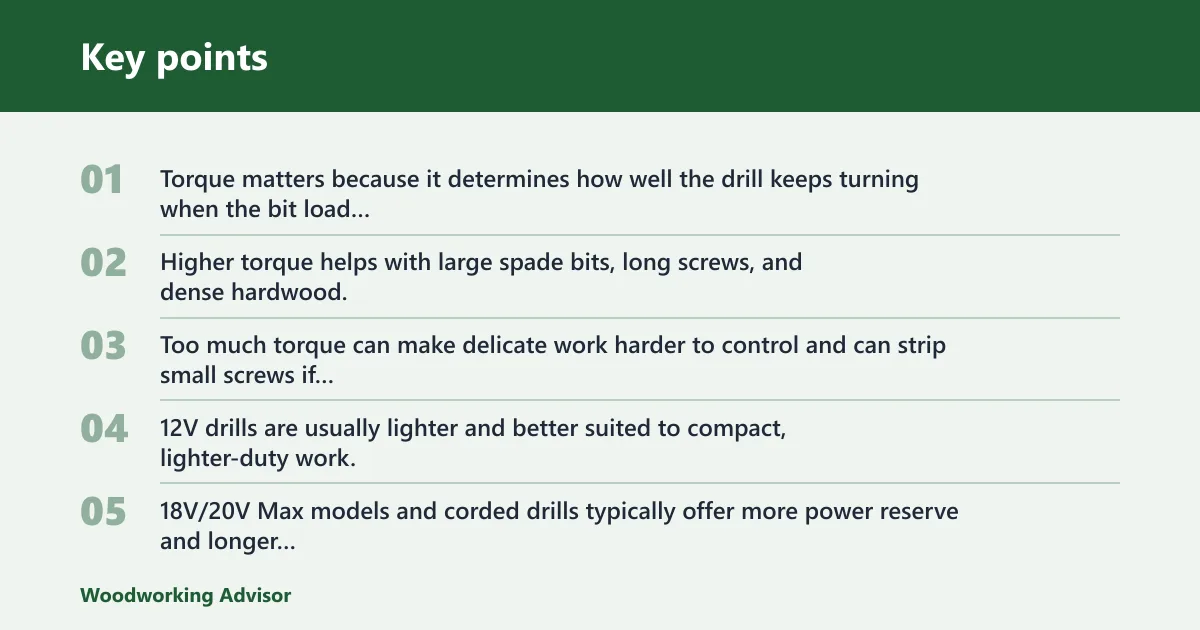
Torque matters because it determines how well the drill keeps turning when the bit load rises. Higher torque helps with large spade bits, long screws, and dense hardwood. Too much torque can make delicate work harder to control and can strip small screws if the clutch is not set correctly.
Voltage class and runtime
12V drills are usually lighter and better suited to compact, lighter-duty work. 18V/20V Max models and corded drills typically offer more power reserve and longer runtime under load, which matters when the work includes repeated drilling or larger bits.
Chuck size and bit compatibility
A 3/8-inch chuck suits many small twist bits and light fastening jobs. A 1/2-inch chuck accepts larger shank sizes and is common on heavier-duty drills, especially when the job may involve hole saws, auger bits, or larger accessories.
Brushless motor and heat management
Brushless motors are generally more efficient and often run cooler under load. That does not make every brushless drill heavy duty, but it does help when the tool must run longer without the heat buildup that can slow a brushed motor.
Gear settings and speed control
Two-speed gearboxes are common because low speed gives better torque while high speed helps with drilling faster. For heavy cuts, low gear matters more than top speed. For small pilot holes and clean twist-bit work, higher speed can be the better match.
Drill selection matrix
This matrix maps common tasks to the minimum practical duty level. The right choice depends more on bit load and material than on the label alone.
| Task | Minimum practical duty level | Typical torque range | Chuck size | Motor type | When Standard Duty is enough |
|---|---|---|---|---|---|
| Pilot holes in softwood | Standard Duty | Low to moderate, about 250 to 500 in-lbs | 3/8-inch | Brushed or brushless | Enough for small pilot holes with twist bits and short fasteners |
| Pocket holes in plywood or softwood | Standard Duty | Moderate, about 300 to 600 in-lbs | 3/8-inch | Brushless preferred, brushed acceptable | Fine for occasional pocket-hole joinery with sharp bits |
| Trim screws and cabinet assembly | Standard Duty | Low to moderate, about 250 to 500 in-lbs | 3/8-inch | Brushed or brushless | Enough if you set the clutch and avoid overdriving small screws |
| 1-inch spade bits in softwood | Heavy Duty | Moderate to high, about 500 to 800 in-lbs | 1/2-inch preferred | Brushless preferred | Possible for a short run in softwood, but progress may slow and heat may rise |
| Hole saws in wood | Heavy Duty | High, about 600 to 900 in-lbs | 1/2-inch | Brushless preferred | Only for small hole saws in thin stock and with careful feed pressure |
| Auger bits in hardwood | Heavy Duty | High, about 700 to 1,000 in-lbs | 1/2-inch | Brushless or corded | Rarely; a Standard Duty drill will often stall or slow sharply |
| Lag screws into framing lumber | Heavy Duty | High, about 600 to 1,000 in-lbs | 1/2-inch | Brushless preferred | Only if the lag screw is short, the pilot hole is correct, and the wood is soft |
| Metal drilling with twist bits | Standard Duty to Heavy Duty | Moderate, about 300 to 700 in-lbs | 3/8-inch or 1/2-inch | Brushless preferred | Enough for thin sheet metal and small twist bits at the right speed |
| Overhead work | Standard Duty | Moderate, about 250 to 500 in-lbs | 3/8-inch | Brushless or brushed | Best when the bits are small and the session is short |
| Daily jobsite fastening | Heavy Duty | High, about 600 to 1,000 in-lbs | 1/2-inch | Brushless preferred | Only for light punch-list work, not repeated high-load use |
Say your list includes 3/32-inch pilot holes in pine, a few pocket holes, and trim screws for baseboard. Standard Duty is enough because the bit load stays low and the work is intermittent. The drill may be small, but it will be the right size for the load.
Suppose you need to cut repeated 1-inch holes for wiring through hardwood studs. A Standard Duty drill may start the cut, then slow down, heat up, and force you to feed more slowly. Heavy Duty gives you more headroom, which helps the bit stay productive instead of stalling.
What torque, voltage, and chuck size should you choose?
For light fastening and small bits, a lower torque drill can be enough if the clutch is set correctly and the work is not continuous. Once you move to larger bits, harder wood, or longer fasteners, more torque and a larger chuck start to matter more than compact size alone.
Torque ranges for common work
A common practical split is roughly 250 to 500 in-lbs for light fastening and 600 in-lbs or more for tougher drilling and driving. Those are not universal rules, but they are a useful way to compare drills when the task includes hole saws, spade bits, or lag screws.
12V, 18V/20V Max, and corded options
12V drills suit light tasks, trim work, and frequent overhead use because they are easier to manage. 18V/20V Max drills cover a wider range, and corded models remain useful when sustained runtime matters more than battery weight.
3/8-inch vs 1/2-inch chucks
A 3/8-inch chuck fits most basic home tasks. A 1/2-inch chuck is the safer bet when your work includes larger shank bits or more demanding drilling, because the bigger chuck supports a broader bit range and is common on heavier-duty tools.
Why balance and weight matter overhead
Higher voltage and heavier gearboxes usually change balance as much as they change output. If you will hold the drill above shoulder height for long periods, a lighter Standard Duty model may be easier to control even if a heavier model has more power on paper.
Do you need a heavy duty drill for woodworking?
Not always. For softwood, pocket holes, trim screws, and occasional pilot holes, a Standard Duty drill plus the right bit can do the work cleanly. Heavy Duty becomes more useful when your projects include hardwood, larger hole saws, auger bits, or long sessions with repeated drilling.
Softwood, hardwood, and mixed-material work
Softwood asks less from the drill than hardwood, even when the hole size looks similar. Hardwood and mixed-material assemblies increase bit load, especially when the hole must stay straight and clean through dense grain or metal hardware.
When a standard drill plus the right bit is enough
Sharp bits, correct speed, and correct pilot sizing can reduce the demand on a Standard Duty drill. That matters for pocket-hole joinery, trim assembly, and small twist-bit drilling where the tool is not asked to cut a large volume of material.
Where heavy duty helps with sustained shop use
If you regularly drill long holes, cut multiple openings, or drive large fasteners in a single session, the extra torque and heat handling of Heavy Duty pay off. The work goes faster, and the drill is less likely to slow, slip, or overheat while the session continues.
Choose Standard Duty if… / Choose Heavy Duty if…
Choose Standard Duty if your work is occasional, your bits are small, and your project list is mostly trim, cabinets, pocket holes, and light home repairs. Choose Heavy Duty if you drill larger holes, drive long screws, work in hardwood or metal, or need the drill to keep going through long sessions.
- Choose Standard Duty if you do occasional homeowner repairs, small pilot holes, trim fastening, and overhead work.
- Choose Standard Duty if your bits stay in the twist-bit and pocket-hole range, and you rarely use hole saws or large spade bits.
- Choose Heavy Duty if you do regular shop work with hole saws, auger bits, or lag screws.
- Choose Heavy Duty if you expect daily jobsite use, repeated drilling, or longer sessions where heat and stall resistance matter.
A common first-timer mistake is buying heavy duty for status, then using it only for shelf screws and tiny pilot holes. That often means extra weight, higher cost, and no real gain in control. A lighter drill can be the better tool when the job never asks for more.
When to step up to a drill driver or hammer drill
Step up to a stronger drill driver when standard fastening starts to stall, the clutch slips too often, or the drill slows badly in hardwood or with hole saws. Choose a hammer drill only when masonry is part of the job, since wood and metal drilling do not need hammer action.

Frequently asked questions
What does heavy duty mean on a drill?
It usually means the drill is intended for higher loads, longer sessions, and tougher materials. Manufacturers often tie that label to more torque, stronger gearing, better cooling, and a larger chuck rather than to one fixed industry-wide standard.
What is standard duty on a drill?
Standard Duty usually means a lighter drill built for occasional home use, trim tasks, small pilot holes, and moderate fastening. It is often easier to handle and less expensive, but it may slow down or heat up sooner under sustained heavy drilling.
Is a heavy duty drill better than a standard drill?
Not by default. Heavy Duty is better for load, runtime under stress, and larger bit work, while Standard Duty is often better for comfort, weight, and occasional tasks. The right choice depends on how often you drill and what size bit you use.
What torque and voltage do I need for my projects?
Light fastening and small pilot holes usually fit lower torque and a 12V drill. For larger bits, hardwood, or regular shop use, 18V/20V Max or corded power with higher torque is the safer choice because the drill has more reserve under load.
Can a standard drill handle hole saws and spade bits?
Sometimes, but only in small sizes and lighter material. A Standard Duty drill may work for a small hole saw or a 1-inch spade bit in softwood, but it can slow down, heat up, or stall as the bit size and material density increase.
Sponsored / affiliate links. As an Amazon Associate I earn from qualifying purchases. I may earn additional commission from eligible campaigns.