Impact Driver vs Drill Driver: Which Do You Need First?
For most beginner woodworkers, buy a Drill Driver first. Choose an Impact Driver first only if your first three projects rely on long screws, pocket-hole screws, or lag bolts. Pick the wrong one and you waste money, strip fasteners, or fight a tool that does the job poorly. This guide compares both tools for woodworking, explains where each fits, and gives a simple buy-first rule based on your first projects.
| Decision factor | Impact Driver | Drill Driver | Winner |
|---|---|---|---|
| Best fastening job | Long screws, lag bolts, repetitive driving | Holes, pilot holes, light to medium screws | Depends on task |
| Bit and chuck support | 1/4-inch hex-shank bits only | 3-jaw chuck for round-shank and hex-shank bits | Drill Driver |
| Fastener control | No adjustable clutch; higher risk on small screws | Adjustable clutch helps prevent over-driving | Drill Driver |
| Woodworking precision | Less friendly for hinge screws, finish work, and small hardware | Better for pilot holes, hinge screws, and clean drilling | Drill Driver |
| Speed on tough fastening | Higher torque and impacts per minute for dense material | Lower fastening force, better all-around control | Impact Driver |
| Noise and feel | Louder, more abrupt under load | Quieter and smoother | Drill Driver |
Impact driver vs drill driver at a glance
Chuck, collet, and bit compatibility
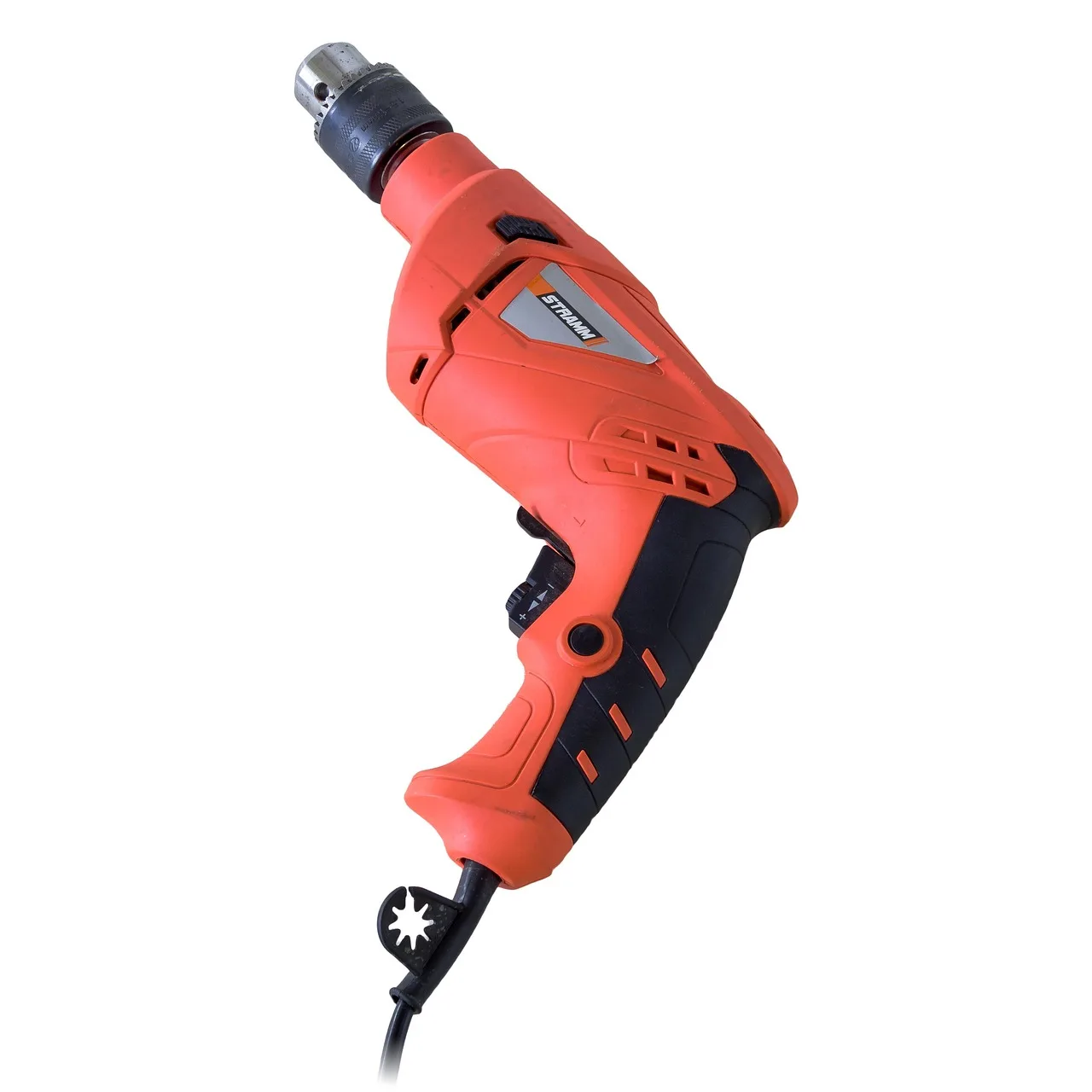
A Drill Driver uses a three-jaw chuck, commonly 3/8-inch or 1/2-inch, and it accepts round-shank bits as well as many hex-shank bits. An Impact Driver uses a 1/4-inch hex collet and only accepts 1/4-inch hex-shank bits. That difference explains many beginner buying mistakes.
Drills are the safer choice for pilot holes, hole drilling, and small fasteners because the chuck holds more bit types and the clutch gives you more control. Impact drivers are built around quick bit changes and driving efficiency, not broad bit compatibility.
Torque, IPM, and clutch control
ToolRecon lists drill torque at 400–700 in-lbs and impact driver torque at 1,500–2,200 in-lbs. ToolRecon also lists impact drivers at up to 3,800 impacts per minute, while drill speed commonly reaches 2,000 RPM. Those numbers matter less as bragging rights than as a clue to how each tool behaves in wood.
A drill’s adjustable clutch helps prevent over-driving fasteners, which matters for pocket holes, hinge screws, and cabinet work. An impact driver has no adjustable clutch, so it keeps hammering as resistance rises. That helps on long screws and lag bolts, but it can also damage screw heads or crush small workpieces.
Noise, size, and hand feel
Impact drivers are usually smaller and lighter, and that compact shape helps overhead and repetitive driving. Consumer Reports notes that impact drivers are especially adept at drilling overhead, which matches their compact build and fast fastening action. The tradeoff is noise and a more abrupt feel in the hand. (Consumerreports)
Drill drivers are usually calmer to run. That matters when you are starting pilot holes near a finished edge or driving a short screw into plywood and want the fastener to stop exactly when you say so.
Do I need an impact driver or a drill first?
For most beginner woodworkers, start with a Drill Driver if your first projects include holes, pilot holes, furniture assembly, or mixed hardware. Start with an Impact Driver first only if your first projects lean hard toward long screws, deck-style screws, or lag bolts. If you expect a balanced mix, a combo kit can make sense, but not before you know which tool your first three builds will actually need.
Buy the drill first when your projects start with holes
Choose a drill first if you will drill pilot holes, install hinges, drill shelf hardware, or make lots of small adjustments during assembly. Popular Mechanics notes that drills can be used for holes in wood, steel, non-ferrous metals, concrete, drywall, and plastics, which makes the drill the broader starter tool. That breadth matters more than raw torque for most woodworking beginners.
Say your first project is a small pine wall shelf with four brackets and eight pilot holes. A drill with an adjustable clutch gives you clean starts and better control near the edge of the board. The same job with an impact driver can work only if you are very careful, and it still offers less control for the pilot holes.
Buy the impact first when your projects use long screws
Choose an impact driver first if your early builds involve deck-style screws, framing screws, or repeated pocket-hole assembly in dense stock. The same source says impact drivers drive screws more efficiently into wood, metal, and cement. That efficiency matters most when the screw is long, the material is dense, or you are driving dozens of fasteners in a row.
Suppose your first project is a simple outdoor bench framed with long screws and lag bolts. The impact driver will do the repetitive fastening faster and with less wrist twist than a drill driver. It is the better first buy when screw-driving speed matters more than hole drilling.
Buy both when you build and assemble often
If your first three projects include both drilling and fastening, buying both tools early is often the cleanest path. The drill covers pilot holes, countersinking, and precision fastening. The impact driver covers long screws and repetitive assembly without tiring your hand as quickly.
That does not mean a combo kit is always the cheapest answer. It can also lock you into one battery platform before you know whether you want 12V for lighter work, 18V/20V Max for general use, or a higher-output system later. Platform choice matters because batteries and future bare tools usually stay within the same family.
Can an impact driver replace a drill for home projects?
An Impact Driver can stand in for a drill on many screw-driving jobs, but it is not a full drill replacement for woodworking. It can handle many fasteners efficiently, and with hex-shank accessories it can even bore some holes. The limit is control, bit variety, and the lack of a clutch.
Where the impact driver can stand
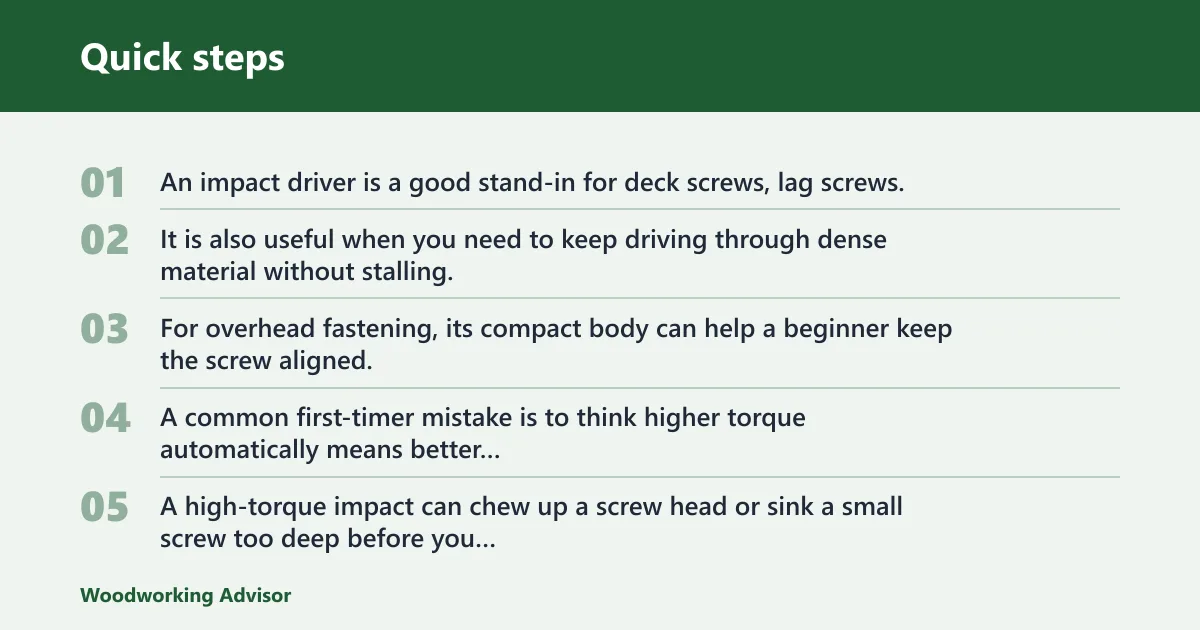
An impact driver is a good stand-in for deck screws, lag screws, and repetitive assembly with longer fasteners. It is also useful when you need to keep driving through dense material without stalling. For overhead fastening, its compact body can help a beginner keep the screw aligned.
A common first-timer mistake is to think higher torque automatically means better results in plywood. It does not. A high-torque impact can chew up a screw head or sink a small screw too deep before you react.
Where the drill is still the safer choice
Use the drill driver for pilot holes, hinge screws, shelf hardware, and small fasteners where over-driving would mar the work. The clutch gives you a built-in stop point. That matters for cabinet boxes, face frames, and any task where a stripped pocket hole or split edge would be hard to hide.
Drilling holes is also a drill job first. An impact driver can drill some holes with hex-shank bits, but its bit set is narrower and its hammering action is less friendly for clean, controlled boring.
Bits and accessories that change the answer
Impact drivers use only 1/4-inch hex-shank bits, so the accessory set is narrower by design. Drill drivers accept a wider spread of bits through the chuck, which is why they are the better starter for general woodworking. If you already own a full bit set with hex-shank versions, the impact driver becomes more useful sooner.
Brushless motors can improve efficiency in both tools and often run cooler than brushed motors. For starter kits, that can mean longer runtime and better torque delivery, but the motor style does not erase the core difference between chuck-and-clutch control versus impact fastening.
Which tool is better for furniture assembly?
For furniture assembly, the Drill Driver is usually the safer first buy because it handles pilot holes, cabinet screws, and finish hardware with better control. An Impact Driver is helpful when the assembly uses long screws or knock-down connectors that need repeated driving. The best choice depends on whether your furniture projects are mostly precise or mostly repetitive.
Cabinet assembly, shelf hardware, and knock-down fittings
Cabinet assembly usually starts with pilot holes and ends with careful screw seating near visible edges. Shelf hardware and knock-down furniture fittings also reward control more than brute force. That is why a drill driver wins these jobs more often than an impact driver.
For knock-down furniture, the impact driver can help when the hardware uses longer connector screws. But if the fastener is small or the material is thin, the drill’s clutch is the safer fit.
Pocket screws and small fasteners in plywood
Pocket screws are a mixed case. An impact driver can be fast and efficient, especially with longer pocket-hole screws in plywood or softwood. Yet the risk of stripped pocket holes rises when the screw head cams out or the driver keeps hammering after the screw has seated.
Drill drivers reduce that risk because the clutch can be set to stop before the fastener is over-driven. That matters in plywood, where a small mistake can crush fibers or make a joint look sloppy.
Hinge screws and finish work
Hinge installation is a drill-first job for most beginners. Hinge screws are small, the holes are often close to an edge, and over-driving can pull the hinge out of alignment or split the wood. A drill driver gives you the better mix of control and visibility.
When the screw head must finish flush, the drill also makes it easier to stop exactly where you want. That reduces screw-head damage and keeps the door alignment closer to where you set it.
Drill driver decision matrix
Use this table by matching your first three projects, not by chasing the biggest torque number. The recommended tool is the one that fits the material, screw length, and failure risk most cleanly. If two jobs point in different directions, consider a combo kit or buy the tool that supports the task you will do most often.
| Task type | Material | Fastener length | Risk of damage | Recommended first tool | Buy outcome |
|---|---|---|---|---|---|
| Pilot holes | Softwood or hardwood | None | Bit wander, tear-out near edges | Drill Driver | Buy drill first |
| Cabinet assembly | Plywood, MDF, softwood | 1 in. to 2-1/2 in. | Over-driving, split edges | Drill Driver | Buy drill first |
| Pocket screws | Softwood or plywood | 1-1/4 in. to 2-1/2 in. | Stripped pocket holes, cam-out | Impact Driver | Buy impact first |
| Lag screws | Solid wood or framing lumber | 2-1/2 in. to 6 in. | High binding and wrist twist | Impact Driver | Buy impact first |
| Deck-style screws | Pressure-treated lumber | 2-1/2 in. to 3 in. | Screw-head damage, repetitive fatigue | Impact Driver | Buy impact first |
| Hinge installation | Cabinet face frame, door jamb | 3/4 in. to 1-1/2 in. | Over-driving, misalignment | Drill Driver | Buy drill first |
| Hole drilling in hardwood | Oak, maple, birch | None | Bit slip, burn marks if rushed | Drill Driver | Buy drill first |
| Hole drilling in softwood | Pine, fir, cedar | None | Splintering and blowout | Drill Driver | Buy drill first |
| Shelf hardware | Plywood, hardwood, wall framing | 3/4 in. to 2 in. | Alignment errors, stripped holes | Drill Driver | Buy drill first |
| Furniture knock-down fasteners | Plywood or particleboard | Varies by connector | Cam-out, crushed edges | Drill Driver | Buy drill first |
| Repetitive trim screws | Softwood trim, blocking | 1 in. to 2 in. | Fatigue, over-driving | Impact Driver | Buy impact first |
| General screw removal | Mixed materials | Existing screws | Stripped heads, stuck fasteners | Impact Driver | Buy impact first |
How to read the task table
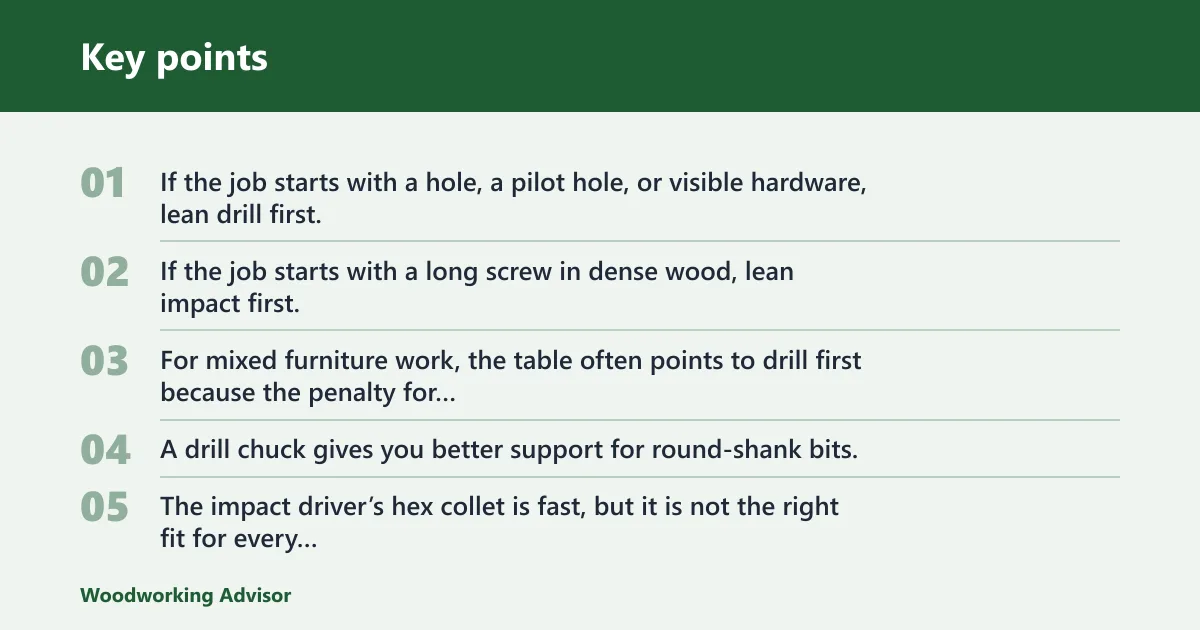
If the job starts with a hole, a pilot hole, or visible hardware, lean drill first. If the job starts with a long screw in dense wood, lean impact first. For mixed furniture work, the table often points to drill first because the penalty for over-driving is easier to avoid with a clutch.
Bit wobble is another reason. A drill chuck gives you better support for round-shank bits, so you are less likely to fight slippage or poor alignment when boring holes. The impact driver’s hex collet is fast, but it is not the right fit for every woodworking bit.
Choose Drill Driver if… / Choose Impact Driver if…
Choose Drill Driver if… your first projects involve holes, pilot holes, hinge screws, cabinet work, or any fastener that could be ruined by over-driving. Choose it if you expect to use a wide mix of bits, want better control on small screws, or plan to drill in both hardwood and softwood.
Choose Impact Driver if… your first projects use long screws, lag bolts, deck-style screws, or repetitive assembly where speed matters more than precision. Choose it if you want the stronger fastening feel, do a lot of overhead driving, or mostly build things that use hex-shank driver bits.
Choose both if… you know you will drill and fasten regularly, or you want to split clean work from heavy fastening. In that case, buy into one battery platform first and keep future bare tools on the same platform to avoid battery lock-in problems later.


Battery, motor, and kit planning
Battery voltage affects the tool family and the weight you carry. A 12V drill is usually the lighter choice for small, stop-and-go woodworking tasks, while 18V/20V Max is the common all-around class for general DIY use. A 60V platform can deliver more output, but it usually brings more weight and cost than a beginner needs.
Amp-hours measure battery capacity, not raw power. Higher Ah packs usually help more with stop-and-go work and longer sessions because they extend runtime. If your projects are short and occasional, a smaller pack may be enough; if you are building cabinets or working through a long assembly day, extra capacity matters more.
Brushless motors are more efficient than brushed motors and often run cooler. In starter kits, brushless is the better long-term pick if the price difference is reasonable. Chuck size can hint at duty level, but it is only a rough proxy: 3/8-inch and 1/2-inch chucks both appear on cordless drills, and the chuck size alone does not tell you everything about real performance.
Frequently asked questions
What is the difference between a drill driver and an impact driver?
A drill driver uses a three-jaw chuck and an adjustable clutch, so it can hold round-shank bits and stop before it over-drives fasteners. An impact driver uses a 1/4-inch hex collet and delivers rotational strikes, which makes it better for long screws and lag bolts but less suited to delicate fastening.
Can you drill holes with an impact driver?
Yes, but only with 1/4-inch hex-shank bits. That makes the impact driver usable for some hole-drilling tasks, especially in a pinch, but the drill driver is still the better tool for clean, accurate holes in wood and for any project where bit choice matters.
What size bits fit an impact driver?
Impact drivers accept only 1/4-inch hex-shank bits. That includes many screwdriver bits and some drill bits made for impact use. If your project needs round-shank bits or a wider accessory range, a drill driver with a chuck is the better starter.
Which tool is better for assembling furniture?
For most furniture assembly, the drill driver is better because it gives you clutch control for small screws, hinges, and pilot holes. The impact driver becomes the better pick when the assembly relies on long screws, pocket screws, or repetitive fastening where speed matters more than finesse.
Which tool should I buy for deck screws and framing?
Buy the impact driver first for deck screws and most framing-style fastening. Its higher torque and impact action help drive longer screws into dense material with less wrist twist. A drill can do the job, but it is usually slower and easier to stall under load.
Should a beginner start with a drill or impact driver?
Most beginners should start with a drill driver because it covers holes, pilot holes, and a wider range of woodworking tasks with better control. Start with an impact driver only if your first projects are mostly long-screw assembly or lag-bolt fastening. If you are unsure, the drill is the safer first buy.
Sponsored / affiliate links. As an Amazon Associate I earn from qualifying purchases. I may earn additional commission from eligible campaigns.