Milwaukee vs Ryobi: Which Cordless Line Is Worth It?
Ryobi is usually the better 3-year value for most DIYers. Milwaukee is worth the extra money only if you need tougher tools, faster charging, or plan to add many pro-grade tools. Buy on sticker price alone, and you can end up paying twice for batteries, chargers, and replacements. This guide compares tool cost, battery systems, and likely 3-year ownership costs so you can choose the right cordless line.
Verdict
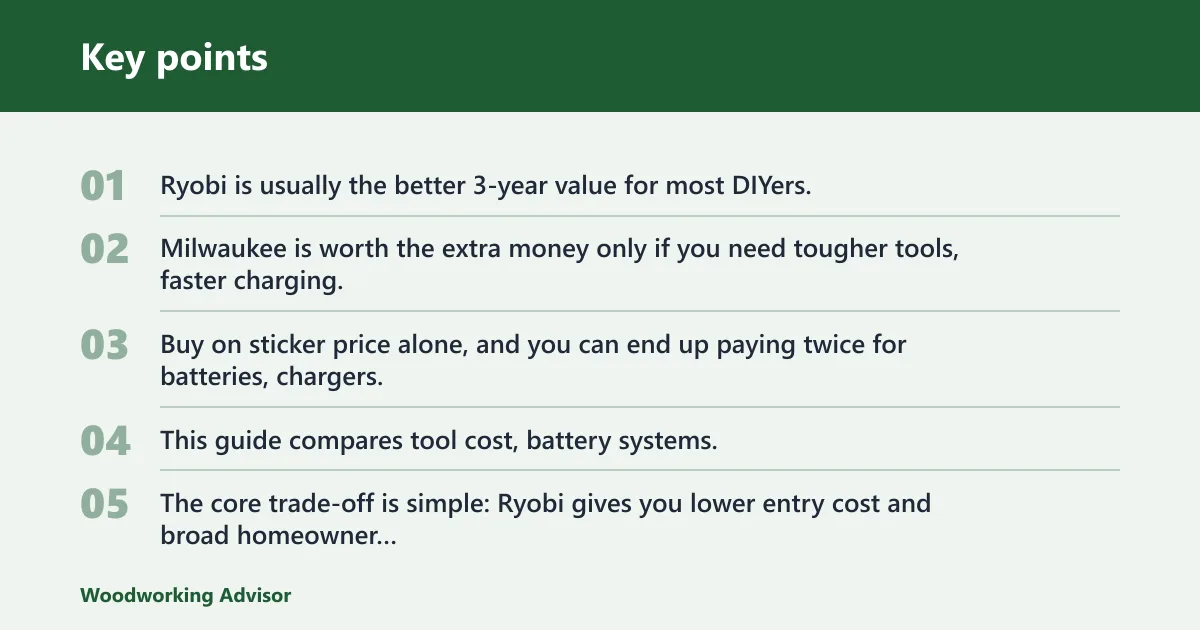

The core trade-off is simple: Ryobi gives you lower entry cost and broad homeowner coverage through one battery family, while Milwaukee asks for more upfront money in exchange for pro-grade depth, stronger specialty options, and a split M18/M12 ecosystem that fits heavier use. The best choice depends more on project frequency than brand prestige.
📊 Milwaukee’s main cordless platforms are M18 and M12. Source: Ryobi vs Milwaukee tools: Which one should you buy.
Specs at a glance
| Decision factor | Ryobi ONE+ | Milwaukee M18 / M12 | Winner |
|---|---|---|---|
| Battery platform | 18V ONE+ system | M18 plus M12 | Ryobi for simplicity |
| Tool lineup breadth | More than 300 cordless tools | Hundreds of cordless tools across two lines | Ryobi for one-battery breadth |
| Target user | Affordable and reliable for homeowners and DIY enthusiasts | Contractors and professionals who need heavy-duty tools | Depends on workload |
| System complexity | Single-battery ecosystem | Two major battery ecosystems with smaller tools on M12 | Ryobi |
| Protection and electronics | Standard platform features vary by tool | Redlink Plus Intelligence on many tools | Milwaukee |
| Expansion path | Drills, saws, yard equipment, lights, inflators, accessories | Core jobsite tools, woodworking tools, storage, and compact M12 tools | Milwaukee for specialty depth |
What is the real 3-year ownership cost?
The real cost is not just the starter kit. Over three years, Ryobi usually wins for light and moderate use because the first buy-in is lower and one battery family can cover many tools. Milwaukee can cost more up front, but that premium makes more sense when you need frequent use, extra batteries, and a wider upgrade path.
Three-year ownership worksheet
| User type | Ryobi starter path | Milwaukee starter path | Likely next purchases | Ownership risk |
|---|---|---|---|---|
| Weekend DIYer | One combo kit with a drill/driver, battery, and charger | One combo kit with a drill/driver, battery, and charger | Ryobi: impact driver or small saw; Milwaukee: same, but at a higher platform cost | Buying more platform than you need |
| Serious homeowner | Starter kit, then an extra battery after the first year if runtime feels tight | Starter kit, then extra battery and possibly a second charger if tools spread across M18 and M12 | Impact driver, circular saw, and a specialty tool such as a light or inflator | Battery aging and charger duplication |
| Jobsite-adjacent woodworker | Brushless drill/driver, impact driver, circular saw, and a second battery to reduce downtime | Brushless M18 drill/driver, impact driver, saws, then M12 for compact tools | Better saws, higher-output batteries, and a specialty tool lane | Platform mismatch if the first line is too small |
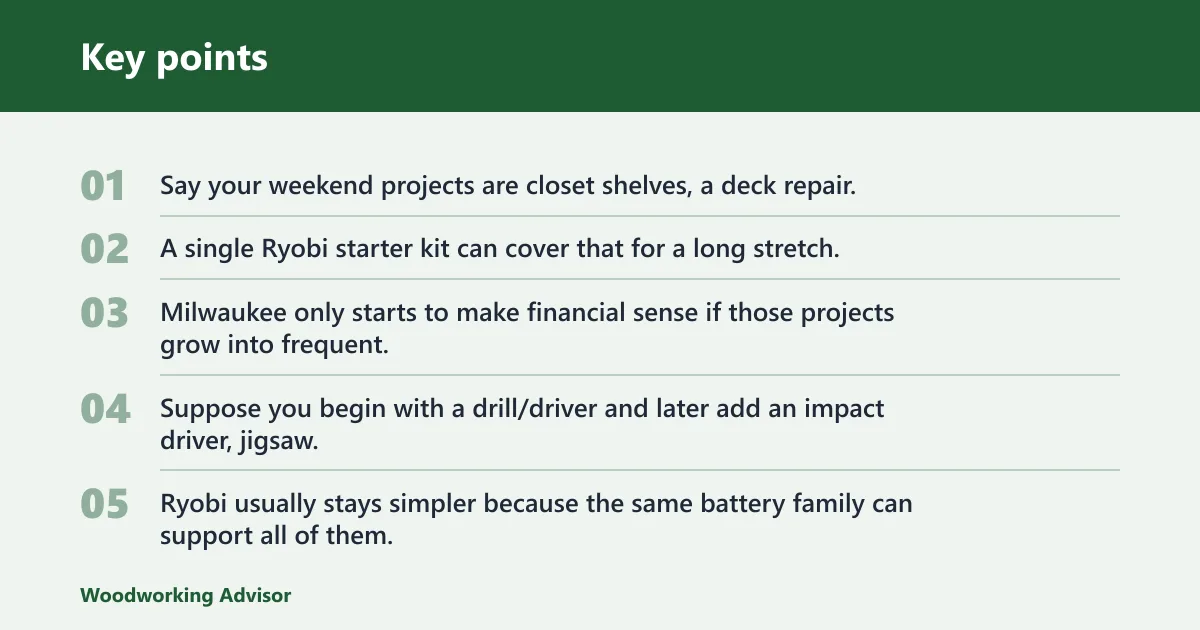
Say your weekend projects are closet shelves, a deck repair, and a few cabinet hinges each month. A single Ryobi starter kit can cover that for a long stretch, and the single-battery system keeps the collection easy to manage. Milwaukee only starts to make financial sense if those projects grow into frequent, longer runtime jobs.
Suppose you begin with a drill/driver and later add an impact driver, jigsaw, and trim saw. Ryobi usually stays simpler because the same battery family can support all of them. Milwaukee may be the stronger long-term platform if you also want compact M12 tools, but that split raises the chance of buying extra chargers and extra batteries.
How do Ryobi ONE+ and Milwaukee M18 differ?
Ryobi ONE+ is a single 18V system built around broad homeowner coverage, while Milwaukee’s main cordless platforms are M18 and M12. That means Milwaukee is not one ecosystem in the same way Ryobi is. The split gives Milwaukee more specialization, but it also increases entry cost and ownership complexity.
Platform overlap and lock-in
Both systems run cordless drills, impact drivers, and saws, so the first purchase can look similar on paper. The difference shows up later: Ryobi keeps nearly everything under one battery family, while Milwaukee asks you to decide whether a tool belongs on M18 or M12. That matters once you expand beyond the first kit.
Ryobi’s single-battery approach helps if you want one charger and one battery type across a lot of household tools. Milwaukee’s split ecosystem helps if you want full-size performance on M18 and lighter, compact tools on M12 without forcing the same battery format onto both jobs.
Which brand is better for cordless drills and saws?
For a basic drill/driver, both brands are capable, but the better choice depends on how often you drive long fasteners, bore larger holes, or run the tool hard. For saws, Milwaukee has the stronger pro-focused lineup, while Ryobi is usually enough for common homeowner cuts, trim work, and occasional sheet-good breakdown.
Drill/driver and impact driver
The drill/driver is the entry tool for most buyers. The key questions are comfort, runtime, and whether you want brushed or brushless. Brushless motors usually bring better efficiency and durability, which matters more as your workload rises.
The impact driver is often the first upgrade after a drill/driver because it delivers higher torque for screws and bolts. This is where brushless tools start to matter more, and Milwaukee’s higher-end range gives you more reasons to pay extra if you drive fasteners all week or work into tougher materials.
Saw categories
Milwaukee’s woodworking category includes circular saws, jig saws, table saws, and miter saws, which points to deeper support for frequent cutting tasks. Ryobi also covers saws, but it is usually the more practical buy when cuts are occasional rather than daily.
For a weekend remodel, Ryobi saws are often good enough. For repeated framing, trim installation, or heavier site work, Milwaukee’s broader pro lineup and battery support are easier to justify.
What tools are available in each line?
Ryobi ONE+ covers a very broad homeowner range, including drills, saws, yard equipment, lights, inflators, and accessories. Milwaukee covers similar base categories, but its platform depth leans harder toward professional and specialty tools, with M18 for larger cordless tools and M12 for compact jobs.
Ryobi ONE+ tool lineup breadth
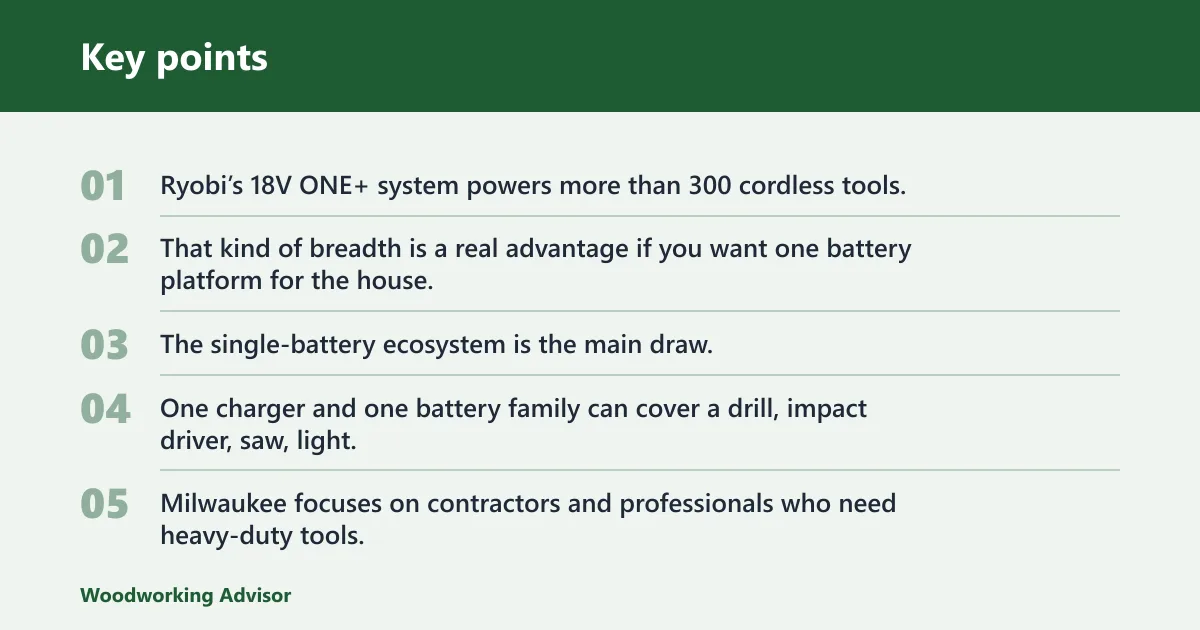
Ryobi’s 18V ONE+ system powers more than 300 cordless tools. That kind of breadth is a real advantage if you want one battery platform for the house, garage, yard, and small workshop without stepping into multiple ecosystems.
The single-battery ecosystem is the main draw. One charger and one battery family can cover a drill, impact driver, saw, light, inflator, and yard tools, which lowers the chance of platform mismatch over time.
Milwaukee M18 lineup breadth
Milwaukee focuses on contractors and professionals who need heavy-duty tools, and its official site includes the M18 and M18 FUEL line. That points to a broad, jobsite-first catalog where performance and tool depth matter more than keeping the first purchase cheap.
Milwaukee’s official site also lists a cordless tool system and a cordless equipment system. For buyers who expect to grow into specialty tools, that wider structure is a real advantage.
Milwaukee M12 add-on value
M12 is Milwaukee’s compact cordless line and is complementary to M18. It is useful for smaller tools and specialty tools where a lighter format makes sense. That makes Milwaukee attractive if you want one brand for both full-size and compact work.
The trade-off is complexity. Once you buy into both M18 and M12, you may need different chargers and battery planning, which raises total ownership cost compared with a single-platform system.
What works better in Milwaukee, and what is good enough in Ryobi?
Milwaukee earns its premium when tool duty is high, runtime matters, or you need deeper specialty coverage. Ryobi is good enough for a lot of household work, and in some cases it is the smarter buy because the savings can go into more tools or better accessories. The right answer depends on how hard you push the platform.
Brushless motors and Redlink Plus Intelligence
Brushless motors are more efficient than brushed motors, so they usually give you better runtime and durability. That matters most in higher-end cordless tools, where frequent use makes small efficiency gains add up over time.
Milwaukee’s Redlink Plus Intelligence adds electronic protection for the motor and battery. That is a meaningful advantage for users who push tools hard, because protection systems are part of why pro-grade tools can hold up under demanding use.
Category-by-category guidance
- Choose Milwaukee for frequent drilling, heavy fastening, repeated saw use, and specialty tools where runtime and protection matter.
- Choose Milwaukee if you expect to expand into M12 compact tools and want one premium brand across both sizes.
- Choose Ryobi for general home repairs, furniture assembly, light remodeling, and a broad tool collection on a budget.
- Choose Ryobi if yard equipment and household accessories matter as much as power tools.
Battery aging and replacement cost
Battery aging changes the math after the starter kit. A system that looks cheap on day one can become expensive if replacement batteries are hard to ignore or if you need multiple chargers to keep several tools ready.
Ryobi’s single-battery model keeps replacement planning simple. Milwaukee can cost more over time, especially if you drift into both M18 and M12 and start duplicating chargers to avoid downtime.
Choose Ryobi if… / Choose Milwaukee if…
Choose Ryobi if your projects are occasional, your budget is tight, and you want one battery family for the garage, house, and yard. Choose Milwaukee if you work tools hard, want stronger specialty depth, and expect to build a larger system where pro-grade runtime and durability justify the higher 3-year cost.
Choose Ryobi if…
- You want the lower entry cost.
- You need a broad homeowner lineup in one battery system.
- You plan to use the tools on weekends, not every day.
- You value simple charging and easy battery sharing across tools.
Choose Milwaukee if…
- You need heavy-duty tools for frequent use.
- You want stronger runtime and electronic protection features.
- You expect to buy specialty tools and compact M12 tools later.
- You are comfortable paying more up front for deeper long-term capability.
Alternatives

This KOOMICY M18 6.0Ah 2-pack with charger is the budget-minded alternative for buyers already invested in Milwaukee M18. The value is clear if you need more runtime, and the included multi-voltage charger helps simplify charging. The drawback is that it is an aftermarket battery solution, so fit, longevity, and support deserve extra caution compared with factory battery kits.

Milwaukee’s M18 FUEL 21-inch self-propelled mower shows how deep the M18 ecosystem can go. It is a strong fit for buyers who want one battery family across outdoor power equipment and tools, but the price is high and the mower makes little sense unless you are already committed to Milwaukee batteries.
Should you buy it
Buy Ryobi if you want the better total value over three years and you are building a cordless collection for home use, repairs, and occasional remodeling. Buy Milwaukee if your tool use is frequent, your cuts and fastening jobs are harder, or you want a longer-term path into both M18 and M12 specialty tools. The right answer depends on workload, not brand status.
Frequently asked questions
Is Ryobi or Milwaukee better for home use?
Ryobi is usually better for home use because it costs less to enter, covers a wide range of homeowner tools, and keeps battery planning simple. Milwaukee makes more sense when home use turns into frequent, demanding projects, but most households do not need that level of tool depth.
Is Milwaukee worth the extra money over Ryobi?
Milwaukee is worth the extra money when you need stronger runtime, better protection features, and more specialty tools over time. If you only need a drill, impact driver, and a few saws for occasional work, Ryobi usually delivers better 3-year value.
What is the difference between Ryobi ONE+ and Milwaukee M18?
Ryobi ONE+ is a single 18V system built for broad homeowner coverage, while Milwaukee M18 is one of two major Milwaukee platforms and sits in a pro-grade family. Milwaukee’s split with M12 adds flexibility, but it also increases complexity and total ownership cost.
Which brand has better battery ecosystem and tool selection?
Milwaukee has the deeper pro and specialty ecosystem, especially if you count both M18 and M12. Ryobi has the simpler single-battery ecosystem and a very large tool count for homeowners, with more than 300 cordless tools on the ONE+ platform.
How long do Ryobi and Milwaukee tools last?
Tool life depends more on workload, storage, and battery care than on the brand name alone. Milwaukee’s heavier-duty positioning, Redlink Plus Intelligence, and brushless options give it an edge under frequent use, while Ryobi is usually the better value when use is lighter.
Should I buy Ryobi for DIY or Milwaukee for jobsite work?
Ryobi is the safer DIY buy because it keeps costs down and covers most homeowner tasks. Milwaukee is the better jobsite choice because it is aimed at contractors and professionals who need heavy-duty tools, broader specialty support, and more durable performance under constant use.
Sponsored / affiliate links. As an Amazon Associate I earn from qualifying purchases. I may earn additional commission from eligible campaigns.