Power Tool Comparisons and Buying Guide for Shops
The smartest starting buy for most home shops is a starter combo kit with a drill/driver and impact driver, plus one cutting tool matched to the work you do most. That covers assembly first, keeps the first battery purchase efficient, and avoids paying too early for specialty tools that mostly collect dust.
Buy for the way work moves through your shop, not for a logo on the case: break down stock first, drill and drive fasteners second, route edges and joinery third; use corded tools at the bench and cordless tools for assembly, installs, and outdoor cuts. I see people miss this all the time, then spend extra on overlapping tools, weak battery systems, poor dust collection, and saws that do not suit the cuts they actually make. This guide compares the core power tools people buy first, corded versus cordless, jobsite versus shop choices, brushless vs brushed tradeoffs, and total ownership cost so you can build a home shop one purchase at a time.
Quick picks by need
- Best first buy path for a new home workshop: cordless drill/driver kit, then a cutting tool that matches project stock, then router only after edge work or joinery becomes common.
- Best path for sheet-goods projects: track saw first if space is tight and plywood handling is the problem; table saw first if repeat rip cuts on narrower parts will dominate after breakdown.
- Best path for trim, install, and punch-list work: cordless drill/driver, cordless circular saw, oscillating multi-tool, compact router last.
- Best path for a small shop with limited space: drill/driver, track saw, compact router, then add a benchtop or jobsite table saw only when repetitive ripping starts costing time.
📊 This Old House says the number of tools in sets ranges from 2 to 60. Source: 6 Best Power Tool Sets (2026 Guide).
What power tools should I buy first for a home workshop?
Start with a drill/driver and one cutting tool that fits the material you use most. Add a router only when edge treatment, hinge work, or joinery starts showing up often. Hold off on niche tools until they solve a repeated problem, because early purchases should cover assembly, rough sizing, and basic accuracy without draining the budget.
Start with drilling, driving, and one reliable crosscutting option
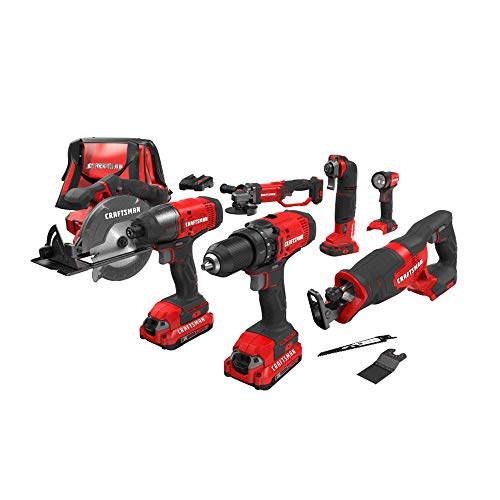
A drill/driver earns the first slot because nearly every woodworking project needs pilot holes, screws, hardware, or assembly. A starter combo kit is usually the cleanest way in because the battery and charger cost is handled up front and the included tools are immediately useful.
From there, pick the first saw by stock type. For dimensional lumber and mixed home projects, a circular saw handles rough cuts and outdoor work well. For furniture parts and repeat sizing, a table saw often pays back better over time. For plywood-heavy cabinet work in a cramped shop, a track saw fixes the breakdown problem faster.
Add the first panel-cutting tool based on project type
If projects begin with full sheets, buy for safe handling first. A track saw takes less space and gives you a cleaner breakdown workflow. A table saw becomes more useful after panels are already manageable and repeat rip cuts start to matter.
Many buyers do this backward and end up wrestling sheet goods on a small saw with poor support. I have seen that go badly. The cheaper purchase can cost more once an outfeed setup, stand, and extra support get added.
Buy routing capability only after joinery or edge work shows up often
A router is rarely the right first power tool. It earns its place when roundovers, dados, hinge mortises, laminate trimming, or flush trimming start showing up on a lot of builds.
For light trim and edge work, a compact router is enough. For deeper dados, raised panels, or wider bit use, a full-size corded router usually makes better financial sense than trying to force cordless into a heavy bench task.
Delay niche tools until they solve a repeated problem
Oscillating multi-tools, reciprocating saws, and second-tier saws can solve very real problems. They are poor early buys if they only cover occasional tasks. Buy them when they remove a known bottleneck, not because they show up in a combo kit.

Workshop-first comparison matrix
| Tool type | Woodworking job it solves | Minimum spec threshold that matters | Hidden add-on costs | When the cheaper tool costs more over two years |
|---|---|---|---|---|
| Cordless drill/driver | Assembly, pilot holes, hardware install | Usable clutch settings, battery platform with future tools, kit if no batteries yet | Extra battery, charger, driver bits, drill bit set, countersink bits, safety glasses | When a bare tool looks cheap but needs battery and charger added later |
| Cordless circular saw | Rough breakdown, site cuts, framing-adjacent wood tasks | Blade diameter and cutting depth that actually clear the stock being cut | Extra batteries, better blade, straightedge guide, hearing and eye protection | When battery drain on repeated cuts forces purchase of larger packs |
| Table saw | Repeat rip cuts, furniture parts, small-sheet processing | Rip capacity that suits project widths, stable stand if jobsite model | Stand, outfeed support, push stick, quality blade, dust hookup, PPE | When a benchtop unit lacks capacity and needs replacement after a few projects |
| Track saw | Precise sheet-goods breakdown, splinter-controlled cuts | Rail system support and dependable dust collection | Rails, connectors, replacement splinter strip, clamps, dust extractor, blade | When the saw price is low but the rail and dust setup doubles real spend |
| Oscillating multi-tool | Flush cuts, trim fitting, hinge relief, detail rework | Variable speed and a blade interface with broad blade availability | Blade packs, scraper blades, sanding pads, battery if cordless | When proprietary blades stay expensive and get used often |
| Router | Edge profiling, dados, flush trim, hinge mortises | Base style matched to work and bit shank size that fits planned bits | Router bits, guide bushings, edge guide, dust hood, table later on | When a trim router gets pushed into full-size tasks and a second router follows |
| Safety glasses / PPE | Impact protection and jobsite compliance | ANSI Z87.1 marking and a fit that works over prescription glasses if needed | Spare pair, hearing protection, dust mask or respirator | When poor fit leads to skipped use and repeated replacement |
Ownership-cost table for a realistic first-shop cart
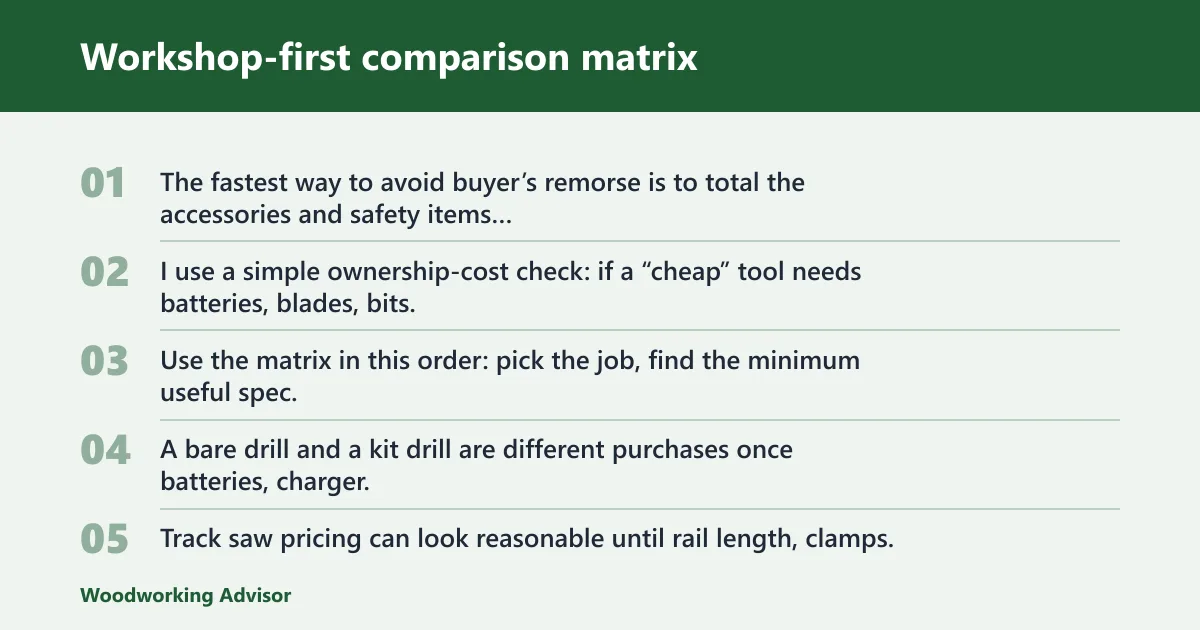
The fastest way to avoid buyer’s remorse is to total the accessories and safety items before you compare brands. I use a simple ownership-cost check: if a “cheap” tool needs batteries, blades, bits, and PPE before it can do the job safely, it was never really the cheap option.
| Purchase path | What is usually included | What you still need to budget for | Why ownership cost changes fast |
|---|---|---|---|
| Starter combo kit | Drill/driver or drill + impact driver, batteries, charger, bag | Driver bits, drill bits, countersink, safety glasses / PPE | The kit can be a strong value, but consumables and PPE still make up a real part of the first checkout total |
| Bare cordless saw | Tool only | Battery, charger, blade, guide, hearing and eye protection | A bare tool often looks inexpensive until battery-system costs are added |
| Jobsite table saw | Saw, basic blade, sometimes stand | Better blade, push stick, outfeed support, dust hookup, safety glasses / PPE | The saw itself may be only part of the spend if support and dust control are weak |
| Track saw setup | Saw, sometimes one rail | Longer rails, connectors, clamps, extra blade, dust extractor, PPE | Rails and dust collection can rival the cost of the saw body |
| Router setup | Router and one base | Bits, edge guide, guide bushings, dust hood, hearing and eye protection | Bit purchases often determine the real cost more than the router itself |
Decision rule for real budgets
Use the matrix in this order: pick the job, find the minimum useful spec, then total the add-ons before checkout. That changes a lot of buying decisions. A bare drill and a kit drill are different purchases once batteries, charger, and bits are counted.
The same logic applies to saws. Track saw pricing can look reasonable until rail length, clamps, and dust extraction are added. Table saw pricing can swell fast after a stand, outfeed support, and blade upgrade land on the list.
How do I compare corded vs cordless power tools?
Cordless earns its keep where movement, setup speed, and off-bench work matter most. Corded still wins for long sessions, stationary tools, and lower expansion cost. Compare them by workflow friction, runtime needs, tool weight, and whether future battery purchases will outgrow the value of staying on one platform.
Where cordless earns its price in woodworking
Cordless works best in assembly, installs, trim work, deck repairs, outdoor cutting, and any shop where tools move room to room. The gain is speed. Pulling a drill off the shelf and driving screws right away matters more than raw power in those cases.
It also matters for tools used in short bursts. A drill/driver, impact driver, oscillating multi-tool, and compact circular saw often fit that pattern well.
Where corded still wins on cost and consistency
Bench tools and high-draw tools still favor corded value in many home shops. Routers, shop vacs, dust extractors, and many table saw setups are better buys when they stay off the battery bill.
Corded also avoids runtime interruptions. A stationary tool used for repeated operations stays more predictable when nobody is managing charge cycles, pack temperature, or premium battery upgrades.
Battery-powered tools and the real runtime math
Battery value depends on duty cycle. Short, intermittent cuts are easy on a platform. Repeated thick ripping, demolition, or heavy routing can force larger packs, more chargers, and backup batteries that change the economics fast.
This is why cordless circular saws need caution. They are handy for rough breakdown and site cuts, but frequent sheet-goods work can drain packs quickly if the tool is also expected to act like a shop saw.
A simple rule for choosing power source by tool type
- Choose cordless for drills, drivers, install saws, and detail tools used away from the bench.
- Choose corded for routers and stationary saw setups unless mobility is a proven need.
- For circular saws, choose by where the cuts happen: cordless for mobility, corded if long cutting sessions are common.
- For table saws and track saws, choose by shop layout, dust control, and material handling before looking at battery appeal.
Which specs actually matter when buying power tools?
Buy on the specs that change the cut, the fit, or the setup time. Ignore inflated feature lists unless they solve a real task. In woodworking, accuracy, control, usable capacity, consumable compatibility, and tool weight matter more than headline claims that read well on a box.
Cut quality, accuracy, and control before raw power claims
A saw that tracks straight and accepts a better blade is often more useful than one sold with vague power language. A drill with a sensible clutch is more helpful in cabinet assembly than a brute that strips screws.
For a first-time buyer, I care much more about whether a tool is sold as a kit or as a bare tool than about inflated marketing language. Retailer product pages and manufacturer spec pages are the right places to confirm what is actually included, whether the tool is brushless, and what accessories are required before the first real project.
Capacity numbers that change what can be built
Only a few capacity specs really change workflow. On a circular saw, blade diameter and cutting depth decide whether common stock can be cut cleanly in one pass. On a table saw, rip capacity decides whether cabinet parts are practical or frustrating.
The useful rule is simple: if the capacity number changes which parts you can safely cut, it matters. If it does not change the project list, it is often just brochure filler.
Ergonomics, weight, and setup friction in daily use
A tool that is heavy, awkward, or fussy to set up will sit unused. For handheld tools, weight and balance affect accuracy more than most buyers expect. For shop tools, setup friction shows up as lost time and rushed cuts.
This is one reason starter kits need a hard look. More tools may look attractive, but if half of them are low-use filler, the real value is weaker than buying a better core pair first.
Service parts, consumables, and resale reality
Blade availability, charger compatibility, battery replacement cost, rail availability, and common bit sizes all deserve attention. A good purchase is easier to keep running. A cheap purchase with odd consumables can get expensive in a hurry.
Our picks by need
If you want the short version, the best first-buy pattern is still the same: get a starter combo kit if you own no batteries yet, buy a bare tool only when you already trust that battery ecosystem, and treat specialty add-ons as later purchases. The product listings below are best used as examples of those roles rather than as a shopping list to buy all at once.
First-tool starter kit: DEWALT 20V MAX drill and impact driver combo kit

If you are starting from zero, this type of kit is the cleanest entry because the retailer listing makes the included batteries, charger, and bag easy to verify before checkout. That matters more than chasing a higher-spec bare tool too early.
The drawback is not performance so much as long-term planning. A good starter combo kit solves drilling and driving on day one, but it does not answer the bigger woodworking questions of sheet breakdown, routing, dust control, or future battery-platform cost.
Bare drill for an existing Makita platform: Makita XPH14Z brushless hammer driver-drill

For buyers already committed to 18V LXT, a brushless bare tool like this is the smarter move than rebuying batteries. This is the basic ownership-cost lesson in action: a bare tool can be a great value only when the battery ecosystem is already in place.
The honest drawback is still the same. For a first-time buyer, a bare drill usually stops being a bargain once battery and charger costs are counted, even if the drill itself is excellent.
Dual-use fastening for shop and hardware work: Bosch GDX18V-1860CN two-in-one impact driver/wrench

This kind of tool makes the most sense when woodworking overlaps with hardware-heavy shop setup, machinery assembly, or lag-screw work. I like tools with a clear second role, but I still would not make this the first cordless purchase for a pure home woodshop.
The drawback is role overlap. If the workflow is mostly pilot holes and cabinet screws, a standard drill/driver kit does more for less money and less friction.
Demolition and rough cutting add-on: Milwaukee M18 Fuel Sawzall brushless reciprocating saw

This makes sense for remodel-heavy woodworkers, punch-list work, or site tasks where wood meets nails, old trim, or awkward cuts. It can be the right add-on if the workshop also supports renovation jobs and outdoor repair work.
The drawback is fit. A reciprocating saw is rarely a core woodworking purchase, and this bare-tool listing adds battery cost for buyers outside the M18 platform. It also does little for fine sheet-goods work or furniture accuracy.
What should I look for in a drill, circular saw, router, and multi-tool?
Match each tool to the work you do most, then check the one or two specs that change results. For drills, that is clutch and battery path. For circular saws, blade size and realistic depth. For routers, base style and bit shank. For multi-tools, blade interface and speed control.
Drill or driver: clutch, voltage, brushless value, and kit vs bare tool
For a first drill, prioritize clutch settings, battery inclusion, and whether the platform has future tools worth buying. Brushless vs brushed matters most on tools used constantly: brushless usually means less maintenance, better battery efficiency, and better heat control, while brushed can still be perfectly fine for lighter household use and tighter budgets.
Voltage system matters most as a platform decision, not as a bragging point. A bare tool can be smart on an existing battery family, but for a first-time buyer the ownership-cost math usually favors a kit because the charger and batteries are already included.
Circular saw: blade size, depth of cut, battery drain, and panel limits
Buy a cordless circular saw for mobility and rough breakdown, not as a full replacement for every stationary cutting task. Blade diameter and cutting depth matter because they decide what stock can be cut cleanly without wrestling the tool or flipping material.
Tool battery ecosystem matters more here than with a drill because saws draw harder. If the future plan includes a cordless saw, check battery-pack pricing early; that is where a platform that looked affordable on a drill can become expensive fast.
Router: compact vs full-size, plunge vs fixed base, corded vs cordless, and shank size
A compact router fits trim, edge easing, laminate work, and light hinge or flush-trim duty. A full-size router fits dados, pattern work, and heavier bit use better. Fixed-base control suits many edge tasks; plunge bases matter once stopped cuts become common.
Bit shank size affects long-term flexibility. If the project list is mostly trim and shelves, a compact unit is enough. If casework and joinery are picking up, corded full-size value is usually better than chasing cordless convenience here. If you want deeper router guidance, the circular saw discussion is useful only as a reminder that cutting tools and battery demands scale differently; routers deserve their own workflow-based decision.
Oscillating multi-tool: blade interface, speed control, corded vs cordless, and where it earns space
Variable speed and broad blade compatibility matter more than styling. This tool earns space when flush cuts, undercuts, patch work, and detail corrections happen often. For occasional use, corded can be the cheaper answer. For install and trim work, cordless speed is usually worth it.
Check blade prices before buying. A cheap tool with costly proprietary blades can outspend a better unit very quickly.
Is a table saw or track saw better for sheet goods?
Neither is the universal winner. A track saw is usually better for first breakdown, tight spaces, and controlled plywood handling. A table saw is better for repeat rip cuts after parts are manageable. Choose by material flow, available support space, and how often full sheets enter the shop.
Accuracy and repeatability on full panels
A track saw starts with the panel where it lies, which removes much of the handling problem. That alone can improve real-world accuracy in a small shop. It also keeps the cut line visible and usually pairs better with dust collection at the point of cut.
A table saw shines after the panel is already reduced. Repeatability is easier when narrower parts move across a stable table with a fence doing the work.
Rip capacity, support, and safe handling
Rip capacity matters, but support matters just as much. Small benchtop saws often promise an answer while creating a handling problem. Full sheets need infeed, outfeed, and side support to stay safe and controllable.
A track saw avoids much of that support burden. The tradeoff is rail management, setup time, and the ongoing cost of rails, clamps, and dust extraction.
Dust, floor space, and transport
Track saws win on floor space. They store easier and turn a bench or foam sheet into a cutting station. Table saws take permanent room or frequent setup effort, especially once a stand and support are added.
For transport, jobsite table saws split the difference. They can work well, but buyers should still ask whether sheet-good ripping is the main job or only an occasional one.
When a two-saw workflow makes sense
If cabinets or built-ins are the goal, a two-saw workflow is often the cleanest path: track saw for breakdown, table saw for final dimensioning. That is not the cheapest starting point, so many home shops should buy one tool first and add the second only after the workflow proves it.
How to choose a battery ecosystem or starter combo kit
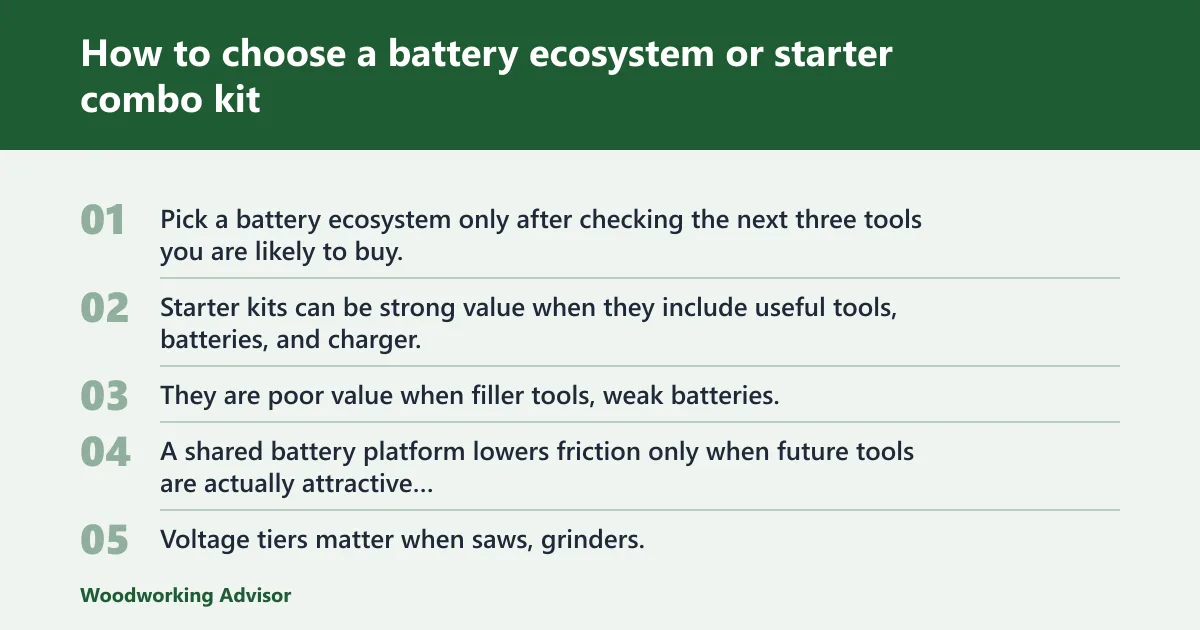
Pick a battery ecosystem only after checking the next three tools you are likely to buy, not the first one. Starter kits can be strong value when they include useful tools, batteries, and charger. They are poor value when filler tools, weak batteries, or awkward voltage tiers push later purchases higher.
A shared battery platform lowers friction only when future tools are actually attractive and priced fairly. Voltage tiers matter when saws, grinders, and other hard-draw tools start entering the cart, because those purchases can force premium batteries or different chargers.
That is the lock-in risk. Expansion stops making financial sense when the next cordless tool costs more than a corded version and the inconvenience saved is small.
Bare tool vs kit pricing over the first three purchases
For most new buyers, the best first purchase is a kit. Once batteries and chargers are already in the shop, bare tools can become the better move. This is why a strong bare-tool listing can still be a weak first purchase.
My rule is simple: if you do not already own at least two healthy batteries and a charger on that platform, assume the kit is the more honest price until proven otherwise.
Starter combo kit value, filler tools, and warranty terms
Starter combo kits need a simple filter: would you buy each included tool on its own within the next year? If the answer is no, the bundle is probably padded. The broad market range in set sizes is a reminder that count alone says little about usefulness. For background on that range, see 6 Best Power Tool Sets (2026 Guide).
In woodworking, the strongest kit is usually a two-tool or four-tool set built around drilling, driving, and one practical cutting tool. The weakest kit is often the one that adds low-use extras before you have solved core shop tasks like safe stock breakdown, drilling, and dust control.
Woodworking-specific brand ecosystem guidance
For woodworking, I would judge a battery ecosystem less by brand reputation and more by whether the line gives you sensible options in these categories: drill/driver, impact driver, circular saw, oscillating multi-tool, compact router, and a path for higher-demand saw work without forcing an expensive second voltage tier too early.
If your future projects are mostly cabinetry and furniture, check whether the brand’s cordless circular saws and compact routers are actually compelling or whether you would rather buy corded for those roles. If your work leans trim, punch-list, or installs, a brand with strong compact cordless tools may be the better ecosystem even if you never expand into large stationary cordless tools.
When to stop expanding one platform and buy corded instead
Stop expanding when battery cost starts dominating tool cost, when a needed tool is weak on that platform, or when the tool will live near an outlet anyway. Routers and stationary saws are common places where corded can be the smarter second system.
This is where a mixed shop usually wins: cordless for drilling, driving, install cuts, and room-to-room work; corded for bench routers, dust collection, and heavier stationary cutting.
Mistakes to avoid
Buying by max specs instead of the joint, cut, or install task
Higher numbers do not automatically make a better shop. Capacity matters only if it changes the project list. A heavy drill with an impressive headline can be worse for cabinet assembly than a lighter tool with a good clutch and a battery already in the shop.
Ignoring blade, bit, rail, stand, charger, and PPE costs
Most buying regret comes from incomplete budgeting. A saw without a better blade, a track saw without enough rail, or a bare tool without a charger is an unfinished purchase. Safety glasses belong on the first cart, not the last one. Look for ANSI Z87.1, impact protection, and fit that works over prescription glasses if needed for jobsite compliance and actual wear time.
Choosing the wrong saw for sheet goods and shop space
A small shop with full-sheet projects often does better with a track saw first. A buyer who picks a table saw too early may spend extra on stands, support, and still struggle with panel handling. The reverse mistake also happens: a track saw buyer later realizes repeat ripping on small parts is slow and adds a table saw anyway.
Skipping safety glasses and basic PPE from day one
Eye protection is part of the real purchase price of power tools. Hearing protection and dust control follow close behind. Poor-fitting glasses get left on the bench. Good fit is mandatory, and safety glasses / PPE should be budgeted at the same time as blades, bits, and batteries.
Frequently asked questions
What is the difference between brushless and brushed motors?
Brushless motors usually run cooler, use battery power more efficiently, and need less maintenance because they avoid physical brushes wearing down. Brushed tools can still be good value for lighter use. The price premium tends to make more sense on a primary drill or frequently used cordless saw.
Which cordless tool brand ecosystem is best for woodworking?
The best ecosystem is the one with the next tools you actually need at prices that still make sense after batteries are counted. For woodworking, look beyond the first drill and check circular saw, router, multi-tool, charger compatibility, and whether higher-voltage tiers become necessary too soon.
How much does a starter power tool kit usually cost?
Starter kit pricing varies widely because tool counts and included batteries vary. Use market roundups only as broad context, then confirm actual current pricing and included batteries on the retailer listing before you buy. For general background on range, see 6 Best Power Tool Sets (2026 Guide).
Are battery-powered tools worth the higher price?
Yes, when the work includes mobility, quick setup, room-to-room jobs, outdoor cutting, or frequent assembly away from outlets. No, not always for stationary tools or long heavy sessions. The extra price pays back only when convenience saves enough time and frustration to offset battery and charger expansion.
What makes one power tool set better than another?
A better set includes tools that match the next real projects, useful batteries, a charger, and a platform worth expanding later. More tools alone do not mean more value. Sets get weak when they pad the count with low-use items that would not be bought separately.
Which specs actually matter when buying power tools?
The specs that matter are the ones that change results: drill clutch settings, circular saw blade size and depth, table saw rip capacity, router base style and shank size, multi-tool blade compatibility, and battery inclusion. Capacity, control, and ownership cost matter more than broad marketing claims.
Sponsored / affiliate links. As an Amazon Associate I earn from qualifying purchases. I may earn additional commission from eligible campaigns.