How to Build a Wooden Banjo From Scratch: Step-by-Step Plans
To build a wooden banjo from scratch, you laminate or carve a wooden rim (typically 11 inches across), attach a neck cut to roughly a 26-inch scale, stretch a synthetic head over the rim under a tension hoop, and string it up in open G tuning (gDGBD). The whole build comes down to four sub-assemblies — rim, neck, head/tone ring, and hardware — that only have to come together correctly at the very end.
Banjo building has a reputation for being an “expert-only” project, but most of what makes a banjo sound like a banjo is mechanical, not magical: head tension, rim mass, and whether a metal tone ring sits under that head. Get those three things right and even a first attempt built with hand tools will sound recognizably like a banjo rather than a drum with strings. This guide walks through real dimensions, the tuning error that trips up a lot of first-time builders, and the one part — the tone ring — that most quick tutorials skip entirely even though it’s the biggest single factor in tone.
Introduction To Wooden Banjo Crafting
RECOMMENDED REPLACEMENT PART
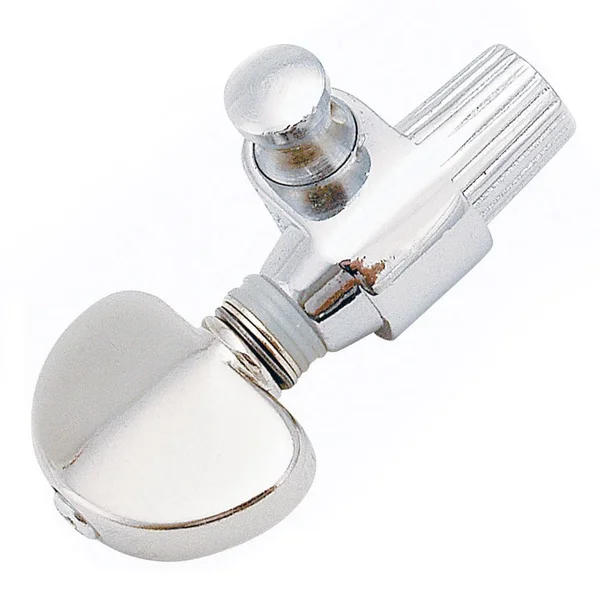 |
Grover 162C Geared 5th-String Banjo Peg – $15 If your hand-cut friction pegs won’t hold tension while you’re stringing up a first build, a geared 5th-string peg like this drops in and holds pitch reliably.
|
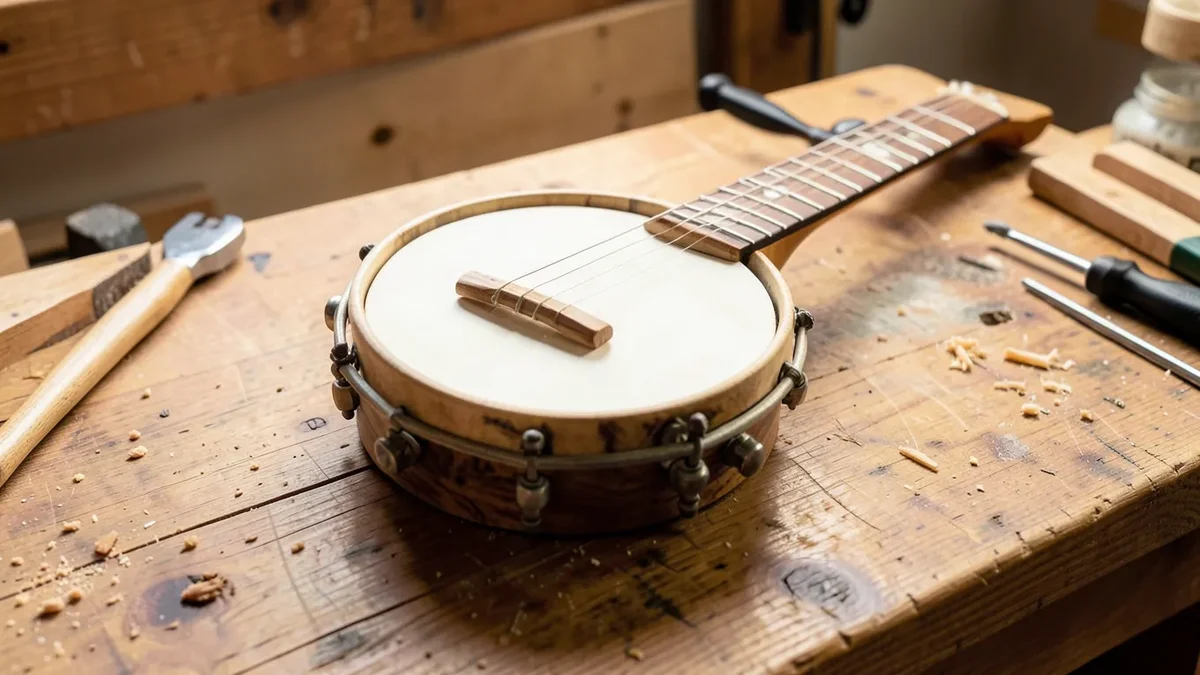
A banjo is really a small drum with a neck bolted to the side of it, which is why building one draws on both woodworking and basic percussion-instrument construction. The rim (the “pot”) has to be round, rigid, and heavy enough to sustain vibration; the neck has to stay straight under roughly 60-80 lbs of string tension; and the head has to seat evenly around the whole circumference or the banjo will buzz on one side. None of that requires exotic tools — a bandsaw or coping saw, a drill, clamps, and basic fretting tools will get you through a full build.
Core tools and materials:
| Tools | Materials |
|---|---|
| Bandsaw or coping saw | 3-ply maple (rim) or a solid maple/mahogany neck blank |
| Drill press | Synthetic (mylar) banjo head, 10-12 mil |
| Fret saw + miter box or fretting jig | Fret wire, tension hoop, bracket hooks |
| Clamps (band clamp for the rim) | Wood glue, strings, tuning pegs |
| Sandpaper, 120 to 320 grit | Finish (wipe-on poly or lacquer) |
Choosing Wood And Planning The Rim
Maple is the standard rim wood on the vast majority of production banjos because it’s stiff and dense enough to sustain vibration without absorbing it, which is exactly what a drum shell needs. Most factory rims are built from three-ply steam-bent maple laminate rather than a single solid ring — the plies fight each other’s tendency to warp and let the wood bend around an 11-inch form without cracking. A solid carved rim is possible on a first build, but it’s heavier, more prone to splitting along the grain, and much harder to get perfectly round by hand.
For the neck, weight matters as much as tone — a banjo already sits unevenly against the body compared to a guitar, so a heavy mahogany or walnut neck can make the whole instrument feel neck-heavy in your hands. Straight-grained maple keeps the neck light and resists warping under tension; mahogany trades some stiffness for a warmer overall tone. Whatever you choose, the neck blank needs to be free of knots and runout — any grain that isn’t running straight down the length of the neck is a future crack.
| Wood Type | Best Used For | Why |
|---|---|---|
| Maple | Rim and neck | Stiff, dense, resists warping; the bluegrass-standard tone |
| Mahogany | Neck | Warmer, slightly darker tone; lighter than it looks |
| Walnut | Neck or rim accents | Attractive grain; heavier, adds sustain but also weight |
Standard 5-string rims run about 11 inches in diameter, and the scale length — the distance from the nut to the bridge — lands around 26 inches on most bluegrass-style banjos. Those two numbers aren’t arbitrary: they’re what modern mylar heads, bridges, and fret templates are sized for, so straying far from them means you can’t just buy standard replacement parts later.
The Tone Ring Most Tutorials Skip
Here’s the part that separates a banjo that sounds like a banjo from one that sounds like a tambourine: the tone ring. It’s a ring of metal — usually bronze, brass, or a cast bell-metal alloy — that sits on top of the wood rim, under the head. The head’s edge presses down onto the tone ring instead of directly onto wood, and that metal-to-skin contact is what produces the sharp, ringing “twang” people associate with bluegrass banjo. Skip the tone ring and mount the head straight onto the wood rim instead, and you get an “open-back” or old-time banjo — quieter, warmer, and arguably easier to build well as a first project, since a wood-to-head fit is far more forgiving than machining a metal ring to sit perfectly flat. If your goal is a mellow front-porch sound rather than a stage instrument, building open-back and skipping the tone ring entirely is a completely legitimate choice, not a shortcut.
Preparing The Wood
Cut the rim blank to rough size first and leave it slightly oversized until after the plies are glued and clamped — trying to hit the final 11-inch diameter before the glue-up is a good way to end up with an oval instead of a circle. A band clamp (the same kind used for round table tops) applies even pressure around the whole circumference, which a series of small clamps can’t reliably do. Let the glue cure fully — typically 24 hours — before trimming to final size on a router with a circle-cutting jig, or a lathe if you have one big enough.
Sand the rim’s top edge dead flat and square to the sides; this is the surface the head will seat against, and any high or low spot here becomes a permanent buzz once the head is tensioned. Work through progressively finer grits — 120 to knock down mill marks, then 220, then 320 — and check flatness with a straightedge laid across the rim in several directions, not just one pass. Pay the same attention to every curve on the neck heel, since that’s the joint that has to carry the entire string load.
Cutting The Neck And Fretting The Fingerboard
Rough out the neck profile on the bandsaw, leaving the heel (the block that joins the neck to the rim) oversized until you’ve test-fit it against the actual rim you built — every rim comes out fractionally different, and cutting the heel to a “standard” dimension before test-fitting is one of the most common reasons first banjos end up with a gap at the neck joint. A traditional dowel-stick rod running through the rim into the heel block is the simplest way to join neck and pot without any metalworking, and it’s also adjustable: loosening the dowel-stick nut lets you reset the neck angle if the head’s tension changes the geometry later.
Fret spacing isn’t a straight ruler measurement — each fret sits closer to the next as you move up the neck, following a fixed ratio (each fret is roughly 5.6% closer to the bridge than the one before it). Don’t eyeball this; use a printed fret-spacing template sized to your exact scale length, tape it to the fingerboard, and mark through it with an awl before cutting. Cut the fret slots with a saw whose kerf matches your fret wire’s tang thickness — too wide and the frets will rattle loose later; too narrow and the fingerboard will crack when you press the wire in. Most 5-string banjo necks carry 22 frets, with the fifth string’s own short peg mounted at the fifth fret.
Assembling The Pot: Head, Tension Hoop, And Hardware
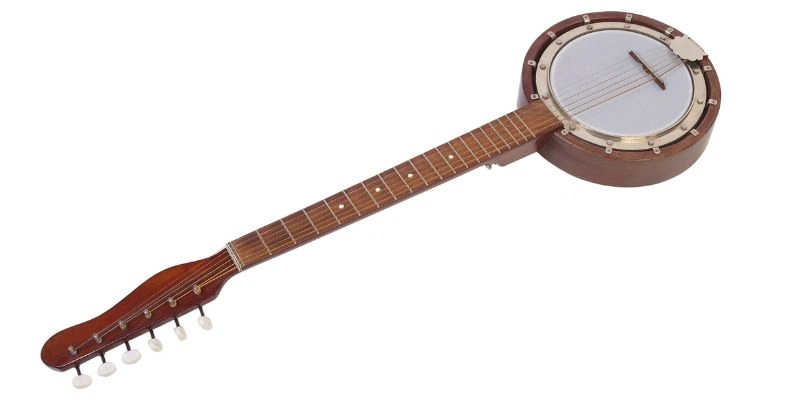
Modern builds almost universally use a synthetic mylar head rather than the tacked rawhide or goatskin used on 19th-century banjos — mylar doesn’t stretch or go slack with humidity changes the way skin does, and it’s far more forgiving for a first build. Center the head over the rim (and tone ring, if you’re using one), drop the tension hoop over the top, and thread the bracket hooks through evenly-spaced holes drilled around the rim’s flange. Production banjos typically use 24 hooks; a simpler DIY pot can get away with 16-18 as long as they’re evenly spaced, since uneven spacing is what causes an out-of-round head and a dead spot in the tone.
| Hardware | Purpose |
|---|---|
| Tension hoop | Clamps the head’s edge down evenly around the rim |
| Bracket hooks + nuts | Pull the tension hoop down; tightened in a star pattern, never one at a time in order |
| Tailpiece | Anchors the strings at the bottom of the pot |
| Coordinator rod / dowel stick | Joins neck to rim and sets neck angle |
Tighten the bracket hooks in a star pattern — like lug nuts on a wheel — rather than working around the rim in order, giving each hook a quarter turn per pass. Tightening sequentially lets the head go on lopsided, and you won’t notice until you’re stringing up and the bridge sits crooked.
Final Assembly And Stringing
Join the neck to the pot using the dowel stick or coordinator rods, and don’t fully tighten the joint until you’ve dry-fit the whole instrument with strings on — you need to be able to sight down the neck and confirm it’s not twisted relative to the head before committing with glue or a permanent bolt. Set the bridge on the head roughly centered between the fourth fret and the tailpiece (exact placement gets fine-tuned by ear and with a tuner once strings are on), and attach the tailpiece to the tension hoop or rim, depending on your hardware style.
String up in standard open G tuning: the short 5th string (the thumb string, starting at the fifth fret) tunes to a high G, the 4th string to D, the 3rd string to G, the 2nd string to B, and the 1st string to D. That’s the tuning nearly all bluegrass and clawhammer playing is built around, and it’s worth double-checking against a tuner rather than by ear on a brand-new build — a string tuned a whole step off (a common mix-up is tuning the 4th string to C instead of D) will feel and sound wrong even though every physical part of the build was done correctly.
Finishing Touches
Finish the neck and rim before final assembly if you can — it’s much easier to get an even coat into every curve when the parts aren’t attached to a fully strung instrument. A wipe-on polyurethane or a sprayed lacquer both work well; lacquer dries harder and thinner, which some builders prefer for how little it dampens the wood’s vibration, while wipe-on poly is far more forgiving for a first-time finisher. Sand lightly between coats with 320-grit or finer, and apply at least two to three coats, letting each cure fully rather than rushing the schedule.
Once the finish has cured and everything is reassembled, stretch the strings by hand and retune repeatedly over the first few days — new strings and a freshly-tensioned head both settle in, and a banjo that’s perfectly in tune on day one is often noticeably flat by day three simply from that settling process.
Playing And Maintenance
Keep the head’s tension consistent by checking it seasonally — humidity swings tighten or loosen a natural-fiber rim slightly, which changes head tension even if you never touch the bracket hooks. Wipe the head and strings down after playing to keep skin oils from dulling the tone, store the banjo away from direct sun and heat vents, and plan to replace strings every few months of regular playing since old strings lose brightness well before they visibly wear out. Check the bridge position periodically too — it can walk out of place from string tension alone, especially in the first few weeks after a rebuild.
Frequently Asked Questions
How Do I Start Building A Wooden Banjo?
Start with the rim: laminate three plies of maple around an 11-inch form, or buy a pre-cut rim kit if you don’t have a way to bend wood to that radius. Everything else — the neck, head, and hardware — gets fit to that rim’s actual finished dimensions rather than to a spec sheet, since even a careful glue-up comes out fractionally different every time.
What Type Of Wood Is Best For A Banjo?
Maple is standard for both the rim and neck because it’s stiff and dense enough to sustain vibration rather than absorb it. Mahogany is a common neck alternative for a warmer tone, and walnut works well for a neck or decorative rim accents, though it adds weight.
Should I Build From Scratch Or Start With A Kit?
A from-scratch build gives you full control over rim diameter, wood choice, and whether you add a tone ring, but it demands a way to steam-bend or laminate the rim accurately. A pre-cut rim/neck kit skips that hardest single step and still leaves the fretting, finishing, and assembly work — a reasonable middle ground if you don’t have rim-bending tooling but still want a genuinely hand-built instrument.
Can I Build A Banjo Without Experience?
Yes, though an open-back build without a metal tone ring is the more forgiving first project — fitting a tone ring flat against the rim adds a machining step that punishes small errors. Take the neck-to-rim joint slowly and dry-fit everything with strings on before you commit to glue.
What Tools Do I Need To Build A Banjo?
A bandsaw or coping saw, drill, a fret saw with a miter box or fretting jig, a band clamp for the rim glue-up, and basic sanding and finishing supplies. A tuning peg reamer and a fret-spacing template sized to your scale length are worth having too — both are inexpensive and prevent two of the most common first-build mistakes.
Conclusion
Building a wooden banjo from scratch is a genuinely achievable weekend-and-evenings project once you treat it as four separate sub-assemblies rather than one intimidating instrument. Get the rim round and flat, cut the neck to a scale length that matches standard parts, tension the head evenly in a star pattern, and tune it correctly in open G — gDGBD, not gCGBD — and you’ll end up with an instrument that sounds like it came from a shop, not a first attempt.
Sponsored / affiliate links. As an Amazon Associate I earn from qualifying purchases. I may earn additional commission from eligible campaigns.