How to Cut a Half Circle in Wood: 5 Methods + Hole Saw Trick
To cut a half circle in wood, set a compass to half the finished width with its point exactly on the board edge, then cut the arc with a jigsaw, band saw or router. If the point sits even 1/4 inch off the edge, the arc meets the edge at a corner instead of leaving cleanly. This guide covers five methods, a hole-saw trick for matching halves, and clean edge finishing.
Which Method Should You Use to Cut a Half Circle in Wood?
Best Half-Round Notch Pick | |
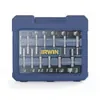 |
IRWIN Marples Forstner Bit Set, 14 Pieces A carbon-steel Forstner set that drills flat-bottomed holes, so one bit can bore a clean half-round notch along a board edge or seam.
|
As an Amazon Associate we earn from qualifying purchases. | |
The right tool depends on how many half circles you need and how big they are. For one notch, a jigsaw is enough. For a matched pair or a repeat job, a Forstner bit, hole saw or router template beats marking and cutting each arc by hand. For a general look at full circles, see our guide to the best way to cut a circle in wood.
| Method | Best for | Edge finish | Watch out for |
|---|---|---|---|
| Jigsaw | One-off cuts at any size | Rough, needs sanding | Blade wander in thick stock |
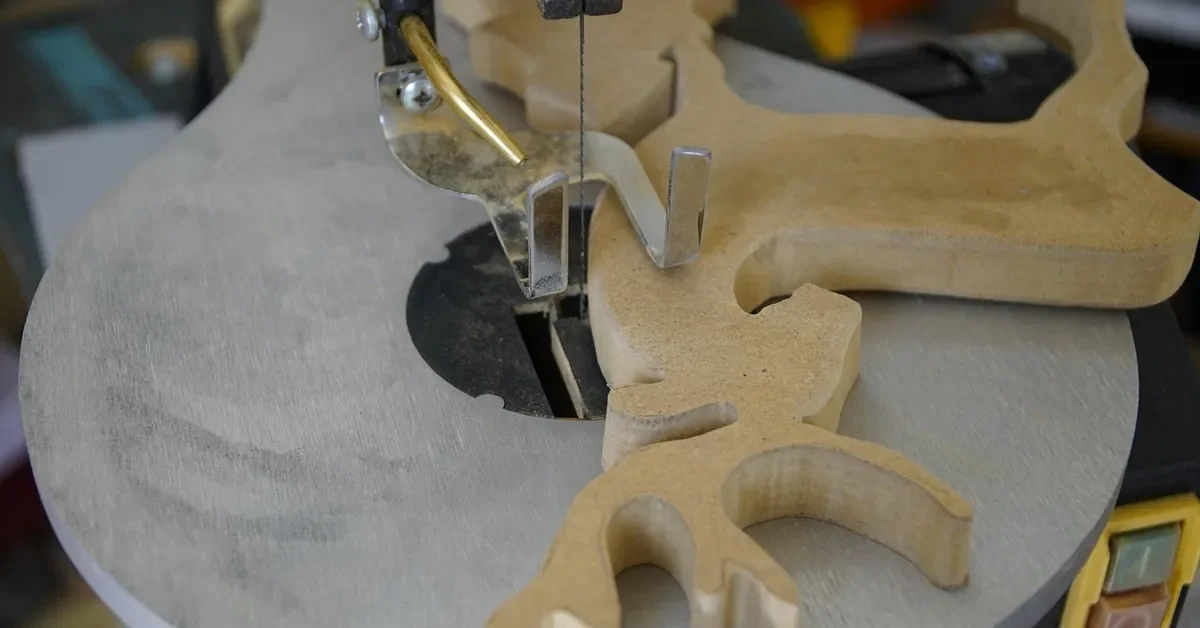
| Band saw | Thick hardwood, smooth curves | Light sanding only | Blade too wide for a tight radius |
| Scroll saw | Small radii, thin stock | Very smooth | Slow in thick boards |
| Forstner bit or hole saw | Matching half-holes and half-discs | Clean, no marking needed | Limited to the bit sizes you own |
| Router and template | Repeating the same arc, table-top ends | Best of the five | Needs a template and shallow passes |
This page focuses on the half-round notch or cutout on a board edge or end. It covers both half-round notches and half discs, which is what most woodworkers mean when they search for how to cut a semicircle in wood.
How Do You Mark a Half Circle on Wood?
A half circle is a full circle cut along its diameter, so the straight edge of your board is the diameter line. Measure the finished width, divide by two, and set your compass to that radius. A 12-inch-wide notch, for example, needs a 6-inch radius.
- Find the center: mark the midpoint of the width on the board edge or end.
- Set the radius: set the compass, trammel or string-and-pencil to half the width.
- Place the point on the edge line: the compass point must sit exactly on the edge, not just inside it.
- Draw the arc: sweep it through the board so it lands on both edge marks.
- Check with a paper template: cut the arc in cardboard first and hold it against the edge to confirm the fit.
That third step is where most bad half circles start. With the point inside the board, the arc is less than 180 degrees and hits the edge at an angle, leaving a pointed corner you then have to sand away.
How Do You Cut a Half Circle with a Jigsaw?
A jigsaw handles any radius and is the tool most home shops already own. Use a fine-tooth, narrow blade for curves and cut on the waste side of the line, leaving about 1/16 inch for sanding.
- Clamp the board: hold it so the arc hangs past the bench edge, with nothing under the blade path.
- Tape the line: apply painter’s tape along the cut to reduce surface tear-out on plywood and veneered boards.
- Start on the straight edge: begin at one end of the arc and let the blade reach full speed before it touches the wood.
- Use relief cuts on tight radii: make short straight cuts into the waste so the blade does not bind.
- Let the saw do the work: pushing hard bends the blade and leaves a bevelled, out-of-square edge.
Kreg’s video below shows the basic technique for cutting curves with a jigsaw.
For a deeper look at picking a saw, see our roundup of woodworking jigsaws, or the best scroll saws if you cut small, thin pieces.
How Do You Cut Perfect Half Circles with a Hole Saw or Forstner Bit?
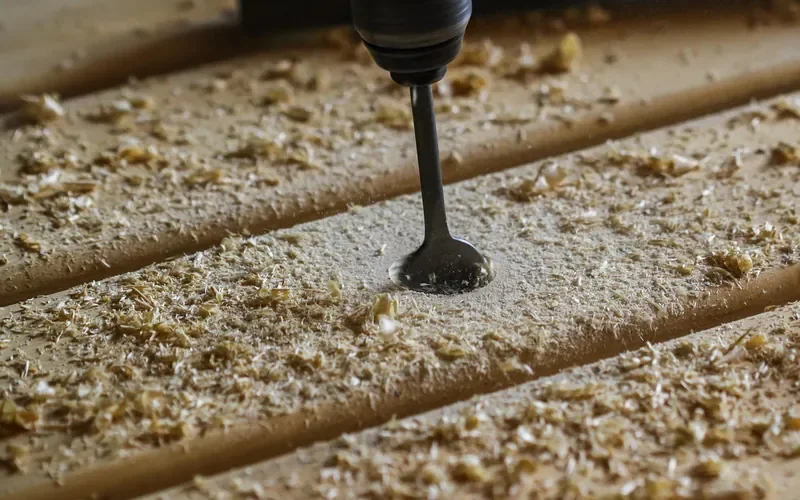
This is the trick most guides skip. Instead of marking and cutting a half circle, drill a full circle centered on the seam between two boards, and both boards get an identical half-round notch. It works because the drill bit, not your hand, sets the radius.
Matching half-round notches
- Butt two boards together: line up the two boards edge to edge, or use one blank twice the length and cut it in half afterward.
- Clamp tightly: clamp both pieces to a scrap base so no gap opens at the seam.
- Center the bit on the seam: a Forstner bit’s short center point holds a seam better than a hole saw’s long pilot bit.
- Drill slowly: use a drill press at low speed, and back the exit side with scrap to prevent blowout.
Matching half discs
The plug a hole saw removes is a full disc. Cut it across its diameter on a band saw with the disc clamped so it cannot rotate, and you have two identical half discs for inlays, shelf brackets or decorative trim. Never feed a loose round disc into a table saw, because it can spin against the blade.
How Do You Cut a Half Circle on the End of a Table Top or Board?
For a wider arc, such as a rounded table end, make a template and use a router. Draw the half circle on 1/4-inch MDF or hardboard, cut it slightly outside the line and sand it to the line, then use it to guide the cut. The same approach works for arched tops; our arch-making guide covers larger curved pieces.
- Rough out the arc: jigsaw 1/16 to 1/8 inch outside your line.
- Fasten the template: clamp or double-stick it to the workpiece.
- Trim with a flush-trim bit: keep the bearing against the template and take shallow passes.
- Finish with a light pass: the curve crosses from long grain into end grain, so the final pass should be the lightest to avoid tear-out.
How Do You Sand and Finish the Curve?
A curve passes from long grain to end grain, and end grain burns and chips more easily, so sand it with care. Start at 80 grit to remove saw marks, move to 120, then finish at 180 or 220. Wrapping sandpaper around a dowel or a scrap of the same radius keeps the arc even; a flat block flattens it.
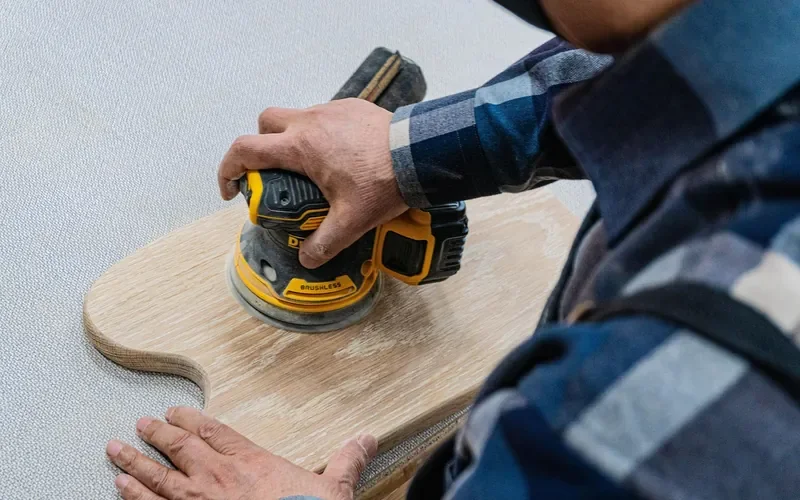
Before finishing, wipe the dust off and seal the end grain, which soaks up stain faster than the rest of the board. If you also need to smooth a round shape, our guide to sanding a circle in wood covers the technique in more detail.
What Are the Most Common Mistakes When Cutting a Half Circle?
- Placing the compass point inside the board edge, so the arc is less than a true half circle.
- Cutting on the line instead of on the waste side, which leaves no material for sanding.
- Forcing a wide blade through a tight radius, so the blade binds and burns the wood.
- Skipping the clamp, which lets thin stock chatter and creates rough, wavy cuts.
- Drilling a hole saw at full speed without backing scrap, which blows out the exit side.
Wear eye and ear protection with every method here, and think about dust, especially when routing or sanding MDF and plywood; see what to do if you inhale sawdust. For hand-tool options, read how to cut a circle in wood without power tools, or how to cut a circle in plywood.
Frequently Asked Questions
How do you cut a half circle in wood without a jigsaw?
Use a hole saw or Forstner bit to drill a full circle centered on a seam between two clamped boards, which leaves a matching half-round notch in each. A band saw, scroll saw or coping saw also follow the marked arc, and a router with a flush-trim bit and template gives the cleanest edge.
Can you cut a half circle with a hole saw?
Yes, if you center the hole saw on the edge or seam so half of it bites into scrap. A hole saw makes a full circle, so clamp a scrap board tight against the workpiece to support the other half. Work slowly at low speed, ideally on a drill press, because the saw can grab and twist.
How do you cut a half circle on the end of a table top?
Mark the arc with a compass or trammel set to half the finished width, rough-cut 1/16 to 1/8 inch outside the line with a jigsaw, then flush-trim with a router and a template. Sand from 80 up to 180 or 220 grit, and go lightest where the curve turns into end grain.
How do you cut a round disc exactly in half?
Cut it on a band saw with the disc clamped so it cannot rotate, or follow a marked diameter with a jigsaw. Avoid ripping a loose disc across a table saw, because a round workpiece can spin against the blade and kick back. A sacrificial fence and clamps keep it still.
What is the best saw for cutting a half circle in wood?
A band saw gives the smoothest result on thick boards, and a jigsaw is the most practical single tool for a home shop. A scroll saw suits small, thin pieces. Match blade width to the radius: tighter curves need a narrower blade, and finer teeth leave less tear-out.
Conclusion
Pick the method by job size: a jigsaw for one-offs, a Forstner bit or hole saw for matching pairs, and a router template for repeat arcs or table ends. Get the compass point onto the edge line, cut on the waste side, and finish with graded sanding for a clean half circle.
Sponsored / affiliate links. As an Amazon Associate I earn from qualifying purchases. I may earn additional commission from eligible campaigns.