Cutting Board Oil Types Chart: Mineral Oil vs Beeswax vs Tung Oil
Mineral oil is the safest default for most wood cutting boards, beeswax is for owners who want better water resistance, and tung oil belongs on fully cured boards that you can maintain on schedule. Pick the wrong finish and you get blotchy soak-in, sticky residue, or a coating that fails inside the wood. This chart matches finish choice to board type, upkeep tolerance, and failure risk.
Cutting board finish chart
| Finish type | Food-safety status | Rancidity risk | Water resistance | Cure time | Reapplication cadence | Best use case | Common failure mode |
|---|---|---|---|---|---|---|---|
| Mineral oil | USP-grade or food-grade; used for direct food contact | None; it is non-rancid | Low to moderate | Does not cure | Frequent; straight mineral oil may need reapplication every 1-2 weeks with heavy use | Daily-use home boards and boards you want to keep simple | Dry patches, fast absorption, water no longer beads |
| Beeswax | Commonly used as a blend with mineral oil | Depends on the oil in the blend | Better than oil alone | Beeswax is generally not described as curing like a drying oil. | Often 4-6 weeks for a board balm; plain wax alone is not a long-term plan | Serving boards, light-use boards, and owners who want a softer sheen | Surface buildup, waxy drag, uneven water spotting if applied too thickly |
| Tung oil | Food-safe once fully cured | Low once cured | High after cure | 15-30 days to fully cure | Infrequent after cure, but the first finish cycle takes patience | Premium boards where you can wait for cure time and follow the label exactly | Premature use, soft finish, or buying a mislabeled “tung oil finish” |
Why the table points to different winners
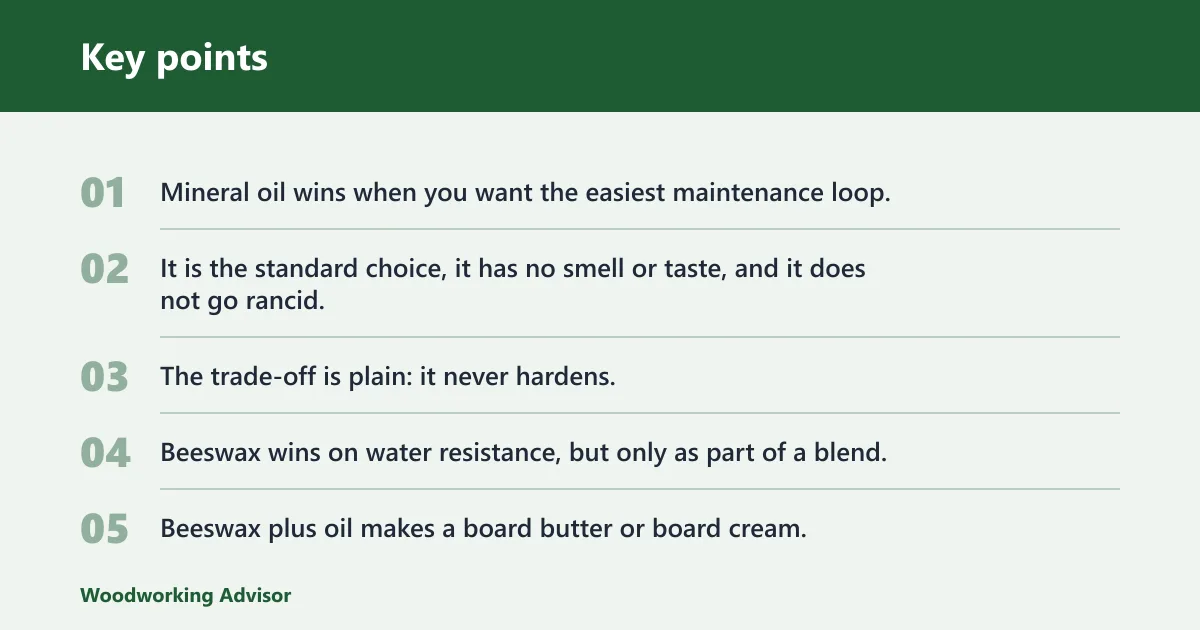
Mineral oil wins when you want the easiest maintenance loop. It is the standard choice, it has no smell or taste, and it does not go rancid. The trade-off is plain: it never hardens, so the wood stays more open to drying and needs repeat treatment.
Beeswax wins on water resistance, but only as part of a blend. Beeswax plus oil makes a board butter or board cream, and that wax layer gives the board better surface protection than oil alone. It is a maintenance upgrade, not a seal. Plain wax by itself does not stop absorbency for long.
Tung oil wins only when you want a cured finish and you can wait for it. Pure tung oil is a drying oil, and it can take 15-30 days to fully cure. That cure time matters because the food-safe claim applies after curing, not during a half-finished coat. Hardware-store “tung oil finish” is usually not real tung oil.
Which finish fits your board?
The right finish depends on board type and how often you use it. Daily prep boards need the simplest upkeep. Serving boards care more about appearance and splash resistance. Premium end-grain boards can justify a more involved finish if you will follow cure and maintenance rules closely.
Daily-use home boards
Choose mineral oil if the board stays on the counter, gets washed often, and sees knives every day. It is the lowest-risk routine because you can reapply it often without waiting for a cure. If you want a little more water resistance, a board balm made from mineral oil and beeswax is the better step up.
Serving boards
Choose beeswax in a board balm or cream when the board is used for bread, cheese, or presentation and you want water to bead longer. The finish does not need to be hard like a film finish, but it does need to resist drink rings and damp fruit better than plain oil can.
Premium end-grain boards
Choose pure tung oil only if you want a cured finish and can live with the slow process. End-grain boards absorb heavily, so a drying oil that cures hard can be a strong match. The catch is discipline: use the real product, follow the cure time, and do not rush it back into service.
Mineral oil vs beeswax vs tung oil
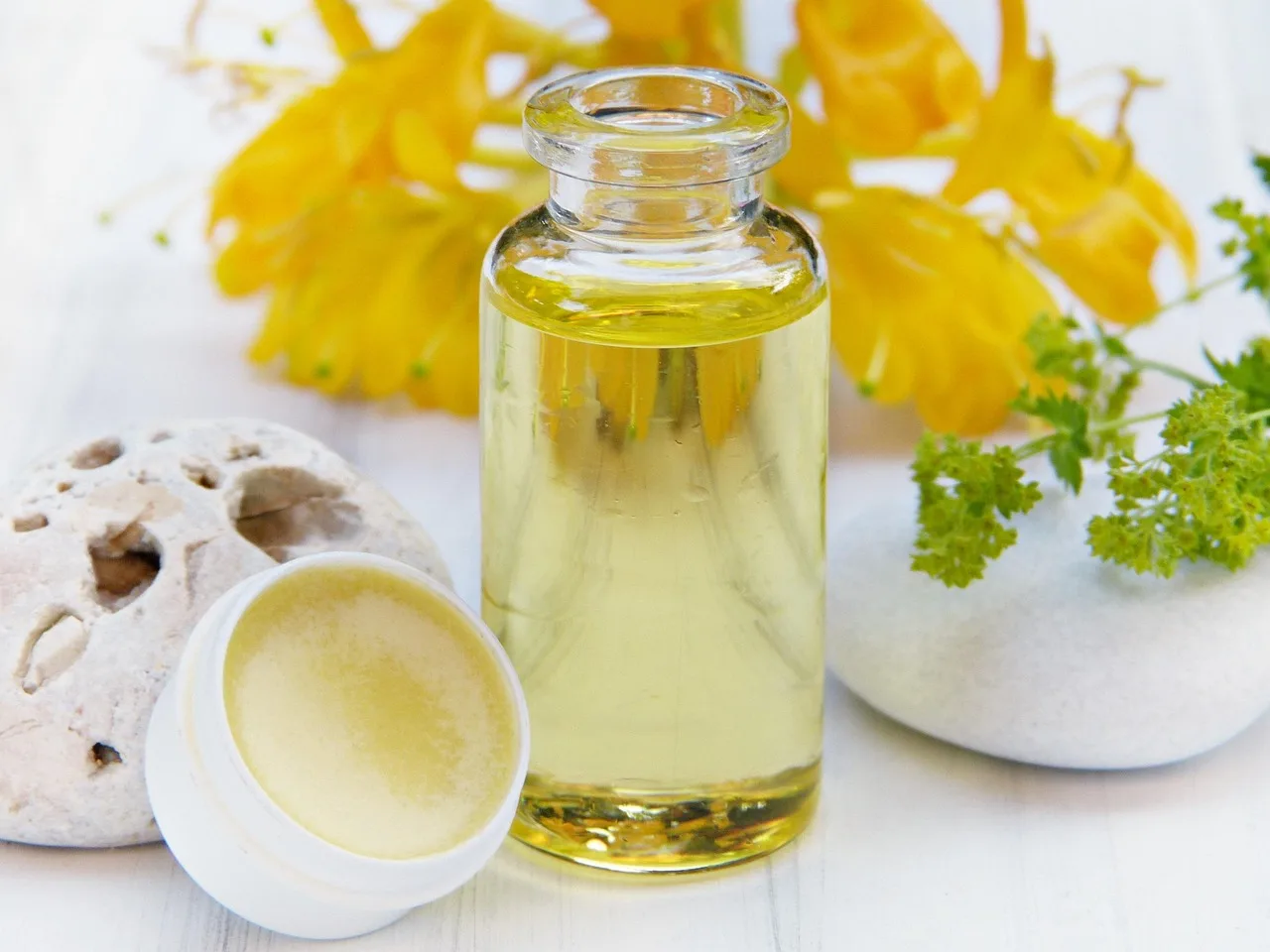
The core trade-off is ease, barrier strength, and cure time. Mineral oil is easiest to maintain but least durable. Beeswax improves water resistance and feel, especially in a blend. Tung oil gives the hardest finish of the three, but it is the slowest and least forgiving during application.
Food-grade mineral oil
Food-grade mineral oil is labeled as USP-grade or food-grade and used in cutting board care and direct food-contact settings. It is non-rancid, odorless, and tasteless. That is why it remains the baseline for most boards. The downside is maintenance: heavy use can call for reapplication every 1-2 weeks, and many finish guides repeat a 2-4 week cycle.
Beeswax and board balm
Beeswax works as a surface barrier, not a deep penetrant. It is usually blended with mineral oil to make board butter or board cream, and that blend gives more water resistance than oil alone. Board balm is the premium maintenance option here, with some products lasting 4 to 6 weeks per application. Plain wax is not the full answer.
Pure tung oil
Pure tung oil is a drying oil, which means it cures into a hard finish rather than staying oily on the surface. That makes it different from mineral oil and different from wax. The catch is cure time: 15-30 days is a long wait, and some people also avoid it if nut allergy concerns matter in the household. Many products sold as “tung oil finish” are not pure tung oil at all.
- Clean and dry the board fully.
- Apply the chosen finish in a thin, even coat.
- Let the board sit until the surface no longer looks dry.
- Wipe off all excess before storage or use.
- Reapply when water stops beading or the wood looks thirsty.
What lasts longest?
Tung oil lasts longest once it has fully cured, because it becomes a hard finish rather than a periodic treatment. For routine upkeep, a board balm can outlast plain mineral oil on the surface. Mineral oil is still the fastest to renew, but it also disappears from service sooner under daily washing and chopping.
Water beading and wear
Water beading is the quick check. If droplets sit on the surface, the finish is still doing its job. If water spreads immediately, the board needs attention. Beeswax blends usually hold beading longer than plain mineral oil, while a cured tung oil finish can hold up longer than both, provided the board was finished correctly.
Say your 12-inch edge-grain board starts darkening unevenly near the sink edge after a month of dinner prep. That usually means the finish is wearing off fastest where water lands most often. The fix is not a thicker coat; it is cleaning, drying, and reapplying before the wood starts to feel rough or look chalky.
What shortens service life
Frequent soaking, hot dishwater, and poor drying shorten every finish’s life. Sticky buildup also causes trouble, especially with wax blends that are applied too heavily. The finish should soak in or sit as a thin barrier; if it gums up, the next application traps residue instead of protecting the wood.
Can you use cooking oils?
Cooking oils are a bad long-term choice for cutting boards. Olive oil, coconut oil, vegetable oil, and canola oil can all leave behind residue that turns stale or rancid over time. They may look fine at first, but they do not give the stable, maintenance-friendly result that food-grade mineral oil or a proper wax blend does.
Olive oil and canola oil
Olive oil on a cutting board can develop off-smells within 1-3 months. Canola oil and other vegetable oils have the same basic problem: they are meant for the pan, not for a porous wood surface that sits in warm air between uses. Once the smell starts, the fix is usually to clean deeper and start over with a proper finish.
Coconut oil
Coconut oil is often suggested because it smells pleasant, but it still behaves like a cooking oil on wood. It can smear, collect dust, and leave a greasy feel. That makes it a poor replacement for mineral oil, even if the board is used mostly for serving.
A common first-timer mistake is wiping a board with leftover kitchen oil because it is already in the cabinet. The board may look refreshed for a week, then start smelling sour or musty. At that point, the finish problem has become a cleaning problem too.
Why rancidity matters
Rancid oil changes both smell and performance. Once oil breaks down, the board can hold onto an off odor and feel uneven under the hand. That is why the chart excludes cooking oils even though they may seem convenient. The short-term savings are not worth the odor and cleanup.
Choose mineral oil if…
Choose mineral oil if you want the simplest routine, the lowest risk of rancid odor, and a finish you can refresh often without waiting for cure time. It is the safest default for daily-use home boards, especially edge-grain boards that see frequent washing and drying.
Choose beeswax if…
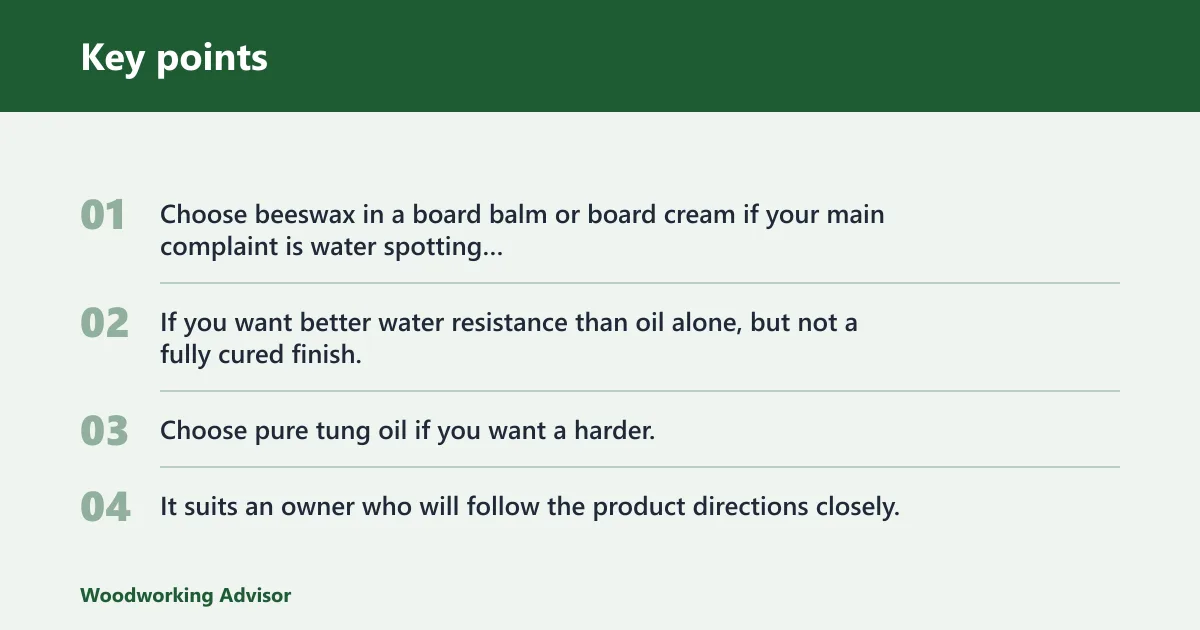
Choose beeswax in a board balm or board cream if your main complaint is water spotting and you want a softer sheen on a serving board. It works best as a blend with mineral oil. If you want better water resistance than oil alone, but not a fully cured finish, this is the practical middle ground.
Choose tung oil if…
Choose pure tung oil if you want a harder, cured finish on a premium board and you can wait 15-30 days for full cure. It suits an owner who will follow the product directions closely, avoid mislabeled “tung oil finish” products, and accept a slower first finish cycle in exchange for a tougher surface.


Frequently asked questions
What is the best oil for a cutting board?
Mineral oil is the best default for most wood cutting boards because it is food-grade, non-rancid, and easy to renew. If you want more water resistance, move to a mineral-oil-and-beeswax board balm. Use pure tung oil only when you can wait for full cure and want a harder finish.
Is mineral oil better than beeswax for cutting boards?
Mineral oil is better if your priority is simple, frequent maintenance. Beeswax is better when you want more surface water resistance and a slight sheen, but it usually works best as a blend with oil. In practice, oil is the base and wax is the upgrade, not the other way around.
Can you use tung oil on a cutting board?
Yes, but only if it is pure tung oil and fully cured before use. Pure tung oil can take 15-30 days to cure, and hardware-store “tung oil finish” is often a different product altogether. Use it for premium boards when you can wait and follow the label exactly.
How often should I reapply cutting board oil?
A monthly upkeep schedule is a good baseline, and new boards often need weekly attention during the first month. Reapply when water stops beading or the wood looks dry. Straight mineral oil may need reapplication every 1-2 weeks with heavy use, while board balm can last longer.
What is the difference between board balm and mineral oil?
Mineral oil is a simple penetrant. Board balm is a blend of mineral oil and beeswax, so it leaves a longer-lasting water barrier and a slightly waxier feel. If you want less frequent maintenance and a better surface barrier, board balm is the premium version of the same basic idea.
How do I know if a cutting board finish has gone rancid?
Look for a sour, stale, or greasy smell that does not wash out, especially after the board has been warm or damp. The surface may also feel sticky or uneven. Cooking oils are the usual culprit. If the odor keeps returning, strip the board back and restart with a food-grade finish.
Sponsored / affiliate links. As an Amazon Associate I earn from qualifying purchases. I may earn additional commission from eligible campaigns.
 2 Pieces Wood Cutting Board Oil Applicator with Lid, Wood Conditioner Wax Applicator Brush, No Mess Cutting Board Oiling Tool for Butcher Blocks Spatulas Spoons Wooden Utensil (Beige)
 Cutting Board Oil Wax Applicator with Lid, for Food Grade Mineral Oil Board, Natural Bamboo Applicator for Cutting Boards, Wooden Spatula, Spoon and Other Utensils