How to Cut a Hexagon Out of Wood: No-Math Layout + Miter Angle
A regular hexagon’s side length always equals its radius, so you can lay one out with just a compass — no protractor math required — then cut it with a jigsaw, band saw, or table saw. Get the layout wrong by even a degree and the piece won’t sit flat or the six sides won’t match, which shows immediately on a coaster, shelf, or tabletop. This guide covers both accurate marking methods, three cutting options, turning a square post into a hexagon, and the correct miter angle for hexagon joints.
Quick Answer
Set a compass to your target side length, draw a circle, and walk that same width around the circumference six times — the six marks give you a perfect hexagon with no math. Cut just outside the line with a jigsaw or band saw, then sand to the line. If you’re cutting individual boards to miter into a hexagon frame or ring (not a solid panel), each board end needs a 30° miter, not the outline method above.
What You’ll Need to Cut a Hexagon Out of Wood
Stick with a hardwood — oak, maple, cherry, or walnut — for a panel you’ll sand and finish; hardwoods hold a crisp corner instead of splintering along the grain the way pine or cedar can on the sharp points of a hexagon. For a rough-service piece like a garden stake or jig template, cheaper softwood or plywood is fine.
- Compass or trammel points: for the no-math layout method
- Protractor or speed square: for the 120-degree layout method
- Jigsaw, band saw, or table saw: pick based on the section below
- Clamps: to hold the workpiece still while you cut
- Sandpaper, 80 through 220 grit: to true up the cut edges
Best Angle-Marking Tool Pick
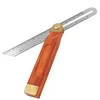 |
Bonsicoky 9-Inch T-Bevel Angle Finder Sliding Gauge – $8.99 Transfers and locks an angle from a protractor or a miter saw’s scale directly onto your workpiece, which is exactly what the 120-degree layout method and the 30-degree miter setting below both need.
|
How to Mark a Hexagon on Wood (2 Accurate Methods)
A regular hexagon is a six-sided shape where every side is the same length and every interior angle is exactly 120 degrees. That fixed 120-degree angle is what makes the compass shortcut below work, and it’s also the number your protractor needs to hit at every corner if you use the second method.
Method 1: The No-Math Compass Trick
For any regular hexagon, the length of one side is always identical to the distance from the center to a corner. That means you never have to calculate an angle to lay one out — you only need a compass.
- Set the compass: Open it to exactly your target side length, then mark the center point on the wood and draw a full circle at that radius.
- Step off six points: Without changing the compass width, place the point on the circle anywhere and swing an arc that crosses the circle; move the compass point to that new mark and repeat five more times, walking it around the circumference.
- Connect the points: Join the six marks with a straightedge to complete the hexagon outline.
- Cut just outside the line: Rough-cut with a jigsaw, band saw, or table saw, leaving the pencil line visible.
- Sand to the line: True up each edge with sandpaper or a router until the pencil line disappears.
Method 2: The Protractor Layout
If you’d rather work from a straight starting edge than a center point, draw one line the length of your target side, then use a protractor (or the angle gauge above) to mark a 120-degree angle at each end. Draw the next side from that angle, mark another 120-degree angle at its far end, and repeat until all six sides are drawn and the shape closes back on itself.
Whichever method you use, decide your dimension in one of two ways before you start: side length (how long each of the six edges is) or width across flats (the distance straight across between two opposite parallel sides — the number that matters if the hexagon has to fit a specific opening). The table below converts between them.
| Side Length | Width Across Flats | Width Across Corners |
|---|---|---|
| 1 inch | 1.732 inches | 2 inches |
| 2 inches | 3.464 inches | 4 inches |
| 3 inches | 5.196 inches | 6 inches |
| 4 inches | 6.928 inches | 8 inches |
Working from a fixed opening or board width instead? Divide the width-across-flats number by 1.732 to get the side length you should set your compass to.
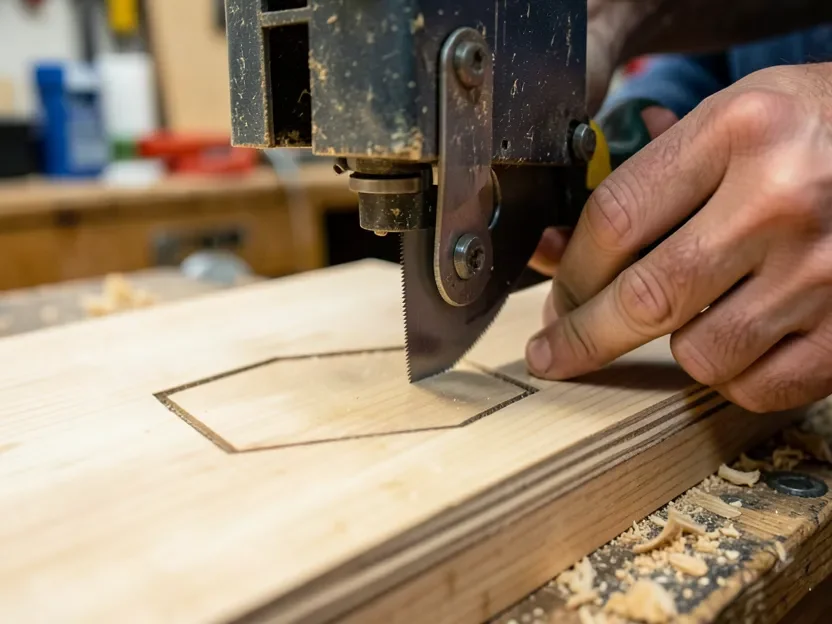
How to Cut a Hexagon Out of Wood (3 Tool Options)
Once the outline is marked, the tool you reach for depends on the wood’s thickness and how many hexagons you need.
Jigsaw
A jigsaw is the easiest option for a single hexagon from thin stock or plywood. Clamp the board down, use a fine-tooth wood blade, and cut just outside the line at a slow, steady feed rate — the six sharp corners are where a jigsaw is most likely to wander if you rush them. See our full jigsaw guide for blade selection by wood thickness.
Band Saw
A band saw’s narrow blade turns the hexagon’s corners more cleanly than a jigsaw and handles thicker stock without wandering off the line. It’s the better choice if you’re cutting several hexagons from the same board.
Table Saw With a Miter Gauge
For dead-straight sides on a larger panel, a table saw works too, but not with a continuous curved cut like the other two tools. Set the miter gauge and make six separate straight passes, rotating the workpiece 60 degrees between each cut so every side lands on its marked line. This method takes more setup but gives the straightest possible edges.
Turning a Square 6×6 Post Into a Hexagon
A different but related job: turning a square 6×6 fence or porch post into a hexagonal cross-section, rather than cutting a flat hexagon panel. Here you’re not tracing an outline — you’re chamfering the four corners of the square post down to create two new faces, for a total of six.
Mark a centered line down each of the post’s four faces, then snap or draw a line from that centerline to a point set back an equal distance on each adjacent face — this is what removes the corner evenly. Set a table saw or circular saw to rip along those four lines at a consistent depth, then check that the resulting six faces read as roughly equal width along the post’s full length before sanding. A post that’s a true regular hexagon in cross-section needs each new chamfer face to end up the same width as the two original faces it’s cut between; a slightly irregular hexagon (wider top/bottom faces, narrower side faces) is common on posts and still looks correct once installed, since the eye reads it from one or two faces at a time.
Cutting Hexagon Rods and Dowels With a Jig
For long, thin hexagonal stock — handle blanks, dowel-style rods, or lathe blanks — a simple V-groove or notched jig clamped to your table saw fence or router table lets you rotate the rod 60 degrees between passes and repeat the same cut down the full length, instead of re-marking every few inches. Build the jig’s groove to hold the rod at a consistent height and rotation stop, make one pass down all four (then six) faces, and the rod comes out as a consistent hexagon along its entire length. This is the same rotate-and-repeat logic as the table saw method above, just scaled down and jig-guided for a long thin workpiece instead of a flat panel.
Setting Your Miter Saw to the Correct Hexagon Angle
📊 Each board end needs a 30-degree miter — half of the hexagon’s 60-degree exterior angle — so two adjoining boards meet at the correct 120-degree interior corner. Source: Hunker, “How to Cut Wood Angles for Hexagons”
This 30-degree setting only applies when you’re mitering the ends of six separate boards to assemble into a hexagon frame, ring, or box — not when you’re cutting a single flat panel with the outline method above. If you’re building a mitered hexagon frame or assembly and want the deeper breakdown of angle math and joint fit, see our dedicated guide to cutting hexagon wood angles.
Sanding and Finishing the Edges
Start with 80 or 100 grit to remove saw marks and any splintering at the corners, then move up through 150, 220, and 320 grit until the edges feel smooth to the touch. On the six points especially, sand with the grain rather than across it — sanding across the grain at a sharp corner is what leaves visible scratch marks that a finish coat won’t hide.
For the edge profile itself, a roundover router bit gives a softer, safer-to-handle edge; a chamfer bit gives a crisper beveled look. Either way, finish with a wipe-on oil, polyurethane, or wood sealant to protect the end grain at the corners, which absorbs moisture faster than the flat faces and is usually the first place a hexagon piece shows wear.
Common Mistakes When Cutting Hexagons
- Changing the compass width mid-layout: even a slight bump throws off all six points — set it once and don’t touch it until the outline is fully marked.
- Rushing the corners with a jigsaw: the blade flexes most at a sharp direction change, which is exactly where a hexagon has six of them — slow down approaching every point.
- Mixing up side length and width-across-flats: use the table above before cutting, not after — the two numbers are about 15% apart and the piece won’t fit its intended spot if you mix them up.
- Sanding across the grain at the points: leaves visible cross-grain scratches that show through stain; always finish sanding with the grain.
Creative Ways to Use Wood Hexagons
Once you’ve got the layout and cutting down, the same process scales to a range of projects: honeycomb-style wall shelves, hexagon coasters and trivets, tabletop inlays, and planter boxes. Our beginner project list has a few more ideas sized for a first attempt.

Frequently Asked Questions
How Do You Cut a Hexagon Out of Wood?
Set a compass to your target side length, draw a circle, and step that same width around the circumference six times to mark the six corners — this works because a regular hexagon’s side length always equals its radius. Connect the points, then cut just outside the line with a jigsaw, band saw, or table saw and sand to the line.
What Angle Do You Cut for a Hexagon?
For a flat hexagon panel cut with the outline method, no angled cuts are needed — the saw stays square. For a mitered hexagon frame or ring built from six separate boards, each board end is cut at a 30-degree miter so two boards meet at the correct 120-degree interior corner.
What Tools Are Needed to Cut a Hexagon Out of Wood?
At minimum, a compass or protractor for marking and a jigsaw, band saw, or table saw for cutting. Clamps to hold the wood steady and sandpaper from 80 through 220 grit for finishing the edges round out the list.
What Type of Wood Is Best for Cutting a Hexagon Shape?
Hardwoods such as oak, maple, cherry, or walnut hold the sharp corners of a hexagon without splintering and take a cleaner finish. Softwoods like pine work fine for a jig, template, or garden-use piece where crisp corners matter less.
Can I Use a Laser Cutter to Cut a Hexagon Out of Wood?
Yes. A laser cutter can trace a hexagon outline directly from a digital file with no manual layout at all, and it produces very clean edges. Confirm the wood species and thickness are rated for your specific laser before cutting, since dense or treated woods can char excessively or exceed the cutter’s power.
Cutting a hexagon out of wood comes down to accurate layout first — a compass alone gets you there without any angle math — and a saw choice that matches your stock thickness and how many pieces you need. Whether you’re cutting a single coaster or chamfering a 6×6 post into a hexagonal profile, the same 120-degree geometry underlies every version of the job.
Sponsored / affiliate links. As an Amazon Associate I earn from qualifying purchases. I may earn additional commission from eligible campaigns.