Concave Depression in Wood: Router, Gouge & Depth Chart
A concave depression in wood is cut with a core box (round-nose) router bit for repeatable dishes, or with a gouge for freehand curves, then scraped and sanded smooth. A drill bit alone leaves a flat-bottomed pocket, not a curve. Work out the curve first: radius equals the width squared, divided by eight times the depth, plus half the depth. This guide covers the router, gouge and drill-depth methods, with a depth chart.
Core Box Bit or Gouge: Which Tool Should Cut Your Concave Depression?
Best Core Box Bit Pick
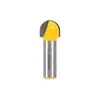 |
YONICO 19103 3/4-Inch Core Box Router Bit, 1/2-Inch Shank – $11.95 A carbide-tipped round-nose bit with a 3/8-inch radius and 5/8-inch cutting depth, sized for cutting a smooth concave channel or a dished pocket in a single setup.
|
Pick the tool from the size of the dish and how many you need. One or two freehand dishes are quick with a gouge and a mallet. Several identical ones, or a dish with a crisp edge, are easier to repeat with a router. Very large scoops, such as a chair seat, are a different job: see how to contour a wooden chair seat, which covers the adze, scorp and angle grinder approach.
| Method | Best for | Main limitation |
|---|---|---|
| Router with core box bit | Repeatable round or oval dishes, crisp rims | Bit radius is fixed, so wide dishes show ridges between passes |
| Gouge and mallet | One-off dishes, any outline, any depth | Needs sharp tools and grain reading; slower to make identical |
| Forstner holes as depth stops, then carve | Getting an accurate curve by hand | Extra drilling; holes must be removed completely |
| Angle grinder with carving disc | Large, deep scoops | Aggressive and dusty; see the chair seat guide |
Concave vs Depression: The Difference That Changes Your Tool Choice
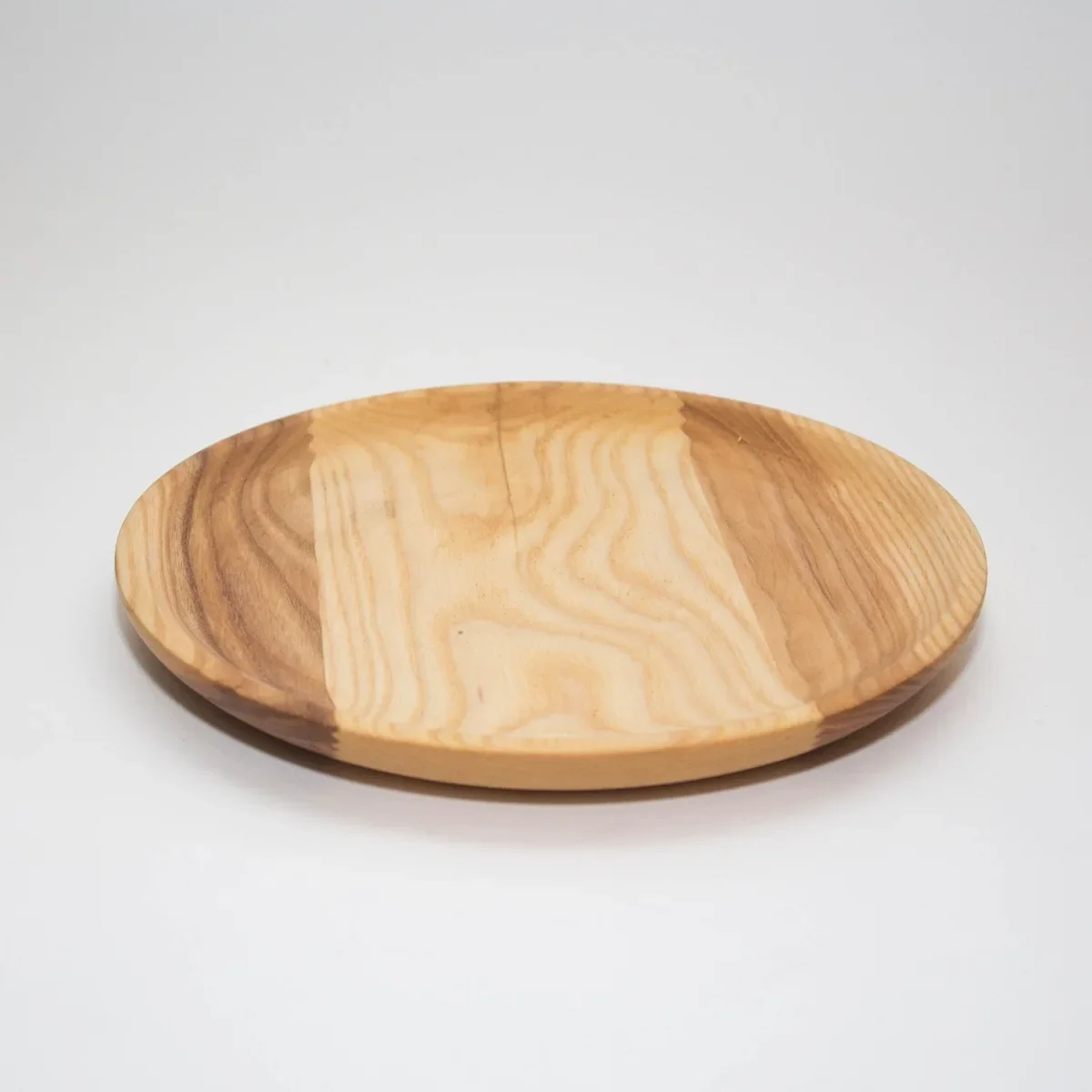
People search for these two words as if they mean the same thing, but they describe different shapes. A depression is any area that sits lower than the surface around it, and it can have a flat floor. A concave surface curves inward like the inside of a bowl. A pocket cut with a Forstner bit or a straight router bit is a depression, but it is not concave because its floor is flat.
That matters for the tool you buy. A Forstner or spade bit will not give you a concave dimple. You need a round-nose (core box) or ball-nose router bit, or a gouge, because only a rounded cutting edge produces a curved floor.
Do the Math First: Radius, Depth and a Drill-Depth Chart
Most guides say “carve until it looks right.” You can do better by treating the dish as a slice of a sphere. If the dish is c inches across and d inches deep, the radius of the curve is R = c² / (8 x d) + d / 2. A small radius makes a steep, bowl-like scoop; a large radius makes a gentle plate-like dish.
| Dish width (in.) | Depth (in.) | Curve radius (in.) |
|---|---|---|
| 3 | 1/4 | 4.6 |
| 4 | 3/8 | 5.5 |
| 6 | 1/2 | 9.3 |
| 6 | 3/4 | 6.4 |
| 8 | 3/4 | 11.0 |
| 10 | 1 | 13.0 |
| 12 | 1 | 18.5 |
Use the radius to check your work: a compass or a curved template cut to that radius should touch the floor of the dish all the way across. Here is the same idea as a drilling guide for a 6-inch dish that is 3/4 inch deep (radius 6.4 inches). The depth at any distance from the center is the full depth minus how far the curve has risen at that point.
| Distance from center (in.) | Depth below rim (in.) | Nearest 1/16 in. |
|---|---|---|
| 0 | 0.750 | 12/16 |
| 1.0 | 0.671 | 11/16 |
| 1.5 | 0.571 | 9/16 |
| 2.0 | 0.428 | 7/16 |
| 2.5 | 0.239 | 4/16 (1/4) |
| 3.0 (rim) | 0 | 0 |
Notice that the floor rises only about 0.08 inch in the first inch from the center but climbs much faster near the rim. That is why a dish carved by eye so often ends up flat in the middle and steep at the edge. Every figure above comes from the formula, so you can rerun it for your own dimensions.

Method 1: Cut the Depression With a Router and Core Box Bit
A router gives the most repeatable result on small and medium dishes. Use a core box bit whose diameter matches your dish width for a channel, or a bit with a 3/8-inch radius, like the one above, and a template or jig for a round dish.
- Mark the outline and the center point, and clamp the workpiece so it cannot shift. Wear eye and hearing protection and a dust mask.
- Set the router to remove no more than about 1/4 inch per pass. Deep single cuts overload the bit and burn the wood.
- Rout the outline first with a template or guide bushing, then clear the floor in overlapping passes, stepping the depth down between passes.
- For a wide, shallow dish, expect small ridges (scallops) between passes. A router mounted on a pivot arm or sled that swings in an arc can cut the curve directly, but it has to be made for your dish size.
- Blend the ridges with a curved scraper or a sanding block with the same radius as the dish.
Keep the router moving, and let the bit reach full speed before it touches the wood. If the floor shows burn marks, the passes are too deep or the bit is dull.
Method 2: Carve It by Hand With a Gouge
Hand carving works for any outline. Choose a gouge whose curve suits the dish: a deep sweep cuts a tight scoop, and a shallow sweep suits a gentle dish (our gouge guide explains sweep numbers). Hold the gouge with the bevel riding on the wood and take light cuts.
- Mark the outline, then make a stop cut around the edge with a chisel so waste chips break off cleanly at the line.
- Remove waste from the rim toward the center in shallow cuts, so the grain does not split past your line.
- Read the grain: on a round dish two sides cut across the end grain and two sides cut along the grain. Change direction where the wood starts to tear rather than forcing the cut.
- Check the curve with the radius from the chart and keep the tool sharp, because a dull gouge crushes the fibers.
- Clamp or vise the piece and keep both hands behind the cutting edge.
For a wider picture of removing wood without power tools, see how to hollow out wood by hand and the general how to carve wood guide. If what you actually need is a narrow curved channel rather than a dish, the round groove guide covers that.
Method 3: Drill Depth Stops, Then Carve to the Holes
This is the most accurate hand method, and few guides mention it. Use the depth chart above to mark a grid of points across the dish. At each point drill a shallow hole with a Forstner bit or a brad-point bit, stopping at the depth from the chart (a masking-tape flag on the bit works as a stop). Then remove the wood between the holes until every hole bottom is just gone. The remaining surface is your curve, and the holes tell you when to stop.
The trick is to remove the holes completely, because leftover rings show through the finish. This method suits a gouge, a scorp or a round rasp.
Smoothing the Curve
Scrape first. A curved cabinet scraper leaves fewer flat spots than sandpaper wrapped around your fingers. Then sand with a foam pad or a block shaped to the curve, starting around 80 grit for router ridges and moving up to 180 or 220 grit. Sand along the grain where you can. Finish with the finish you would use anywhere else, and choose a food-safe oil if the dish will hold food.
Common Mistakes to Avoid
- Using a Forstner bit and expecting a curve. It cuts a flat floor.
- Carving from the center outward. Cut from the rim toward the middle, or the rim can tear out.
- Cutting to full depth in one router pass.
- Skipping the radius check, so the middle ends up flat.
- Leaving drill holes partly visible in the finished surface.
- Working with a dull gouge, which tears the grain instead of slicing it.
Frequently Asked Questions
What is the difference between a concave depression and a flat pocket?
A concave depression curves inward like the inside of a bowl. A flat pocket, such as one cut with a Forstner bit or straight router bit, is a depression with a flat floor, so it is not concave.
What tool makes a concave dimple in wood?
A round-nose (core box) or ball-nose router bit, or a gouge. A regular twist or Forstner bit cuts a flat-bottomed hole, not a curved one.
How do I work out the radius of a concave dish?
Use R = c squared divided by (8 x d), plus d divided by 2, where c is the dish width and d is its depth. A 6-inch dish that is 3/4 inch deep has a radius of about 6.4 inches.
How deep should a concave dish be?
For a shallow tray or plate, a depth of about one eighth of the width is a comfortable starting point, such as 3/4 inch deep for a 6-inch dish. Deeper dishes behave more like bowls and need a tighter radius.
Sponsored / affiliate links. As an Amazon Associate I earn from qualifying purchases. I may earn additional commission from eligible campaigns.