7 Best Woodworking Project Books to Buy in 2026
Search “woodworking projects book” and most results either push a paid PDF bundle or bury two or three book mentions inside a longer tool-buying guide. These seven are real, currently purchasable books — not templates, not plan subscriptions — filtered down to titles actually built around finishable projects, not joinery theory, finishing technique, or general reference material padding out most competing lists. Each entry below states the real project count, the real page count, and the specific reader it fits, so the choice comes down to what you can actually build, not which cover looks best in a listicle.
Quick Answer
The best overall woodworking project book is Great Book of Woodworking Projects by Randy Johnson (Fox Chapel Publishing, 256 pages) — 50 plans spanning indoor storage to outdoor furniture. True beginners with only basic tools should start with I Can Do That! Woodworking Projects instead (48 projects, 208 pages); it needs no table saw or router to finish a single build.
Which of These Woodworking Project Books Should You Buy?
The right pick depends on tools and experience level, not on which book has the biggest number on the cover. Beginners with only a drill and a circular saw should start with I Can Do That! Woodworking Projects or Build Stuff with Wood; anyone wanting broad variety should get Great Book of Woodworking Projects or Weekend Woodworker; woodworkers who just bought a table saw, bandsaw, or router should start with Table Saw, Band Saw and Router to learn to set it up correctly.
| Book | Author | Projects | Pages | Best For | |
|---|---|---|---|---|---|
| Great Book of Woodworking Projects | Randy Johnson (ed.) | 50 | 256 | Best overall / most variety | Check Price |
| I Can Do That! Woodworking Projects | David Thiel & Scott Francis | 48 | 208 | Best for true beginners | Check Price |
| Build Stuff with Wood | Asa Christiana | 14 | 208 | Best with only basic tools | Check Price |
| Weekend Woodworker | John A. Nelson | 110 | 190 | Best for quick, simple builds | Check Price |
| The Complete Book of Woodworking | Tom Carpenter & Mark Johanson | 40+ | 480 | Best skills-plus-projects combo | Check Price |
| Table Saw, Band Saw and Router | Warner, Bird & Mehler | Guide | 400 | Best power-tool buying & setup guide | Check Price |
| Mid-Century Woodworking | A.W.P. Kettless | 80 | 288 | Best for a specific design style | Check Price |
What Makes a Woodworking Project Book Worth Buying?
A woodworking project book earns its price with four things: a stated project count that matches real finishable builds (not filler), a page-to-project ratio that shows how much instruction each build actually gets, a clear skill-level target, and diagrams or cut-list-style dimensions rather than photos alone. A book missing more than one of these reads like a photo book, not a build guide.
Project count alone is misleading. Weekend Woodworker lists 110 projects across 190 pages — under 2 pages per project — while Build Stuff with Wood gives 14 projects across 208 pages, roughly 14.9 pages per project. Neither number is wrong; they measure different things. A high project count with a low page-per-project ratio means faster, simpler builds and lighter instruction; a low project count with a high page-per-project ratio means fewer choices but deeper step-by-step guidance per build.
The 7 Best Woodworking Project Books, Reviewed
Each book below is currently in print or actively sold as a paperback or Kindle edition, cross-checked against its publisher listing and Amazon’s own catalog data for project count, page count, and price.
1. Great Book of Woodworking Projects — Best Overall
Great Book of Woodworking Projects, edited by Randy Johnson and published by Fox Chapel Publishing in 2011, packs 50 project plans into 256 pages for indoor storage, outdoor furniture, and home heirlooms, each rated by real build time from a few hours to a full weekend. It is linked here as the Kindle edition, which carries the same 50 plans as the paperback.
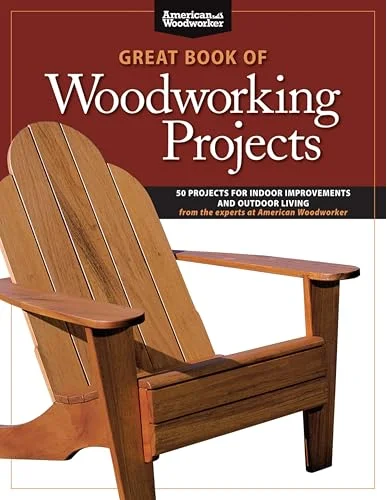
- Best for: a reader who wants one book covering the widest range of project types — kitchen storage, decks, furniture, and heirlooms
- What’s inside: shop-tested plans from the editors of American Woodworker, with step-by-step photos and workshop tips alongside each build
- Honest limitation: at roughly 5 pages per project, instructions run leaner than a dedicated single-project book — expect to look up finish specifics elsewhere
2. I Can Do That! Woodworking Projects — Best for True Beginners
I Can Do That! Woodworking Projects (3rd edition), edited by David Thiel and Scott Francis for Popular Woodworking Books, delivers 48 furniture projects in 208 pages designed to be built with a modest kit of portable tools and materials from any home center. It is linked here as the Kindle edition, matching the paperback’s 48 projects.
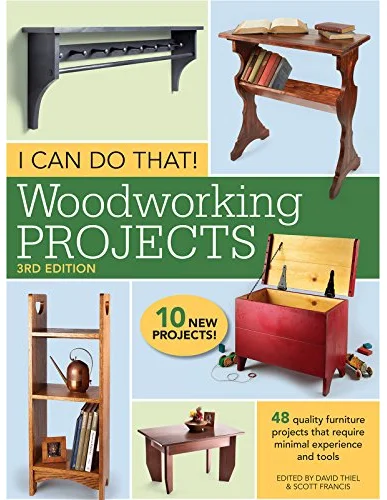
- Best for: someone who owns a drill, a circular saw, and little else, and wants a finished piece of furniture on the first try
- What’s inside: 10 projects new to this 3rd edition, each built without a table saw or router; furniture only, not outdoor or shop-storage builds
- Honest limitation: the furniture-only focus means no birdhouses, decks, or garden builds — pair it with a shop-storage title if that’s the goal
3. Build Stuff with Wood — Best with Only Basic Tools
Build Stuff with Wood, written by former Fine Woodworking chief editor Asa Christiana for Taunton Press in 2017, covers 14 projects across 208 pages — about 14.9 pages per project, more depth per build than any other true-beginner title on this list. It is linked here as the Kindle edition, with the same 14 projects as the paperback.
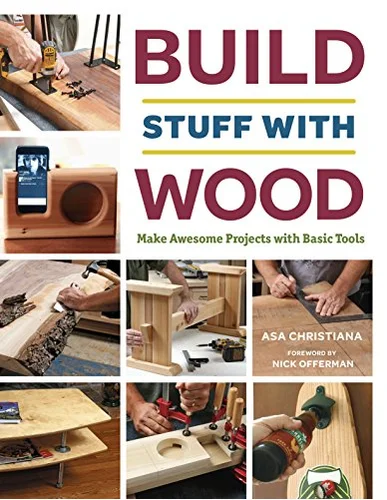
- Best for: a reader who wants fewer projects explained in more depth rather than a large catalog of thin entries
- What’s inside: 14 projects built entirely with basic, accessible tools; the book carries a foreword from actor and woodworker Nick Offerman
- Honest limitation: only 14 projects total — a reader who wants more variety should pair it with a larger compilation like the Great Book above
4. Weekend Woodworker — Best for Quick, Simple Builds
Weekend Woodworker, by John A. Nelson (Random House Value Publishing, 1993), lists 110 easy projects in 190 pages, including shelves, boxes, toys, and outdoor pieces sized to finish in a weekend.
- Best for: someone who wants the largest possible pool of small, weekend-length projects to pick from
- What’s inside: 110 projects sorted by type — shelves, boxes, toys, and outdoor pieces — each meant to finish in a day or two
- Honest limitation: at under 2 pages per project, many entries are simple toys and small boxes rather than furniture-scale builds, and the 1993 styling reads dated next to newer designs
5. The Complete Book of Woodworking — Best Skills-Plus-Projects Combo
The Complete Book of Woodworking, by Tom Carpenter and Mark Johanson (Landauer Publishing), runs 480 pages and pairs step-by-step skills and technique instruction with detailed plans for more than 40 projects and over 1,200 photos.
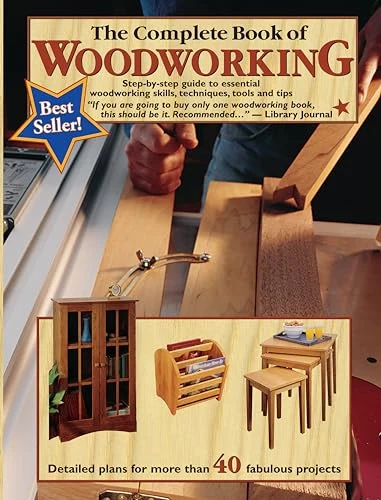
- Best for: a reader who wants one book to teach fundamentals (tool use, joinery basics, finishing) alongside the projects, rather than assuming prior skill
- What’s inside: at roughly 12 pages per project, a meaningful share of the 480 pages goes to general technique instruction, not project plans alone
- Honest limitation: the hybrid skills-plus-projects format means less pure project density than a dedicated project book like the Great Book above
6. Table Saw, Band Saw and Router — Best Power-Tool Buying & Setup Guide
Table Saw, Band Saw and Router: Fine Woodworking’s Complete Guide to the most Essential Power Tools, by Pat Warner, Lonnie Bird, and Kelly Mehler (Taunton Press, 2006), runs 400 pages on what to look for when buying each of these three tools and how to set them up and tune them for accurate cuts — not a set of finishable project plans like the other six picks on this list.
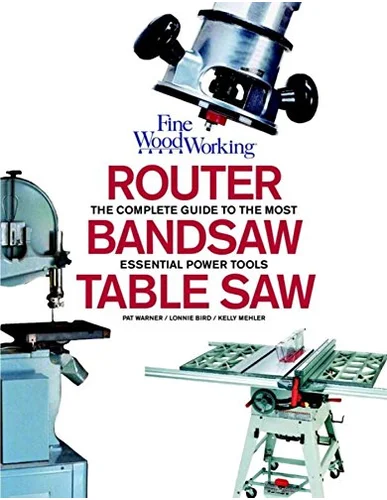
- Best for: a reader who owns, or just bought, a table saw, bandsaw, or router and wants to buy the right one and set it up correctly — not another stack of project plans
- What’s inside: three named Fine Woodworking contributors covering what to look for when buying each tool, plus tune-up and setup instructions for accurate, safer cuts
- Honest limitation: this is a tools-and-technique guide, not a project book — pair it with a project title like Build Stuff with Wood above if the goal is a finished piece, not just a properly tuned machine
7. Mid-Century Woodworking — Best for a Specific Design Style
Mid-Century Woodworking: 80 Projects to Make by Hand, by A.W.P. Kettless (Batsford, 2023, 288 pages), is the only book on this list built around one aesthetic — 1950s-and-60s-style shelves, bookends, chests of drawers, and desks, arranged by difficulty.
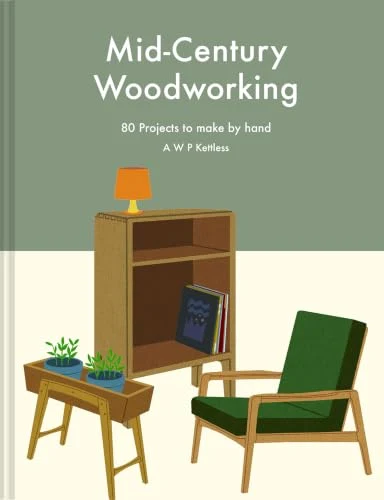
- Best for: a reader who specifically wants mid-century-style furniture, not a general project catalog
- What’s inside: 80 projects with clear patterns, diagrams, and step-by-step instructions, arranged from beginner-friendly to more advanced pieces
- Honest limitation: style-locked to mid-century design — skip this one if traditional, rustic, or shop-storage projects are the goal
How Do You Choose the Right Book for Your Skill Level?
Match the book to the tools already owned, not the project count on the cover. A reader with only a drill and a circular saw gets the most finished projects per dollar from I Can Do That! Woodworking Projects or Build Stuff with Wood; a reader who already owns a table saw and bandsaw is better served picking up Table Saw, Band Saw and Router first to make sure those tools are set up correctly, then choosing a project book to match.
For a single library-style reference, the page-per-project numbers above point the way: Great Book of Woodworking Projects (5.1 pages/project) and The Complete Book of Woodworking (12 pages/project) both cover general fundamentals alongside builds, so either works as a first and only book. Mid-Century Woodworking is the one exception on this list — buy it for the style, not as a general-purpose first book, since every project shares the same design language.
Are Woodworking Project Books Still Worth It When Free Plans and Videos Exist?
Yes, for three specific reasons free content doesn’t replace: every project in a book uses one consistent unit system, drawing style, and skill-level scale from cover to cover, while free plans scattered across different sites vary in quality and format from page to page. A book also works without a screen at the workbench, and a physical or Kindle copy doesn’t disappear when a blog goes offline or a YouTube channel stops uploading.
That said, books and free resources solve different problems. Free plan PDFs with real cut lists are the faster choice for a single specific build with no other purchase required, and project videos on YouTube show techniques in motion that a still diagram can’t — useful for a cut that’s hard to visualize from a drawing alone. A book earns its price when the goal is a consistent library of 12 to 150 projects to work through over months, not a single weekend build.
Frequently Asked Questions
Are woodworking project books still useful when free plans are online?
Yes. A book gives one consistent unit system, drawing style, and skill scale across every project, where free plans from different sites vary page to page. Books also work at the workbench without a screen or an internet connection.
What’s the difference between a woodworking project book and a plan bundle?
A published book (like the seven above) goes through editing, photography, and diagram production before print, and its author and publisher are named and checkable. A “plan bundle” sold as thousands of downloads for a flat fee is usually unedited, unverified, and impossible to check for quality before paying.
Do woodworking project books include a real cut list, or just photos?
It varies by book. Six of the seven titles above are project books with diagrams or step-by-step photos and dimensions; Table Saw, Band Saw and Router is a buying-and-setup guide rather than a project book. Among the project books, a higher pages-per-project ratio, like Build Stuff with Wood, tends to mean more detailed dimensioned instructions per project than high-count compilations like Weekend Woodworker.
Which of these books is best for someone with only basic hand tools?
Build Stuff with Wood and I Can Do That! Woodworking Projects are both built specifically around basic, portable tools — a drill, a circular saw, and simple hand tools — with no project requiring a table saw or router.
Are these woodworking project books available on Kindle?
Three of the seven — Great Book of Woodworking Projects, I Can Do That! Woodworking Projects, and Build Stuff with Wood — are linked above as Kindle editions. Mid-Century Woodworking is also confirmed available as a Kindle/eBook edition, while Weekend Woodworker, The Complete Book of Woodworking, and Table Saw, Band Saw and Router are print/hardcover editions.
How many projects should a beginner expect to finish from one book?
A realistic first goal is 3 to 5 completed projects from a beginner-focused book like I Can Do That! Woodworking Projects or Build Stuff with Wood before picking up a table saw, bandsaw, or router and a guide like Table Saw, Band Saw and Router to set it up correctly.
Start With One Book, Not a Stack
Pick one book that matches the tools already in the shop, finish two or three projects from it, then decide whether the next purchase is a bigger compilation or a step up in tool requirements. For the wider range of woodworking projects at every format and skill level — free plans, downloadable PDFs, videos, and guides for specific age groups — the DIY woodworking projects hub is the place to keep browsing.
Sponsored / affiliate links. As an Amazon Associate I earn from qualifying purchases. I may earn additional commission from eligible campaigns.