How to Weigh Down a Gazebo
Weight a gazebo with ballast on calm patios, and add stakes, augers, or tie-downs when wind, soft ground, or longer setup time raise the risk. Poor anchoring can let the frame shift, bend, tip, or damage the canopy and hard surface. This article shows how to choose and apply the right anchoring method for concrete, pavers, and grass, then explains why a layered setup is usually the safest choice.
Choose the right gazebo anchor


The safest way to weigh down a gazebo depends on three things: the surface under the frame, how windy the site is, and how long you plan to leave it in place. Hard surfaces usually need ballast. Soft ground can take pegs. In stronger wind, one weight may not be enough, and a gazebo with sidewalls may need ballast plus straps.
Match the method to the surface
Use gazebo leg weights on concrete, asphalt, terraces, balconies, patios, and other hard surfaces where pegs will not bite. On lawn or soil, use ground pegs and straps, or combine them with ballast where that helps the setup stay steady. Water weight bags are a useful middle option because they can adapt to uneven ground.
Match the method to wind exposure
Wind changes the choice fast. A light breeze may only call for ballast, but gustier sites need ballast plus straps or pegs so the frame cannot lift at a corner or twist out of square. Sidewalls and curtains can raise the wind load, so a gazebo that feels steady in open air may behave differently once fabric panels are installed.
Match the method to how long the gazebo will stay up
Short events can often use removable ballast. Longer setups call for heavier systems, especially on exposed patios or paved areas. Concrete weights are recommended for longer-term stability, while temporary setups can often rely on leg weights or water bags if the weather is calm and the frame is not carrying sidewalls.
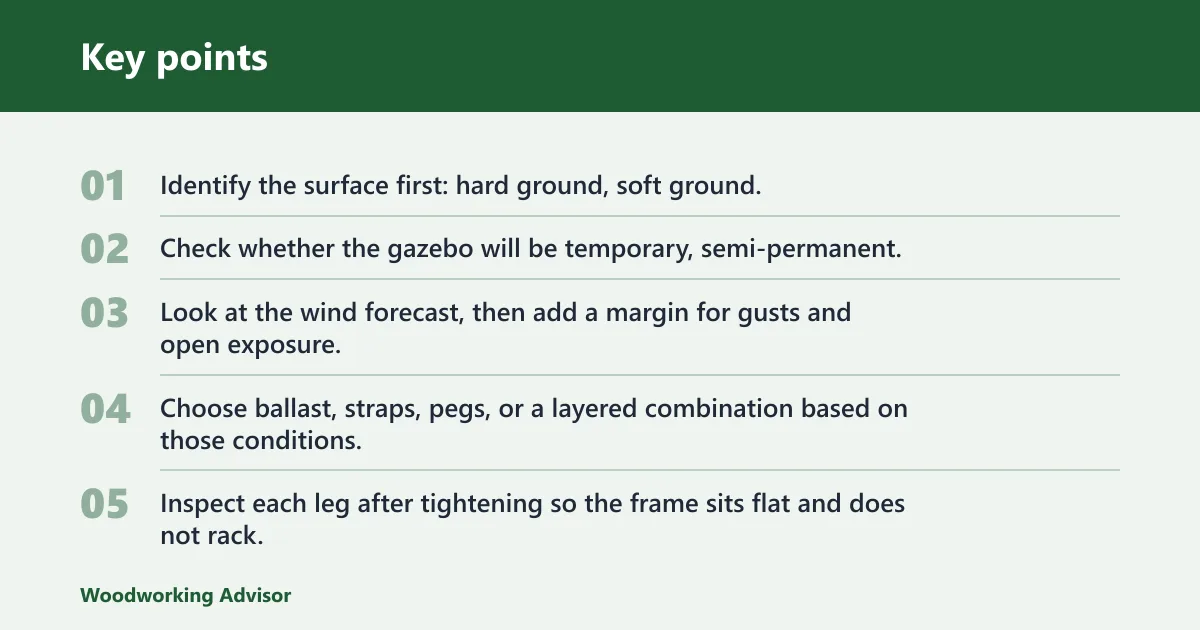
- Identify the surface first: hard ground, soft ground, or a mixed edge such as pavers beside soil.
- Check whether the gazebo will be temporary, semi-permanent, or left up for an extended period.
- Look at the wind forecast, then add a margin for gusts and open exposure.
- Choose ballast, straps, pegs, or a layered combination based on those conditions.
- Inspect each leg after tightening so the frame sits flat and does not rack.
Anchoring decision table
| Surface type | Intended duration | Wind risk | Recommended ballast | Straps required? | Common failure mode |
|---|---|---|---|---|---|
| Patio concrete | Short event | Low | Gazebo leg weights, 15 kg or 28 kg per leg | Optional in calm weather | Leg lift or slow frame drift |
| Patio concrete | Longer-term | Medium to high | Concrete weights, such as four 25 kg weights per leg assembly | Yes | Twisting or racking under gusts |
| Lawn | Temporary | Low to medium | Ground pegs with straps | Yes | Pull-out from soil or pegging at the wrong angle |
| Balcony | Temporary or semi-permanent | Medium | Leg weights or water weight bags | Yes | Slide, tip, or railing interference |
| Gazebo with sidewalls | Any duration | Medium to high | Ballast plus straps, often with heavier weights | Yes | Curtain-sail effect and corner lift |
| Asphalt or terrace | Longer-term | Medium | Concrete weights or cast iron gazebo weights | Yes | Frame creep and wind uplift at the feet |
How do you weigh down a gazebo on concrete?
On concrete, weigh down each leg with hard-surface ballast rather than pegs. Cast iron gazebo weights are a common choice, and heavier leg weights are one recommended option for hard ground. For lighter setups, smaller leg weights can be stacked with heavier ones when more hold is needed.
Use leg weights on hard surfaces
Gazebo leg weights should sit on or around each leg, not in a single pile at one corner. That keeps the load where uplift starts. The weights should be distributed on all four feet, which matters because one overloaded corner does little for a frame that can still lift at the others.
Add straps when wind is a concern
Weights stop sliding and tipping, but straps help resist uplift. On concrete, use tension straps if the site is exposed or if the gazebo has a tall roof profile. A strap anchored to a suitable structural point on the frame can keep the canopy from acting like a lever in gusts.
What to do on patios, terraces, balconies, and asphalt
Patios, terraces, balconies, and asphalt often call for the same basic approach: ballast instead of pegs, with non-slip feet or plates where needed. A balcony can add another concern because movement is more visible and space is tighter. If drilling is allowed for a permanent install, that is a separate choice; for temporary use, ballast and straps are the safer starting point.
Can you weigh down a gazebo without drilling into concrete? Yes. For a temporary or seasonal setup, that is usually the preferred route. Use leg weights or water bags, add straps if the site is breezy, and check that the feet sit flat so the frame does not skate across the surface.
How do you anchor a gazebo on soft ground?
On soft ground, anchor the gazebo with pegs and straps, with ballast added only where it helps the overall setup. Lawn and soil let pegs grip the ground, which is why hard-surface ballast is not the primary fix there. The best hold comes from tension that pulls the frame down and out, rather than weight alone.
Use ground pegs for lawn or soil
For soft ground, the recommended anchoring set includes pegs and a hammer. Competitor guidance commonly shows spiral and flat-iron peg formats, and the listed peg length is 45.5 cm. That length gives the anchor more bite in turf or soil than a short stake would.
Set straps at about a 45-degree angle
For optimal hold, tension straps should form about a 45-degree angle. That angle helps the strap resist both lift and sideways movement. Attach the strap to the gazebo frame at a secure point, then drive or set the peg far enough away that the pull stays clean and steady.
Why soft ground still needs tension
Soft ground can look secure right after setup, then loosen as the soil shifts or the grass tears under stress. The frame may stay upright while the corners creep out of place. A strap-peg combination holds shape better than a peg alone, especially on uneven lawn or compacted soil near a path.
Suppose a small garden gazebo sits on turf for an afternoon cookout. If one corner starts to lean after a gust, that is often a sign the peg angle or tension is off, not just that the gazebo needs more weight. Recheck the strap path before adding more hardware.
What weight setup should you choose?
Choose a setup that matches the surface and wind risk, and step up to a heavier or more layered arrangement as conditions become more exposed. Leg weights suit hard surfaces and short events. Water weight bags help when the ground is uneven or when you need a less bulky option. Concrete weights make more sense for longer-term stability, especially when the gazebo stays in one place.
When to use leg weights
Gazebo leg weights are the best fit for patios, concrete, asphalt, terraces, and balconies. The common sizes called out are 15 kg and 28 kg. The lighter units can be stacked with heavier ones, which gives you a simple way to increase stability without changing the whole setup.
When to use water weight bags
Water weight bags are supplied in sets of four, each holding 20 litres. They attach directly to gazebo legs and can be useful when you want portability or when the ground is uneven and a rigid weight would rock instead of sit flat.
When to choose concrete weights
Concrete weights are recommended for longer-term stability. They suit terrace, balcony, concrete, or asphalt setups where you want more permanence than a water bag can provide. A heavier, denser weight is less likely to shift, which matters when the gazebo stays up for days or weeks.
How sidewalls change the choice
Sidewalls and curtains change the math because they add sail area. A gazebo without fabric panels may handle moderate weather with leg weights alone. Add sidewalls, and the same frame can catch more wind, so a layered system becomes the safer choice.
A common first-timer mistake is choosing one weight size for every frame. A compact patio gazebo with open sides may do fine with leg weights, while the same frame fitted with curtains needs straps as well. The fabric changes how the wind loads the structure.
How do you stop wind lift?
Stop wind lift by anchoring both the feet and the frame. Ballast controls sliding and tipping. Straps resist uplift and twisting. When curtains or sidewalls are installed, that extra fabric can push the gazebo into a sail-like failure, so the anchor system has to do more than hold weight at the bottom.
Why curtains and sidewalls raise wind load
Curtains and sidewalls catch air, even when they are partly open. That increases pull on the frame and on the corners. The result can be leg lift on one side, then twisting across the roof line as the structure tries to move with the gust rather than resist it.
Why straps matter even with ballast
Ballast alone does not stop uplift well. A heavy base can still leave the upper frame free to flex, and that is where wind starts the damage. Tension straps, used with pegs or weights, add the missing restraint and help keep the gazebo square under load.
Common failure modes to watch
Watch for leg lift, twisting, racking, and curtain-sail effect. Leg lift means one corner starts to rise. Twisting means the roof rotates slightly. Racking means the frame goes out of square. Curtain-sail effect means sidewalls catch enough wind that the whole gazebo acts like a panel.
Check the weather before leaving a gazebo up. If stronger wind is forecast, pull the sidewalls, add straps, or take the structure down. Severe gusts can outmatch ballast alone, especially on exposed hard surfaces where there is no soil grip to help.
Frequently asked questions
How do you weigh down a gazebo?
Start with the surface. Use leg weights on concrete, patio, asphalt, terrace, or balcony. Use pegs and straps on lawn or soil. In breezier conditions, add straps to the weight system so the frame is held down and pulled in at the same time.
What weights work best for a gazebo on a patio?
For a patio, leg weights are the usual choice. Water weight bags can also work, especially if the surface is uneven or you need a movable option. For longer-term use, concrete weights are the heavier-duty answer, and straps help when the patio is exposed to wind.
Should you use straps as well as weights on a gazebo?
Yes, when wind risk is more than calm and sheltered. Weights hold the base down, but straps help resist uplift and twisting. That layered approach matters most on hard surfaces, in open yards, and on any gazebo fitted with curtains or sidewalls.
Can you weigh down a gazebo without drilling into concrete?
Yes. Temporary and semi-permanent setups can usually rely on leg weights, water weight bags, or concrete weights without drilling. For hard surfaces, the key is to keep the ballast at each leg and use straps if wind exposure is moderate or higher.
Sponsored / affiliate links. As an Amazon Associate I earn from qualifying purchases. I may earn additional commission from eligible campaigns.