Is Thompson’s Water Seal Any Good? (Cheap, But Needs Yearly Reapplication)
Thompson’s Water Seal does one job well: it repels water for a season. Independent testing on a full-sun deck found the clear formula kept water beading only 6 to 12 months, gave no UV protection, and did not peel on bare wood. Peeling shows up when it goes over old stain. This guide covers how long it lasts, the mold question, where it works, and what to use on a deck.
Why Thompson’s Water Seal Stops Working Within a Year (And When It Really Peels)
Best Deck Alternative Pick
 |
Thompson’s WaterSeal Penetrating Transparent Timber Oil, Redwood – $68.90 If the yearly splash test on your deck keeps failing, this is the step up from the clear waterproofer: a tinted oil that the label says to apply as a thin coat at a rate the wood will absorb.
|
As an Amazon Associate we earn from qualifying purchases.
The clear formula is thin by design. Thompson’s own Clear Multi-Surface Waterproofer data sheet lists a vehicle of hydrocarbon resin and oil, no pigment, and only 10% solids by volume, so very little material stays in the wood once the carrier dries. With no pigment, the coating also does nothing to screen sunlight.
📊 In a two-year test on a full-sun teak deck, the clear waterproofer stopped repelling water by the 6 to 12 month mark, the wood grayed within months, and the finish still scored 8 out of 10 for not peeling or wearing. – Source: Deck Stain Help, Thompson’s WaterSeal review
That corrects the usual complaint. On bare wood the clear formula soaks in, so it fades instead of flaking. Peeling is a separate problem with a separate cause: Thompson’s labels say not to apply it over painted or recently stained surfaces, and its Clear Wood Sealer page says to remove all loose, flaking or peeling stain first. Over an old coat the product cannot soak in, so it sits on top and lifts along with the stain underneath, as Deck Stain Help also describes.
How Long Does Thompson’s Water Seal Last?
There is no single number, because Thompson’s sells several products under one name and each makes a different promise. Check which formula is in your can first; the oil-based vs water-based breakdown shows how to tell.
| Source | Product | What it says |
|---|---|---|
| Thompson’s data sheet | Clear Multi-Surface Waterproofer | No fixed lifespan: protection varies with environment, run the splash test once a year |
| Thompson’s product page | Clear Wood Sealer (oil-based) | Reapplication recommended every year for maximum protection from sun damage and color change |
| Thompson’s product page | Transparent Wood Sealer (tinted) | Guaranteed 4 years on decks, 5 years on fences and siding |
| Deck Stain Help test | Clear waterproofer, full-sun teak deck | Water repellency gone by 6 to 12 months in a two-year test |
The long guarantee belongs to the tinted line, not the clear one. For the clear formula, plan on yearly reapplication and treat anything longer as a bonus.
“Perform the splash test once a year to see whether reapplication is necessary.”
Thompson’s WaterSeal, Clear Multi-Surface Waterproofer data sheet
Where It Actually Works Well
Concrete, brick, stucco, masonry and exterior wood are the substrates on the data sheet, so the product is not wrong for those surfaces. The real cost is how much it takes, because coverage swings widely with porosity. Thompson’s lists these approximate rates; the third column is our arithmetic for a 400 square foot job, one coat.
| Surface | Label coverage (sq ft per gallon) | Gallons for 400 sq ft | Note |
|---|---|---|---|
| Concrete | 250 | 1.6 | Smooth, flat concrete must be opened with a concrete etch first |
| Stucco | 250 | 1.6 | Must be fully cured, at least 4 weeks, and dry |
| Brick | 175 | 2.3 | Clean with a concrete cleaner first |
| Smooth concrete block | 50 | 8.0 | Very thirsty, budget for it |
| Smooth-sawn wood (typical deck boards) | 200 | 2.0 | Yearly reapplication matters most here |
| Rough-sawn wood (typical fences) | 100 | 4.0 | Soaks up twice the product of smooth boards |
| Plywood | 150 | 2.7 | Same yearly splash test applies |
| Metal | Not listed | Not listed | Not on the label’s recommended substrate list |
A 400 square foot deck needs about two gallons per coat at the label rate for smooth-sawn wood. That is a useful number to hold up against an annual redo.
Does It Prevent Mold, Mildew, and Rot?
No. Thompson’s Water Seal repels liquid water, which removes one thing mold needs, but it is not a fungicide or a wood preservative. The Clear Multi-Surface Waterproofer data sheet lists only two key features, helps prevent water damage and dries clear, and makes no mold-resistance claim. (Thompson’s markets its tinted Transparent Wood Sealer as a mold-and-mildew-resistant finish, which is a different product.)
The independent result is worse than neutral. Deck Stain Help reports its whole test deck was covered in black mold after two years, and suspects the oils in the oil-based clear formula feed the spores. That is one deck, so treat it as a warning rather than a rule. The label itself requires the surface to be free of mildew before application, so sealing over existing mildew is the wrong move.
For actual rot concerns, start with the wood: pressure-treated lumber or a real preservative treats the fungal risk, while a water repellent only slows moisture.
How to Apply Thompson’s Water Seal Correctly
Most of the weak results trace back to skipped prep rather than a bad can. These steps follow the manufacturer’s data sheet.
- Clean the surface: use a deck cleaner on wood or a concrete cleaner on masonry. The surface must be free of mildew, dust, dirt, oil and grease.
- Let it dry: allow at least 48 hours on wood and 72 hours on concrete or brick after cleaning or rain.
- Check the weather: surface and air must stay above 50°F during application and for 48 hours after, with no rain forecast for 24 hours.
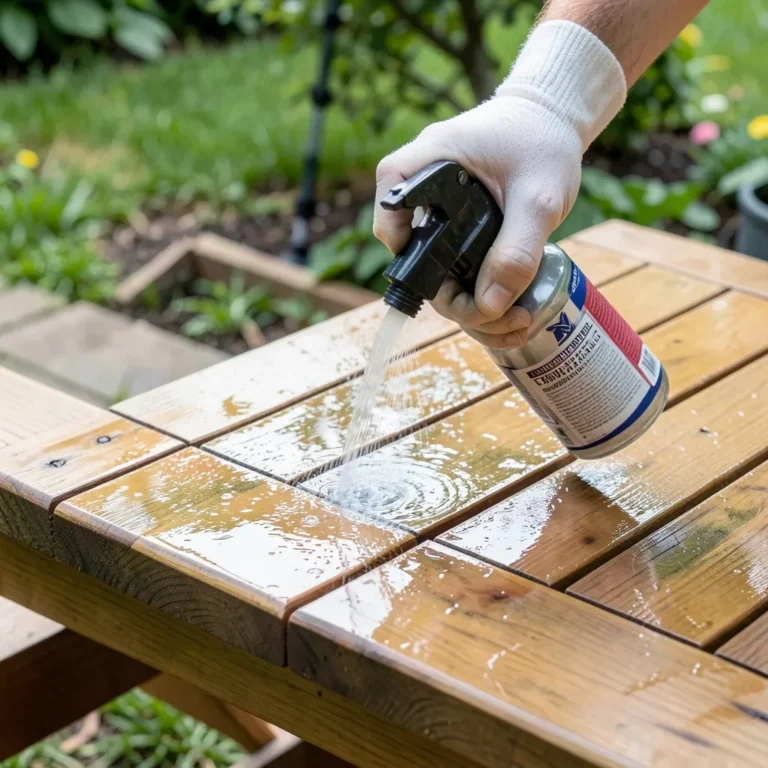
- Run the splash test: sprinkle water on the surface. If it soaks in and darkens the wood within five seconds, the surface is ready; if it beads, it does not need protection yet.
- Test a small patch, then apply one light coat: a pump-up garden sprayer is the simplest method. The product looks milky white wet and dries clear. If it puddles, redistribute or wipe it off within 15 minutes.
- Do not over-apply: too much leaves a darkened, tacky surface. Allow at least 24 hours to dry, then repeat the splash test to see whether a second coat is needed.
- Repeat the splash test every year: reseal when water stops beading.
If you plan to paint later, the data sheet says to wait 3 days before oil-based paint and 45 days before latex paint.
Does Thompson’s Water Seal Go Bad?
The data sheet gives no shelf life or expiry date. It does give storage rules: keep the container closed, do not store it below 32°F or let it freeze, and do not transfer it to other containers. It also says to shake or stir before and during use. Our rule of thumb: if a stored can will not mix back into a smooth liquid after shaking, replace it, because the coverage and color will not be reliable.
Thompson’s Water Seal on Metal, Plastic and Overspray
Metal and plastic are not on the data sheet’s recommended substrate list, so the maker gives no performance claim for them. The practical risk is overspray on things you did not mean to coat. The data sheet says to cover plants and move objects out of the spray zone, and that wet overspray can be flushed off with water immediately, while dried overspray needs a regionally compliant cleaner. Do not wait for it to dry.
What to Use Instead on a Deck
If a yearly redo is the dealbreaker, step up to a tinted penetrating oil or stain, because pigment is what gives wood UV protection and the clear waterproofer has none. Deck Stain Help rates stains from other brands as lasting significantly longer in the same test. Our oil-based vs water-based deck sealant comparison covers lifespan and recoat timing, and the sealer vs waterproofer explainer shows why a clear waterproofer behaves the way it does.
If you stay with Thompson’s, its Penetrating Timber Oil data sheet is worth reading before you buy. It calls for one thin coat, says excess left on the surface causes a tacky finish and long dry time, and warns that rags soaked with the product can spontaneously catch fire if improperly discarded. Put them in a sealed, water-filled metal container.
Frequently Asked Questions
Is Thompson’s Water Seal effective for wood protection?
It repels water at first, but the clear formula has no pigment and no UV protection. In Deck Stain Help’s two-year test on a full-sun deck, water beading faded by the 6 to 12 month mark and the wood grayed within months, though the finish did not peel on bare wood.
How long does Thompson’s Water Seal last?
Thompson’s gives no fixed lifespan: its data sheet says protection varies with the environment and to run the splash test once a year. Its Clear Wood Sealer page recommends reapplying every year, and an independent two-year deck test saw water repellency fade at 6 to 12 months.
Does Thompson’s Water Seal prevent mold, mildew, or rot?
No. It repels water but is not a fungicide or a wood preservative, and the Clear Multi-Surface Waterproofer data sheet makes no mold-resistance claim. Deck Stain Help’s test deck was covered in black mold after two years, and the label requires the surface to be free of mildew before you apply it.
Can Thompson’s Water Seal be used on concrete?
Yes. Concrete, brick, stucco and masonry are on the data sheet’s recommended substrate list, at roughly 250 square feet per gallon on concrete. Smooth, flat concrete must be opened with a concrete etch first so the product can penetrate.
Is Thompson’s Water Seal worth it?
For a cheap yearly water-repellent coat on concrete, masonry or a fence, yes. For a sun-exposed deck, usually not: the clear formula gives no UV protection and needs yearly reapplication, so a tinted penetrating oil or stain is the better long-term choice.
Does Thompson’s Water Seal go bad?
The data sheet gives no expiry date. It says to keep the container closed, never store it below 32 degrees F or let it freeze, and shake or stir it before and during use. If a stored can will not mix back to a smooth liquid, buy a fresh one.
Can you put Thompson’s Water Seal over stain or old sealer?
No. The label says not to use it on painted or recently stained surfaces, and loose, flaking stain has to be removed first. Over an existing coat it cannot soak in and sits on top, which is where most peeling reports come from.
Conclusion
Thompson’s Water Seal is cheap, easy to apply and fine as a yearly water-repellent coat on concrete, masonry and fences. It is a weak choice for a sun-exposed deck: the clear formula has no UV protection and independent testing saw its water repellency fade within 6 to 12 months. Run the splash test every year, never put it over old stain, and move to a tinted penetrating oil when yearly redoes stop being worth it.
Sponsored / affiliate links. As an Amazon Associate I earn from qualifying purchases. I may earn additional commission from eligible campaigns.