Menards Deck Screws: Length, Coating and Box Count Guide
Most people shopping for deck screws at Menards are really asking three things: how long should the screw be, what coating survives pressure-treated lumber, and how many boxes to carry to the register. The answers come from simple arithmetic and one label check, not from a brand name. This guide gives you the screw length for each decking thickness, a coating chart, and a screw-count table you can use before you leave the house. For the wider question of screws by material, see our guide to Menards wood screws.
The Short Answer: A #10 Exterior Screw Sized to Your Boards
Best 5/4 Decking Screw Pick
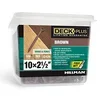 |
Deck Plus #10 x 2-1/2 in. Deck Screws, 365 Pieces, 5 lb Box, Brown A T25 star-drive exterior screw with a coating sold for treated lumber, in a size that matches 1-inch decking over 2x joists. Menards sells its own selection, so use this as a spec to compare against, not a brand you must buy.
|
For most residential decks, the target is a #10 exterior deck screw with a star (T25) drive, long enough to reach 1-1/2 inches into the joist, with a coating the label says is suitable for pressure-treated lumber. Menards, like any big-box store, carries several deck screw lines, and we could not read their current listings (their site blocks automated access), so we do not quote store prices, brands or stock here. Instead, use the four checks below on whatever box is on the shelf.
- Diameter and length: printed on the box, for example 10 x 2-1/2 in.
- Coating claim: the box should name pressure-treated (or ACQ) lumber, not just say weather resistant
- Drive: star (Torx) resists stripping better than Phillips, and the matching bit is usually in the box
- Count and weight: a 5 lb box of #10 x 2-1/2 in. holds roughly 365 screws, which sets how many boxes you need
Screw Length: Board Thickness Plus 1-1/2 Inches
A deck screw holds by threads in the joist, so the rule is simple: board thickness plus about 1-1/2 inches of joist penetration. A 2x joist is 1-1/2 inches thick in real life, so the screw should nearly reach the bottom of the joist without poking through. Many builders skip this math and grab whatever box is closest, which is how decks end up with screws that only bite a half inch.
| Decking board | Actual thickness | Screw length to choose |
|---|---|---|
| 5/4 x 6 (pressure-treated or cedar) | 1 in. | 2-1/2 in. |
| 2 x 6 (pressure-treated) | 1-1/2 in. | 3 in. |
| Composite or PVC | Varies by brand | Use the maker’s specified screw or hidden fastener |
Note that a 5/4 x 6 board is not 1.25 by 6 in real life. It is about 1 inch thick and 5-1/2 inches wide. If your deck uses 2×6 boards, the 2-1/2 inch box in the picture above is the wrong length, so read the box before you buy. Composite is its own category: most manufacturers specify a particular fastener, and using something else can void the warranty. Our composite decking fasteners guide covers that in detail.
Coating: The Label Matters More Than the Word Rust-Resistant
This is the part most guides skip. Modern pressure-treated lumber is treated with copper-based preservatives, which corrode plain steel and thin zinc plating much faster than the old treatments did. So a screw that says outdoor or rust-resistant is not automatically fine for treated wood. Look for a package that says it is suitable for pressure-treated lumber, or choose stainless steel. If you are not sure what is in the boards you bought, see our page on pressure-treated wood at Menards.
| Deck situation | Screw material or coating to look for |
|---|---|
| Pressure-treated pine | Coated deck screw labeled for treated lumber, hot-dip galvanized, or stainless steel |
| Cedar, redwood, or tropical hardwood | Stainless steel, because galvanized or plated screws can leave dark stains from the wood’s natural tannins |
| Coastal, salt spray, or pool area | Type 316 stainless steel, the grade made for salt and chlorine exposure |
| Composite or PVC | The fastener the board maker specifies |
Stainless costs more per box, but on a small deck the difference is often modest compared with the boards themselves, and screws are the one part you cannot easily replace later without lifting boards.
How Many Screws You Need: Numbers by Deck Size
The standard pattern is two screws at every joist crossing, with joists 16 inches on center. With 5-1/2 inch wide boards and a small 1/8 inch gap, that works out to about 3.2 screws per square foot. Diagonal decking or joists at 12 inches on center push it closer to 4.3. The table adds a 10 percent allowance for stripped and dropped screws, then converts to boxes of 365.
| Deck area | Screws (16 in. joists) | With 10% extra | 5 lb boxes of 365 |
|---|---|---|---|
| 100 sq ft | 320 | 352 | 1 |
| 144 sq ft (12 x 12) | 461 | 507 | 2 |
| 160 sq ft (10 x 16) | 512 | 563 | 2 |
| 320 sq ft (16 x 20) | 1,024 | 1,126 | 4 |
These are estimates for a plain rectangular deck. Extra screws are needed for the end joists, rim boards, stairs, and any pattern with breaker boards. One 365-count box covers roughly 114 square feet before waste, so a 12 x 12 deck is a two-box job even though it looks close to one.
Driving Deck Screws Without Splitting Boards
- Place screws about 3/4 inch in from each board edge, and keep them at least 1 inch from the board ends.
- Drive the head flush with the surface, not sunk deep. Overdriving crushes the wood fibers and lets water sit in the hole.
- Pre-drill near board ends and in dense woods such as ipe, even if the box says self-drilling.
- Use the matching star bit and keep pressure straight. A worn bit strips the recess quickly, especially with an impact driver.
- Leave a small gap between boards for drainage, following the board manufacturer’s guidance for wet lumber.
If the head does strip, do not keep spinning it. Back up, switch to a fresh bit, or drive a new screw a couple of inches away and cut off or pull the damaged one.
Deck Screws Are Not Structural Fasteners
General deck screws are made to hold decking boards to joists. They are not the same as structural screws or bolts, and using them for the ledger board, stair stringers, or guardrail posts is a common shortcut that inspectors do not accept. Building codes generally call for lag screws, through-bolts, or specifically approved structural screws at those connections. We explain the difference in our guide are deck screws structural, and the comparison of screw types in deck screws vs wood screws.
Buying at Menards: What We Could and Could Not Check
Menards is a normal place to buy the boards and the screws in one trip. If you are also pricing lumber, our Menards deck boards page covers the boards. What we cannot do is quote today’s shelf prices or brands: Menards blocks automated price checks, so any number we printed would be a guess. Before you buy, confirm three things in the aisle: the diameter and length, the treated lumber claim on the package, and the pieces per box. Take a photo of the box label so you can compare against your plan later.
Frequently Asked Questions
What size screws do I need for deck boards?
Use board thickness plus about 1-1/2 inches. That means 2-1/2 inch screws for 5/4 decking (1 inch thick) and 3 inch screws for 2x decking (1-1/2 inches thick), usually in #10 diameter.
Are Menards deck screws safe for pressure-treated lumber?
Check the package rather than the store. Any deck screw you buy, at Menards or elsewhere, should say it is suitable for pressure-treated lumber, or it should be stainless steel. Rust-resistant on its own is not enough for copper-treated wood.
How many deck screws do I need for a 12 x 12 deck?
About 460 screws for a 12 x 12 deck with 5/4 x 6 boards and joists 16 inches on center, or roughly 507 with a 10 percent allowance. That is two 5 lb boxes of 365.
Can I use deck screws for the ledger board?
No. Ledger boards, stair stringers, and guardrail posts need bolts, lag screws, or structural screws that are listed for that use. Follow your local building code.
Choose the length from the board thickness, choose the coating from the wood, and count boxes from the deck area. Do those three things and the brand on the box matters far less than the label. When you are unsure about a structural connection, ask your local building department.
Sponsored / affiliate links. As an Amazon Associate I earn from qualifying purchases. I may earn additional commission from eligible campaigns.