Best Exterior Wood Screws for Decking: we compared
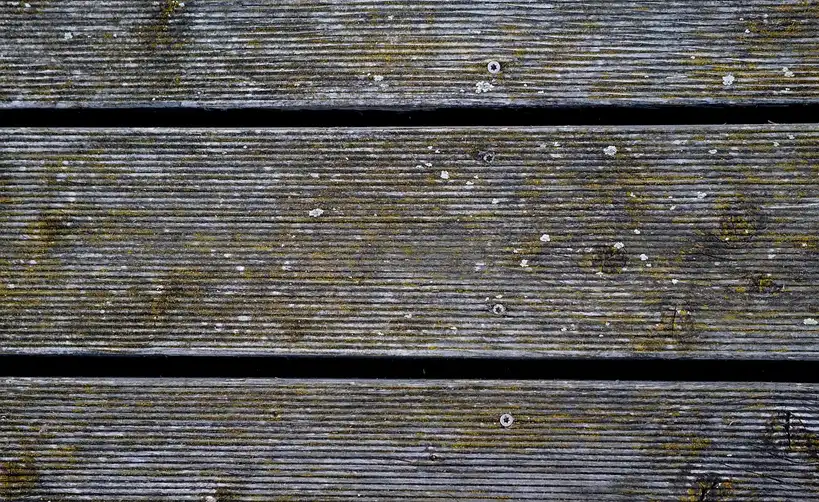
For decking, many makers recommend stainless steel for cedar, redwood, and coastal exposure, and hot-dip galvanized for pressure-treated lumber; for 1-inch deck boards, use screws around 2 1/2 inches, and for framing ties, use screws around 3 inches. Wrong fasteners can stain boards, corrode early, and loosen joints. This guide compares screw material, drive type, and length by deck species, exposure, and for fastening decking or framing.
This guide is part of our Woodworking fasteners and project basics series.
Quick comparison
| Product | Badge | Best for | Price | ||
|---|---|---|---|---|---|
 |
Power Pro Exterior Wood Screws, #9 x 3in, 74 Pack, BronzePower Pro | Our pick | #9 x 3in · Bronze · 74 Pack | $12.49
Price as of 14 Oct 2026
|
View |
 |
Simpson Strong-Tie SDWS16212QMB Strong-Drive SDWS FramingSimpson Strong-Tie | Budget pick | 0.160 x 2-1/2in · Tan · 250 Pack | $77.52
Price as of 14 Oct 2026
|
View |
 |
Fastenmaster FMHLGMTT412-12 4 1/2 Headlok | Fasteners,FASTENMASTER | Also great | 4-1/2in · Black · Torx Drive | $22.46
Price as of 14 Oct 2026
|
View |
 |
Starborn Pro Plug System Rocky Harbor PVC Composite DeckStarborn | Pair with it | 2-3/4in · Rocky Harbor · Complete Kit | $79.99
Price as of 14 Oct 2026
|
View |
 |
GRK Fasteners RSS™ 5/16 x 5-1/8" Rugged Structural Screws,GRK | Upgrade pick | 5/16 x 5-1/8in · SS 305 · 40 PCS | $91.99
Price as of 14 Oct 2026
|
View |
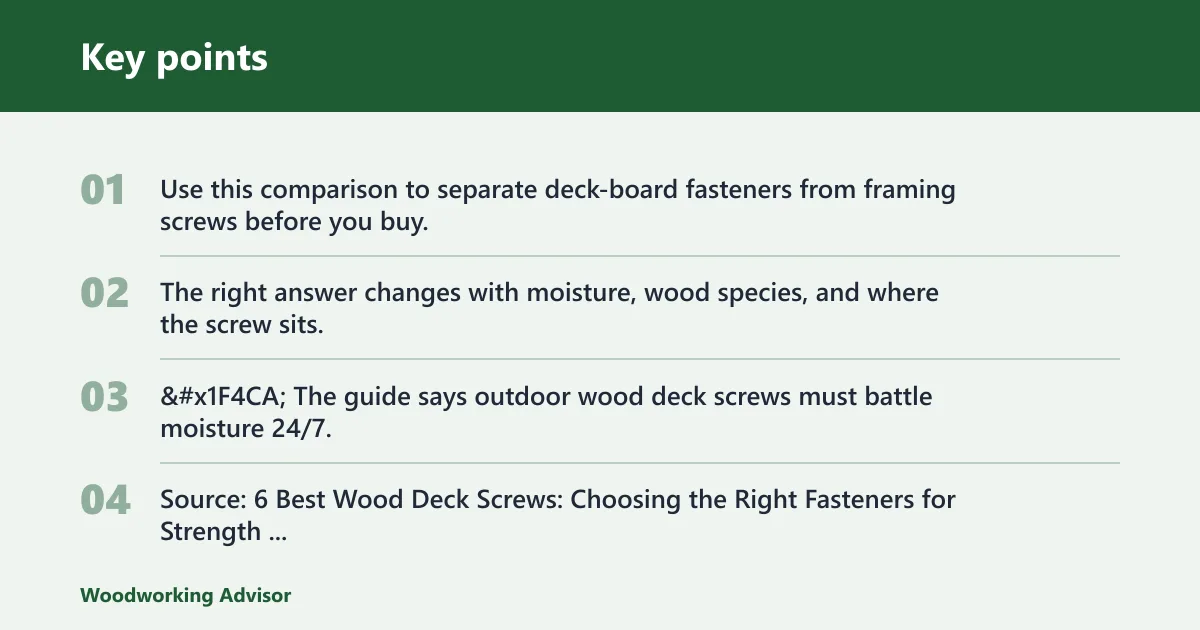
Use this comparison to separate deck-board fasteners from framing screws before you buy. The right answer changes with moisture, wood species, and where the screw sits, visible on the surface or hidden inside a structural joint.
📊 The guide says outdoor wood deck screws must battle moisture 24/7. Source: 6 Best Wood Deck Screws: Choosing the Right Fasteners for Strength ….
How we chose
We compared four things: corrosion resistance by exposure level, drive type and cam-out control, length and gauge for boards versus framing, and compatibility with pressure-treated lumber, cedar, and hardwoods.
Outdoor deck screws fight moisture every day, so material matters as much as length. We also split deck boards from structural framing, because those jobs need different screw sizes and head profiles.
Finally, we weighed when pilot holes make sense. That step matters near board ends, in dense hardwoods, and anywhere splitting would be costly.
Decision table: match the screw to the deck and exposure
| Deck material and exposure | Recommended screw material | Drive type | Recommended length | Pre-drill or avoid standard coated screws? |
|---|---|---|---|---|
| Cedar or redwood, dry inland deck boards | Stainless steel or polymer-coated | Torx/T-star or square drive | #9 or #10 x 2.5-3 inch | Pre-drill near ends; avoid basic galvanized if staining matters |
| Pressure-treated lumber, typical backyard deck boards | Stainless steel or hot-dip galvanized; polymer-coated as a budget option in mild climates | Torx/T-star or square drive | #9 or #10 x 2.5-3 inch | Pre-drill at ends and in dense grain; avoid standard coated screws in wet climates |
| Hardwood decking, any exposure beyond dry inland | Stainless steel | Torx/T-star or square drive | #9 or #10 x 2.5-3 inch | Pre-drill most holes; avoid standard coated screws |
| Wet, coastal, or high-rain sites | Stainless steel | Torx/T-star or square drive | #9 or #10 x 2.5-3 inch for boards; #12 x 3.5 inch for framing | Pre-drill where splitting is likely; avoid standard coated screws |
| Structural framing, joists, ledgers, and blocking | Stainless steel or structural-coated fasteners matched to code and wood type | Torx/T-star, square drive, or 6-lobe structural drive | #12 x 3.5 inch or longer as specified by the connection | Pre-drill where required by manufacturer or near edges; avoid light-duty deck screws |
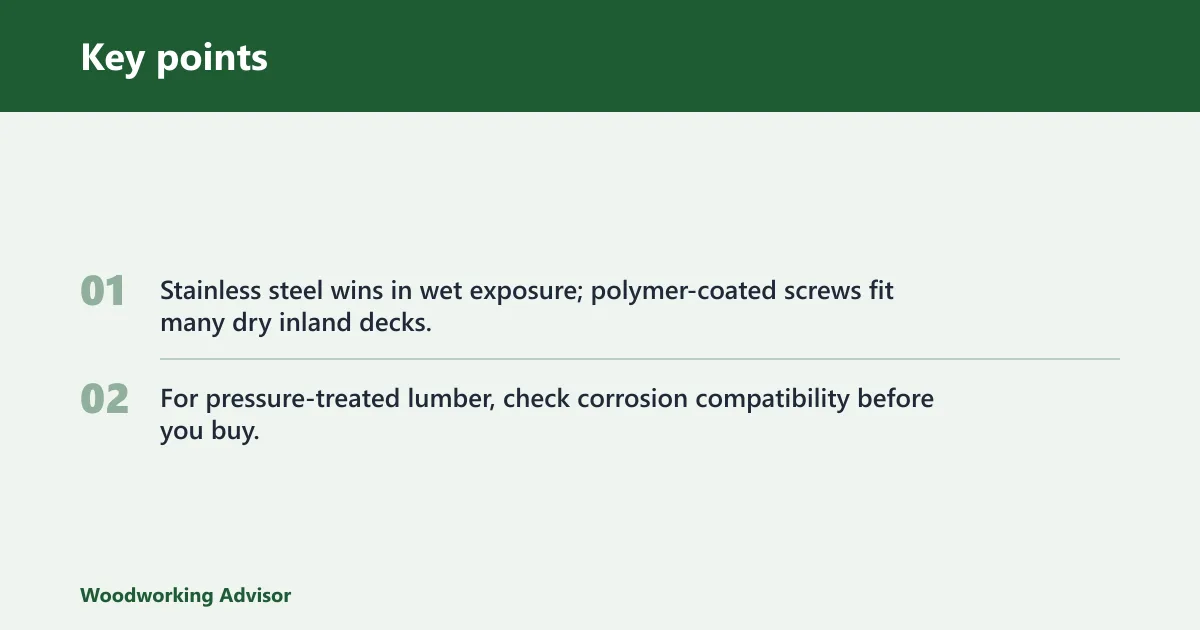
The short version is simple. Stainless steel wins in wet exposure; polymer-coated screws fit many dry inland decks; galvanized still has a place, but it is the weaker choice in wet climates. For pressure-treated lumber, check corrosion compatibility before you buy.
Stainless steel deck screws: best for wet and coastal decks
Stainless steel is the safest choice when salt, wet weather, or year-round dampness is part of the job. It resists corrosion better than coated carbon steel, and that matters on cedar, redwood, and pressure-treated lumber where rust stains and early failure are common risks.
When stainless is the right call
Use stainless when you are near the coast, on a shaded deck that stays wet, or on premium wood where stain marks would be obvious. It is also the better match for hardwood decking, which tends to punish lesser fasteners and magnify splitting around the hole.
Stainless usually costs more. That is the tradeoff. But in wet climates, the longer service life is why it leads this guide.
Polymer-coated deck screws: best for dry inland projects
Polymer-coated screws are a practical middle ground for many exterior decks. They add weather protection and often cost less than stainless, which makes them attractive for dry inland projects and moderate exposure where the deck does not stay soaked for long periods.
Where coatings work well
These screws suit ordinary pressure-treated deck boards in mild climates, provided the coating is designed for exterior use and the manufacturer approves it for treated lumber. They are also useful when you want a darker screw head that blends into the board.
The limit is clear. The sourced guidance says stainless steel or polymer-coated options outlast galvanized by 5-10x in wet climates, but coating alone is not a cure-all. On coastal decks, constant rain, or long wet-dry cycles, stainless is still the safer answer.
Galvanized deck screws: best for lighter-duty outdoor use
Galvanized screws still make sense for some outdoor jobs, especially where exposure is mild and budget matters. They are better than interior wood screws, but they are a weaker choice in wet climates than stainless or polymer-coated fasteners.
Where galvanized still fits
Use them only when the deck drains well, the species is less demanding, and the project does not sit in constant moisture. They are common on simple exterior repairs and some framing jobs, but they are not the first choice for coastal decks or premium boards.
Suppose you fasten cedar deck boards on a covered porch with small seasonal wetting. A galvanized screw may seem fine at first, but staining and corrosion risk rise if water lingers in joints. That is exactly where stainless earns its keep.
Power Pro exterior wood screws: best for deck boards
This is the practical pick for typical deck boards when you want a dedicated exterior screw with a Torx-style drive. The #9 x 3 inch size fits the common range for 5/4 decking, and the T25 star drive gives six contact points that cut slipping.
It suits homeowners fastening pressure-treated deck boards or general exterior trim where a bronze finish is acceptable. The self-starting tip is also meant to speed engagement and reduce splitting in treated lumber.
The drawback is that this is still a coated exterior screw, not stainless steel. For coastal exposure or other severe wet sites, stainless remains the safer long-term choice.
Simpson Strong-Tie SDWS framing screws: best for framing ties
This screw is built for structural work, not visible deck-board fastening. The 0.160-inch by 2-1/2-inch size, low-profile head, and 6-lobe drive fit framing connections where holding power and code-minded fastening matter.
It fits jobs like joists, blocking, and other structural tie points where you need a stronger fastener than a standard deck screw. The Quik Guard coating adds outdoor corrosion protection, which is useful in exposed framing.
The drawback is length. At 2-1/2 inches, it is not the right answer for every thicker framing connection, and it is not a substitute for a properly sized deck-board screw on the walking surface.
FastenMaster HeadLok: best for heavy-duty structural connections
This is the strongest structural choice in the list for big framing connections, ledger-style work, and other high-load joints. The 4-1/2 inch length and wide head are aimed at load capacity rather than hiding in a deck board.
It makes sense where you need a structural wood screw with Torx drive and a head that helps clamp parts tightly. That matters for deck and fence installation projects, especially when the connection is doing real work.
The drawback is obvious: it is oversized for ordinary deck boards and not meant for surface fastening. Use it where the structure needs it, not where a smaller deck screw would be cleaner.
Starborn Pro Plug System: best for composite deck boards
This kit is aimed at composite and PVC decking when you want hidden fastening with color-matched plugs. The template places screws in the thickest part of the board, which helps reduce the chance of blowing out a thin edge.
It is a good fit when appearance matters as much as holding power. The complete kit also simplifies the job because the plugs, screws, tool, and drill bit are bundled together.
The drawback is scope. It is a system, not a general-purpose screw buy, so it only makes sense when you are using compatible composite or PVC boards and want plugged fastening.
GRK Fasteners RSS: best for structural hardwood and long spans
This is the heavy-duty option in the group, aimed at structural applications that need more bite than a standard deck screw can provide. The 5/16 x 5-1/8 inch size, ESR-2442 approval, and W-cut thread design point to serious framing and connection work.
It is a strong choice when dense wood or demanding structural details would make a smaller screw feel underbuilt. The Zip-Tip is designed to reduce the need for pre-drilling in most wood types, which can save time on large jobs.
The drawback is cost and size. It is overkill for routine deck-board fastening, and you should not buy it just because it is the biggest screw on the shelf.
What screws should you use for decking?
For deck boards, use exterior-rated deck screws, not generic interior wood screws. For 5/4 decking, #9-#10 x 2.5-3 inch screws are the common target, while structural framing often calls for #12 x 3.5 inch screws or longer. Torx/T-star and square drives are preferred because they reduce cam-out and work better with impact drivers.
Deck boards versus framing
Deck-board screws hold the walking surface to the joists. Framing screws hold joists, blocking, ledgers, and other structural members together. Those are different jobs, and buying one screw for both usually leads to poor fit, weak clamping, or unnecessary overbuild.
A common first-timer mistake is using a long structural screw on visible deck boards because it “looks stronger.” That can leave heads too deep, increase split risk, and make future board replacement harder.
Common sizes and drive types
#9 and #10 screws are common for deck boards. #12 screws are more typical where thicker joists or structural connections need greater shear strength. For exterior work, Torx/T-star and square drive beat Phillips because they give better bit engagement and less slipping under torque.
- Choose the screw material for the exposure level first.
- Choose the drive style next, with Torx or square at the top.
- Match the length to the job: deck board or framing connection.
- Pre-drill where splitting is likely, especially near ends.
- Drive screws straight and stop before the head strips.
Which one should you buy?
Buy stainless steel if the deck stays wet, sits near salt air, or uses cedar, redwood, or hardwood boards. Buy polymer-coated screws for a dry inland deck when you want a lower-cost exterior option. Buy galvanized only for lighter-duty outdoor use, and avoid it as a default in harsh weather.
Best choice by budget
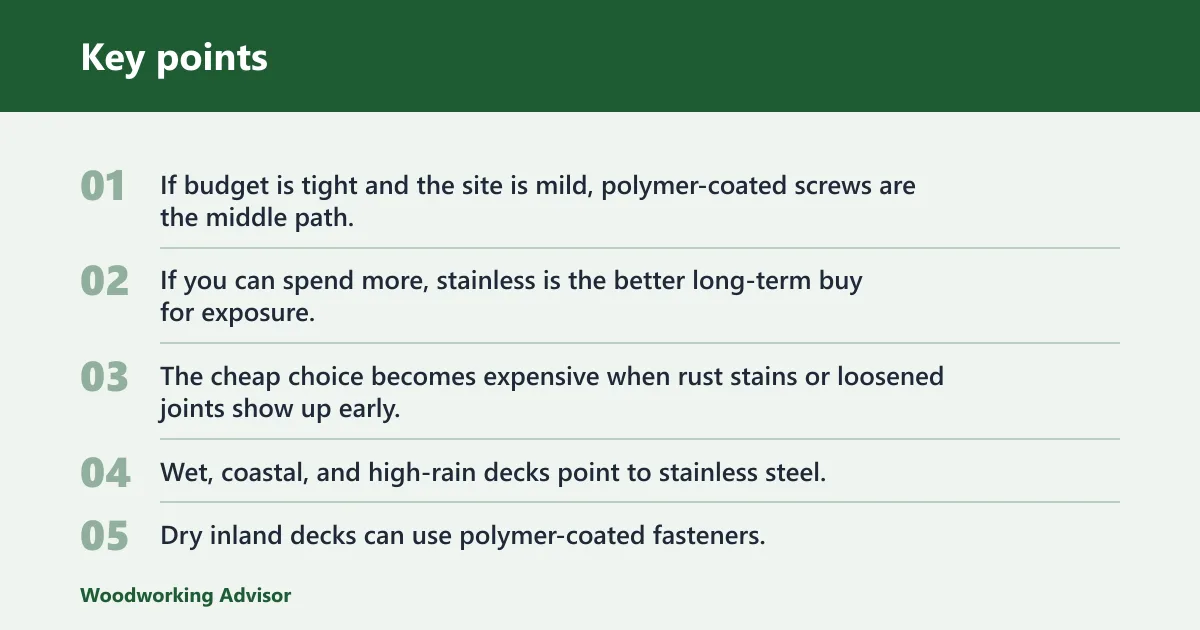
If budget is tight and the site is mild, polymer-coated screws are the middle path. If you can spend more, stainless is the better long-term buy for exposure. The cheap choice becomes expensive when rust stains or loosened joints show up early.
Best choice by exposure
Wet, coastal, and high-rain decks point to stainless steel. Dry inland decks can use polymer-coated fasteners. Galvanized belongs in the least aggressive conditions, not on the most exposed faces of the deck.
Best choice by wood species
Cedar and redwood favor stainless, especially if the screw heads will remain visible. Pressure-treated lumber needs a corrosion-resistant fastener compatible with wet treated stock. Hardwood decking often needs stainless plus pre-drilling to limit splitting and edge checking.
Best choice by job type
For deck boards, choose #9 or #10 exterior deck screws around 2.5-3 inches long. For framing ties, move up to structural screws such as #12 x 3.5 inch or the length specified by the connector and code requirements. Do not mix those jobs casually.
Picture a 5/4 pressure-treated deck board with screws placed too close to the edge. Without a pilot hole, the board can split and the screw may not clamp well. Pre-drilling is the fix, and the guide’s figure says it can boost holding power by 40%.
Another common failure is cam-out from a worn Phillips bit. The head slips, the recess rounds, and the screw finishes at the wrong angle. A Torx or square drive cuts that risk sharply, especially with an impact driver.
Frequently asked questions
exterior screws vs deck screws
Exterior screws are made for outdoor use, but deck screws are more specific. Deck screws usually add better corrosion resistance, sharper points, and drive styles that cut cam-out. A generic exterior screw may work on trim, but deck work needs a fastener built for repeated moisture and board movement.
deck screws vs wood screws
Deck screws are a subtype of wood screw made for outdoor exposure. Generic wood screws are often intended for interior use and may not have the coating, drive type, or thread profile needed for decks. That difference matters because moisture, movement, and corrosion are constant problems outdoors.
what size screws for decking
For typical 5/4 deck boards, #9-#10 screws around 2.5-3 inches are the common choice. For structural framing work, #12 x 3.5 inch screws are more typical. Length should match the task, because deck boards and framing parts need different holding power and penetration depth.
Sponsored / affiliate links. As an Amazon Associate I earn from qualifying purchases. I may earn additional commission from eligible campaigns.