Menards Treated Lumber Sizes: 2×4 to 6×6 + Landscape Timbers
Menards sorts its AC2 pressure-treated lumber into Above Ground, Ground Contact and Critical Structural, and the listings we checked run from 1×2 boards to 6×6 timbers in lengths up to 20 ft. Pick the rating by where the wood sits, not by size. This guide covers actual dimensions, how a landscape timber differs from a 4×6 timber, and the board-foot math for comparing cost without a price list.
Menards Treated Lumber Sizes by Rating
Best Landscape Timber Screw Pick
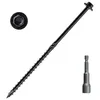 |
LIONMAX Timber Screws, 6 Inch (60-Pack): $24.99 A 4×6 timber laid flat is 3.5 in. thick, so a 6 in. screw passes through one course and bites about 2.5 in. into the course below, the stacking method this guide describes for landscape timber walls and beds.
|
As an Amazon Associate we earn from qualifying purchases.
Menards sells one treatment brand, AC2, a copper-based preservative that its listings describe as micronized copper particles pressure-impregnated into southern yellow pine. What changes from shelf to shelf is the rating: Above Ground for wood that never touches soil, Ground Contact for posts, joists and anything near dirt, and Critical Structural, which Menards says carries 50 percent more preservative than Ground Contact. For which rating suits which build, see our guide to which treated lumber grade to buy at Menards.
The table below lists the size and rating combinations that appeared in Menards product listings when we searched on October 1, 2026. Menards.com blocked our direct page reads, so we are reporting only product names and sizes, not prices or stock, which change by store.
| Product line | Sizes seen in listings | Menards rating label | Typical use |
|---|---|---|---|
| Small boards and strips | 1x2x8, 2x3x3 | Above Ground | Trim, lattice, fence nailers |
| Dimensional lumber | 2x4x6, 2x6x16, 2x8x14, 2x10x12 and x20, 2x12x12 | Ground Contact (grades #1 and #2 Prime) | Joists, rim boards, stringers, fence rails |
| Square timbers | 4x4x4, 4x4x8 | Ground Contact | Fence and railing posts |
| Square timbers | 4x4x12, 6x6x4 to 20 ft | Critical Structural | Posts set in concrete or soil, pergola and pole-barn style posts |
| Rectangular timbers | 4x6x8 | Ground Contact | Retaining walls, raised beds |
| Long rectangular timbers | 4x6x16, 18 and 20 ft | Critical Structural | Beams and heavy posts |
| Rough sawn timber | 3x12x16 | Critical Structural | Heavy structural and rustic work |
| 5/4×6 decking | 6 to 20 ft | Above Ground (#1 Premium and #2 Standard) | Deck surfaces |
Menards labels each product by name, while lumber industry tags use AWPA use categories. The AWPA categories that line up are UC3B for Above Ground, UC4A for Ground Contact and UC4B for Critical Structural. That ordering matters: UC4B is the heavier-duty category, and the Preserved Wood use category chart lists horticulture posts and building poles under UC4B. Always confirm the category printed on the end tag of the piece you pick up.
Nominal vs Actual Size: What You Really Get
A 2×4 is not 2 inches by 4 inches. Dimensional softwood is planed after drying, so lumber thinner than 2 inches loses about 1/4 in. and lumber from 2 to under 8 inches loses about 1/2 in. on each face dimension. Treated lumber follows the same rule, and the difference decides whether a hanger, a bracket or a post base fits.
| Nominal size | Actual size | Board feet per 8 ft piece |
|---|---|---|
| 2×4 | 1-1/2 in. x 3-1/2 in. | 5.3 |
| 2×6 | 1-1/2 in. x 5-1/2 in. | 8.0 |
| 4×4 | 3-1/2 in. x 3-1/2 in. | 10.7 |
| 4×6 | 3-1/2 in. x 5-1/2 in. | 16.0 |
| 6×6 | 5-1/2 in. x 5-1/2 in. | 24.0 |
Board feet are calculated from nominal sizes: thickness in inches times width in inches times length in feet, divided by 12. Menards lists the actual size of its 4x6x8 Ground Contact timber as 3-1/2 in. x 5-1/2 in. x 8 ft and its 6x6x6 Critical Structural timber as 5-1/2 in. x 5-1/2 in. x 6 ft, which matches the chart.
Comparing cost without a price list: divide any posted price by the board feet in the table. A 6x6x8 holds 24 board feet and a 4x6x8 holds 16, so the 6×6 should cost about 1.5 times the 4×6 before any difference in rating. If the gap is much wider or narrower, you are looking at a rating or grade difference, not just more wood.
Menards Landscape Timbers: Three Different Products
Shoppers searching for “menards landscape timbers” usually find three different things in the same aisle, and they are not interchangeable.
- Treated landscape timber, 8 ft. Menards lists an 8 ft treated landscape timber on its landscaping timbers page, and also sells it in a bundle of 25. It is sold as a landscaping product, so treat it as border and light-duty material and confirm its end tag.
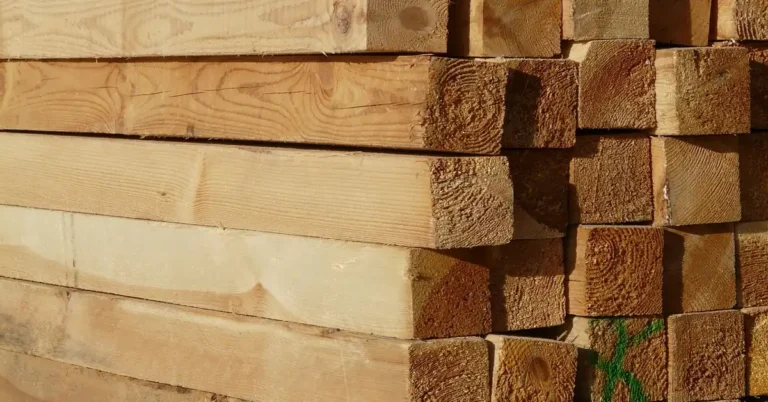
- 4x6x8 Ground Contact timber. A full AC2 timber with an actual size of 3-1/2 in. x 5-1/2 in. x 8 ft, graded #2 and sold in the timbers aisle. Choose it when the wall or bed has to carry soil load.
- 8 ft black plastic landscape timber. A recycled-plastic alternative that does not rot, which suits borders where you never want to replace wood.
The practical difference is rating and grade. A landscape timber is a border product. A 4×6 Ground Contact timber is a lumber product with an end tag. Menards also sells 6×6 Critical Structural timbers, which are the heavier-duty option for anything that holds back soil. For wall design and height limits, see wood retaining wall ideas.
Stacking and Fastening Timbers
Stagger the joints like brickwork, pre-drill, and fasten each course to the one below. Two long screws per timber end, or rebar driven through drilled holes into the soil, keep the wall from shifting. Our rebar spacing guidance is a common field practice rather than a Menards instruction, so check the instructions of any wall system you use. Use hot-dip galvanized or stainless fasteners: Simpson Strong-Tie recommends post-hot-dip galvanized (G185 or ZMAX) connectors for preservative-treated wood, not bare steel.
Using Timbers for Raised Beds
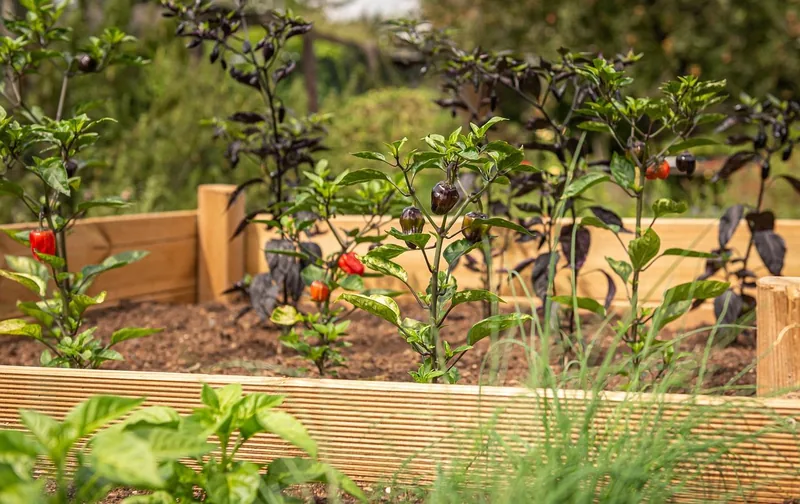
Beds are the most common reason people buy landscape timbers. The AWPA states that its expertise covers wood durability rather than human health, and defers to the EPA, which registers wood preservatives for general consumer use; it also notes a plastic barrier is an option if you want to separate wood from soil. For the full vegetable-garden discussion see using pressure-treated wood in a vegetable garden and treated wood for raised beds.
Treated Decking and Boards at Menards
Menards sells 5/4×6 treated decking in lengths from 6 to 20 ft, in a #1 Premium grade and a #2 Standard grade, rated Above Ground. The product listing describes its thick decking as 1-5/32 in. thick, about 15 percent thicker than its thin 5/4 decking, and says Above Ground wood belongs at least 6 inches off the ground. A deck that sits lower than that, such as a ground-level platform, should use Ground Contact material instead. For decking sizes and grades in detail, see our 5/4 deck boards at Menards guide.
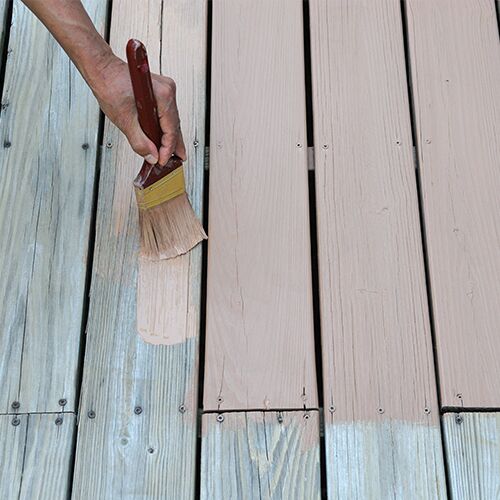
Fresh AC2 lumber is wet when it leaves the yard, so boards can shrink and twist as they dry. Buy decking early, stack it with spacers, and let it dry before fastening. Once it has dried, sealing it slows weathering, and service life on a deck depends mostly on exposure and drainage.
Fasteners and Handling Safety
Use hot-dip galvanized (ASTM A153) fasteners with ZMAX connectors, or stainless fasteners with stainless connectors. Do not mix galvanized fasteners with stainless connectors. Cut ends expose untreated wood in the core of a board, so keep ends away from soil where you can.
CCA-treated wood was voluntarily discontinued for residential use effective December 31, 2003, and the EPA says to wear goggles and a dust mask when sawing it and to wash your hands afterward. Source: EPA, Chromated Arsenicals (CCA)
Wear the same protection for any treated lumber you cut, and never burn offcuts. The EPA warns that smoke and ash from burning CCA-treated wood are a hazard; see why treated wood should not go in a fire pit. Old landscape timbers and railroad ties may be older creosote or CCA material, so do not assume reclaimed timbers match what Menards sells today.
Common Mistakes When Buying Treated Lumber at Menards
- Assuming Ground Contact is the top rating. Critical Structural is the heavier-duty tier, with 50 percent more preservative according to Menards.
- Treating a landscape timber like a 4×6 timber. They are different products with different ratings; confirm on the end tag.
- Ignoring actual size. A 6×6 is 5-1/2 in. square, so post bases and brackets must be sized to the actual dimension.
- Putting Above Ground boards near soil. The listing guidance is at least 6 inches of clearance.
- Comparing prices per piece instead of per board foot. The chart above takes ten seconds and exposes which cart item is the real bargain.
Comparing stores before you drive? Our guide to pressure-treated wood at Lowe’s covers the competing lineup, and for what ground-contact ratings mean in practice see ground contact pressure treated lumber.
Frequently Asked Questions
What sizes of treated lumber does Menards sell?
Menards listings we checked run from 1×2 boards through 2×12 dimensional lumber to 4×4, 4×6 and 6×6 timbers, plus 5/4×6 decking. Lengths seen range from 3 ft to 20 ft depending on the product. Stock varies by store, so confirm on Menards.com or in the store.
Is Menards treated lumber rated for ground contact?
Some of it is. Menards labels its AC2 lumber Above Ground, Ground Contact or Critical Structural, and only the last two are meant for soil contact. Check the end tag for the use category, UC4A for Ground Contact or UC4B for the heavier-duty tier, before you buy.
What is the difference between a landscape timber and a 4×6 timber?
A landscape timber is a border-grade product sold in the landscaping aisle, such as the 8 ft treated landscape timber. A 4×6 timber is a lumber product with an actual size of 3-1/2 by 5-1/2 inches and a use-category end tag. Use the 4×6 where soil load or structure is involved.
Can I use Menards treated lumber for a raised garden bed?
Many gardeners do. The EPA registers modern wood preservatives for general consumer use, and the AWPA suggests a plastic barrier if you want to keep wood and soil apart. Avoid old creosote timbers or railroad ties, which are a different material.
What fasteners should I use with treated lumber?
Use hot-dip galvanized fasteners that meet ASTM A153 with G185 or ZMAX connectors, or stainless steel fasteners with stainless connectors. Simpson Strong-Tie recommends these finishes for preservative-treated wood because copper-based treatments are corrosive to bare steel.
Can I burn leftover treated lumber?
No. The EPA says CCA-treated wood should not be burned because the smoke and ash can be harmful, and burning any treated offcuts is a poor idea. Check with your local waste authority for disposal rules.
Menards treated lumber is easiest to buy well when you read it in three steps: choose the rating for the wood’s exposure, convert nominal to actual size for your hardware, and compare cost per board foot. Check Menards.com or your store for current prices, since they change by location.
Sponsored / affiliate links. As an Amazon Associate I earn from qualifying purchases. I may earn additional commission from eligible campaigns.