Redwood Deck Boards: Grades, Sizes, and How to Choose the Right One
Not all redwood decking sold at the lumber yard is the same wood. “Redwood deck boards” can mean anything from all-heartwood Clear grade to Construction Common boards that are half pale sapwood — and which one you get changes how it ages, how long it resists rot, and whether it needs a finish at all.
Grade First, Then Everything Else
Check This Before You Buy or Finish Redwood
 |
Proster Pinless Wood Moisture Meter – $25.85 Redwood decking should read roughly 12-15% moisture before you finish or fasten it — installing or staining it wet is the single biggest cause of early cupping and finish failure.
|
Compare More Redwood Decking Essentials
 TWP 100 Pro Series Redwood Wood Protectant, 1 Gal – $24.99 Penetrating oil finish formulated to match redwood’s natural tone instead of masking it. View on Amazon |
 DeckWise Deck & Wood Brightener – $17.95 Neutralizes the tannin bleed and gray weathering redwood is known for before you finish it. View on Amazon |
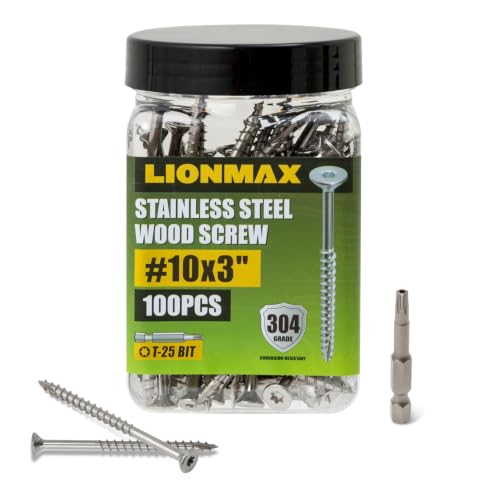
 DeckWise Stainless Trim-Head Deck Screws, 100 Pk – $35.97 304 stainless resists the black staining reaction plain steel screws cause in tannin-rich redwood. View on Amazon |
Redwood’s natural decay resistance lives almost entirely in the heartwood — the reddish-brown core of the tree. The pale, cream-colored sapwood around the outside has none of that natural resistance and will rot just like an untreated softwood if it stays wet. Grading rules exist specifically to tell you how much of each you’re getting:
- Clear All Heart / B Heart: 100% heartwood, no sapwood, the fewest knots. Highest decay resistance, highest price.
- Construction Heart: All heartwood but with more knots allowed. The common choice for structural framing and ground-contact use where the wood stays in heartwood territory but appearance matters less.
- Construction Common: A mix of heartwood and sapwood. Costs less, looks fine once finished, but the sapwood portions need a protective finish and shouldn’t touch soil or sit in standing water.
If a board is labeled just “redwood decking” with no grade stamp, assume it’s a common grade with sapwood mixed in, and plan to finish every face — don’t rely on “redwood is naturally rot-resistant” as a reason to skip a finish, because that resistance is a heartwood property, not a species-wide guarantee.
Board Profile and Orientation
Standard redwood decking comes as 5/4×6 radius-edge decking (the rounded-edge board you see on most residential decks) or full 2×6 dimensional lumber for a heavier, more traditional look. Vertical-grain (quarter-sawn) boards are more dimensionally stable and resist cupping better than flat-grain boards, which matters more on wider boards. On flat-grain boards, installing bark-side-up (following the curve of the growth rings) is the long-standing rule of thumb for shedding water and resisting cupping over time — check the end grain of each board before you commit to a layout, since it’s not always obvious from the face.
The “Low Maintenance” Claim Needs a Caveat
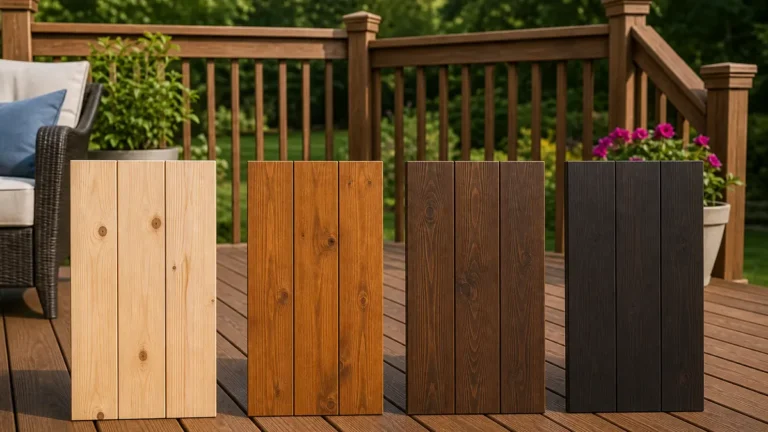
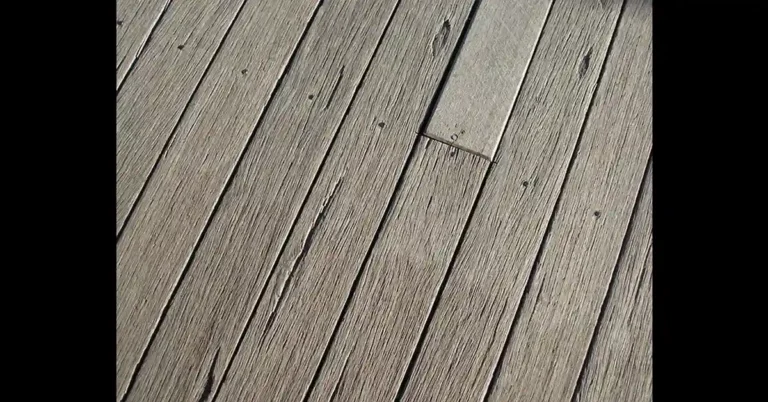
Redwood is genuinely low-maintenance in the sense that it resists rot and insects without chemical treatment. It is not low-maintenance if you want to keep its reddish-brown color: like all untreated wood, UV exposure turns it a silver-gray within about six months to a year outdoors. If gray is the look you want, you can leave it unfinished and let it weather naturally with zero upkeep. If you want to keep the red-brown tone, that requires a UV-blocking penetrating oil finish reapplied every 1-3 years depending on sun exposure — there’s no one-and-done sealer that keeps the color indefinitely. Check moisture content with a meter before finishing (redwood should be in the 12-15% range, not fresh off a wet delivery truck), since finish applied to damp wood traps moisture underneath and fails early.
Fasteners: Why Plain Steel Screws Stain Redwood Black
Redwood, like cedar, is naturally high in tannins. When those tannins react with iron — from a plain steel screw, nail, or even runoff from a steel bracket upstream — they form a dark, hard-to-remove stain around the fastener head. Stainless steel (304 is fine for most climates; 316 for coastal/salt-air exposure) doesn’t react with the tannins and is worth the extra cost over galvanized or plain steel, especially anywhere the fastener head will be visible on a finished surface.
For the cost side of a redwood deck project — current price-per-board-foot ranges, how supply and demand affect pricing, and a full project budget breakdown — see our dedicated redwood deck lumber prices guide.
Frequently Asked Questions About Redwood Deck Boards
What’s the difference between redwood grades?
Clear All Heart and B Heart are 100% heartwood with the fewest knots and the highest decay resistance. Construction Heart is all heartwood with more knots allowed. Construction Common mixes in pale sapwood, which lacks redwood’s natural decay resistance and needs a protective finish.
Is redwood really low maintenance?
It’s low maintenance for rot and insect resistance without chemical treatment. It is not low maintenance if you want to keep the red-brown color, which fades to gray within about a year outdoors unless you apply a UV-blocking finish and reapply it every 1-3 years.
Why did my screws leave black marks around the heads?
Redwood is high in tannins, which react with iron in plain steel or galvanized fasteners to create a dark stain. Switching to 304 or 316 stainless steel screws prevents the reaction.
Which way should I install flat-grain redwood boards?
The long-standing rule of thumb is bark-side-up, following the curve of the growth rings visible on the board’s end grain, which sheds water better and resists cupping. Vertical-grain (quarter-sawn) boards are more dimensionally stable regardless of orientation.
Sponsored / affiliate links. As an Amazon Associate I earn from qualifying purchases. I may earn additional commission from eligible campaigns.