Sam Maloof’s Carved Details: The Scoop, Curve, and Contour Work
Beyond the structural Maloof joint that connects a chair’s seat, arm, and leg, Sam Maloof’s rocking chairs carry a set of distinct hand-carved details that are more about comfort and visual softness than structure: a scooped, contoured seat, rounded and tapered armrests, and smoothly rounded spindle tops. These are the details that make an authentic piece feel different in the hand and against the body than a flat-seated, square-edged production chair, and they’re carved and sanded by hand rather than machine-profiled.
The Scooped Seat
See the Carved Details Up Close
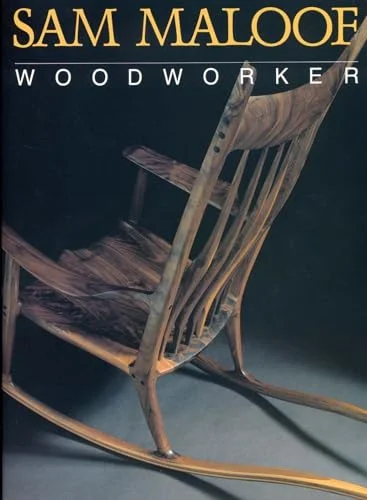 |
Sam Maloof, Woodworker (Paperback) – $44.79 Full of close-up photography of the carved details covered here — the scooped seats, contoured arms, and rounded spindle tops photographed directly from his own pieces.
|
Rather than a flat seat pan, Maloof’s chairs use a seat carved into a shallow contour that follows the shape of a seated body — deeper where weight concentrates, rising toward the edges. This is carved by hand with rasps and shaped progressively, checked repeatedly against actual sitting rather than a fixed template, which is part of why no two seats carve out to exactly the same depth or profile even across chairs of the same general design.
Contoured, Tapered Armrests
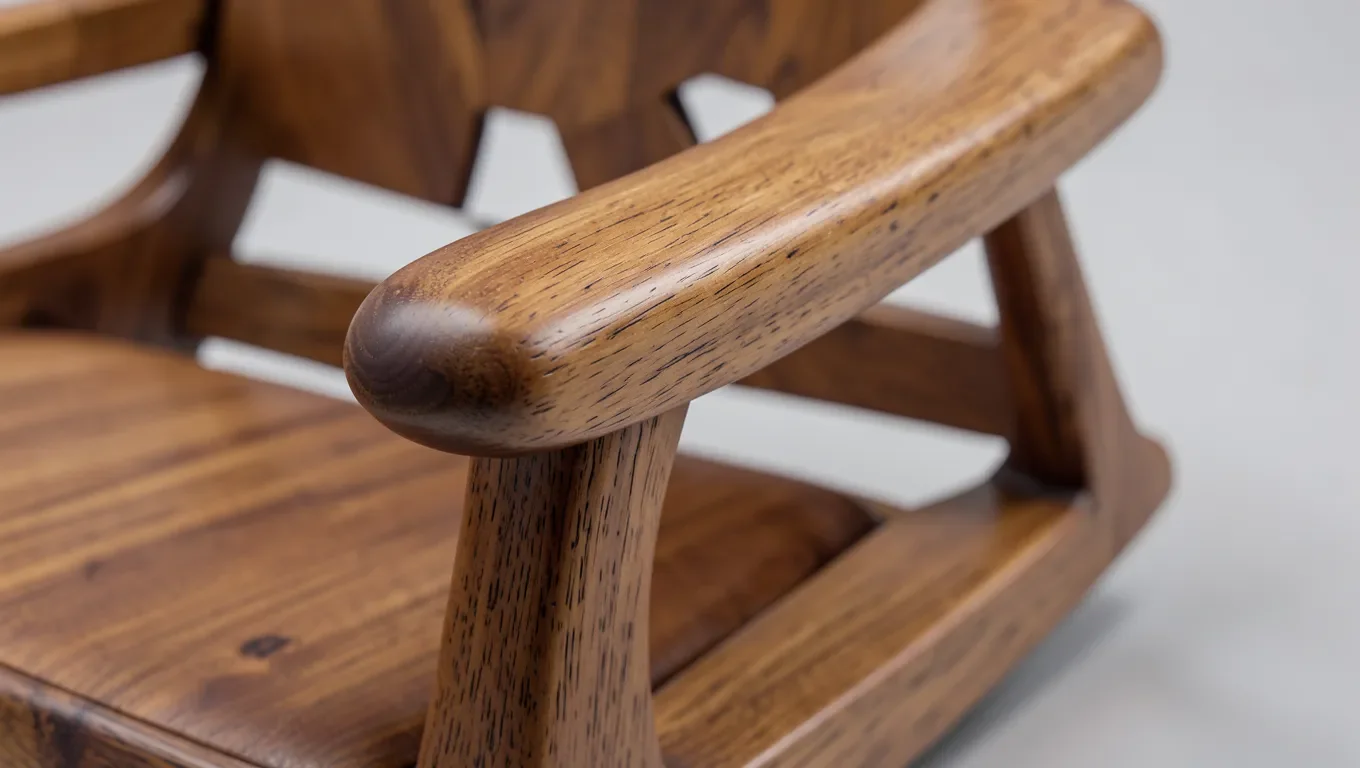
The armrests taper and round from where they meet the back spindles down to where they blend into the seat-and-leg joint, following the same continuous-curve philosophy as the joint itself. The underside is typically carved thinner and more rounded than the top, which keeps the arm visually light despite being structurally substantial — a detail that’s easy to miss looking at a photograph but immediately noticeable running a hand along a real piece.
Rounded Spindle Tops
Where many spindle-back chairs leave the spindle tops flat or simply chamfered, Maloof’s are carved into a rounded, almost pebble-like profile at the top edge, softening what would otherwise be a row of hard right angles across the top of the backrest. It’s a small detail relative to the seat and arm work, but it’s consistent across his chairs and is one of the quicker visual tells distinguishing an original or faithful reproduction from a generic spindle-back chair that only borrows the overall silhouette.
Hand-Carved vs. CNC-Routed: A Real Way to Tell Them Apart
Many modern reproductions and licensed pieces approximate Maloof’s contours using a CNC router programmed from a 3D scan, which produces a mathematically consistent, symmetrical curve on every unit. A genuinely hand-carved original almost never has that perfect symmetry — the left and right armrests, or the two sides of a seat scoop, typically show small, real variations from each other because they were shaped by eye and touch rather than cut from the same digital file twice. Running a hand across both armrests and comparing them side by side is a simple, practical check that doesn’t require an expert: near-perfect mirror symmetry points toward a machine-routed piece, while small but genuine differences between the two sides point toward true hand-shaping. This is a different signal from the underside signature mark covered on our Maloof signature authentication page, and worth checking alongside it, not instead of it.
Frequently Asked Questions
What makes a Maloof rocking chair’s seat different from a standard chair?
The seat is hand-carved into a shallow contour that follows the shape of a seated body, rather than left as a flat panel. It’s carved and checked by hand, so the exact depth and profile vary slightly between individual chairs.
Are the carved details structural or decorative?
Mostly decorative and comfort-related, distinct from the structural Maloof joint connecting the seat, arm, and leg. The scooped seat, tapered arms, and rounded spindle tops are about feel and visual softness rather than load-bearing strength.
How can you tell a hand-carved Maloof chair from a CNC-routed reproduction?
Check for small asymmetries between the left and right armrests or seat scoop. A CNC-routed reproduction typically shows near-perfect mirror symmetry since it’s cut from a single digital file, while a hand-carved original usually shows small genuine differences between the two sides.
Conclusion
The carved scoop, taper, and rounding across a Maloof chair are what separate it from a chair that only copies the overall silhouette — details shaped by hand and checked against actual use, not cut to a fixed profile. For the structural joinery behind the same chairs, see our breakdown of the Maloof joint, and for his full biography, visit the Sam Maloof chair hub.
Sponsored / affiliate links. As an Amazon Associate I earn from qualifying purchases. I may earn additional commission from eligible campaigns.