Spar Urethane vs Marine Varnish for Boats and Doors?
For boats and exterior doors, Marine Varnish is often the better choice when longer UV defense is needed and maintenance every about 1-3 years is realistic; Spar Urethane is generally better suited to lower-exposure trim or sheltered doors. Ignore that rule and the film will chalk, crack, peel, and expose the wood. This comparison explains Spar Urethane vs Marine Varnish by failure mode, sunlight, movement, and maintenance burden so you can pick the right clear finish.
This guide is part of our Which Wood Finish to Use: Polyurethane, Oil, Wax or Varnish and How to Apply It series.
| Decision factor | Spar Urethane | Marine Varnish | Winner |
|---|---|---|---|
| UV exposure | Often includes UV inhibitors, but outdoor protection depends heavily on film thickness and maintenance. | Built for sunlight exposure on exterior brightwork and meant to stay in service outdoors. | Marine Varnish |
| Wood movement | More oil and flexibility than regular interior polyurethane, so it tolerates movement better than a hard interior film. | Also made for exterior movement, but the finish still depends on staying intact before failure starts. | Spar Urethane |
| Maintenance burden | Can be a good choice where you want a simpler outdoor clear coat, especially on lower-exposure parts. | Needs maintenance before the film fails; once it starts breaking down, repairs get harder. | Spar Urethane |
| Best-fit use case | Doors, trim, outdoor furniture, and sheltered areas where sunlight is lower and upkeep is realistic. | Boat brightwork and other exposed surfaces that take strong sun and moisture. | Depends on exposure |
How sunlight and weather affect both finishes
The difference is in failure behavior, not branding. One gives you more forgiveness on moving wood and lower-exposure parts, while the other is built for stronger sun and a stricter maintenance schedule before the film breaks down.
What each finish is built to do
Spar urethane was originally formulated for boats, and it is made with more oil and flexibility than regular interior polyurethane. It often contains UV inhibitors for outdoor use, and it can be oil-based or water-based. Marine varnish is the traditional exterior brightwork finish: a film on top of wood, built to live in sunlight and moisture.
So the real question is not which label sounds more suitable. It is what the surface will face, and how often you can recoat before the finish starts to fail.
Where the labels overlap and where they do not
Both products are exterior clear coatings, and both can fail if you treat them as one-time protection. Sunlight bakes the surface, rain works at edges, temperature swings move the wood under the film, and dirt holds moisture and grime against the coating. Marine varnish is the stronger pick for high UV exposure, while spar urethane is often the more forgiving pick for less punishing outdoor conditions.
A common first-timer mistake is buying the word “marine” and assuming that alone solves sunlight. On a south-facing door or a bare boat handrail, the film still has to stay intact. When it does not, the wood pays for the mistake.
How sunlight and moisture break the film
Outdoor wood is stressed by sunlight, rain, temperature changes, and dirt. UV exposure breaks coatings down from the surface, moisture works at edges and joints, and temperature swings push the wood to move under the finish. That is why UV inhibitors matter, especially in high-UV environments.
Peeling versus cracking versus chalking
Peeling usually points to adhesion failure or a film that was allowed to fail too far before maintenance. Cracking points to a film that got too brittle for the wood movement it had to follow. Chalking is a surface breakdown from sun exposure; it often shows up before the finish fully lets go.
Those failures are not random. A rigid film on a moving part cracks sooner. A neglected exterior film peels sooner. A finish without enough UV defense breaks down sooner under strong sun.
Why maintenance timing matters more than brand names
Marine varnish is not magic. It needs attention before film failure, because repairs are easier when you catch dulling, thinning, or early surface breakdown. Spar urethane also needs maintenance, but on lower-exposure parts the interval can be more forgiving.
Suppose a 36-inch-wide exterior door gets afternoon sun and wind-driven rain. If the clear coat starts to dull at the top rail and the lower panel edges stay wet, the finish is already telling you where the next failure will begin. Waiting until the film flakes makes the repair larger and the wood harder to save.
Which finish handles wood movement better?
Spar urethane is generally the more flexible choice because it is made with more oil and flexibility than regular interior polyurethane. That matters on doors, trim, and brightwork that expand and contract with weather. Marine varnish is also intended for exterior service, but it still depends on a sound film to keep up with movement.
End grain and joint stress points
End grain drinks finish faster than face grain, and joints move and open more than flat panels. Those spots are where failure usually begins. If you skimp on sealing end grain, hinge edges, miter joints, or fastener holes, either finish can fail early even if the main field looks fine.
Surface prep matters more than sheen choice. So does film build. A thin, uneven edge coat is a weak coat, no matter how good the label sounds.
When a more flexible film helps
Use the more flexible option where the wood is expected to move and you are not chasing the longest possible UV interval. That is why spar urethane often fits sheltered doors, trim, and furniture better than a brightwork system meant for the harshest sun.
For brush-on work, oil-based spar urethane can also be thinned for wipe-on application. A practical wipe-on mix is about 75% finish to 25% thinner, and if needed the mix can be increased to a 50/50 dilution. Mineral spirits, naphtha, and paint thinner are commonly used thinner options for oil-based spar urethane. Between coats, sand in the 320–400 grit range.
Can you use spar urethane on an exterior door?
Yes, especially on a door that gets weather but not full-day sun. Spar urethane is a reasonable choice for exterior doors when you want a flexible film, a straightforward application, and less pressure to maintain boat-level brightwork schedules. It is a weaker choice if the door is high-UV, south-facing, or hard to recoat before the finish fails.
Best-fit door conditions
Spar urethane fits best on a covered or partially sheltered door, a side entry, or a door with a deep porch overhang. It also suits doors with panels, rails, and stile joints that move enough to stress a brittle coating. If the door has detailed edge profiles, the extra flexibility helps reduce cracking at those transitions.
When a door needs less gloss and more upkeep tolerance
Gloss is not the deciding factor. A lower-sheen coat may hide wear a little longer, but it does not stop UV breakdown or moisture intrusion. What matters is whether you can renew the film before it peels and whether the door sits in a relatively manageable exposure zone.
Choose Marine Varnish instead if the door is essentially a sunbaked exterior panel, such as a front door with direct afternoon light and little overhang. In that case, the stronger UV-oriented exterior system is the safer choice if you can keep up with maintenance.
Is marine varnish better for boats?
For exposed boat brightwork, yes, Marine Varnish is usually the better choice because it is built around sunlight and moisture exposure and is maintained before the film fails. That is especially true on handrails, toerails, coamings, and trim that live in strong UV and shed water constantly.
Boat brightwork and high-sun exposure
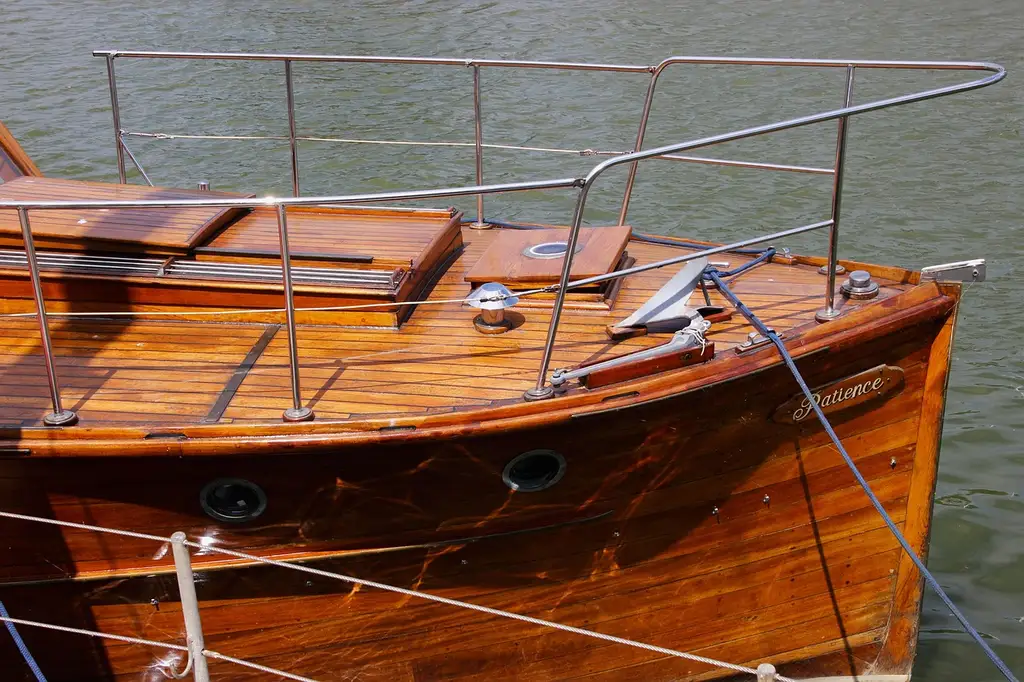
Brightwork is where the comparison becomes most one-sided. Strong sun, reflected glare, salt spray or rain, and constant wetting punish a coating quickly. Marine varnish is the more appropriate exterior system when the goal is to keep a protective film intact and repair it on schedule.
Spar Urethane can appear tempting because it says “spar,” but the use case still matters. On exposed boat trim, the deciding issue is not whether the finish came from a boat-related formulation. It is whether it can stay ahead of UV and moisture long enough to protect the wood.
Repair-before-failure maintenance
Marine varnish lasts best when you sand, clean, and recoat before the old film is gone. Once the coating gets thin enough to crack or lift, repairs become more time-consuming because you are no longer refreshing a healthy film; you are rebuilding a damaged one.
Say your cockpit rail starts turning dull near the fasteners but still feels smooth. That is the time to recoat, not after the first flakes appear. Waiting until the rail needs stripping turns a routine maintenance job into a much larger repair.
Spar urethane decision matrix
Use this matrix to match the finish to the job, not the label. The better choice depends on exposure, wood movement, and how often you can return before the film fails.
| Use case | Better finish | Expected maintenance burden | Top failure risk |
|---|---|---|---|
| Boat brightwork | Marine Varnish | High; plan on regular inspection and recoating before failure | UV breakdown leading to cracking and peel |
| Exterior door | Marine Varnish for full sun; Spar Urethane for sheltered exposure | Moderate to high depending on exposure | Edge wear, joint cracking, and moisture intrusion |
| Trim | Spar Urethane | Moderate | Thin film at edges and end grain |
| Sheltered porch furniture | Spar Urethane | Moderate to lower than full-sun locations | Surface dulling and localized wear |
| High-UV exposure | Marine Varnish | High | Chalking and UV breakdown |
| Low-maintenance owner | Spar Urethane on sheltered parts only | Lower than marine varnish, but not maintenance-free | Delayed recoating leading to peel |
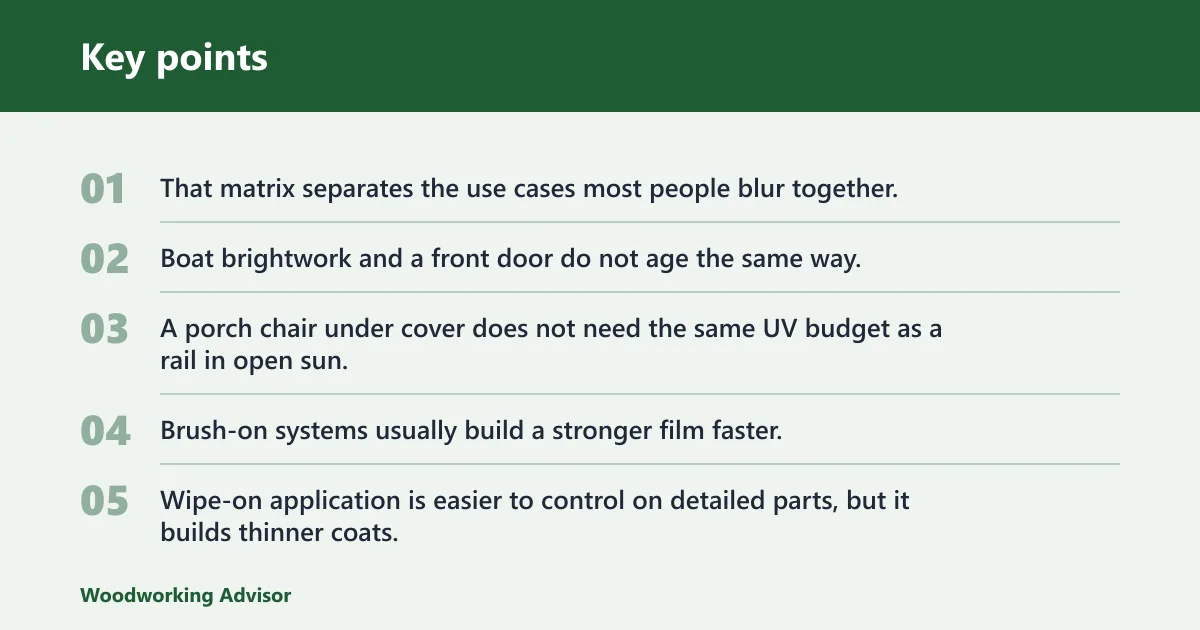
That matrix separates the use cases most people blur together. Boat brightwork and a front door do not age the same way. A porch chair under cover does not need the same UV budget as a rail in open sun.
Application method changes the result
Brush-on systems usually build a stronger film faster. Wipe-on application is easier to control on detailed parts, but it builds thinner coats, so it asks more of your prep and more of your maintenance schedule. Thin coats are useful on profiles and tight spaces, yet they do not buy you more outdoor life on their own.
That is why a water-based product like TotalBoat Halcyon can stay clearer than oil-based versions but still ask for more frequent maintenance in high-UV environments. Oil-based options, including Epifanes, are favored by many woodworkers for exterior durability and may amber over time, which is a visual trade-off rather than a defect.
Choose Spar Urethane if… / Choose Marine Varnish if…
Choose Spar Urethane if the wood is on a sheltered door, trim, or outdoor furniture piece with manageable sun exposure. Choose it if you want more flexibility over a hard interior polyurethane, if you need a wipe-on approach, or if you can accept a finish that may need attention sooner on exposed areas.
Choose Marine Varnish if the surface is boat brightwork or another high-UV exterior part that will see direct sun and frequent weather. Choose it if you want the strongest fit for sunlight and moisture exposure, and if you are willing to maintain the film before it fails instead of waiting for visible peeling.

Frequently asked questions
Is spar urethane better than marine varnish for a front door?
Not by default. For a sheltered front door, spar urethane can be a practical choice because it is more flexible and easier to use on moving wood. For a front door with full sun and rain exposure, Marine Varnish is usually the better pick because it is the stronger UV-oriented exterior film.
Is marine varnish better than spar urethane for boats?
For exposed brightwork, usually yes. Marine Varnish is designed for sunlight and moisture exposure on exterior boat surfaces, and it performs best when you maintain it before the film fails. Spar urethane can be used in some boat-related situations, but it is not the better default for open, high-UV brightwork.
What is the difference between spar urethane and marine varnish?
Spar urethane is a more flexible exterior urethane, originally formulated for boats and often made with UV inhibitors. Marine Varnish is the traditional exterior brightwork finish built as a film on top of wood for sun and moisture exposure. The practical difference is how each one handles movement and maintenance timing.
Which finish lasts longer outside in sun and rain?
Marine Varnish usually lasts longer in direct sun and rain if you keep up with maintenance. Its advantage is not immunity to weather; it is that the system is meant to be renewed before the film fails. If you miss that maintenance window, both finishes can chalk, crack, and peel.
Does marine varnish need more maintenance than spar urethane?
Usually yes, especially in high-UV exposure. Marine Varnish is a maintenance-forward exterior system, and its longest life depends on recoating before breakdown starts. Spar urethane can be a little more forgiving on sheltered parts, but it still needs upkeep if you want the wood protected.
Which clear finish is more flexible on moving wood?
Spar Urethane is generally the more flexible choice because it has more oil and flexibility than regular interior polyurethane. That makes it a better fit for doors, trim, and some furniture parts that move with weather. Marine Varnish can still work well, but it is less about flexibility alone and more about staying ahead of failure.
What should I choose if I want the easiest finish to repair later?
Choose the finish you can refresh before it fails. In practice, that often means spar urethane on lower-exposure parts and marine varnish on brightwork that gets regular inspection. Once a film peels or cracks deeply, repair becomes harder regardless of the product name.
Sponsored / affiliate links. As an Amazon Associate I earn from qualifying purchases. I may earn additional commission from eligible campaigns.