Termite-Infested Wood: How to Identify, Treat & Dispose of It
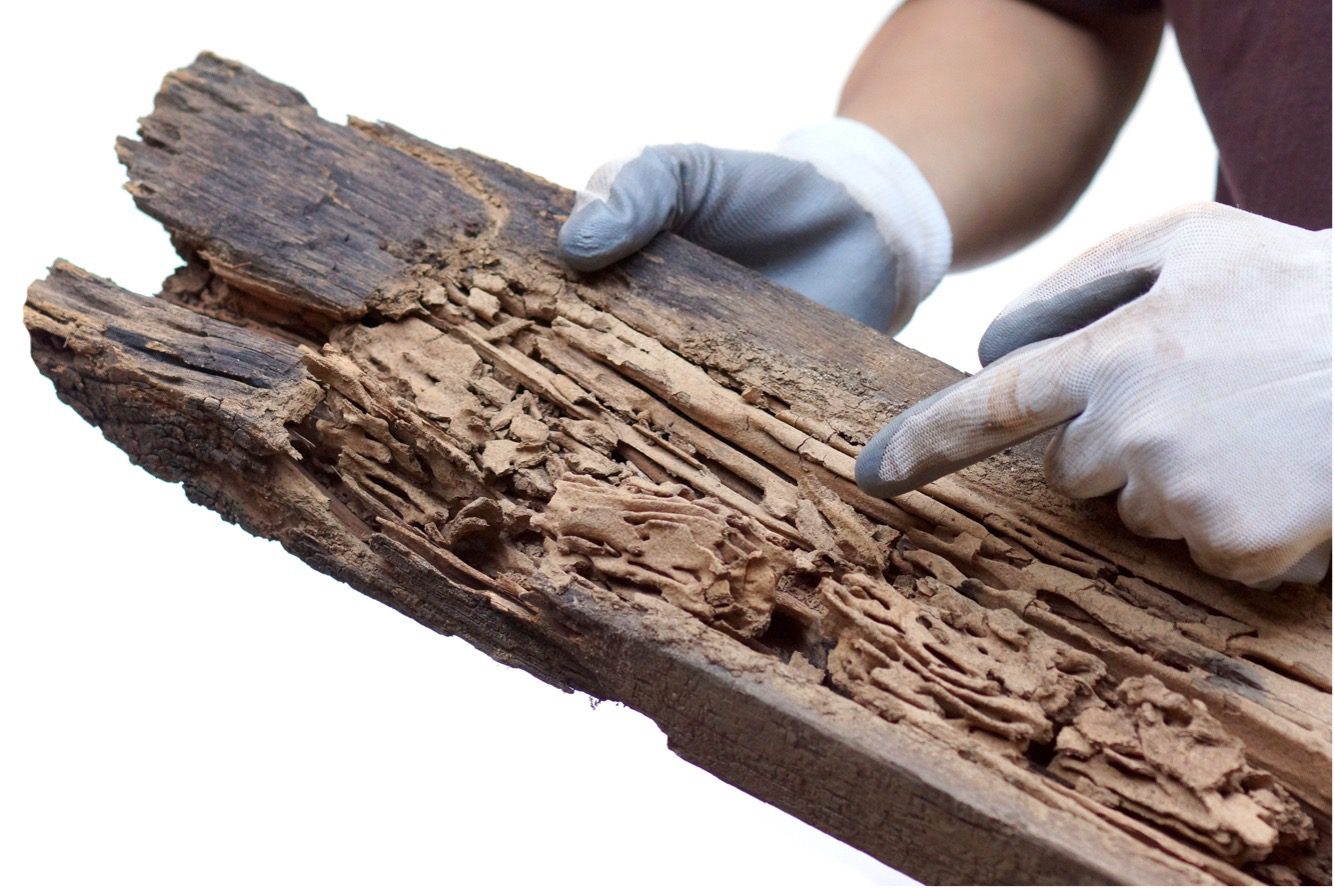
Termite-infested wood sounds hollow or papery when tapped, and pencil-thin mud tubes on a foundation confirm subterranean termites are active – the fix depends on which of the three termite types you have. Left untreated, a mature colony can hollow out a structural beam within months, turning a $10 tube of borate into a $2,000+ tenting job. This guide covers testing severity with a screwdriver, DIY vs. professional treatment, and safe disposal.
Quick Answer
Termite-infested wood typically sounds hollow when tapped and shows pencil-thin mud tubes or tiny six-sided fecal pellets nearby. Probe it with a screwdriver: if the tip sinks in easily, treatment alone will not be enough and the wood needs replacing. Minor surface damage can often be treated in place with a borate solution instead.
What Are Wood Termites?
Wood termites are insects that feed on cellulose in wood, causing structural damage to homes and outbuildings. Three types show up across the U.S., and each needs a different treatment:
| Type | Where Found | Key Sign | Treatment |
|---|---|---|---|
| Subterranean | Underground, needs soil contact | Mud tubes on walls/foundation | Soil liquid termiticide barrier or bait stations |
| Drywood | Inside dry wood, no soil needed | Six-sided fecal pellets (frass) | Fumigation or localized heat treatment |
| Dampwood | Wet, decaying wood near moisture | Football-shaped fecal pellets | Fix the moisture source, then replace the wood |
Subterranean termites are the most destructive species in North America and build pencil-thin mud tubes from the soil up to the wood they are eating. Drywood termites do not need soil contact, so a single colony can spread through the frame of an entire house. Dampwood termites are the largest of the three and almost always signal a moisture problem that has to be fixed before any wood repair will last.
Termites vs. Flying Ants: How to Tell Them Apart
A termite swarm and a flying-ant swarm look similar from across the room, but three details give it away up close. Termites have straight, bead-like antennae; ants have antennae that bend at a sharp angle partway down. Termites have a thick, straight waist with no pinch; ants have a narrow, hourglass-shaped waist. Termites have two pairs of wings that are the same length; flying ants have a longer front pair and a noticeably shorter back pair. Only termites eat wood – flying ants are a nuisance indoors but will not damage a structure.
Signs Of Termite-Infested Wood
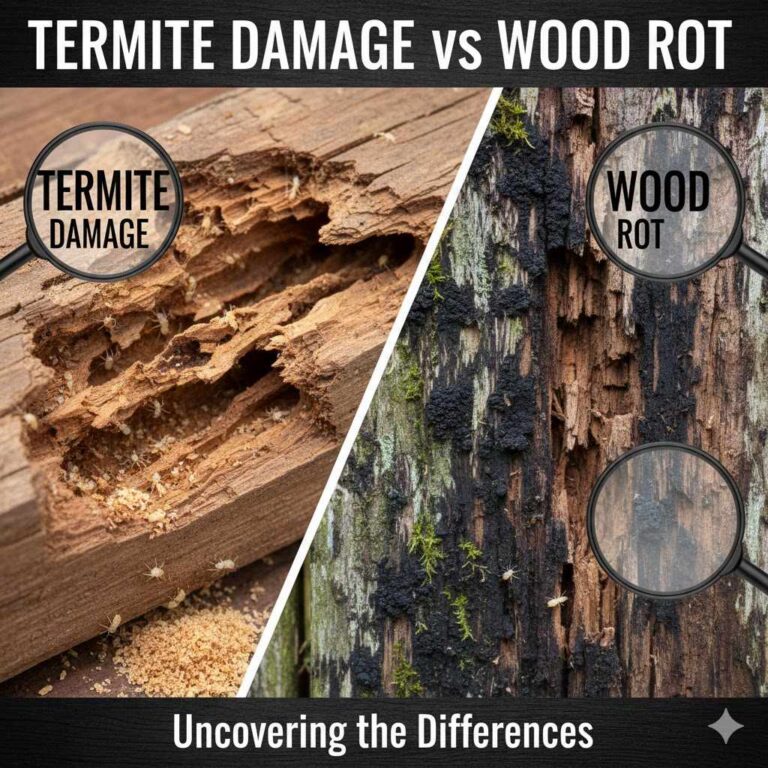
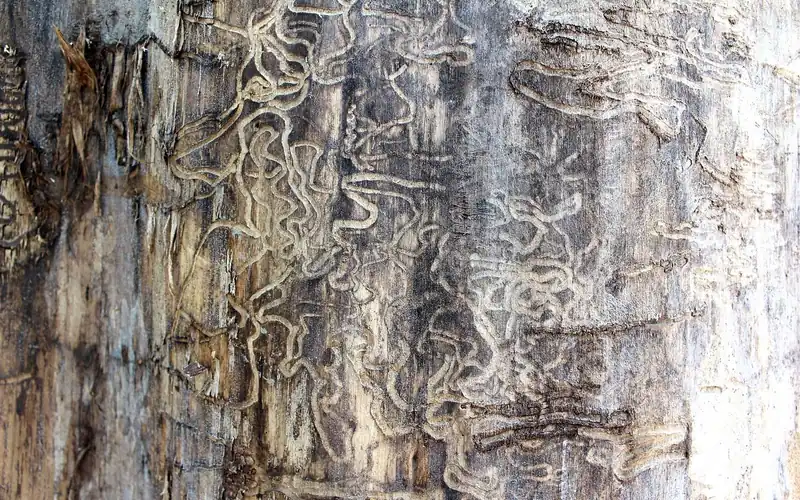
Termite damage is often invisible until you know where to look. Tap wood surfaces with the handle of a screwdriver – a hollow or papery sound means termites have eaten it out from the inside. Then check for these signs:
- Mud tubes: pencil-thin brown tunnels running up a foundation, wall, or support pier – subterranean termites travel through them between the soil and their food source.
- Discarded wings: after a swarm, termites shed four equal-length wings near windows, doors, and light fixtures.
- Frass: drywood termites push tiny, six-sided, sand-like pellets out of small “kick-out” holes in the wood.
- Bubbling or blistering paint: damage just under a painted surface can look like water damage even with no leak nearby.
- Sagging floors or sticking doors: warped or hollowed framing can shift a floor or door frame just enough to notice.
The Screwdriver Test: How To Check Damage Severity
Once you suspect termites, a flathead screwdriver tells you how bad the damage actually is. Press the tip into the suspicious area at a slight angle and note how it feels:
| Damage Level | What It Feels Like | What It Looks Like | What To Do |
|---|---|---|---|
| Minor / surface | Screwdriver resists, sinks in only slightly | Small surface tunnels; wood still looks mostly solid | Treat with a borate solution (non-structural wood only) |
| Severe / structural | Screwdriver sinks in easily; wood feels spongy or hollow | Crumbling, layered, or completely hollowed-out wood | Call a licensed pest control professional; the wood likely needs replacing |
If the wood is part of a load-bearing beam, joist, or wall stud, treat any deep softness as severe and get a professional inspection before doing anything else – probing structural wood too aggressively can weaken it further.
DIY Termite Treatment Methods
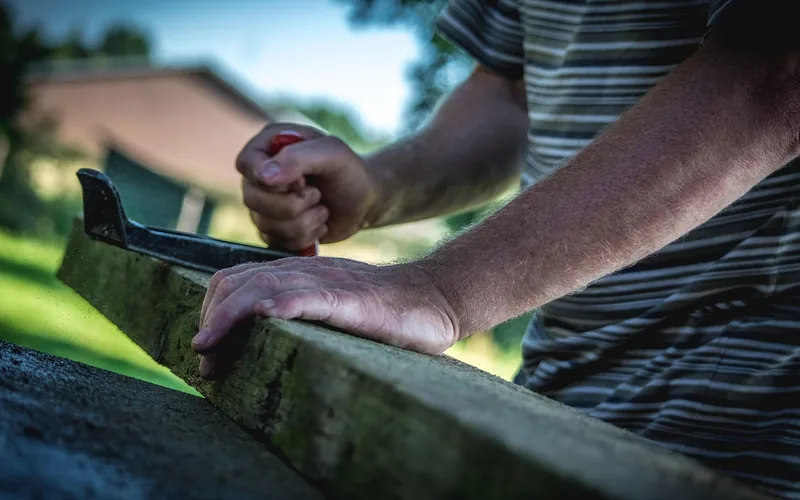
DIY treatment works for isolated, non-structural wood – furniture, fence posts, small trim pieces. For anything load-bearing, skip ahead to professional treatment – and see our full wood care & maintenance guide for keeping repaired wood protected afterward.
How To Treat Termite-Infested Wood With A Borate Solution
- Strip the finish: sand or strip any paint, stain, or sealant off the wood – borate only soaks into bare wood fibers.
- Choose a borate product: use a disodium octaborate tetrahydrate solution (sold as Bora-Care or a similarly labeled borate treatment), mixed per the label.
- Apply generously: brush or spray the solution onto every exposed surface, working it into any visible tunnels or cracks.
- Recoat: apply a second coat once the first has soaked in, focusing on end grain and joints where it absorbs fastest.
- Let it cure: allow 24 to 48 hours of drying time before repainting, staining, or sealing the wood.
Beneficial nematodes are a chemical-free option for outdoor wood like fence posts and decking. These microscopic worms are natural termite predators – mix them with water per the package directions and apply to the soil around the affected wood, and they will hunt down termites over the following days.
For small, movable items, you can also freeze out an infestation: seal the piece in a plastic bag and place it in a freezer for 2 to 3 days. Or use summer heat – set the item in direct sun under clear plastic until the wood’s core temperature holds above 120°F for at least 30 minutes, which is enough to kill termites at every life stage.
Best Termite Wood Treatment Pick
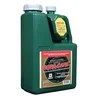
Bora-Care with Mold-Care Borate Concentrate, 1 Gallon
The same disodium octaborate tetrahydrate concentrate used in the borate treatment steps above, in a size that covers multiple pieces of infested wood.
- Best for: treating exposed structural or furniture-grade wood before it gets worse
- Why we picked it: it is the product named in most professional borate treatment protocols, not a generic substitute
- Main drawback: only works on bare, unfinished wood – strip paint or stain first
Compare more termite wood repair options
 Option 1 PC-Petrifier Wood Hardener, 16 oz
|
 Option 2 Abatron WoodEpox Kit, 2-Part Filler
|
 Option 3 TERRO Carpenter Ant & Termite Killer, 16 oz
|
As an Amazon Associate we earn from qualifying purchases.
How Termites Actually Eat And Digest Wood
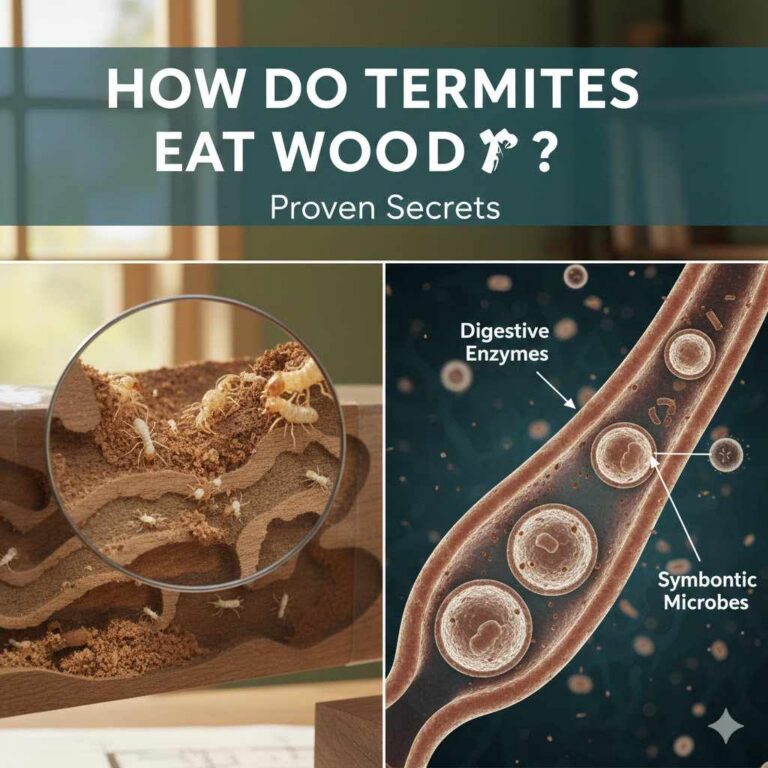
Wood is almost pure cellulose, and no termite can digest cellulose on its own. Lower termites – the subterranean, drywood, and dampwood species behind nearly all structural damage in the U.S. – carry protozoa in their hindgut that break cellulose down into usable sugars. The protozoa cannot do it alone either: bacteria living inside the protozoa produce the cellulase enzyme that actually splits the cellulose fibers apart. Newly hatched termites are born without these microbes and pick them up by feeding on a colony-mate’s droppings, a behavior called trophallaxis. Break that chain – through heat, cold, or a borate poison that kills the gut microbes – and the termite starves even while still surrounded by wood.
How Fast Do Termites Eat Through Wood?
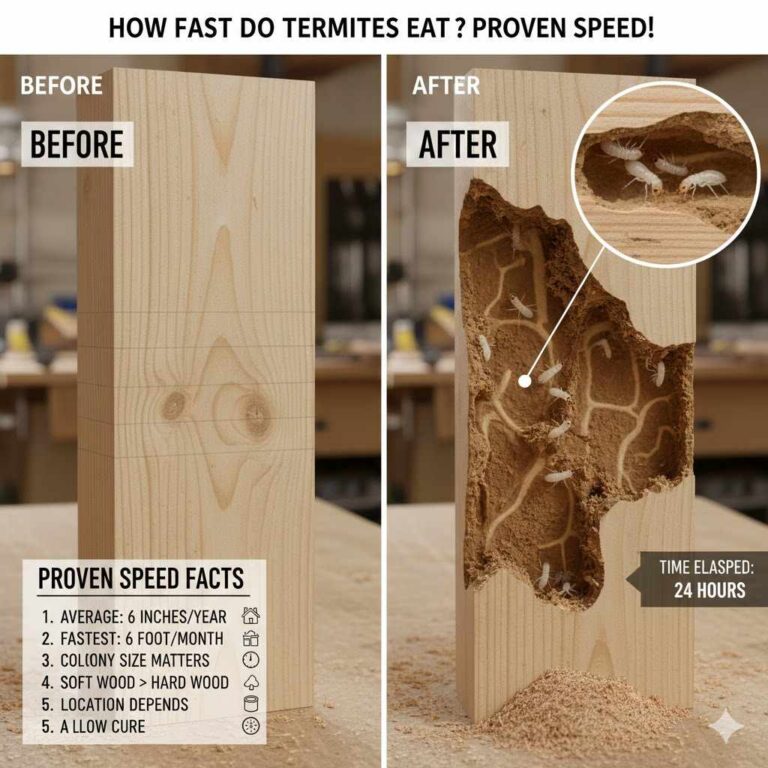
Consumption speed depends almost entirely on colony size and species. A young Eastern subterranean colony of about 60,000 workers eats roughly 1/5 ounce (5 grams) of dry wood a day – barely noticeable (source: Rutgers New Jersey Agricultural Experiment Station). A large, mature Formosan subterranean colony, which can number over 10 million termites, can eat about 13 ounces of wood a day – roughly two feet of a 2×4 every month (source: LSU AgCenter). At that upper rate, a colony can seriously compromise a wall stud in a matter of weeks, which is why early detection matters more than the size of the damage you can currently see.
📊 Termites cause billions of dollars in structural damage every year, and U.S. property owners spend more than $2 billion annually just to treat them. – Source: U.S. Environmental Protection Agency
Preventing Termite Infestation
Prevention is cheaper than any treatment on this page. A few habits keep termites from finding your wood in the first place:
- Keep at least a 6-inch gap between soil and any wood on the house – siding, door frames, deck posts.
- Store firewood and lumber at least 20 feet from the house, off the ground, and out of direct soil contact – the same clearance rule that keeps wood decks from staying damp against the soil.
- Fix leaky pipes, faucets, and AC condensation lines – moisture is what draws subterranean and dampwood termites in.
- Keep gutters and downspouts clear so water drains away from the foundation instead of pooling against it.
- Schedule a professional inspection every year or two, especially in warm, humid climates where subterranean termites are most active.
Professional Termite Treatment For Wooden Houses
Once termites have reached structural wood, a licensed pest control professional is almost always the right call. Which treatment they recommend depends on the termite type and how far the infestation has spread.
| Treatment | Best For | Avg. Cost | Vacate Time |
|---|---|---|---|
| Liquid termiticide (soil barrier) | Subterranean termites | $5-$15 per linear ft | None |
| Fumigation (tenting) | Widespread drywood infestations | $2,000-$8,000 | 2-3 days |
| Heat treatment | Localized to whole-structure drywood infestations | $2,000-$6,000 | 6-8 hours |
| Spot treatment (foam or borate injection) | Accessible, isolated infested wood | $200-$900 | None |
Liquid termiticide creates a chemical barrier in the soil and infested wood that kills subterranean termites on contact. Fumigation seals the home under a tent and pumps sulfuryl fluoride gas through every crack, which is the standard for widespread drywood infestations. Heat treatment raises the core wood temperature to at least 120°F for 30 minutes or more to kill drywood termites at every life stage; most professional rigs actually target 130-140°F to make sure the heat penetrates dense structural beams and studs, and the whole job usually takes 6 to 8 hours with same-day re-entry.
Get at least two professional quotes before committing (see our guide on how to kill termites in wood for DIY-vs-pro decision points), and confirm whether you have subterranean or drywood termites first – the wrong treatment type will not touch the infestation you actually have.
Repairing Termite-Damaged Wood
Repair comes after treatment, never before – installing new wood while termites are still active just gives them a fresh meal.
- Wood replacement: cut out damaged wood with a saw or chisel back to solid material, and replace it with new, termite-resistant wood such as cedar or pressure-treated lumber that matches the original dimension.
- Minor surface damage: for shallow tunneling that has not reached the wood’s core, a water-based wood hardener stabilizes the softened fibers first, followed by a two-part epoxy filler to rebuild the surface once the hardener cures.
- Structural reinforcement: for weakened beams or joists that are still structurally salvageable, a contractor can sister them with new lumber or steel brackets rather than a full replacement.
How To Safely Dispose Of Termite-Infested Wood
You cannot just toss termite-infested wood in the regular trash or burn it – either one can spread termites to a neighboring woodpile or release toxic fumes if the wood was ever chemically treated.
| Do | Don’t |
|---|---|
| Call local waste management first for disposal rules | Throw it in your regular trash or compost pile |
| Take it directly to an approved landfill | Burn it in a fireplace, wood stove, or backyard fire |
| Let your pest control company remove it if they treated the infestation | Leave it stacked in the yard near other wooden structures |
| Bag small pieces before transport | Move it near the house “just until trash day” |
Never burn wood that may have been pressure-treated or otherwise chemically treated in the past – most residential lumber treated with chromated copper arsenate (CCA) was phased out by the end of 2003, but older CCA-treated wood is still in plenty of decks and fences, and burning it releases arsenic compounds into the smoke.
Long-Term Termite Control
Getting rid of an active infestation is only half the job – keeping termites from coming back takes ongoing attention.
- Ongoing monitoring: check exposed wood every few months for new mud tubes, frass, or hollow spots; in-ground termite monitoring stations can catch activity before it reaches the house.
- Barrier treatments: a soil-applied termiticide barrier or a bait-station system stops termites before they reach the structure, and both need periodic professional refreshing.
- Annual inspections: a licensed inspector spots early activity that is easy to miss from the ground – especially in crawl spaces and behind finished walls.
Frequently Asked Questions
How can you tell if wood is infested with termites?
Tap the wood – a hollow or papery sound is the clearest sign. Look for pencil-thin mud tubes on nearby foundations, six-sided fecal pellets (frass) near small holes, and discarded wings after a swarm. If a screwdriver sinks in easily when probed, the infestation has likely gone past the surface.
Can termite-infested wood be saved, or does it need to be replaced?
It depends on how deep the damage goes. Wood with only minor surface tunneling can often be treated with a borate solution and kept in place, especially for non-structural pieces. Wood that feels spongy or hollow when probed, or that sits in a load-bearing beam or joist, should be replaced rather than repaired.
Can I reuse wood that has had termites?
Only if the damage was minor and the wood has been fully treated with a borate solution – and even then, stick to non-structural uses like decorative pieces or shop jigs. Never reuse previously infested wood anywhere it needs to bear weight, like a shelf bracket or a chair leg.
Is it safe to burn termite-infested wood?
No. Burning does not reliably kill an entire colony, so surviving termites or swarmers already in the wood can start a new colony near the fire. If the wood was ever pressure-treated or chemically treated, burning it can also release toxic fumes.
Will a bug bomb or fogger get rid of termites?
No. Foggers only kill insects the mist directly touches in open air. Termites live inside wood or underground, completely out of reach of a bug bomb, so fogging a room does nothing to the colony causing the damage.
How fast do termites cause serious damage?
It depends on colony size. A small, newly established colony might not cause noticeable damage for a year or more, but a mature colony of a million-plus termites can seriously compromise framing lumber within months. Regular inspections catch the difference before it becomes a structural problem.
How do you fix termite-damaged wood?
Treat the infestation first, then remove any wood that is soft or hollow with a saw or chisel. Stabilize shallow damage with a wood hardener and epoxy filler, or replace severely damaged sections with new, termite-resistant lumber that matches the original piece.
Conclusion
Termite-infested wood is manageable once you know what you are looking at (browse more of our termite prevention & control guides for related fixes): tap for a hollow sound, probe with a screwdriver to judge severity, and match the treatment to what you find – borate for minor surface damage, professional treatment for anything structural. Handle disposal correctly, fix the moisture problem that likely invited them in, and schedule a follow-up inspection in a year. Termites work slowly compared to a house fire or a burst pipe, so an infestation caught early is one of the more manageable problems a wood-frame home can have.