Wood Stove in a Garage: Is It Safe?
A wood stove is usually a poor fit for a garage: many codes bar solid-fuel appliances where gasoline, solvents, or vehicle fuel vapors may be present, and any allowed install must be checked against local rules. Ignore that, and you risk fire, carbon monoxide, denied insurance, and a failed inspection. This guide covers code limits, vapor hazards, insurer concerns, and the clearance rules you must check before you install anything.
The fuel vapor ignition risk in garages
Usually, no, not in the way people mean when they ask this. A garage is first a fuel-vapor zone, then a workspace or parking bay. If the stove sits where gasoline vapors, solvent fumes, or propane leaks can collect near the floor, the ignition risk changes completely, even if the stove is listed and the clearances look correct on paper.
Why garages are different from other shops
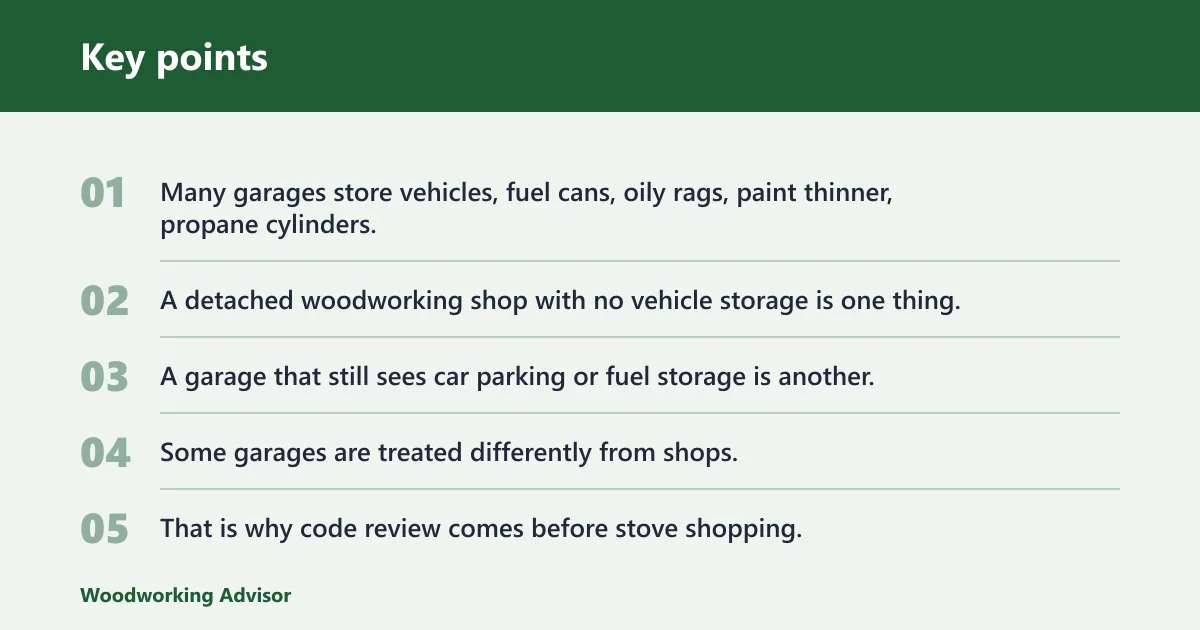
Many garages store vehicles, fuel cans, oily rags, paint thinner, propane cylinders, or lawn equipment. That mix changes the hazard profile. A detached woodworking shop with no vehicle storage is one thing. A garage that still sees car parking or fuel storage is another.
Some garages are treated differently from shops, and attached garages are often restricted. That is why code review comes before stove shopping.
The floor-level vapor ignition problem
Gasoline and many solvents produce heavier-than-air vapors. Those vapors can linger low, especially after spills, refueling, or moving a container from a car. A stove firebox, hot stovepipe, or even a glowing ember can become the ignition source long before anyone smells trouble.
That floor-level risk is the garage-specific failure mode most general wood-stove articles miss. A stove can be installed with proper clearances and still be a poor choice if the room contains fuel vapors during normal use.
When the safest answer is no
The safest answer is no when the garage stores a car, gasoline, solvent-based finishes, aerosol cans, propane, or any fuel-treated equipment. It is also no when the garage is attached and the local code treats the space as part of the dwelling fire separation. If you cannot keep fuel vapors out of the room, the stove does not belong there.
Say your two-car garage still holds one sedan, a mower, and two cans of finish thinner. Even a properly listed stove becomes a bad bet because the room is still a fuel-vapor environment, not a clean heating room.
Attached garage rules and risks
Attached garages face the tightest restrictions. Many codes treat them as a higher-risk zone because they connect to the dwelling, share a fire-separation assembly, and often contain vehicles or fuel. That does not mean every attached garage is forbidden, but it does mean approval is much harder and the use case matters.
Car storage makes the risk profile worse
Car storage usually pushes the answer toward no. Hot exhaust parts, gasoline drips, fuel vapor, and routine parking traffic all add ignition sources and fuel exposure. Even if the stove is on a raised hearth, the garage still needs a code review focused on the whole room, not only the appliance label.
The building department may also care whether the stove could affect the required separation wall, door, or penetrations between garage and house. Attached garages are often restricted, and the fire-separation wall must stay intact.
Workshop-only use still needs code review
A workshop-only attached bay can sometimes be treated differently, but it still needs written approval. The important question is not whether you plan to park a car there. It is whether the room is legally and practically free of fuel-vapor exposure, and whether the code allows a solid-fuel appliance in that exact occupancy.
What local officials usually focus on: room use, fuel storage, the intact fire separation, chimney routing, and detector requirements. Ask for the rule that applies to your address, not a general opinion.
Detached garage and shop cases
Detached spaces are often easier to approve than attached garages, but detached does not mean automatic approval. Local code still governs the appliance listing, chimney system, floor protection, and fuel storage limits. The difference is that the detached building usually removes the house connection from the risk picture.
Unheated detached shop
An unheated detached shop is often the least complicated case if the shop is dedicated to woodworking and not vehicle storage. Still, cold starts matter. A cold chimney can draft poorly at first, which raises smoke rollback risk and makes creosote more likely if the stove is undersized or the chimney run is weak.
Insulated detached shop
An insulated detached shop can be easier to heat, which helps practical use. It can also tempt owners to oversize the stove. That is a mistake. A stove that is too large for the space may run with dampered-down fires, which increases smoke and creosote risk.
A common first-timer mistake is to size the stove for “the biggest cold day” instead of the actual shop volume. The room shape, insulation, and air leakage still matter.
Why detached does not mean automatic approval
Detached buildings still need a code path, and some places still limit solid-fuel appliances by occupancy. You still need the right listing, the right chimney, and the right floor protector. If the building department says the space is a garage, not a shop, that label alone can change the answer.
Garage wood stove decision matrix
This matrix treats legality risk, fire risk, carbon monoxide risk, insurance friction, and heating practicality as separate questions. That separation matters. A setup can look practical and still be a poor choice because the legal or insurance side fails first.
| Scenario | Legality risk | Fire risk | CO risk | Insurance friction | Heating practicality | Go / no-go | Ask first |
|---|---|---|---|---|---|---|---|
| Attached garage with car storage | High | High | High | High | Low to moderate | No-go | Is any solid-fuel appliance allowed in an attached garage with vehicle storage? |
| Attached workshop-only garage | High to moderate | High | Moderate | High | Moderate | Only if approved in writing | Does the fire-separation wall stay intact, and does the code allow this occupancy? |
| Detached unheated shop | Moderate | Moderate | Moderate | Moderate | Moderate to high | Possible with review | What listing, chimney, and floor-protector details does the local code require? |
| Detached insulated shop | Low to moderate | Moderate | Moderate | Moderate | High | Best candidate | Will the inspector accept the stove type, vent path, and clearances shown on the label? |
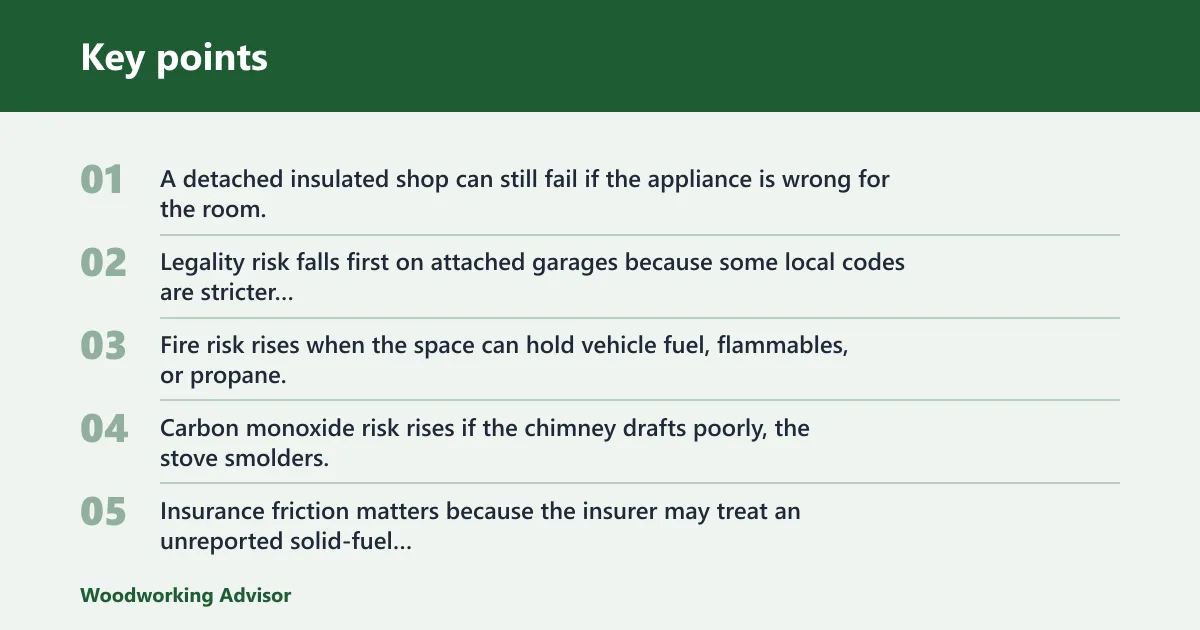
Use the table as a filter, not a promise. A detached insulated shop can still fail if the appliance is wrong for the room, the chimney is undersized, or the insurer will not cover the setup.
Scenario scores by legality, fire, CO, and insurance
Legality risk falls first on attached garages because some local codes are stricter about attached garages and workshop-only spaces. Fire risk rises when the space can hold vehicle fuel, flammables, or propane. Carbon monoxide risk rises if the chimney drafts poorly, the stove smolders, or the room is tightly closed without proper air supply.
Insurance friction matters because the insurer may treat an unreported solid-fuel appliance as an underwriting problem. Even if the installation passes inspection, a claim can become harder to handle if the carrier was not told or never saw the approval paperwork.
Go/no-go summary and next questions
The quick answer is simple. Attached garage with car storage: generally treated as a no-go scenario. Attached workshop-only garage: usually only if local officials approve it in writing and the insurer accepts it. Detached unheated shop: possible. Detached insulated shop: often considered the best candidate, but it is still not automatic.
Before you buy anything, ask whether the local code uses NFPA 211 as a reference for solid-fuel appliance installation, whether the building is classified as garage or shop, and whether the fire separation or occupancy rules block the project outright.
What codes and listings matter?
Three documents drive most of the decision. NFPA 211 is often referenced by codes for chimneys, fireplaces, vents, and solid fuel-burning appliances. EPA 2020 sets the emissions bar for new U.S. wood heaters. UL 1482 is a common listing standard for freestanding stoves and ties the label to tested clearances and approved chimney types.
NFPA 211 and local code references
NFPA 211 matters because local codes often point to it for installation details, even when the local ordinance makes the final call. That means the stove, chimney, connector pipe, floor protector, and clearances should all match the listing and the adopted code. The label is not decorative.
EPA 2020 emissions limits
The EPA 2020 wood heater emissions standard caps new wood heaters in the U.S. at 2.0 grams of particulate per hour. That standard is about emissions, not garage suitability. A stove can meet emissions rules and still be a poor fit for a garage because of location, fuel storage, or clearance issues.
UL 1482, Class A chimney, and double-wall stovepipe
UL 1482 is where the label becomes practical. The stove label should list exact clearances and the chimney types it was tested with. For through-the-wall or through-the-roof runs, the chimney is typically a Class A chimney, meaning a listed and labeled chimney system built for that use. Between the stove and the chimney, double-wall stovepipe is commonly used to reduce connector clearance requirements, but only when the stove label and code allow it.
The non-combustible floor protector also matters. The hearth or stove board must extend beyond the stove footprint by the code and the manufacturer’s instructions.
What should you ask the building department and insurer?
Ask for written answers before you buy the stove. That is the shortest path to avoiding a sunk cost. The building department can tell you whether the room is eligible at all, and the insurer can tell you whether the installation will remain covered after you finish it.
Permit and inspection questions
Start with these questions: Is a permit required for a wood stove in this building? Does the structure count as an attached garage, detached garage, workshop, or shop? Does the local code allow a solid-fuel appliance in this occupancy? What inspection must happen before first use? Does the inspector want the stove label, chimney spec sheet, and floor-protector details?
Also ask whether the installation needs a yearly inspection. Many owners use that to catch creosote buildup, damaged gaskets, or clearance changes before the heating season starts.
Documentation insurers often want
Insurers often want proof that the stove is listed, installed to code, and inspected. Be ready to provide the permit, final inspection sign-off, stove model, chimney type, and photos of the completed installation. Some carriers also ask whether the stove is in an attached or detached building and whether fuel is stored nearby.
Ask whether the policy needs an endorsement or a disclosure form for a solid-fuel appliance. If the answer is vague, get the name of the person who confirmed coverage and save the date and details in your records.
Questions about use, storage, and occupancy
Ask the insurer whether the space can still store a vehicle, gasoline, solvents, paint, propane, or oily rags. Ask whether the building must remain a workshop only. Ask whether the stove must be removed if the garage becomes an occasional parking space. Those questions matter because the use of the room can change the risk class.
Garage stove safety checklist
Use this checklist before any purchase or install. It is not a substitute for local code, but it will help you catch the failures that turn a permitted stove into a bad idea. Treat the garage as a fuel-vapor environment first and a heating room second.
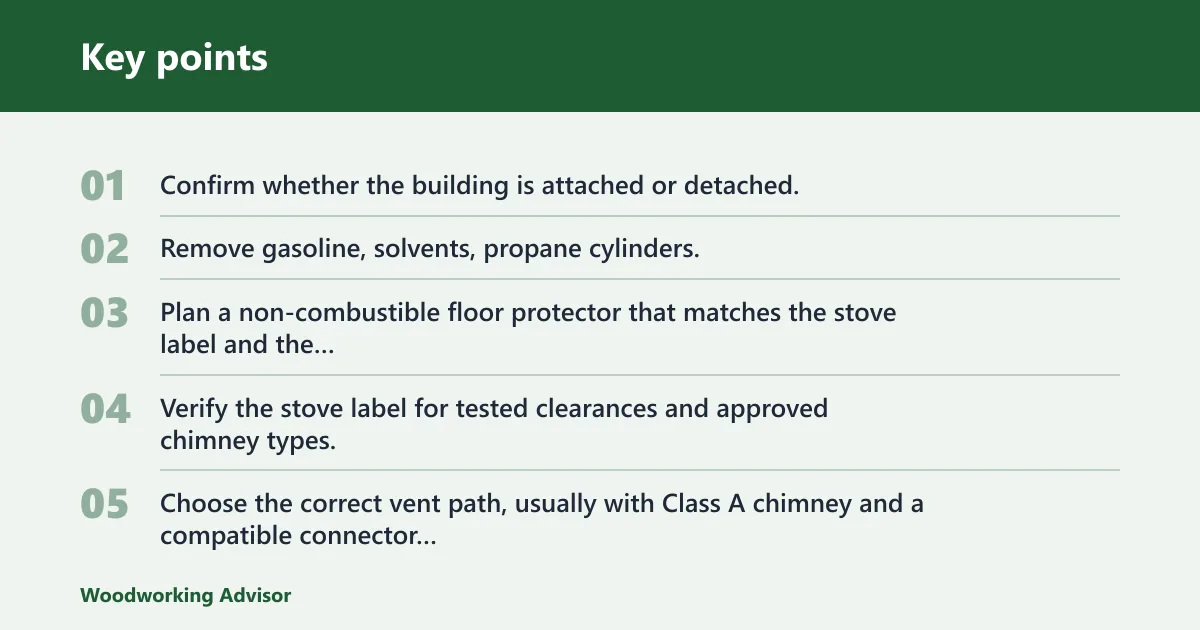
- Confirm whether the building is attached or detached, and whether the local code allows a wood stove in that occupancy.
- Remove gasoline, solvents, propane cylinders, and oily rags from the room and from the immediate stove area.
- Plan a non-combustible floor protector that matches the stove label and the manufacturer’s extension requirements.
- Verify the stove label for tested clearances and approved chimney types.
- Choose the correct vent path, usually with Class A chimney and a compatible connector pipe.
- Check local code and manufacturer guidance for carbon monoxide detector placement.
- Confirm combustion air and make sure the stove can draft cleanly on a cold start.
- Keep an exit path open so loading, ash removal, and emergency egress do not cross the hot side of the stove.
- Schedule inspection and cleaning, especially if the stove is used through a cold season.
Fuel storage and vapor controls
Never store gasoline, solvent cans, propane cylinders, paint thinner, or aerosol flammables near the stove. Keep them out of the room if possible. If the garage has vehicle storage, the answer often moves toward no before any stove model enters the conversation.
Floor protection and clearances
Do not treat clearance numbers as flexible suggestions. A listed stove label is checked against exact clearances and approved chimney types. If the label requires a certain wall shield, floor protector depth, or connector type, those details control the install. The stove board must also be non-combustible and large enough for the specific appliance footprint.
CO detector placement
Check local code and manufacturer guidance for carbon monoxide detector placement. A garage stove should also have smoke detection where the building code requires it, but CO monitoring is the detector most people forget.
Combustion air, draft, and egress
A garage stove needs enough combustion air to avoid lazy, smoky burns. Poor draft on a cold start can send smoke back into the room and increase creosote. Keep the path to the exit clear so you do not block the door while carrying wood, ash, or tools around the stove.
Picture a detached 24-by-28-foot insulated shop with no vehicle storage and a properly listed stove. That can be a workable project if the chimney, floor protection, and permit path all line up. Now change only one thing: add a car bay with gasoline cans. The answer changes fast.
Frequently asked questions
Is it safe to have a wood stove in a garage?
Usually not if the garage stores a vehicle, gasoline, solvents, or propane. The main problem is not only heat; it is the fuel-vapor zone near the floor. A detached, dedicated shop is easier to approve, but safety still depends on code, clearance, chimney, and storage controls.
Can I put a wood stove in my garage?
Sometimes, but only after you verify the local code and occupancy rules. If the building is attached to the house, the answer is often restricted or no, especially when the fire-separation wall must stay intact.
Are wood stoves allowed in garages?
That depends on the jurisdiction and the garage type. Many places are strict about attached garages and vehicle storage. Detached garages or workshop-only spaces are more likely to pass, but you still need a listed stove, approved chimney, permit if required, and final inspection.
Does a garage wood stove need a permit?
In many places, yes. A permit is common for solid-fuel appliance installation, and the inspector may want the stove label, chimney details, floor protector specs, and clearances. Ask the building department before buying anything, because permit rules and inspection steps vary by location.
What kind of chimney do I need for a garage wood stove?
For through-the-wall or through-the-roof venting, a Class A chimney is commonly required. Between the stove and the chimney, double-wall stovepipe is often used if the stove label permits it. The exact chimney type must match the stove’s tested and approved installation instructions.
What should never be stored near a garage wood stove?
Never store gasoline, solvents, propane cylinders, paint thinner, aerosol flammables, or oily rags near the stove. Keep them out of the room if you can. The garage is already a fuel-vapor environment in many cases, so nearby combustibles and fuel containers make the ignition hazard worse.
Sponsored / affiliate links. As an Amazon Associate I earn from qualifying purchases. I may earn additional commission from eligible campaigns.