Chipboard vs Plywood: Strength, Cost & Formaldehyde Compared
Plywood outperforms chipboard on strength and moisture resistance thanks to its cross-grain veneer layers, but chipboard costs less and holds up fine for dry, low-load furniture like shelving. Using chipboard anywhere it gets wet, such as a subfloor or bathroom cabinet, causes swelling and sagging that most warranties will not cover. This guide compares strength, moisture resistance, EPA formaldehyde limits, cost, and which screws actually hold in each material.
What’s the Difference Between Chipboard and Plywood?
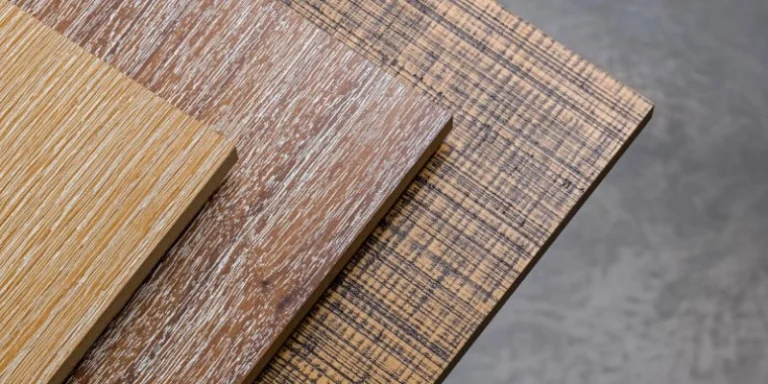
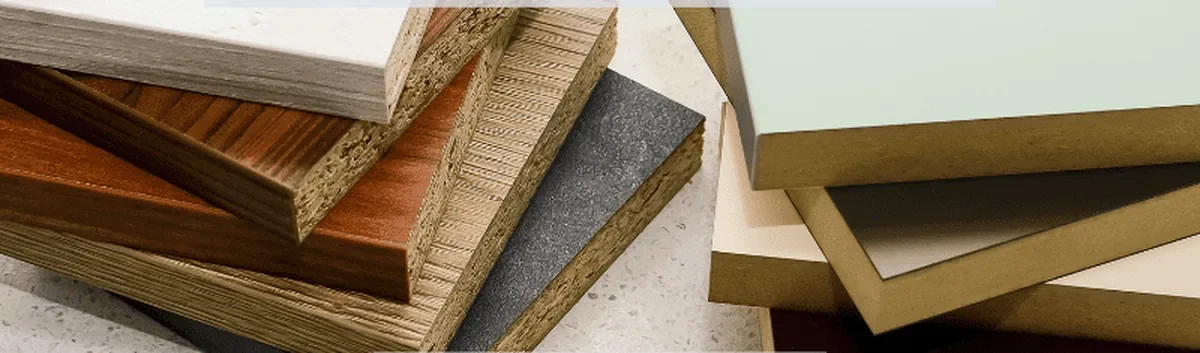
Chipboard (also called particleboard) is made by compressing wood chips, shavings, and sawdust with a resin binder under heat and pressure. Plywood is built from thin layers of real wood veneer glued together with the grain of each layer running perpendicular to the one below it. That cross-grain structure is the single biggest reason plywood outperforms chipboard almost everywhere except price.
How Each Material Is Made
Chipboard manufacturing sorts wood particles by size, dries them, coats them in resin, then presses them under heat into a flat panel. Plywood manufacturing peels or slices veneer sheets, glues an odd number of layers (3, 5, 7…) with alternating grain direction, then presses and trims them to size. The alternating grain in plywood is what resists warping; chipboard has no grain direction to resist anything.
Recycled wood and sawmill residue are common feedstock for chipboard – see our guide on whether wood is recyclable for how that supply chain works.
Where Each One Gets Used
- Chipboard: flat-pack furniture, cabinet boxes, shelving, subfloor underlayment (not structural subflooring), interior partitions
- Plywood: roof and wall sheathing, structural subflooring, outdoor furniture (exterior grade), cabinetry that needs to hold screws near an edge
Strength and Load-Bearing Capacity
Plywood’s cross-laminated veneers distribute load across the whole panel, which is why it carries a structural span rating for roof and floor sheathing under IRC and APA span tables. Standard chipboard has no such structural rating – building codes treat it as a non-structural, interior-only material.
Under sustained weight, chipboard is more prone to sagging between supports than plywood, which is why shelving spans need to be shorter (or the panel thicker) when the material is chipboard instead of plywood.
Which Fasteners Hold Best in Chipboard vs Plywood?
Plywood holds a standard wood screw well because the layered veneer resists splitting. Chipboard crumbles around a standard screw thread, especially within about an inch of an edge, because the compressed particles have nothing to grip. The fix isn’t a bigger screw – it’s a screw designed for particle-based panels and a pre-drilled pilot hole.
“Every time a cabinet screw stripped out of chipboard in our shop, it was because we skipped the pilot hole. Confirmat-style screws with a stepped pilot bit solved it – they need a purpose-drilled hole, but once it’s there the joint doesn’t loosen the way a standard wood screw does in particleboard.”
Best Fastener Pick for Chipboard & Particleboard
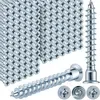 |
Blulu 7mm x 50mm Confirmat Screws (400-Pack) – $49.99 Purpose-built for the dense fiberboard and chipboard joints this guide covers – the stepped shank and sharp tail are made to hold in compressed particles instead of splitting them, which is exactly the failure mode described above.
|
As an Amazon Associate we earn from qualifying purchases.
For a deeper look at how these fasteners compare to standard wood screws, see our cabinet screws vs. wood screws guide.
Moisture Resistance: Which Holds Up Better?
Plywood’s cross-grain veneers and moisture-resistant adhesives give it real resistance to swelling. Standard chipboard swells and loses structural integrity when it absorbs water – edges are the most vulnerable point because they soak up moisture fastest.
According to the Composite Panel Association, moisture-resistant particleboard is graded under ANSI A208.1 as MR10 or MR30: MR10 panels must limit thickness swell to no more than half of a standard-grade panel’s allowance, while MR30 panels must pass an accelerated six-cycle aging test (ASTM D1037). Standard, non-MR chipboard meets neither bar and should stay out of bathrooms, kitchens, and anywhere near a plumbing line.
Formaldehyde and Indoor Air Quality
Both materials use formaldehyde-based resins, but the legal emission limits differ by product type – and this is the one comparison most chipboard-vs-plywood articles skip entirely.
📊 Under the EPA’s TSCA Title VI rule, particleboard sold in the U.S. is capped at 0.09 ppm formaldehyde, hardwood plywood at 0.05 ppm, and MDF at 0.11–0.13 ppm – compliance has been mandatory nationwide since December 12, 2017. — Source: Federal Register, EPA TSCA Title VI Final Rule
In practice, that means legally-compliant hardwood plywood emits almost half as much formaldehyde as compliant particleboard. If indoor air quality is a concern – a nursery, a small bedroom, a poorly ventilated workshop – plywood is the lower-emission choice even before factoring in strength.
Cost Comparison
Chipboard is consistently the cheaper material, largely because it’s manufactured from wood waste rather than full veneer sheets. Based on current U.S. building-supply pricing:
| Material | Typical 4×8 Sheet Price | Best For |
|---|---|---|
| Standard chipboard (3/4″) | $15 – $30 | Cabinet boxes, shelving, subfloor underlayment |
| Plywood sheathing (1/2″) | $25 – $50 | Roof/wall sheathing, structural subfloor |
| Cabinet-grade plywood (3/4″) | $55 – $95 | Furniture, visible cabinetry, built-ins |
Chipboard’s lower upfront cost can disappear fast if moisture exposure forces a replacement – factor in the actual conditions the panel will sit in, not just the sticker price.
Environmental Considerations
Chipboard has a genuine sustainability edge on raw material sourcing: most of it is made from wood chips, shavings, and mill residue that would otherwise be waste, so it uses less virgin timber per panel than plywood. Plywood’s environmental case rests on the source forest instead – look for an FSC (Forest Stewardship Council) certification label if sustainable sourcing matters for the project, since that verifies the veneer came from a responsibly managed forest rather than uncontrolled logging.
Surface Finishing and Customization
Plywood’s smooth, consistent surface takes veneers, laminates, paint, and stain cleanly. Chipboard’s raw surface is rougher and less uniform, so it’s usually sold pre-laminated (melamine-faced) rather than finished after the fact – trying to stain or paint bare chipboard directly tends to look blotchy because the surface absorbs unevenly.
If you’re deciding between the two for a piece that needs a real wood-grain look, our engineered wood guide breaks down where MDF and OSB fit into the decision too.
Which Should You Choose?
Choose chipboard for dry, low-load, budget-driven builds: cabinet boxes, closet shelving, interior partitions, flat-pack furniture that won’t get wet or carry heavy weight.
Choose plywood for anything structural, anything that touches moisture, or anything you want to hold screws reliably near an edge: subfloors, outdoor furniture, cabinetry that gets used hard, roof and wall sheathing.
When in doubt, the moisture test decides it: if the project will ever sit in a humid bathroom, a mudroom, or anywhere near plumbing, spend the extra money on plywood.
Frequently Asked Questions
What are the disadvantages of chipboard?
Chipboard has several real disadvantages: it’s less durable than plywood, prone to swelling and crumbling when exposed to moisture, and has no structural rating for load-bearing use. It also emits more formaldehyde than hardwood plywood under EPA limits, and it lacks the natural grain of solid wood or plywood veneer.
Is pressboard stronger than plywood?
No. Pressboard (another name for chipboard/particleboard) has no structural span rating and is significantly weaker under load than plywood’s cross-laminated veneer construction.
Is chipboard a good subfloor?
Standard chipboard has no IRC code approval as a structural subfloor – it’s only approved as thin (1/4-inch minimum) non-structural underlayment placed over a real structural subfloor. Only specially manufactured structural particleboard graded 2-M-3 under ANSI A208.1 has model-code recognition as combination subfloor and underlayment. For actual subflooring, use OSB or plywood.
Is chipboard stronger than OSB?
No – this is a common myth. OSB (oriented strand board) is generally stronger than chipboard because its larger wood strands are layered and cross-oriented similarly to plywood, while chipboard’s fine particles have no directional strength. OSB is code-approved for structural sheathing; standard chipboard is not.
Is chipboard cheaper than plywood?
Yes. Standard 3/4-inch chipboard typically runs $15–$30 per 4×8 sheet versus $25–$50 for 1/2-inch plywood sheathing and $55–$95 for 3/4-inch cabinet-grade plywood, based on current U.S. building-supply pricing.
Can chipboard be used outdoors?
No, not standard chipboard – it swells and breaks down when exposed to rain and humidity, even the moisture-resistant MR-rated grades aren’t designed for direct weather exposure. For outdoor furniture or structures, use exterior or marine-grade plywood instead.
Conclusion
Plywood wins on strength, moisture resistance, and formaldehyde emissions; chipboard wins on price. Match the material to where the project actually lives – dry and low-load favors chipboard, anything structural or damp-prone favors plywood – and use the right screw for whichever one you pick.
Sponsored / affiliate links. As an Amazon Associate I earn from qualifying purchases. I may earn additional commission from eligible campaigns.