Can You Varnish in Cold Weather? Minimum Temp
You can varnish in cold weather only if the air and the wood stay at or above the product’s labeled minimum, often 50°F, and the overnight low will not dip below that before the coat sets. If not, drying slows, haze can form, and the finish may stay soft or fail to bond well. This guide explains when to apply, when to recoat, and when to wait by checking air temperature, wood temperature, and overnight low.
What you’ll need
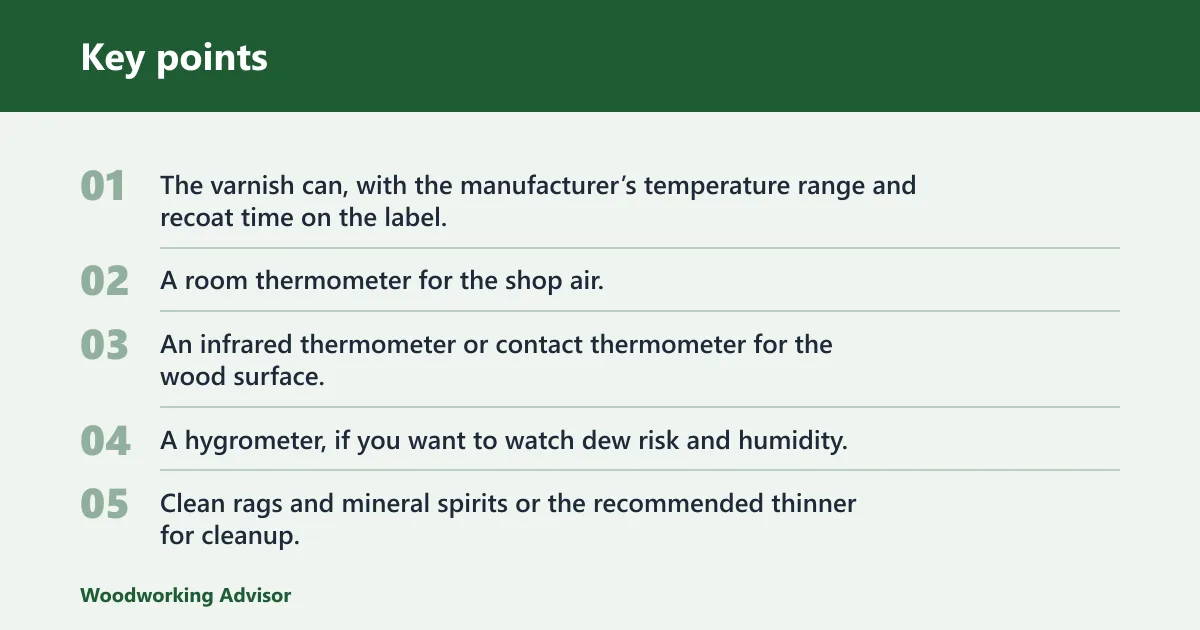


- The varnish can, with the manufacturer’s temperature range and recoat time on the label.
- A room thermometer for the shop air.
- An infrared thermometer or contact thermometer for the wood surface.
- A hygrometer, if you want to watch dew risk and humidity.
- Clean rags and mineral spirits or the recommended thinner for cleanup.
- A quality brush or pad made for varnish.
- A dust-free, heated space if possible.
- Plastic sheeting or a way to keep damp air, fog, and rain out of the finishing area.
Finish label and temperature check
Read the label before you open the can. For most finishes, there is a temperature, usually around 55°F, beneath which you should not proceed. Some products list about 50°F as a lower limit, but many manufacturers still prefer about 60°F to 85°F for easier flow, better leveling, and more reliable curing.
📊 For most finishes, there is a temperature—usually around 55°F—beneath which you should not proceed. Source: Finishing in Cold Weather.
Can you varnish in cold weather?
Yes, but only when the finish, the air, and the wood all stay within the product’s allowed range through the first hours of drying. Varnish is an oil-based finish that cures as solvent evaporates and the film hardens. Cold air slows both steps, so the label and the overnight low matter as much as the room temperature at brush-on.
Minimum application temperature
For most finishes, around 55°F is the practical floor. Some products allow 50°F, but that is the edge of the range, not the ideal target. If the label gives a warmer minimum, follow that instead. Product instructions win over any general rule. (Finewoodworking)
When to wait instead
Wait if the shop air is barely acceptable but the wood is colder than the air, or if the forecast points to fog, rain, or a drop below the label limit overnight. A coat that looks fine at noon can still turn cloudy or stay soft by morning if the substrate chills and condensation forms.
What temperature should the wood be?
The wood surface matters just as much as the room air. A cold substrate slows cure even if the shop feels warm enough. If the board was stored inside overnight, the surface temperature is usually a better guide than the thermometer on the wall. If the wood feels cold to the touch, treat it as cold until you measure it.
Air temperature vs. wood temperature
Air temperature tells you whether the room is acceptable. Wood temperature tells you whether the film can start curing on a stable substrate. A panel in a 60°F shop can still be too cold if it came in from an unheated shed. Let it acclimate before you brush on the first coat.
Why overnight lows matter
Use the overnight low as a go/no-go check. If the temperature will fall below the labeled minimum before the varnish sets, the film can skin over while solvents remain trapped below. That raises the risk of a cloudy finish, poor adhesion, or a soft surface that never feels fully hard.
Cold-weather varnish decision table
Use this table as a scheduling tool, not a substitute for the label. The expected recoat window widens fast as temperature drops. TotalBoat Gleam Marine Spar Varnish lists 1 hour at 80°F, 3 hours at 65°F, and 8 hours at 50°F. TotalBoat Lust Rapid Recoat Marine Spar Varnish lists 1 hour at 72°F, 3 hours at 60°F, and 6 hours at 50°F.
| Ambient temperature | Wood surface temperature | Expected recoat window | Go/no-go recommendation |
|---|---|---|---|
| 50°F | 50°F or warmer after acclimation | About 6 to 8 hours for the examples above | No-go unless the label allows 50°F and the overnight low stays above 50°F |
| 55°F | 55°F or warmer | Longer than room-temperature drying; plan for most of a day | Go only if the label permits it and dew risk is low |
| 60°F | 60°F or warmer | About 3 to 6 hours for the examples above | Usually go, if humidity is controlled and the overnight low stays safe |
| 65°F | 65°F or warmer | About 1 to 3 hours for the examples above | Go for most labels that list 55°F or 50°F minimums |
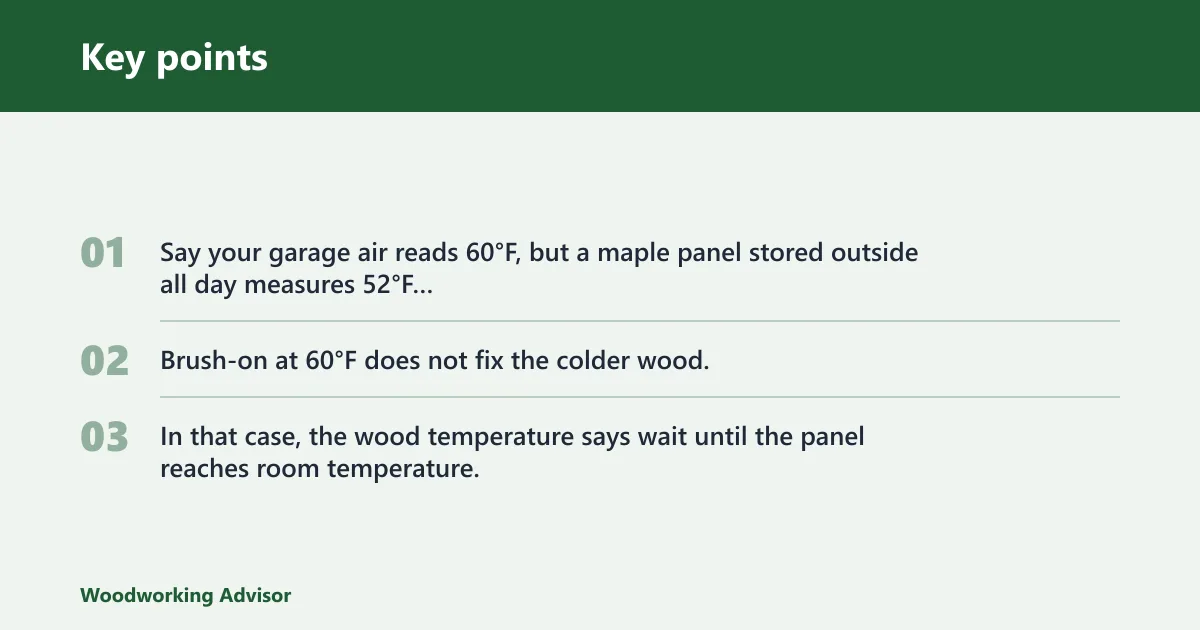
Say your garage air reads 60°F, but a maple panel stored outside all day measures 52°F on the face. Brush-on at 60°F does not fix the colder wood. In that case, the wood temperature says wait until the panel reaches room temperature, or the first coat may stay soft longer than expected.
How do you apply and recoat in winter?
Warm the varnish to at least 60°F before use, then apply a thin coat and give it the full recoat time the label calls for. Thick coats slow solvent release. Many varnishes should not exceed 3 mils wet film thickness, and heavier build can trap solvent beneath the surface film.
- Move the can to a heated space and bring the finish to at least 60°F before opening.
- Measure both the room air and the wood surface, then confirm that the overnight low stays above the label minimum.
- Apply one thin coat and keep the wet film at 3 mils or less.
- Wait the full recoat window for that product and that temperature before sanding or recoating.
- Check the surface for tack, softness, or cloudiness before you move to the next coat.
Plan the next coat
Do not judge by the clock alone. A coat can feel dry on top and still stay uncured underneath. In cold weather, that gap matters. If the film still feels rubbery, leaves a fingerprint, or gums up sandpaper, give it more time before recoating.
Common mistakes
Most winter failures come from moisture, excess film build, or poor airflow. Those three issues do not just slow drying. They can change the appearance and strength of the finish.
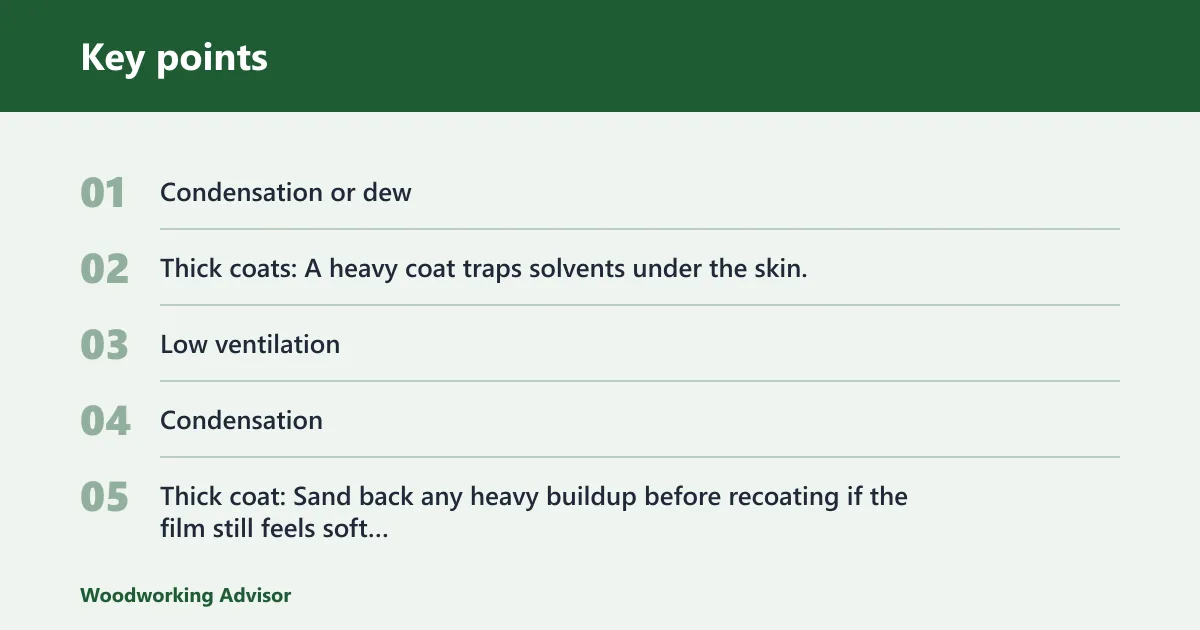
- Condensation or dew: If the surface has moisture on it, the coat can blister or delaminate. Avoid finishing when fog, rain, or a dropping overnight temperature points to condensation.
- Thick coats: A heavy coat traps solvents under the skin. The result can be a soft or squishy finish that takes far longer to harden.
- Low ventilation: Solvent evaporation slows when air exchange is poor. That can leave the film hazy and extend cure time.
Suppose a trim board in a cold shop looks dry on top after a few hours, but the room stays damp and the overnight low falls near the dew point. The next morning, the finish may look cloudy or feel soft because moisture and slow evaporation worked together against it.
Failure checklist
- Condensation: Wait until the wood is dry and the surface temperature is safely above the dew point.
- Thick coat: Sand back any heavy buildup before recoating if the film still feels soft after the expected window.
- Low ventilation: Increase air movement without blowing dust onto the wet surface.
How long does varnish take to cure in cold weather?
Cold weather can stretch every phase of cure. Skin-dry is not cured. Handle-safe is not recoat-safe. The practical rule is simple: if the film is still soft, tacky, or fingerprint-prone, treat it as uncured. At about 50°F, some products may need many more hours than they do at about 65°F, and the safe interval can differ by roughly a workday.
Skin-dry vs. cured
Skin-dry means the top layer no longer feels wet. Cured means the film has hardened enough to sand, handle, or topcoat without damage. A cold coat may skin over quickly while the solvent underneath is still leaving the film. That is when sanding dust clogs, edges dent, and the finish stays weak.
When a coat is safe to handle
Use the product’s recoat time as the earliest safe checkpoint, not the latest. TotalBoat Gleam lists 8 hours at 50°F before overcoating, while TotalBoat Lust lists 6 hours at 50°F. At 65°F and above, those windows shrink sharply. If the surface still feels cool, soft, or sticky, wait longer.
Frequently asked questions
What is the minimum temperature to apply varnish?
Use the label first. For most finishes, around 55°F is the practical cutoff. Some products list 50°F, and many manufacturers still prefer 60°F to 85°F for application. If the wood itself is colder than the room, let it acclimate before you start.
How cold is too cold for varnish?
Below the product’s stated minimum is too cold, even if the shop air feels only slightly chilly. For many finishes, that means anything under about 55°F is a stop sign. If the forecast shows a dip below that point overnight, wait for a warmer window.
Will varnish dry at 50°F?
Some varnishes will dry at 50°F, but only if the label allows it and the surface stays dry. At that temperature, drying is slow enough that condensation, cloudiness, and soft film become real risks. A warm, ventilated, dry space is much more reliable.
Should I warm varnish before applying it?
Yes. Cold varnish should be warmed to at least 60°F before use. That helps it flow, level, and release solvent more predictably. Keep the can at room temperature before opening, and do not rely on warming only the room air.
What happens if varnish dries too slowly?
Slow drying can leave the film soft, cloudy, or easy to dent. It also raises the risk of solvent entrapment when the surface skins over before the lower layers finish curing. If the coat still feels tacky after the expected recoat window, give it more time and improve the environment.
Can condensation ruin a varnish coat?
Yes. Varnish applied with condensation on the surface may blister or delaminate. That is why overnight low, fog, and dew point matter so much. If the substrate can chill below the dew point, do not coat it until it is dry and stable.
Sponsored / affiliate links. As an Amazon Associate I earn from qualifying purchases. I may earn additional commission from eligible campaigns.