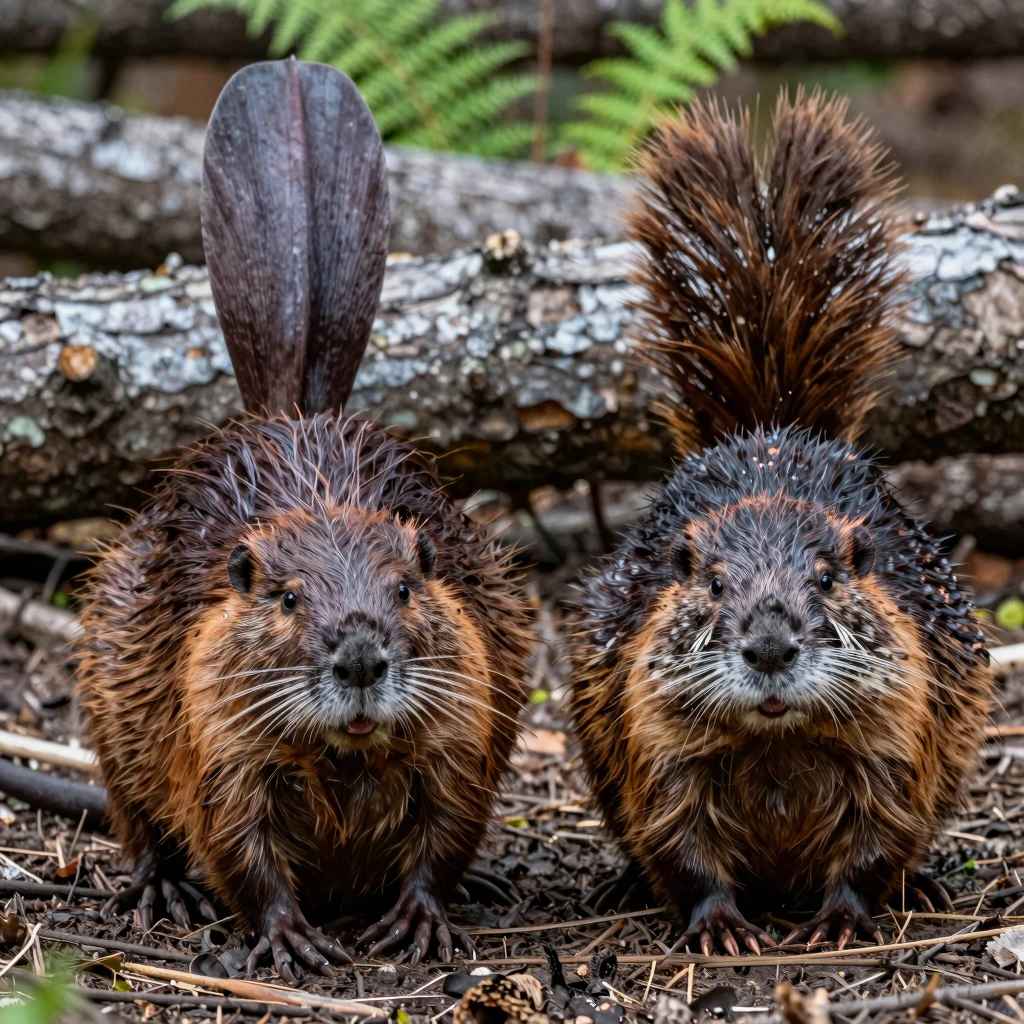
Are Beavers And Woodchucks Related? The Answer Is Interesting
It’s a question that pops into your head when you see them near the water or busy with nature’s work. Are these two furry critters related? Maybe they share a common ancestor?
It’s easy to lump similar-looking animals together. But when it comes to beavers and woodchucks, the truth is quite fascinating.
Let’s dive in and clear this up. We’ll look at what makes them tick, where they fit in the big animal family tree, and why people often mix them up. By the end, you’ll know exactly how these two animals stand apart, and where they might have a distant cousin connection.
Beavers and woodchucks are not closely related. Beavers are rodents that live near water and build dams. Woodchucks, also called groundhogs, are rodents that live on land and burrow.
They belong to different families within the larger order of rodents.
Understanding Beavers and Woodchucks
To see if beavers and woodchucks are related, we need to look at them closely. What are they? What do they do?
Where do they live? Knowing their habits and traits helps us place them in the animal kingdom.
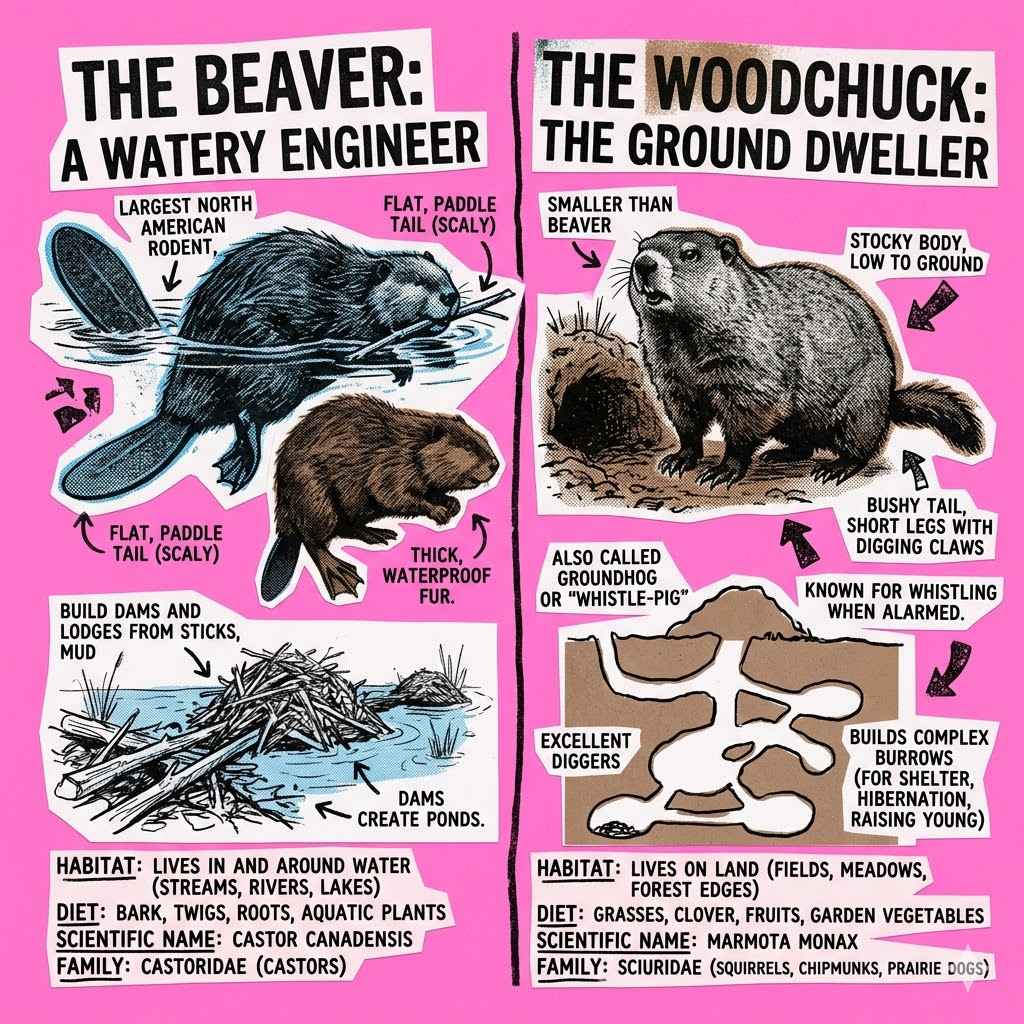
The Beaver: A Watery Engineer
Beavers are famous for one thing: building. They are the largest rodents in North America. They have thick, brown fur that keeps them warm.
Their tails are flat and paddle-like, covered in scales. This tail helps them steer in water and slap the surface to warn others of danger.
Beavers spend most of their lives in and around water. They build dams across streams and rivers. These dams create ponds.
They also build lodges, which are homes made of sticks and mud. These lodges protect them from predators and the weather. They eat bark, twigs, roots, and plants.
Beavers are very skilled architects of nature.
Their scientific name is Castor canadensis. They are in the family Castoridae. This family has only one other living genus, found in Europe.
The Woodchuck: The Ground Dweller
Woodchucks are also called groundhogs. They are smaller than beavers. They have grizzled gray-brown fur.
Their bodies are stocky and low to the ground. They have short, strong legs with claws for digging. Unlike the beaver, they do not have a flat, scaly tail; their tails are bushy and shorter.
Woodchucks live on land. They are excellent diggers. They create complex burrows with many tunnels and rooms.
These burrows are used for shelter, raising young, and hibernating during the winter. They are often found in fields, meadows, and along forest edges. They eat grasses, clover, fruits, and sometimes garden vegetables.
They are often seen whistling when alarmed, which is how they got the name “whistle-pig.”
Their scientific name is Marmota monax. They belong to the squirrel family, Sciuridae. This family also includes squirrels, chipmunks, and prairie dogs.
This is a very different family from the beaver’s.
The Animal Family Tree: Rodent Relatives
When we ask if beavers and woodchucks are related, we are asking about their place in biology. All mammals are grouped into orders. Beavers and woodchucks are both mammals.
They are also both rodents.
The order Rodentia is huge. It includes over 40% of all mammal species. This order is defined by a few key traits.
Rodents have a single pair of continuously growing incisors in both the upper and lower jaws. These teeth are perfect for gnawing on tough materials like wood and nuts. Both beavers and woodchucks fit this description.
However, being in the same order doesn’t mean they are close relatives. Think of it like humans and dogs. We are both mammals, but we are not closely related.
We are in different families and orders.
Beaver’s Place
Beavers are in the family Castoridae. This family is part of the infraorder Anomalia. This group contains a few unique rodent families.
Beavers are more closely related to other animals in this specific group than they are to woodchucks.
They have ancient roots. Fossil evidence shows beaver-like animals existed long ago. They are unique in their specialized lifestyle.
Woodchuck’s Place
Woodchucks are in the family Sciuridae. This is the squirrel family. This family is much larger and more diverse.
It includes many different types of ground squirrels and tree squirrels. They are part of the infraorder Sciurimorpha. This group has a different evolutionary path than the group beavers belong to.
So, while both are rodents, their paths in evolution split a long, long time ago. They developed different skills and lifestyles based on their environments.
Key Differences: Spotting Them Apart
Even though they are both furry rodents, they have many differences. These differences are important for understanding their roles in nature and their family connections.
Home and Habitat
The biggest difference is where they live. Beavers are aquatic. They need water to survive and thrive.
Their homes, lodges, are built in or near water. Their dams change the landscape to suit them.
Woodchucks are terrestrial. They live on land. Their homes are underground burrows.
They prefer open areas like fields or the edges of woods. They do not build dams or rely on water for their homes.
Physical Traits
Their bodies are built for their homes. Beavers have webbed hind feet for swimming. Their fur is dense and oily to keep them dry.
Their large, flat tail is a defining feature, used for balance, swimming, and communication.
Woodchucks have sturdy legs and strong claws for digging. Their fur is not as dense or oily. Their tail is shorter and bushier, not used for swimming or building.
Their body shape is more compact for living in burrows.
Diet
Both eat plants, but their specific diets differ. Beavers eat tree bark, cambium (the layer under the bark), twigs, leaves, and aquatic plants. They are known for felling trees to get at the bark and build their homes.
Woodchucks eat grasses, clover, flowers, fruits, berries, and sometimes insects or grubs. They are more generalist herbivores in their land-based environment.
Behavior and Lifestyle
Beavers are semi-aquatic and are often active at dawn and dusk. They are known for their industrious building. Their social structure often revolves around family colonies.
Woodchucks are diurnal, meaning they are most active during the day. They are solitary animals, except when mating or raising young. Their most notable behavior is hibernation during the winter months.
Beavers do not hibernate; they remain active year-round in their lodges.
Beaver vs. Woodchuck: At a Glance
- Habitat: Water (streams, rivers, ponds) vs. Land (fields, meadows, forests)
- Tail: Large, flat, scaly vs. Shorter, bushy
- Feet: Webbed hind feet vs. Strong claws for digging
- Home: Dams and lodges vs. Underground burrows
- Activity: Dawn/dusk, year-round vs. Daytime, hibernation
- Diet: Bark, twigs, aquatic plants vs. Grasses, fruits, flowers
Why the Confusion? Similarities That Trick Us
Despite their many differences, it’s easy to see why people might think beavers and woodchucks are related. They share some general characteristics that can lead to confusion.
Both Are Rodents
As we’ve discussed, the most significant similarity is that they are both rodents. This means they share the characteristic continuously growing incisors. They both have a powerful gnawing instinct.
This might be the primary reason for the mix-up. When people see a large, furry mammal that gnaws, they might assume a closer relation.
General Appearance
Both animals are mammals of a decent size. They have fur, whiskers, and a generally rounded body shape. To someone not familiar with the details, they might look similar from a distance, especially if you only catch a glimpse.
Imagine seeing a furry animal near water. If it’s busy, you might not get a clear look at its tail or feet. It’s easy to then think “beaver” or “woodchuck” and assume they are part of the same animal group.
Occasional Overlap in Range
While beavers stick to water and woodchucks to land, their territories can overlap. You might find a woodchuck living near the edge of a field that borders a stream where a beaver also lives. This proximity can lead to people seeing both in the same general area, reinforcing the idea they might be related.
Quick Fact: Gnawing Power
Both beavers and woodchucks use their strong incisors to gnaw. Beavers use them to fell trees and process wood for building and food. Woodchucks use their teeth to dig through roots and tough vegetation.
This shared trait of powerful gnawing is a key characteristic of the rodent order.
The Science Behind the Separation
The scientific classification of animals is based on evolutionary history. This history is pieced together through genetics, anatomy, and fossil records. When scientists look at beavers and woodchucks, they see significant differences that point to them diverging long ago.
Evolutionary Divergence
The rodent order (Rodentia) is very old. It split into different branches early in its history. The ancestors of beavers and the ancestors of woodchucks went down very different evolutionary paths.
Beavers belong to the group that adapted to semi-aquatic life. This adaptation involved developing specific physical traits like webbed feet and a paddle-like tail. Their lineage is more specialized for water environments.
Woodchucks, on the other hand, are part of the squirrel family. This family adapted to a wide range of terrestrial environments, including forests, grasslands, and mountains. Their adaptations are more general for digging and living on land.
Genetic Evidence
Modern science uses DNA to understand relationships between species. Genetic studies confirm that beavers and woodchucks are not closely related. Their DNA sequences show significant differences, indicating a deep evolutionary split.
While they both have rodent DNA, the genes specific to their families and species show clear distinctions. This is like comparing the DNA of two distant cousins versus two people who just happen to share a common surname.
Common Ancestry: Way Back When
Family Tree Comparison:
- Order: Rodentia (Both)
- Beaver: Family Castoridae
- Woodchuck: Family Sciuridae (Squirrel Family)
This shows they share a common ancestor within the rodent order, but their families diverged millions of years ago.
My Own Encounter with the Confusion
I remember one summer when I was helping my aunt clean out her garden shed. It was located near a small creek. I heard a rustling in the tall grass near the water’s edge.
I peeked over the fence and saw this chunky, furry animal. It was busy digging near the bank. It looked brown and stout.
My first thought was, “Wow, a woodchuck lives right by the water!” I mentioned it to my aunt, and she nodded.
Later that week, we were talking about local wildlife. She mentioned how the beavers had been busy downstream. I remember thinking, “So, beavers and woodchucks are just different kinds of diggers that live near water?” That’s when I started to wonder.
It seemed odd that both would be so common in the same general area but have such different jobs.
It wasn’t until I did some reading for another project that I learned the big difference. The beaver was the one who built the dam I remembered seeing last year, not the chunky animal by the creek. The one by the creek was indeed a woodchuck, and it was perfectly happy living on land, just a stone’s throw from the water.
It was a good reminder that appearances can be deceiving and that nature has specific roles for different creatures.
What This Means for You
Understanding that beavers and woodchucks are not closely related helps us appreciate nature more. It shows us how different animals adapt to their surroundings.
Appreciating Biodiversity
When you see a beaver, you’re seeing an animal that has shaped its environment. Its dam creates wetlands that help many other species. Its engineering skills are unmatched among rodents.
When you see a woodchuck, you’re seeing a master of the land burrow. Its tunnels aerate the soil and provide homes for other small animals. Its role in the ecosystem is vital for grassland health.
Correct Identification Matters
Knowing the difference helps when you’re observing wildlife. You can better understand their behaviors and needs. If you see an animal gnawing trees, it’s likely a beaver.
If you see one digging burrows in a field, it’s likely a woodchuck.
This knowledge is also helpful if you’re dealing with garden pests. A woodchuck might nibble your vegetables. A beaver might fell trees around your property if you live near a suitable waterway.
Knowing which animal you’re dealing with leads to better solutions.
When You See Them
Beaver: Look for signs of chewed trees, logs in water, dams, or lodges. You might see them swimming with their flat tails visible.
Woodchuck: Look for burrows with a large hole, often with a pile of excavated dirt nearby. You’ll see them in grassy fields or open areas during the day.
Quick Fixes & Tips
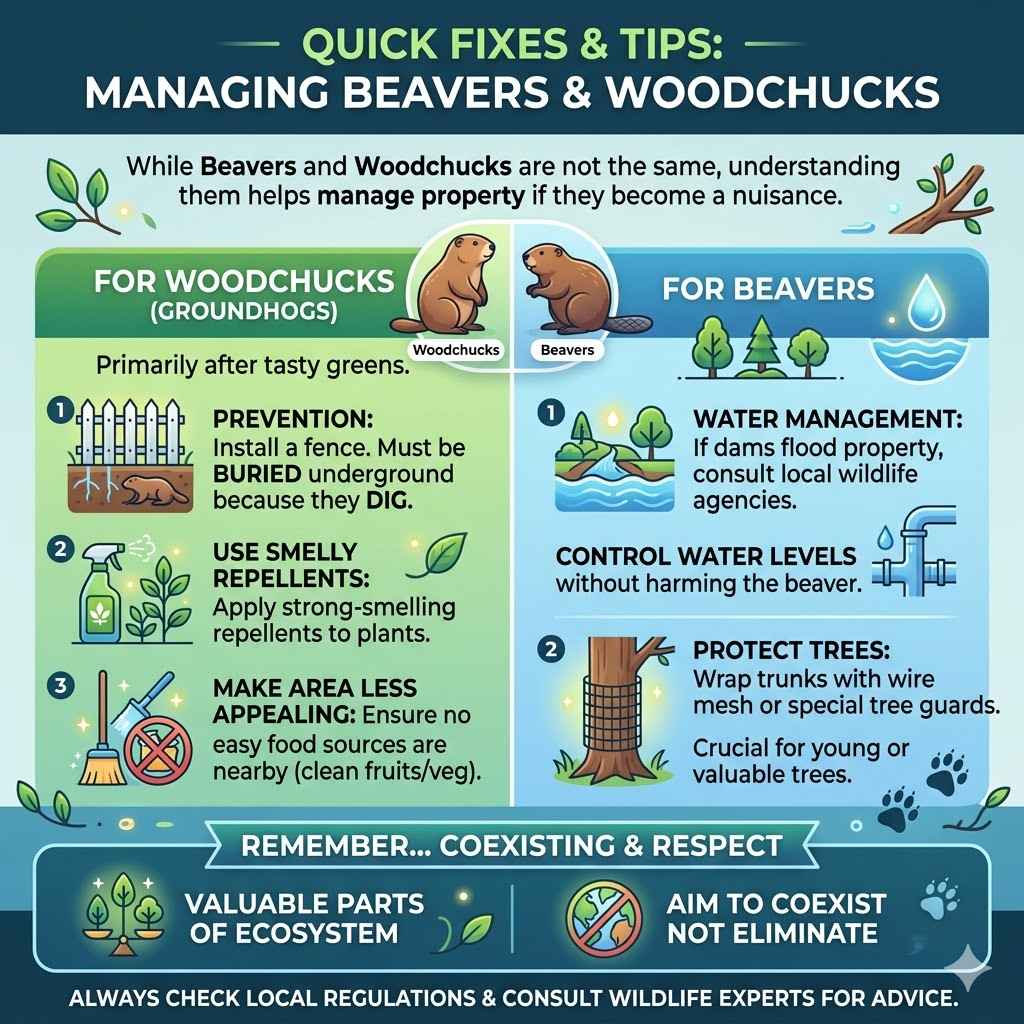
While beavers and woodchucks are not the same, understanding them can help you manage your property if they become a nuisance.
For Woodchucks (Groundhogs)
If woodchucks are eating your garden, the best approach is prevention. Fencing can help, but it needs to be buried underground because they dig.
Some people use strong-smelling repellents. Others try to make the area less appealing. Making sure there are no easy food sources nearby is key.
Remember, they are primarily after tasty greens.
For Beavers
Beaver problems often involve water management. If a beaver dam is flooding your property, you can consult local wildlife agencies. There are methods to control water levels without harming the beaver.
Protecting trees from beavers involves wrapping them with wire mesh or special tree guards. This is especially important for young or valuable trees.
It’s important to remember that both animals are valuable parts of our ecosystem. We aim to coexist rather than eliminate them. Always check local regulations and consult wildlife experts for advice.
Frequent Questions
Are beavers and woodchucks part of the same family?
No, beavers and woodchucks are not part of the same family. Beavers belong to the family Castoridae, while woodchucks belong to the family Sciuridae, which is the squirrel family.
What is the main difference between a beaver and a woodchuck?
The main difference is their habitat and lifestyle. Beavers are semi-aquatic, build dams, and live in lodges. Woodchucks are land dwellers, dig burrows, and hibernate.
Do beavers and woodchucks look alike?
They share some general features like being furry rodents. However, beavers have large, flat, scaly tails and webbed feet, while woodchucks have shorter, bushy tails and strong digging claws.
Are woodchucks related to squirrels?
Yes, woodchucks (groundhogs) are part of the squirrel family, Sciuridae. They are a type of large ground squirrel.
Can a woodchuck swim like a beaver?
Woodchucks can swim if they need to, but they are not built for aquatic life like beavers. Beavers are excellent swimmers with specialized adaptations.
Where do beavers and woodchucks fit in the animal kingdom?
Both are mammals and belong to the order Rodentia (rodents). However, they are in different families and suborders within that order, showing they have been separate for a very long time.
Conclusion
So, there you have it. Beavers and woodchucks are definitely not close relatives. They are both rodents, which is where the similarity ends.
They have evolved to live very different lives.
One is a master builder of watery worlds, the other a skilled architect of underground homes. Next time you see one, you’ll know exactly who you’re looking at and appreciate their unique place in nature.