Ash Flooring Review: Is It Worth the Cost?
Ash flooring is often worth the cost when it lands roughly 10% below comparable oak and you want a lighter floor that takes stain well; if the price gap is smaller, white oak is usually the safer buy. Bad species, grade, or finish choices can erase the savings through higher finishing and upkeep costs. This guide compares ash with oak and hickory on price, durability, and long-term maintenance.
Ash flooring verdict and cost

For value buyers, ash can be a good buy when the quote is clearly below white oak and you want a lighter look with solid shock resistance. White ash sits at 1,320 lbf on the Janka scale, close to white oak at 1,360 lbf and above red oak at 1,290 lbf, so the real question is usually price and room fit, not whether ash can handle normal residential use.
Where ash makes sense: low- to moderate-traffic rooms, buyers who want visible grain without a dark species, and projects where stain control matters. Where white oak is the safer buy: family rooms, kitchens, and entry paths that see more spills, abrasion, and furniture movement, especially if the ash quote is only slightly lower.
Bottom-line verdict for value buyers
Ash can be a smart purchase if the flooring is priced to leave room for better finish work or a higher grade. It is not the cheapest hardwood on the board, and it is not the hardest. Its value comes from a useful middle ground: solid everyday performance, easy stain response, and a look many buyers want.
Where ash is worth the money
Choose ash when you want a pale-to-light golden brown floor, a stronger grain than maple, and a species that is comfortable above red oak for residential use. It also fits buyers who are weighing ash vs oak flooring and want something close to white oak in overall performance without paying white oak pricing.
Where oak is the safer buy
White oak is the safer default when you want less second-guessing about long-term wear, resale appeal, and room-to-room consistency. If the price gap narrows, white oak’s slightly higher hardness — commonly cited at about 1,360 lbf versus 1,320 lbf for white ash — and very similar performance usually make it the more conservative choice.
Ash flooring pros and cons
Ash has real strengths: it takes stain well, handles impact well, and offers a lighter base color than many domestic hardwoods. Its limits are also real: visible grain movement, dent risk in busy rooms, color change from sunlight, and supply uncertainty tied to emerald ash borer pressures.
Pros
- Light cream to light golden brown color that suits many stains.
- White ash has a Janka hardness rating of 1,320 pounds-force.
- Strong shock resistance for everyday furniture movement and dropped items.
- Open grain can create a clear, classic hardwood look.
- Stain response is usually strong, especially with proper sanding and sealing.
Cons
- Dents still show, especially in entryways and around pets.
- Plain-sawn boards can show strong cathedral grain and visual movement.
- Sunlight can warm or deepen color unless you use a UV-inhibiting finish.
- Supply can be less predictable because of emerald ash borer concerns.
- Mismatched grade or finish can make maintenance more visible and more expensive.
Who is ash flooring for?
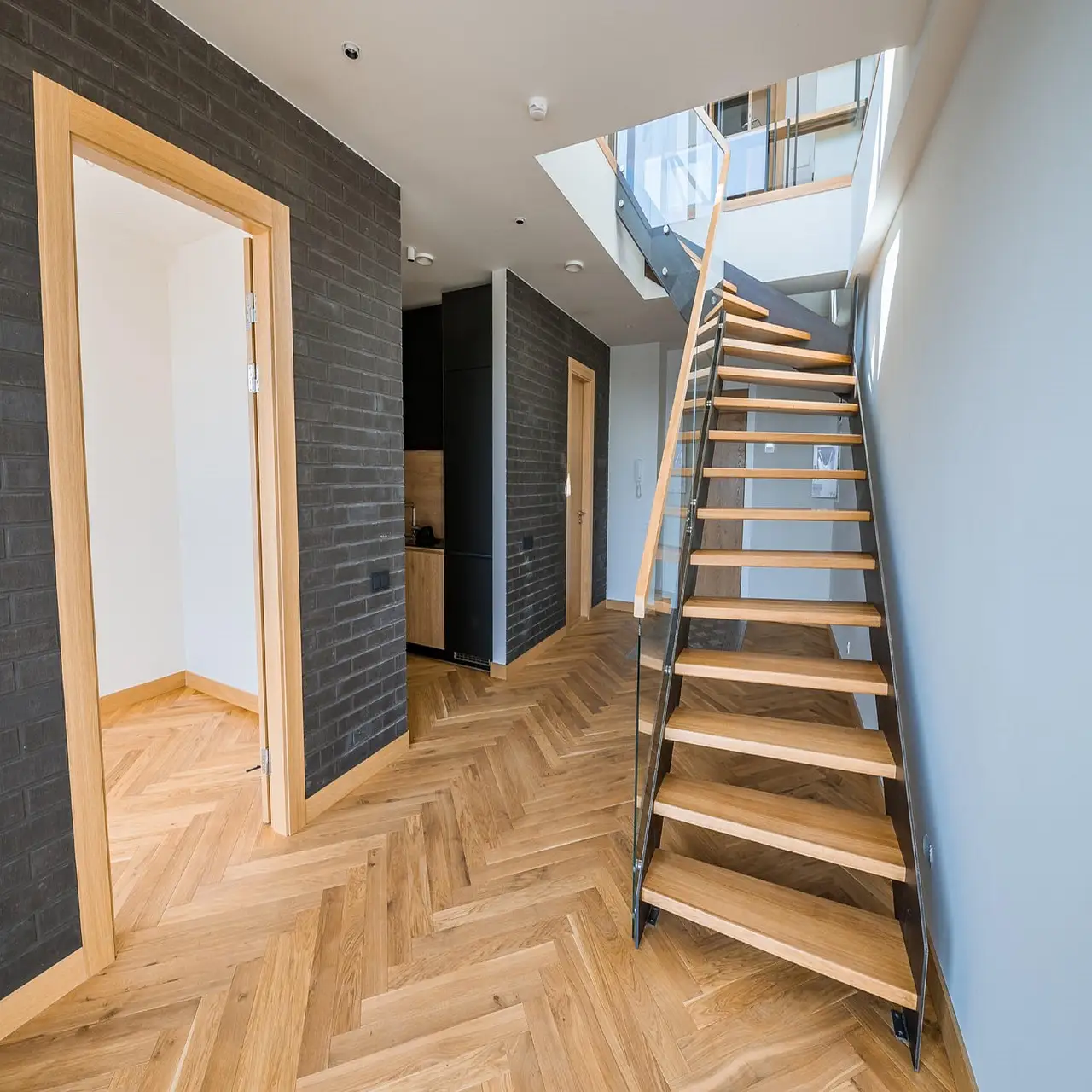
Ash fits homeowners who want a lighter hardwood and can keep traffic moderate. It is a strong candidate for living rooms, bedrooms, home offices, and dining areas that do not take constant abuse. It is less attractive for mudrooms, hard-used kitchens, or homes that expect frequent chair drag and pet nail wear.
Families and pet owners should be careful if the floor will sit under rolling toys, heavy chairs, or frequent bowl spills. Sunlit rooms also change the decision because ash’s lighter tone can shift over time unless the finish includes UV inhibitors.
Best room types and traffic levels
Low-traffic and moderate-traffic spaces are the best fit. Ash works well where the goal is a clean hardwood look rather than maximum dent resistance. If the room sees limited grit and controlled footwear, ash can age well without demanding the more expensive durability tier of hickory.
When families and pets should look elsewhere
Suppose a 14-by-18-foot family room has two dogs, toys, and a media cabinet on casters. In that case, ash can still work, but white oak or hickory is usually the safer pick because repeated impacts and dragged furniture will show sooner on a 1,320 lbf floor than on a harder species.
When sunlight exposure changes the decision
Picture a south-facing great room with three large windows and afternoon sun on half the floor. Ash can lighten, yellow, or deepen unevenly over time, so a UV-inhibiting finish becomes part of the value calculation, not a cosmetic add-on.
Ash vs oak flooring: which costs less?
Ash can be a good value if it is priced at roughly 10% below comparable oak. If ash comes in at least 10% below comparable oak, the math starts to work for many buyers. If the gap is smaller, white oak usually offers the cleaner long-term bet because performance is so close.
Ash vs white oak
White oak at 1,360 lbf is only slightly harder than white ash at 1,320 lbf, so neither species wins by a wide margin on everyday residential durability. The difference usually comes down to pricing, grain preference, and how much risk you want to take on maintenance and resale appeal.
Ash vs red oak
Red oak is listed at 1,290 lbf in the comparison chart, which puts it just below white ash. That means ash can justify a small premium over red oak if you prefer its look, but red oak is still a useful benchmark when you compare quotes from the same installer.
Where hickory fits in the comparison
Hickory is listed at 1,820 lbf, far harder than ash. That extra hardness matters in pet-heavy homes, but it usually comes with a different grain look and a higher cost position. If dent resistance is the main goal, hickory makes more sense than ash. If look and budget matter more, ash stays competitive.
Ash flooring comparison table
| Species | Price | Dent resistance | Grain visibility | Stainability | Stability | Best fit |
|---|---|---|---|---|---|---|
| Ash | Often below white oak; value depends on quote gap | Good for residential use; 1,320 lbf | High, especially in plain-sawn boards | Very good | Moderate; better in engineered form in some rooms | Low-traffic rooms, value-focused buyers |
| White oak | Usually higher than ash | Very good; 1,360 lbf | Moderate to high | Very good | Good | All-around safer choice |
| Red oak | Often close to ash or slightly lower | Good; 1,290 lbf | High | Very good | Good | Comparable budget alternative |
| Hickory | Often higher than ash | Excellent; 1,820 lbf | High | Good | Good | High-wear rooms, dent resistance priority |
Simple room recommendations
- Low-traffic room: Ash if the quote is clearly below white oak.
- Family room: White oak unless ash saves enough to fund a better finish or thicker wear layer.
- Pet-heavy room: Hickory or white oak before ash.
- Sun-exposed room: Ash only with a UV-inhibiting finish and a color change you can accept.
Should you choose solid or engineered ash?
Choose solid ash when you want thicker planks and the option to refinish more than once, assuming the subfloor is dry and stable. Choose engineered ash when moisture swings, slab construction, or a variable subfloor make movement risk more important than extra refinish potential. Engineered ash is often the safer install in those cases.
Solid ash for refinish potential
Solid ash flooring is often the better fit when room conditions are steady and you want a traditional plank that can be sanded and refinished later. It can cost more in material than engineered ash in many cases, and installation can be less forgiving if the subfloor is not flat and dry.
Engineered ash for moisture-prone rooms
Engineered ash flooring is worth a close look in basements, over concrete, or in houses with seasonal humidity swings. Engineered ash is generally more dimensionally stable in some situations, which can reduce movement risk. That matters as much as hardness when the floor sits over a less predictable subfloor.
Subfloor and underlayment factors
- Check subfloor flatness before picking a plank format.
- Confirm moisture levels for wood subfloors or concrete slabs.
- Match underlayment to the install method and room conditions.
- Use engineered ash when movement risk matters more than refinish depth.
- Use solid ash when the room is dry, stable, and built for long-term sanding.
Ash cut, grade, and finish choices
Cut, grade, and finish change the real cost of ash more than many buyers expect. Plain-sawn ash gives you the boldest grain and the most visual movement. Rift- and quarter-sawn ash looks straighter and can move a bit less. Clear/Select grade gives the cleanest appearance, while Rustic/Character grade usually costs less or reads busier.
Plain-sawn vs rift- and quarter-sawn ash
Plain-sawn ash is the common cut most buyers see, and it often shows cathedral grain that feels lively across a room. Rift- and quarter-sawn ash reduces that cathedral patterning and can bring slightly better dimensional stability, which helps in rooms where you want a straighter, more uniform floor.
Clear/Select vs Rustic/Character grade
Clear/Select grade has minimal knots and more consistent color, so it suits buyers who want the cleanest look. Rustic/Character grade allows larger knots and more color variation, which can lower cost or hide everyday wear more easily. Pick the grade that matches both the room and the maintenance you can accept.
UV-inhibiting finish and color change
A UV-inhibiting finish slows sunlight-related color change and helps preserve ash’s lighter tone. That matters because ash starts out light and can shift in visible ways near windows. If you want the original color to stay closer to the day-one look, finish choice becomes part of the purchase decision, not a later upgrade.
Frequently asked questions
Is ash wood expensive compared with oak flooring?
Ash is often less expensive than white oak, but the gap is what matters. If ash is at least 10% below comparable oak, it can be a good value. If the spread is smaller, white oak usually offers the safer long-term buy for similar performance.
Is ash wood durable enough for floors?
Yes, ash is durable enough for many residential floors. That puts ash in a solid middle tier for normal home use.
How does ash flooring compare with white oak flooring?
Ash and white oak are very close in overall performance, with white ash at 1,320 lbf and white oak at 1,360 lbf. White oak is usually the safer default because the difference in durability is small and the market often prices it as the more broadly trusted option.
Does ash flooring stain well?
Ash usually stains well because of its open grain and light starting color. Clear/Select grade gives a more even result, while Rustic/Character grade can create more visual variation. Proper sanding and sealing matter more than the species alone if you want consistent color.
Will ash flooring dent, scratch, or show wear easily?
It can dent in busy spots, though it is strong for residential use. The 1,320 lbf hardness rating means ash resists wear reasonably well, but it is not in the hickory class. Pet nails, grit, and chair legs can still leave marks over time.
Is ash flooring a good choice for kitchens or high-traffic rooms?
It can work in kitchens or high-traffic rooms, but it is not the safest default. White oak is usually the better all-around choice, and hickory is better when dent resistance matters most. Ash fits best when the room traffic is moderate and the price is attractive.
Sponsored / affiliate links. As an Amazon Associate I earn from qualifying purchases. I may earn additional commission from eligible campaigns.