Ash Lumber Overview: Workability, Grain, Value Guide
Ash is a strong, ring-porous hardwood that is often a good choice for handles, bent parts, paint-grade furniture, or oak-like projects when clear 4/4 stock is priced roughly in line with red oak. Ignore that rule and you can overpay for scarce boards, spend extra time filling grain, or buy grades that lose half the width to shorts and defects. This guide covers workability, grain and finishing behavior, grades, thicknesses, typical prices, and when ash beats oak or hickory.
What ash lumber is and which ash species buyers actually see
White ash is the main North American reference species
For most North American buyers, “ash lumber” means white ash. Dealers, mills, and wood references usually treat it as the standard species for hardness, grain, and common uses such as flooring, furniture parts, tool handles, and sports equipment.
White ash is usually light in color, from cream sapwood to light brown heartwood. Ohio Timber Works lists ash color as white to pale brown, which lines up with what buyers usually see in commercial stock. The grain is often straight, though board orientation still changes the look quite a bit.
White ash tests at about 1,320 lbf on the Janka hardness scale. That puts it in a range that handles routine wear in furniture and flooring, while still machining cleanly when the stock is straight and dry.
European ash is a comparison species, not a default substitute
European ash comes up often in ash discussions because it looks related: light color, open pores, and a strong grain pattern. Still, you should treat it as a comparison wood, not assume it matches white ash in every buying decision.
The reason is simple. North American buyers usually purchase based on a local dealer’s grade mix, moisture control, and width selection. Those details affect usable yield more than a broad “ash is ash” label. If a listing simply says “ash,” ask which species it is and whether the stock is domestic, imported, reclaimed, or pre-harvested.
Why species labels matter
Species labels change expectations for supply, price, and consistency. That matters even more now because emerald ash borer has tightened supply in many regions and pushed more buyers toward reclaimed or older inventory.
If you are matching new boards to an older floor, buying handle stock, or trying to control finish color, the species name belongs in the value calculation. Skip that step, and the sticker price can look fine while the usable result does not.
📊 White ash tests at about 1,320 lbf on the Janka hardness scale. Source: Ash Wood Lumber: Grades, Properties & Buying Guide.
How ash grain and pore structure affect appearance
Ring-porous anatomy and what it looks like on the board
Ash is a hardwood with large earlywood pores set in distinct growth-ring bands, usually with a mostly straight grain and strong visual contrast from one ring to the next. On the board, that anatomy creates the bold open-grain look many buyers want when they do not want a quiet, closed-pore surface.
Ash has a medium to coarse, open texture that often benefits from pore filler. That fact drives many finishing choices. Under a clear coat, the surface will usually show texture unless you fill it. Under stain, those pores create contrast, but they can also make the finish look busier than expected.
Color range and board orientation
White ash often shows light cream sapwood beside light brown heartwood. If a project needs a uniform pale look, ask whether the dealer has sapwood-heavy boards or sorted packs. Mixed-color boards can still work well, but they change how much cutting and matching the project needs.
Flatsawn ash shows cathedral grain and the strongest ring contrast. Riftsawn and quartersawn boards look calmer and straighter, which can suit table legs, face frames, and long rails where a more even line matters.
Appearance choices have buying consequences
Ash pays off when you want that grain pattern on purpose. It loses value when the project calls for a smooth, closed-pore look with little finish labor. In that case, the cheap board can become the expensive board once filling, sanding, and extra topcoats are counted.
Picture a 36-inch vanity door set with flat panels and a satin clear finish. If the design calls for a glassy surface, ash needs more prep than many buyers expect. If the design wants visible pore texture, ash starts to look like a better fit.
How hard and durable is ash lumber in real use?
White ash is hard enough for everyday wear, with about 1,320 lbf Janka hardness, but that figure only predicts resistance to surface denting under a standardized steel-ball test. It does not fully predict shock resistance, stiffness, or whether ash is the best buy once finish labor, supply, and grade waste are counted.
What Janka hardness does and does not tell you
Janka hardness measures how much force it takes to embed a steel ball halfway into the wood, so it is mainly a dent-resistance number. For flooring, that helps set expectations: ash is not soft, but it is not immune to dropped tools, chair impacts, or pet claws. For furniture, the number helps most with top surfaces, chair parts, and table aprons that see routine contact.
What it does not tell you is how the wood handles repeated impact. It also does not settle questions of machining quality, drying defects, or whether a low-grade pack will yield enough long clear parts.
Shock resistance is the separate reason ash stays relevant
Ash is used for baseball bats, axe handles, and hockey sticks because it absorbs repeated jarring blows. That trait keeps ash in the conversation even when hickory may be harder or local oak may be easier to find.
Shock resistance matters most in handles, striking tools, and other impact-heavy parts. For a side table or a cabinet door, that trait may offer little buying advantage. For a maul handle or a shop mallet handle, it is a core reason to pay attention.
What durability means by project type
For flooring, ash can wear well enough in normal residential use, but its open grain and visible pores will show dirt and finish wear differently than smoother-pored woods. For furniture, it is durable enough for frames, legs, chairs, and case parts. For tool handles, it remains one of the more sensible choices when straight grain is available.
How workable is ash wood with hand and power tools?
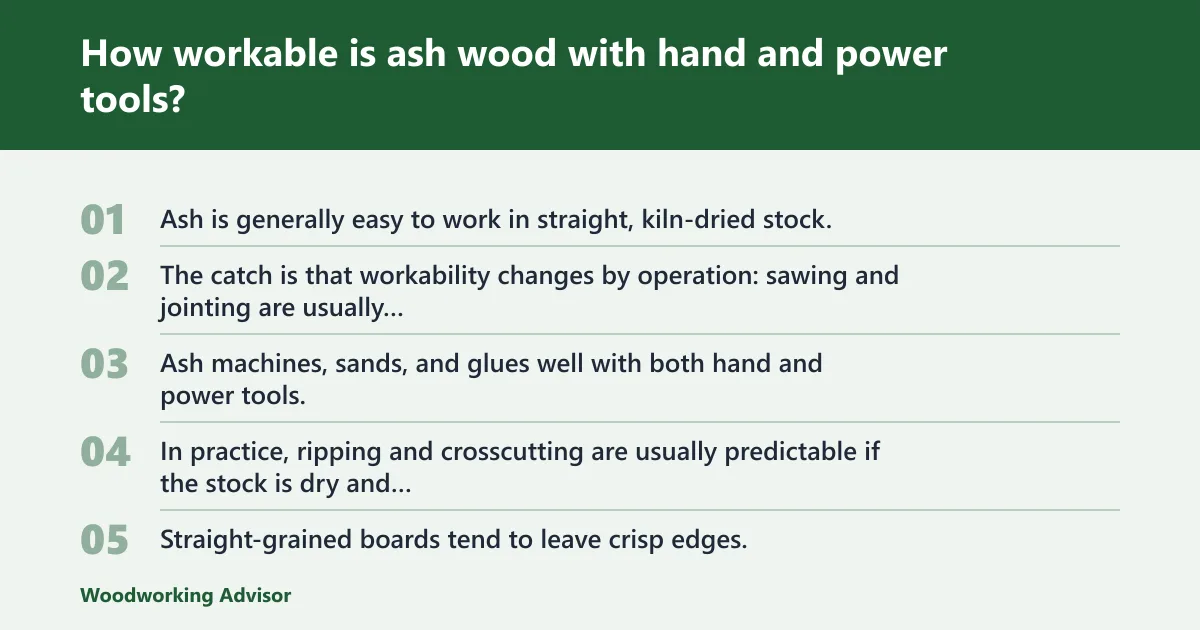
Ash is generally easy to work in straight, kiln-dried stock, and many makers describe it as highly machinable. The catch is that workability changes by operation: sawing and jointing are usually friendly, while planing figured areas, routing end grain, and sanding open pores need more care.
Sawing, jointing, and planing
Ash machines, sands, and glues well with both hand and power tools. In practice, ripping and crosscutting are usually predictable if the stock is dry and not badly tensioned. Straight-grained boards tend to leave crisp edges.
Jointing is usually clean on straight stock. Planing is where caution starts. Reversing grain can cause edge tearout, especially near knots, grain runout, or cathedral transitions on flatsawn faces. Use a light final pass and a sharp cutterhead to reduce the risk.
A common first-timer mistake is rough-milling 4/4 ash to near final thickness on day one, then finding a rail twisted the next morning. Leave flattening margin if the board came from a mixed storage environment or reads wetter than the rest of the batch.
Routing, drilling, turning, and fasteners
Routing ash is usually straightforward on long-grain edges, but the open pores and ring structure can chip at exit points or around short-grain details. Backer boards help on profile cuts. Router burn is less common than chipout, but a slow feed with a dull bit can still mark the wood.
Drilling is clean when bits are sharp. Fastener work needs more care. Ash holds screws well, but it can split near ends or edges if pilot holes are undersized. For nailing, especially in narrower strips, predrilling or careful nail placement cuts waste.
Turning is often rewarding because ash is strong and usually straight-grained, though the open pores remain visible after shaping. If a turned part needs a polished, nearly pore-free look, plan for extra finish work.
Sanding, gluing, and surface defects
Sanding goes quickly at first, then slows when fuzzy pore structure appears. Do not try to sand the pores flat by brute force. Clean scratch removal and a sensible grit sequence usually work better than jumping to very high grits too early.
Glue-up is generally uncomplicated. Ash bonds well, but surface prep still matters because coarse texture can hide shallow milling errors. Check edge joints under raking light before clamping.
Failure points to watch include fuzzy grain after sanding, chipout at routed edges, surface checks in poorly stored boards, and movement after rough milling. Those are buying issues as much as shop issues, because they decide how much usable lumber the stack really contains.
Does ash take stain well?
Ash can take stain well enough for many projects, but “well” needs a limit: its open pores, color variation, and ring contrast produce a bold look, not a uniform one. Ohio Timber Works rates ash stainability as fair, which is a better buying signal than vague praise.
Why open pores change the finish schedule
Ash has a medium to coarse, open texture that often benefits from pore filler. If the goal is a flat film finish on tabletops, cabinet doors, or interior trim, pore filling is often the difference between “finished” and “still textured.”
Without filler, clear coats sink into the pores and leave visible grain valleys. Some buyers like that effect. Others expect a level surface and only realize late in the process that ash will need more labor than maple or poplar for the same visual flatness.
Clear finish versus stain on ash
Under clear finish, ash stays light and shows strong growth-ring contrast. Under pigmented stain, the pores and earlywood structure can darken sharply, which pushes the grain forward. That can look excellent on mission-style furniture, stair parts, and bold frame-and-panel work.
It is less convincing when the target is a quiet, even brown that hides structure. Ash is less prone to classic blotching than many diffuse-porous woods, but “less blotching” is not the same as “fully even color.” Color shifts between sapwood and heartwood still need planning.
When pore filler pays for itself
Use pore filler when the project needs a smooth reflected surface, a polished topcoat, or a more formal look. Skip it when tactile texture fits the design. Say your project is a 72-inch dining table with a dark stain and satin clear coat. If the buyer expects a glassy top, ash likely needs filler, if visible texture is welcome, it may not.
Choosing the right stain color for ash
Selecting the correct shade for ash wood is critical because its open grain can easily look muddy or blotchy if you use the wrong tone. ash stain color guide breaks down which hues work best for open-grain timber, explaining how undertones influence the final look and when to choose dye, stain, or clear finish. The article provides a practical comparison of options, ranging from natural clear finishes that preserve the wood’s character to bold blackened modern tones that suit contemporary trim.
This resource helps you avoid expensive mistakes on furniture and trim projects by walking you through a three-sample test plan. It helps you determine whether a medium brown or light walnut shade will keep the grain visible, or if you prefer higher contrast. Knowing these distinctions ensures your ash project achieves the intended aesthetic without unnecessary trial and error.
Is ash lumber good for furniture, flooring, and tool handles?
Ash is good for furniture, flooring, and tool handles when the project benefits from straight grain, visible pore texture, or shock resistance. It is a weaker value when you need a closed-pore finish, outdoor durability, or the lowest usable cost from local stock, where oak or hickory may win.
Furniture uses that suit ash
Ash fits chair parts, table bases, case frames, bed rails, interior millwork, and bent or shaped parts where strength and clean machining matter. It is also a reasonable paint-grade furniture wood when the grain is not the star and the buyer still wants better hardness than soft maple alternatives in some markets.
For wide clear panels, ash may lose ground if the available stock is short, mixed-color, or full of defects. The species can be excellent, and the pack can still be wrong for the job.
Flooring expectations
White ash at about 1,320 lbf Janka hardness is hard enough for many residential floors. Expect good wear, but not immunity from dents. Expect visible grain. Expect open pores to remain part of the look even under film finishes.
If a floor needs a busy grain to hide minor dents and daily marks, ash can work well. If the goal is a more water-tolerant species choice or a tighter look, white oak often makes more sense.
Why ash still earns its place in handles
Shock resistance is the key. Ash remains a traditional pick for hammer handles, axe handles, mauls, bats, and other parts that absorb repeated impacts. Straight grain matters more than decorative figure here. If the stock is off-grain, the species advantage drops fast.
For heavy striking tools, hickory is often the closer comparison than oak. Hickory may be the smarter buy when impact performance matters most and the weight increase is acceptable.
How to buy ash by grade, thickness, moisture, and board foot
Use NHLA grades to estimate yield, not prestige
NHLA grades matter because they change the usable percentage of long, clear cuttings. For ash buyers, that directly affects whether a lower sticker price is real savings or a pile of waste.
For visible furniture faces, FAS or Select stock usually saves time and cuts defect trimming. For painted parts, utility shelving, jigs, or secondary components, a lower grade can still be the right buy. The point is yield. If you need eight straight 30-inch rails, a cheap bundle of shorts is not cheap.
Choose thickness by final part size and flattening margin
4/4 works for many furniture parts, drawer fronts, panels, and face frames. 5/4 gives more room for legs, thicker tops, and flattening after movement. 6/4 and 8/4 make sense for heavier parts, thick legs, workbench details, and handle blanks.
Ohio Timber Works sells ash in 4/4 thickness for $2.50 and in 8/4 thickness for $3.50. Those are board-foot prices, so thickness changes both price and yield. A thicker board can still be better value if it yields the part in one piece with less milling loss.
Moisture content still needs checking at purchase
Ohio Timber Works says ash is kiln dried to between 6 and 8% moisture content. That is a sound target range for interior furniture and flooring stock. It does not remove the need to check boards with a moisture meter, especially if the pack has been stored in an open shed, transported through changing weather, or mixed with older inventory.
Kiln-dried ash that actually arrives near 6% to 8% is easier to trust for panels, doors, and flooring. Wet boards can cup after milling, open glue joints, and turn a fair price into a bad one.
Board-foot pricing versus usable cost
Board-foot pricing is only the starting number. Real cost changes with width mix, grade, defect location, sapwood-heartwood balance, and thickness. A cheap 4/4 board with checks at both ends and a knot in the middle may yield less than a more expensive board with two clean wide cuttings.
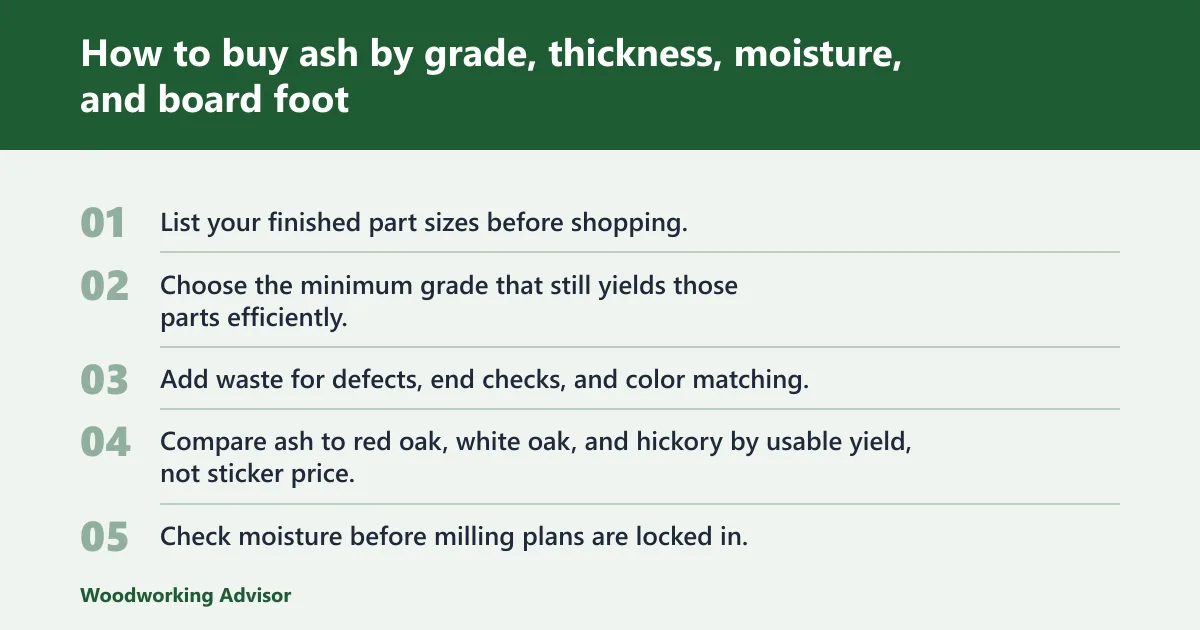
- List your finished part sizes before shopping.
- Choose the minimum grade that still yields those parts efficiently.
- Add waste for defects, end checks, and color matching.
- Compare ash to red oak, white oak, and hickory by usable yield, not sticker price.
- Check moisture before milling plans are locked in.
Why ash is harder to find now and when scarcity changes the value
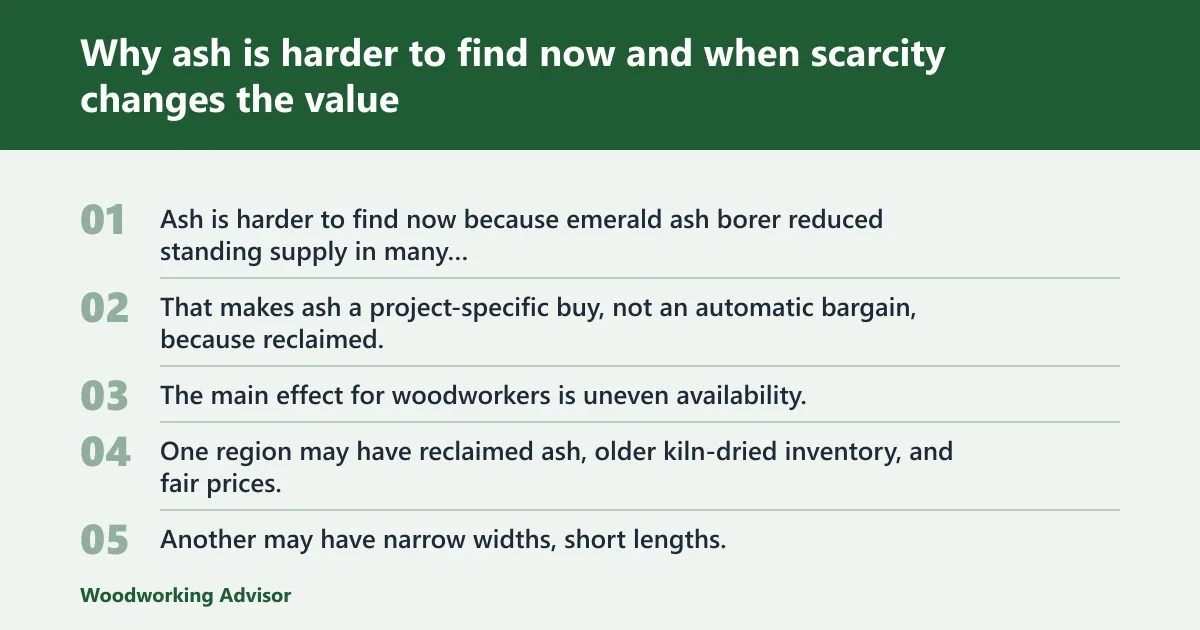
Ash is harder to find now because emerald ash borer reduced standing supply in many areas and changed what dealers can stock consistently. That makes ash a project-specific buy, not an automatic bargain, because reclaimed, pre-harvested, and newly sawn boards now arrive with wider variation in price, grade, and stability.
Emerald ash borer changed the buying pattern
The main effect for woodworkers is uneven availability. One region may have reclaimed ash, older kiln-dried inventory, and fair prices. Another may have narrow widths, short lengths, or premiums high enough to erase ash’s value advantage over oak.
This is why blanket advice fails. A species can be excellent and still be the wrong purchase if the local dealer’s ash is scarce, mixed, or priced like a specialty wood.
Reclaimed and pre-harvested stock can be good or costly
Reclaimed ash can be appealing when clear long stock is available, but buyers should expect more metal risk, color variation, and prep labor. Pre-harvested stock can be excellent if it was dried and stored well. The label alone does not settle quality.
When oak or hickory becomes the better buy
Red oak is often the better buy when you want a ring-porous grain, indoor use, and easier replacement stock. White oak can be the better buy for flooring, higher moisture exposure, or projects where better decay resistance matters. Hickory often wins for heavy-impact handles if weight and machining effort are acceptable.
Suppose local ash is priced 25 percent above comparable red oak, with only short 4/4 boards in lower grades. For a dining table base, ash stops looking like value. For splitting maul handles, the same dealer’s straight-grained ash blanks may still be worth buying.
Ash value matrix by project type
Buyer-focused ash value matrix
| Project type | Ash value rank | Recommended thickness | Acceptable grade | Expected waste | Finish difficulty | When oak or hickory is the better buy |
|---|---|---|---|---|---|---|
| Tool handles and striking-tool blanks | High | 6/4 to 8/4 | Clear, straight-grained stock; grade matters less than grain direction | Medium, due to grain selection and runout rejection | Low | Choose hickory for maximum impact use or when ash is off-grain |
| Chair parts and furniture bases | High | 4/4 to 8/4 depending on part size | Select or FAS for visible parts | Medium | Medium | Choose red oak if local ash carries a scarcity premium above about 10 to 20 percent |
| Flooring | Medium-high | Commonly milled from 4/4 stock | Flooring-matched stock with color control | Medium | Medium-high because pores stay visible | Choose white oak for higher moisture tolerance or easier replacement stock |
| Cabinet face frames and interior millwork | Medium | 4/4 | Select is often enough | Low to medium | Medium | Choose red oak for easier sourcing; choose poplar or maple if a smoother painted surface is needed |
| Wide panels and tabletops | Medium-low | 5/4 preferred for flattening margin | FAS | Medium-high | High if a flat film finish is required | Choose oak if ash widths are short or mixed; choose another closed-pore wood if finish prep must stay low |
| Paint-grade furniture | Medium | 4/4 to 5/4 | Select or lower if defects can be cut around | Medium | Medium because grain telegraphs under paint | Choose poplar or soft maple if a smoother painted face matters more than hardness |
| Outdoor projects | Low | Varies | Grade is secondary to species choice | Project-dependent | High | Choose white oak or another exterior-suitable wood |
How to read the matrix
The matrix treats ash as a value wood only when the project needs what ash does best: shock resistance, a bold ring-porous look, and clean machining in straight stock. Once scarcity premiums rise, or once the finish schedule needs pore filling and extra labor, ash drops quickly.
That is why a wide-panel dining table and a hatchet handle should not be judged by the same standard. One punishes open pores and width waste. The other rewards straight grain and shock resistance.
Frequently asked questions
Is ash lumber good for furniture?
Ash is good for furniture when the design benefits from visible grain, straight stock, and decent dent resistance. It is less attractive when you need very wide clear panels, a closed-pore surface, or the lowest finishing labor, because grade waste and pore filling can erase any price advantage.
What grain pattern does ash lumber have?
Ash has large pores arranged in distinct earlywood bands, usually with a mostly straight grain and a medium to coarse open texture. Flatsawn boards show stronger cathedral grain, while riftsawn and quartersawn boards look calmer. That bold pore structure is a visual asset in some projects and extra finish work in others.
Why is ash wood harder to find now?
Ash is harder to find because emerald ash borer reduced supply in many regions and changed what dealers can stock with consistency. Buyers now see more reclaimed and pre-harvested material, more regional price swings, and more cases where oak is easier to replace or match later.
Is ash lumber worth the price compared with oak?
Ash is worth the price when clear stock is close to red oak in usable cost and the project benefits from ash’s shock resistance or stronger ring contrast. If ash carries a scarcity premium, needs heavy pore filling, or comes in poor grades, oak is often the smarter purchase.
What grade or thickness of ash lumber should I buy?
Buy the lowest grade that still yields your parts with reasonable waste. Select or FAS makes sense for visible furniture faces, while lower grades can work for paint-grade parts or short components. For thickness, 4/4 suits many parts, 5/4 adds flattening margin, and 6/4 to 8/4 fits handles and heavy sections.
Sponsored / affiliate links. As an Amazon Associate I earn from qualifying purchases. I may earn additional commission from eligible campaigns.