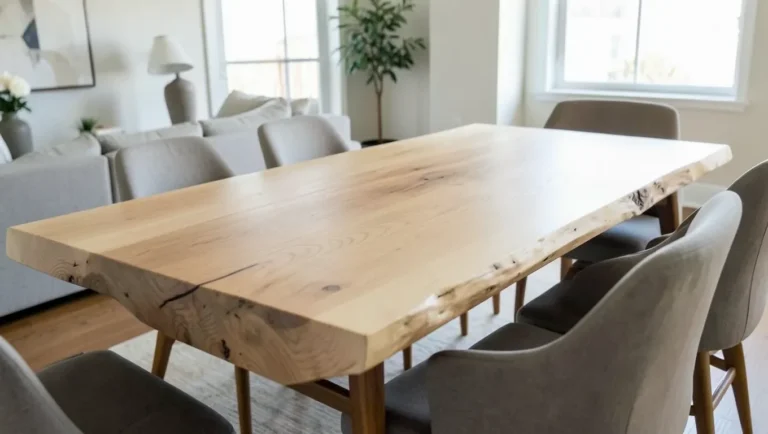
Ash vs Oak Flooring: Which Should You Choose for Your Home?
Choose oak if moisture exposure, supply consistency, or resale comfort matter. Choose ash if you want a lighter floor with a springier feel and can accept more color change over time. Pick the wrong species and you can get cupping, uneven wear, or a floor that ages badly. This guide compares ash and oak on moisture tolerance, appearance change, installation fit, and buying trade-offs.
Ash vs oak flooring: the real trade-off


| Factor | Ash | Oak Flooring | Winner |
|---|---|---|---|
| Cost / availability | Availability can vary by region. | Red oak is a common residential flooring species; white oak is widely specified, often at a premium. | Oak Flooring |
| Dent resistance | Strong, with white ash around 1,320 lbf on the Janka scale. | Red oak is around 1,290 lbf; white oak is around 1,360 lbf. | Oak Flooring |
| Moisture tolerance | Open grain; less forgiving in humid rooms. | White oak has a closed grain and better natural moisture resistance than ash or red oak. | Oak Flooring |
| Color stability | Warms and yellows under UV exposure. | Oak darkens under UV exposure. | Tie |
| Grain visibility / look | Open, straight grain with a lighter look; feels airier and suits modern or Scandinavian-leaning rooms. | Red oak has open grain with warm undertones; white oak has a tighter, less open pattern that reads more refined. | Ash |
| Stain predictability | Good, but open pores can read differently with some stains. | Common and predictable for many stains; white oak is very good, especially for wider color ranges. | Oak Flooring |
| Installation fit / risk | Moderate; solid ash needs acclimation and careful moisture control. | Moderate; similar handling needs, with white oak slightly more forgiving in some rooms. | Oak Flooring |
| Best-fit use | Dry bedrooms, living rooms, and light-use spaces. | Whole-house use where budget and availability matter; kitchens, main floors, and other moisture-prone zones are best for white oak. | Oak Flooring |
| Format / design flexibility | Comes in solid, engineered, and prefinished formats, giving more installation and design choices. | Supports nail-down, glue-down, and floating installation; engineered oak improves stability over concrete and in humidity swings. | Tie |
| Overall durability in real rooms | Can work well, but asks for stricter cleaning and a finish that can take wear. | White oak gives the best margin for dents and moisture swings; oak is framed as the safer hardwood choice in damp conditions. | Oak Flooring |
What ash brings to a room
White ash flooring has an open, straight grain and a light to medium brown color, with white ash around 1,320 lbf on the Janka scale. It comes in solid, engineered, and prefinished formats, so you get more installation and design choices than many homeowners expect.
What oak brings to a room
Red oak is a common residential flooring species with open grain and warm pinkish-to-salmon undertones, and it sits around 1,290 lbf on the Janka scale. White oak is around 1,360 lbf, has a closed grain, and resists moisture better than ash or red oak.
Why hardness alone does not decide the winner
Janka hardness is a dent-resistance scale in lbf, and it is not the whole durability picture. It does not tell you how a floor handles humidity, how stain behaves in open pores, or how a finish ages under sunlight.
📊 White ash has a Janka hardness of about 1,320 lbf. Source: Ash vs Oak Flooring: A Comprehensive Comparison for Homeowners.
How do ash and oak compare on durability?
On paper, ash, red oak, and white oak sit in the same general durability band, so the Janka numbers do not separate them by a wide margin. In real rooms, dent resistance matters, but so do seasonal movement, finish wear, and how often chairs, pet claws, or dropped items hit the floor.
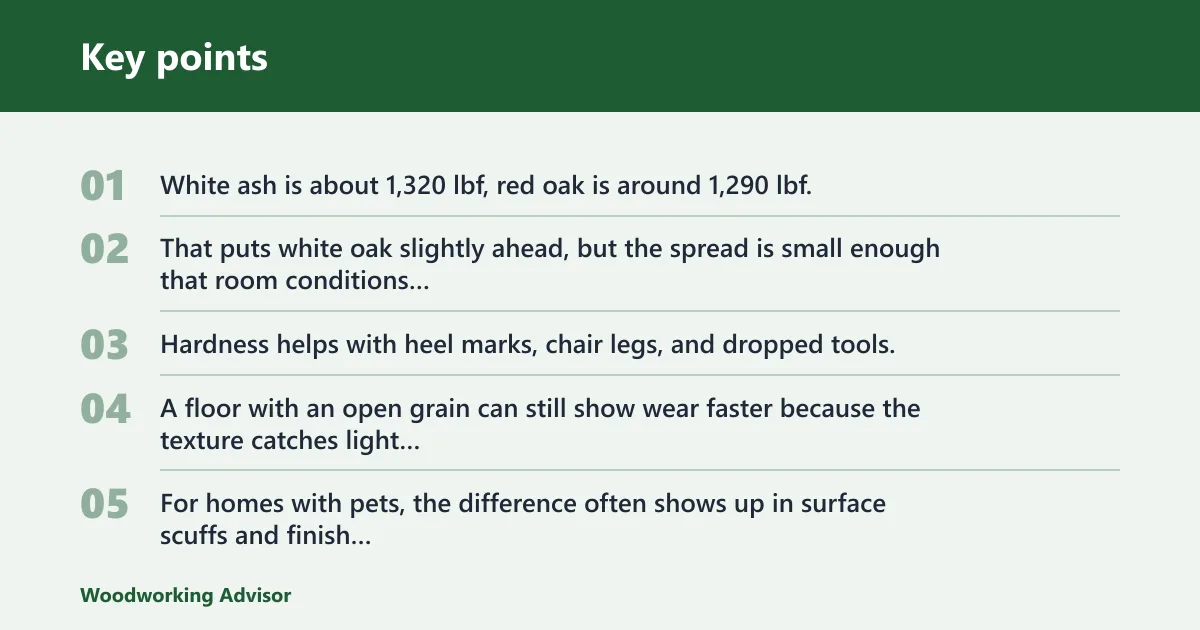
Janka hardness numbers for white ash, red oak, and white oak
White ash is about 1,320 lbf, red oak is around 1,290 lbf, and white oak is around 1,360 lbf. That puts white oak slightly ahead, but the spread is small enough that room conditions and finish choice can matter more than the raw number.
Dent resistance versus everyday wear
Hardness helps with heel marks, chair legs, and dropped tools, but it does not stop finish wear. A floor with an open grain can still show wear faster because the texture catches light and dirt differently than a tighter-grained surface.
What pets, chairs, and dropped objects change in practice
For homes with pets, the difference often shows up in surface scuffs and finish scratches before it shows up in deep dents. In a dining room, chair movement and grit under the legs can matter more than a few points on the Janka scale.
Say your living room has a long traffic path from the entry to the sofa, plus two dogs. White oak gives you the best margin for dents and moisture swings; ash can still work, but it asks for stricter cleaning and a finish that can take wear.
Which wood has the better look for flooring?
Ash gives you a lighter, more open floor image, while oak reads warmer and more familiar in most homes. If you care about how the floor will age under daylight, that matters as much as the first-day color.
Color and undertone differences
White ash starts light to medium brown, red oak carries warm pinkish-to-salmon undertones, and white oak usually sits in a calmer tan-to-brown range. Oak often looks more traditional; ash feels airier and can suit modern or Scandinavian-leaning rooms.
Grain visibility and room style
Ash flooring has an open, straight grain that stays visible even with simple clear finishes. Red oak also has open grain, while white oak’s closed grain gives a tighter visual pattern that many buyers read as more refined.
How UV color change affects the final look
Ash tends to yellow over time under UV exposure, while oak darkens. That means ash may lose some of the pale look buyers want from day one, especially in sunny rooms with rugs and furniture shadowing.
A common first-timer mistake is choosing ash for a bright, pale finish and then placing large area rugs over half the room. Six months later, the uncovered zones warm up while the covered zones stay lighter, and the contrast becomes obvious.
How do ash and oak compare in moisture resistance?
White oak is the best of the three for moisture resistance, because its closed grain slows moisture exchange better than the open grain in ash and red oak. Even so, none of these woods is waterproof, and kitchen spills, basement humidity, and seasonal movement can still cause gapping or cupping.
Open grain versus closed grain
Open-grain woods absorb and release moisture more readily through their pore structure. White oak’s closed grain gives it an edge in damp conditions, which is why it is the safer hardwood choice for rooms that see more humidity or more frequent cleaning.
Humidity, seasonal movement, and cupping risk
All wood floors expand and contract with seasonal changes. If a room swings from dry winter air to humid summer air, you can see gaps in the heating season and cupping or edge lift when moisture rises too quickly.
Best room types for kitchens, basements, and main floors
For kitchens, white oak is often the best hardwood pick among these three. For basements, engineered flooring is often the practical choice, since concrete slabs usually call for a system that handles vapor and dimensional change better than solid wood on its own.
Suppose you are finishing a basement family room over concrete and want a wood look without high risk. Engineered white oak on the right underlayment is the safer route; solid ash on a slab is the one to avoid unless the subfloor system is built for it.
What finish and installation choices change the result?
Finish and installation can matter as much as species. A good species choice can still fail if the wrong format goes over the wrong subfloor, or if an open-pore wood gets a finish system that does not suit its surface.
Site-finished versus prefinished flooring
Site-finished floors let you control sheen and color, and low-VOC finishes are available. Prefinished flooring installs more cleanly and usually comes with a tougher factory coating, which can reduce job-site variables for busy remodels.
Nail-down, glue-down, and floating installation
Both ash and oak support nail-down, glue-down, and floating installation. Nail-down is common over wood subfloors, glue-down is common where extra stability is wanted, and floating systems are often paired with engineered flooring when subfloor conditions call for more flexibility.
Why engineered flooring matters on concrete slabs
Engineered ash or engineered oak changes the equation because it improves stability over concrete and in rooms with wider humidity swings. If you are covering a slab, engineered flooring is usually the practical way to use ash or oak without inviting movement problems.
Why open-pore woods may need grain filling
Open-pore woods like ash and red oak can benefit from grain filling when you want a smoother, more refined finish. Skipping that step leaves the pore pattern more visible, which may be exactly what you want in a rustic room and exactly what you do not want in a sleek one.
Ash vs red oak vs white oak: decision matrix

This matrix turns the comparison into room-use guidance. The best choice changes with moisture exposure, desired color, and how much variation you can tolerate in sourcing and installation.
| Scenario | Ash | Red oak | White oak | Recommendation |
|---|---|---|---|---|
| Dry bedroom with a light, open look | Strong fit | Works, but warmer in tone | Works, but visually heavier | Ash |
| Busy family room with pets | Good, but needs more care with grit | Good value choice | Best margin for wear and moisture | White oak |
| Kitchen or mudroom | Possible, but not the safest pick | Acceptable with careful maintenance | Best natural moisture tolerance | White oak |
| Budget-sensitive whole-house remodel | May cost more if local supply is limited | Usually the easiest to source | Often the premium option | Red oak |
| Design-driven room that wants a pale floor | Best first-day color, but it yellows | Warmer from the start | Tighter grain, less airy | Ash |
| Slab over concrete | Use engineered only | Use engineered only | Use engineered only | Engineered white oak if moisture risk is a concern |
| Need easy stain matching across rooms | Good, but open grain can read differently | Common and familiar for many stains | Best for controlled color results | White oak |
| Lowest install risk from supply and spec matching | Region dependent | Most common match | Widely available, but often at a premium | Red oak |
What the matrix means in real buying terms
Ash makes sense when the room is dry, the look is the priority, and some color shift is acceptable. Red oak is the easy middle ground when you want reliable sourcing and a classic residential floor. White oak wins when moisture tolerance, finish control, and long-term flexibility matter most.
Choose Ash if… / Choose Oak Flooring if…
Choose ash if the room is dry, you want a lighter and more open-grained floor, and you are comfortable with yellowing over time. Choose oak if you need better moisture tolerance, easier spec matching, or a more predictable path for kitchens, pets, and resale.
Choose ash if…
Choose ash if you want the airy look of a light hardwood, especially in bedrooms, studies, and low-moisture living spaces. It also makes sense if you are comparing engineered or prefinished options and want a floor that reads less traditional than oak.
Choose red oak if…
Choose red oak if you want a common residential flooring species with a familiar warm tone and broad availability. It is often the most practical value choice when you want a proven hardwood without paying white oak pricing.
Choose white oak if…
Choose white oak if the room sees more humidity, you want better natural moisture resistance, or you need the best odds for a cleaner stain result. It is the safest pick for kitchens and the strongest overall option among the three for many remodels.
Frequently asked questions
ash vs oak flooring
Ash is the better pick when you want a lighter, more open-grained floor and can live with more color change over time. Oak is the safer choice when room moisture, product availability, or matching across a whole-house remodel matters more than the first-day look.
ash vs white oak flooring
White oak is usually the better all-around flooring choice because its closed grain improves moisture tolerance and stain control. Ash can still win for a brighter visual effect, but it asks more of the room conditions and the finish system.
is ash harder than oak
White ash is a bit harder than red oak, but a bit softer than white oak. That small gap does not decide the whole job, because moisture behavior and finish wear matter too.
is ash stronger than oak
“Stronger” depends on what you mean. On dent resistance, ash is close to red oak and slightly below white oak; on stability in damp rooms, white oak is the stronger choice because its closed grain handles moisture better than ash or red oak.
what is the difference between ash and oak flooring
Ash has an open, straight grain and tends toward a lighter look that warms or yellows under UV. Oak is warmer from the start, with red oak’s pinkish undertones and white oak’s tighter grain and better natural moisture resistance.
should I choose ash or oak for a kitchen floor
Choose oak, and favor white oak if the budget allows. Kitchens see spills, more cleaning, and bigger humidity swings than bedrooms or living rooms, so the better moisture tolerance of white oak gives you more protection against cupping and edge movement.
Sponsored / affiliate links. As an Amazon Associate I earn from qualifying purchases. I may earn additional commission from eligible campaigns.