How Much Does Ash Lumber Cost Per Board Foot?
Common kiln-dried ash lumber often costs about $4 to $10 per board foot. Clear, wide, or furniture-grade boards often run $8 to $14 or more. Misjudging grade, moisture, or milling can add roughly 20% to 50% to a project bill. This guide breaks down the price drivers and shows how to estimate your full ash lumber budget.
Ash lumber price overview
What a board foot means
Board foot pricing uses a volume unit, not a finished-piece price. One board foot equals a piece 12 inches by 12 inches by 1 inch thick, or any equivalent volume. That matters because a 1 x 12 x 8-foot board contains 8 board feet before waste, surfacing, or defects.
Typical retail price bands
For many retail lumber yards, ash falls into three broad bands. Rough, common-grade, or less-select boards may sit near $4 to $6 per board foot. Typical kiln-dried retail stock often lands around $6 to $10. Clear, wide, or better-graded ash boards can often run $10 to $14 or more per board foot, especially when supply is tight.
Why prices vary by seller
Retail yard pricing is usually higher than sawmill or wholesale pricing because the yard absorbs storage, sorting, drying, and yard handling. Minimum purchase sizes also matter. A seller may quote a lower board-foot price on a larger order, while small orders can carry a premium or a short-order fee.
What drives ash lumber cost
Ash lumber price changes with species, grade, drying, surfacing, and local supply. White ash often sits in a higher tier than green ash, and clear, kiln-dried, surfaced boards cost more than rough, green stock. The same species can carry very different pricing depending on board size and defect allowance.
Species differences: white ash and green ash
White ash is often the higher-priced species because clearer, straighter boards bring more demand and because available stock can be limited in many regions. Green ash may price lower, especially when it comes from lower-grade or salvage material. Substitution can make sense when appearance, strength, and color match the project.
Grade differences: FAS, Select, and common
Grade has a direct effect on price. FAS and Select boards usually cost more because they offer more clear wood and less waste. Common grades are cheaper because knots, mineral streaks, pinholes, or shorter clear sections lower usable yield. Clear stock commands a premium because more of the board can become finished parts.
Drying and moisture content
Kiln-dried ash usually costs more than green ash because drying adds time, energy, and handling. Kiln-dried stock is commonly sold around a furniture-safe moisture content, often near 6% to 8% depending on seller and region. Green ash can be cheaper, but it brings movement risk, so it may need more drying time before joinery or finishing.
Rough-sawn versus surfaced stock
Rough-sawn lumber is usually cheaper than surfaced lumber because it has not been planed and jointed to final dimensions. Surfaced boards cost more because they already have extra machine time and less thickness left after milling. If you need finished dimensions, surfaced stock can save labor even when the per-board-foot price is higher.
Picture a cabinet project that needs 60 board feet of ash for doors and rails. If you buy rough boards at $5 per board foot, the lumber subtotal is $300. Add surfacing, waste, and a small shipping charge, and the real total can move much closer to $400 than the sticker price suggests.
Ash lumber cost estimator
Start with the board-foot total, then add grade, milling, drying, shipping, and waste. For a simple estimate, multiply the board-foot requirement by a price band that matches the species and milling state. Then add 20% to 50% if the stock is rough, undersized, or likely to produce cutoffs.
| Species / grade / milling state | Low $/bf | Typical $/bf | High $/bf |
|---|---|---|---|
| Green ash, common grade, rough-sawn | 3 | 4 | 6 |
| Green ash, Select, rough-sawn | 5 | 7 | 9 |
| White ash, common grade, kiln-dried | 5 | 7 | 10 |
| White ash, Select, kiln-dried, surfaced | 8 | 11 | 14 |
| White ash, FAS or clear stock, surfaced | 10 | 12 | 16 |
Board-foot totals for common projects
Use these rough planning numbers before you call a yard. A small shelf or utility project may need 10 to 20 board feet. A set of cabinet doors or a small table can land around 30 to 60 board feet. A dining table, bench, or several carcasses can push into 75 to 150 board feet.
- 10 board feet: roughly $40 to $140 depending on grade and milling
- 25 board feet: roughly $100 to $350
- 50 board feet: roughly $200 to $700
- 100 board feet: roughly $400 to $1,400
Added-cost checklist
Budget for the items below before you settle on a supplier. These charges vary by yard and region, but they often determine the real total more than the base board-foot rate does.
- Drying fees for green stock, if the seller charges them separately.
- Surfacing or planing fees if you want S2S or S4S material.
- Shipping or delivery charges, especially for long boards or low-volume orders.
- Minimum purchase requirements that force you to buy extra board feet.
- Waste factor from knots, checks, twist, or boards cut to usable length.
A common first-timer mistake is buying exactly the net footage needed. Suppose a small workbench needs 40 board feet finished. If the layout and defects force 25% waste, you should budget for 50 board feet before surfacing and cutting losses are added.
Is white ash more expensive?
Yes, white ash is often more expensive than other ash species because better stock is harder to find and clearer boards bring more usable yield. Green ash can be cheaper, especially in rough or salvage form, but it may not offer the same appearance or board quality as white ash.
Why white ash often costs more
White ash is commonly sold as a premium hardwood when the boards are straight, clear, and well dried. Buyers often want it for visible parts, which pushes up demand for better grades. If the board has long clear sections and wide widths, the price can move up quickly.
How green ash pricing can differ
Green ash may sit lower on price charts because it is often sold from mixed grades, storm salvage, or lower-clearance stock. That does not mean it is inferior for every use. It can be a smart buy for painted parts, rough utility work, or projects where appearance is secondary.
When substitution makes sense
Substitute green ash for white ash when the project will be painted, heavily shaped, or hidden from view. Choose white ash when you need a more uniform appearance, better clear yield, or a tighter furniture-grade result. The right choice depends on the final finish, not just the species name.
Why ash is harder to find
Ash has become harder to find in many areas because the emerald ash borer has reduced standing ash trees and affected the supply chain. That scarcity can raise prices, narrow grade options, and increase shipping costs. In some regions, availability is still reasonable; in others, ash is a special-order item.
Emerald ash borer effects
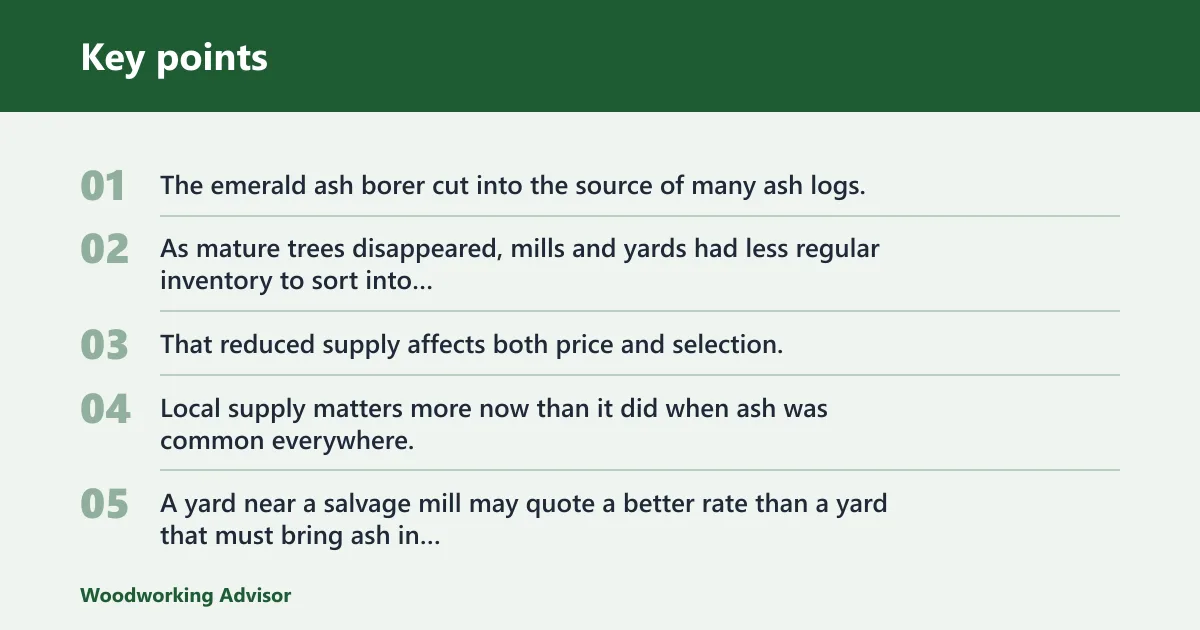
The emerald ash borer cut into the source of many ash logs, especially for consistent domestic supply. As mature trees disappeared, mills and yards had less regular inventory to sort into lumber grades. That reduced supply affects both price and selection.
Regional scarcity and shipping
Local supply matters more now than it did when ash was common everywhere. A yard near a salvage mill may quote a better rate than a yard that must bring ash in from another state. Shipping can erase the savings on small orders, especially for long clear boards.
Salvage and reclaimed stock
Salvage ash can be a lower-cost option when the boards are structurally sound and the defects fit the project. Reclaimed stock may be useful for rustic furniture, painted parts, or wide boards with character marks. It makes less sense for precise joinery, hidden defects, or projects that need reliable thickness and color match.
How to estimate project cost
Start with the seller type, then build the budget from the board-foot count. Retail yard pricing usually includes sorting and storage, while wholesale or sawmill pricing may be lower but come with minimums, rougher stock, or less selection. For many buyers, the better question is total delivered cost, not posted price per board foot.
Retail yard pricing versus wholesale pricing
Retail yards are often the easiest source for small projects because they can sell mixed quantities, surface stock, and help you choose boards. Sawmills or wholesale sellers may offer lower rates, but they often prefer larger orders and may sell rough material only. If you only need 20 board feet, retail is often the practical route.
Waste factor and yield
Waste factor is the hidden cost most budgets miss. Boards with knots, short clear sections, or twist can lose useful yield fast. A project that needs 30 finished board feet may require 36 to 45 board feet purchased, depending on grade and how much matching you need for color and grain.
When to call local yards
Call local lumber yards when you need current pricing, a specific grade, or a delivery quote. Rates change with region, seller, and board size, so a nearby yard can beat a published average or be far above it. Ask for grade, moisture content, thickness, surfacing, minimum purchase, and delivery charges in the same quote.
Say your project needs 80 board feet of Select white ash for shelving and face frames. If the yard quotes $11 per board foot, your lumber total is $880 before surfacing, shipping, and waste. If a nearby sawmill offers rough stock at $7, you may still spend less with the yard once you add milling and lost yield.
Frequently asked questions
How expensive is ash wood?
Ash wood is usually midpriced among domestic hardwoods, but the exact cost depends on species, grade, and milling state. Common kiln-dried stock often runs $4 to $10 per board foot, while clear or furniture-grade boards can reach $8 to $14 or more. Local supply shifts the number fast.
How much does ash lumber cost per board foot?
For many buyers, ash lumber costs about $4 to $10 per board foot at retail for common kiln-dried stock. Rough green boards can be cheaper, and clear surfaced boards can be higher. A single quote is not enough; ask about species, grade, moisture, and whether surfacing is included.
What affects ash lumber price per board foot?
Species, grade, drying, surfacing, and local availability drive the number. White ash often costs more than green ash, FAS and Select cost more than common grades, kiln-dried costs more than green, and surfaced boards cost more than rough-sawn stock. Shipping and minimum orders can change the final bill.
Is white ash more expensive than other ash species?
Often, yes. White ash usually sits in a higher price tier because clear, usable boards are harder to find and more desirable for furniture and visible parts. Green ash can be less expensive, especially in rough or salvage form, but it may not match the appearance or yield of white ash.
Why is ash lumber harder to find now?
The emerald ash borer reduced the standing ash supply in many regions, which affects lumber availability years later. That shrinks selection, raises shipping dependence, and can push prices up where ash is no longer a local product. Salvage and reclaimed material may fill gaps, but availability still varies by seller.
How do kiln-dried and rough-sawn ash prices differ?
Kiln-dried ash usually costs more because drying adds processing time and reduces moisture-related movement risk. Rough-sawn boards are often cheaper per board foot, but you may pay later for planing, jointing, and lost thickness. If the project needs finished sizes, the lower sticker price may not be the lower total cost.
What is a fair price for ash lumber near me?
A fair local price depends on whether you are buying from a retail yard, sawmill, or wholesale source, and whether the boards are rough, surfaced, green, or kiln-dried. In many areas, $4 to $10 per board foot is a reasonable retail starting point, but local scarcity can move it higher.
How does ash lumber compare in cost to oak or hickory?
Ash often lands near oak in many markets, though white ash can run higher when clear stock is limited. Hickory is frequently priced similarly or above ash for select material because it is dense and often sold in narrower, more challenging boards. Comparing species only works when grade and milling match.
Sponsored / affiliate links. As an Amazon Associate I earn from qualifying purchases. I may earn additional commission from eligible campaigns.