5 Best Wood Glues for Joinery (2026): we compared
For most furniture joinery, the best wood glue is a quality aliphatic resin PVA made for tight wood-to-wood joints; choose Type II or Type III PVA for moisture, epoxy for repairs and gap filling, and a longer-open-time glue for large assemblies. Pick the wrong glue and joints can creep, starve, or fail before the clamps come off. This guide compares glue types by joint type, moisture exposure, open time, and repair needs.
This guide is part of our Woodworking joinery and cutting techniques series.
Quick comparison
| Product | Badge | Best for | Price | ||
|---|---|---|---|---|---|
 |
Titebond III Ultimate Wood Glue 4 Oz. – WoodworkingTitebond | Our pick | Type I Waterproof · 4 Oz. Bottle | $4.98
Price as of 9 Oct 2026
|
View |
 |
Gorilla Original Gorilla Glue, Waterproof PolyurethaneGORILLA | Also great | Polyurethane · 2 Ounce Bottle | $5.98
Price as of 9 Oct 2026
|
View |
 |
Titebond Original Wood Glue 5063, Industry Standard forTitebond | Budget pick | Original · 8 Oz. Bottle | $3.92
Price as of 9 Oct 2026
|
View |
 |
Elmer’s E7010 Carpenter’s Wood Glue, Interior, 8 Ounces ,Elmer’s | Also great | Interior Carpenter’s · 8 Oz. Bottle | $8.65
Price as of 9 Oct 2026
|
View |
 |
Gorilla Ultimate Waterproof Wood Glue, Natural Color, 8 ozGORILLA | Our pick | $5.97
Price as of 12 Oct 2026
|
View |
Start with the joint, then match the adhesive. A tight indoor edge glue-up does not need the same chemistry as a loose repair, an outdoor chair, or a mixed-material assembly.
Water resistance is only one part of the choice. Open time, cleanup, and gap handling often decide whether a joint comes together cleanly or fails at the worst moment.
📊 Liquid hide glue can offer open time up to 30 minutes. Source: Wood Glue: The Best Wood Glue and How to Glue Wood Together.
How we chose
This guide ranks glue by joinery fit first, then by exposure, open time, cleanup, and failure mode. That means a glue can be the right answer for one job and the wrong answer for another.
The comparison also favors products and chemistries that are easy to source, widely used, and realistic for DIY furniture work. Specialty adhesives appear when the joint demands them, not when a label sounds strong.
The last filter is practical. If a glue is hard to spread, hard to clean, or likely to fail because the joint fit is poor, it drops in priority.
PVA wood glue: best for most raw wood-to-wood joinery
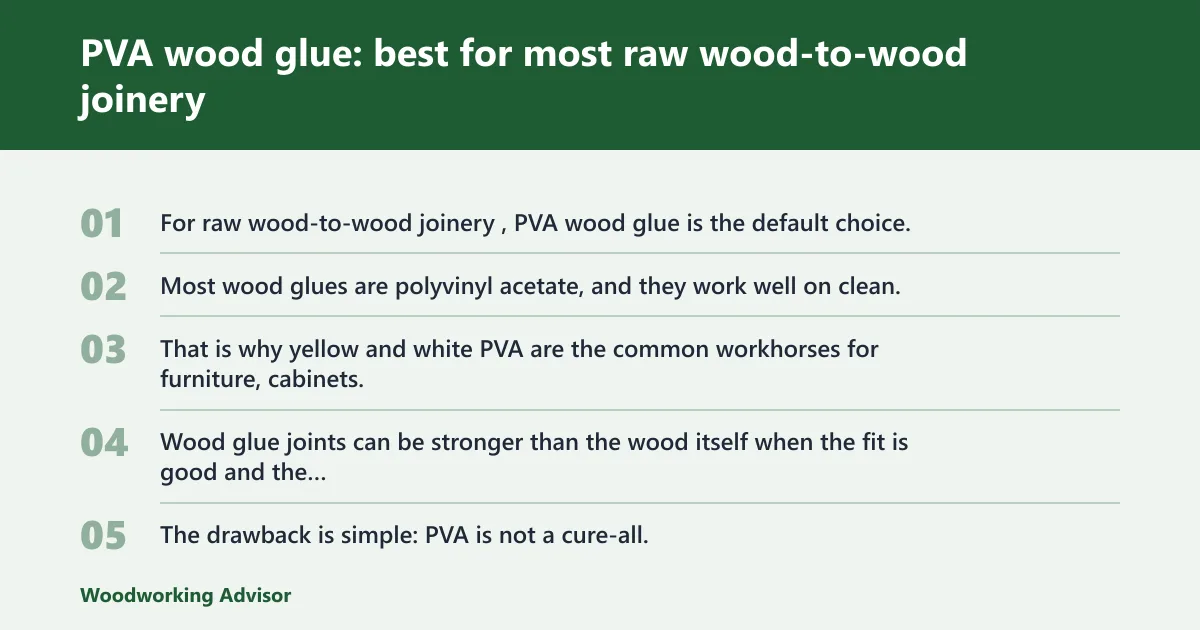

For raw wood-to-wood joinery, PVA wood glue is the default choice. Most wood glues are polyvinyl acetate, and they work well on clean, tight-fitting parts because the adhesive penetrates the wood fibers and forms a strong bond.
That is why yellow and white PVA are the common workhorses for furniture, cabinets, and general shop assembly. Wood glue joints can be stronger than the wood itself when the fit is good and the clamps do their job.
The drawback is simple: PVA is not a cure-all. It is not the right answer for large gaps, oily surfaces, or joints that need waterproof performance beyond what a standard interior glue provides.
Yellow vs. white PVA: interior and exterior use
White and yellow interior glue is the common workhorse for indoor projects. It is the best fit for shelves, casework, face frames, and most furniture assembly, but it is not for outdoor use.
Yellow exterior wood glue is used for outdoor projects and is labeled water resistant or exterior. Titebond II is a common example. It handles occasional wetting better than interior glue, but it is not for continuous submersion.
If the joint will live outside, choose the glue by the wettest condition it will actually see. Water resistant and waterproof are not the same thing.
Yellow exterior wood glue: best for outdoor projects
Yellow exterior glue is the right step up when the project will see rain, damp air, or wet cleanup after assembly. It is designed for outdoor projects where a standard interior PVA would be the wrong choice.
Titebond III is a good example for this category because it is commonly described as highly water-resistant and has a longer open time for more complex glue-ups. That longer working window helps on assemblies that need careful alignment.
The drawback is scope. Even exterior glue is not for continuous submersion, so a fountain part, pond repair, or permanently wet detail needs a different adhesive.
When exterior glue is still the wrong choice
Use exterior PVA when the joint may get wet but will dry again. Skip it when a part stays wet, sees standing water, or needs gap filling that exceeds the glue line.
Say your outdoor bench slats are tight and properly clamped. Exterior PVA fits that joint well. Suppose the leg has a 1/8-inch void from a bad cut; that is a repair problem, not a normal PVA problem.
Liquid hide glue: best for furniture repair
Liquid hide glue is often the better choice for furniture repair because it gives longer open time and behaves well on older assemblies. It is recommended for repair work, and its open time can be up to 30 minutes.
That longer window matters when you need to work adhesive into old joints, clean squeeze-out, and align parts that do not go together quickly. It also suits reversible repair work where future disassembly matters more than speed.
The tradeoff is curing time. Liquid hide glue is not the fastest route to a stressed joint, so you still need patience before loading the repair.
When reversibility matters more than speed
Choose liquid hide glue when the repair may need to come apart later without brutal damage to the surrounding wood. That is common with antique furniture, veneer work, and repairs where the original design expected traditional adhesive behavior.
It is less useful for modern exterior furniture or any joint that needs waterproof performance. For those cases, another chemistry fits better.
Polyurethane glue: best for waterproof bonds and mixed materials
Polyurethane glue is the better pick when the assembly needs a completely waterproof bond or must bond wood to metal or some plastics. It is useful on tricky assemblies where PVA would not bond the full mix of materials.
Gorilla Original Gorilla Glue is a common example. The chemistry expands as it cures, which can help fill irregular surfaces, but it also makes cleanup messier than PVA.
The drawback is working time. Polyurethane glue can have open time up to 15 minutes, so you need parts ready, aligned, and clamped before the clock runs down. (familyhandyman.com)
Clamp time, cure time, and mess control
Polyurethane glue needs a firm clamping approach. In practice, many makers keep it clamped for at least a short period and avoid stressing the joint until it seems fully cured.
The foaming expansion can push out of joints and stain nearby surfaces if you overapply it. Mask off finished areas and keep a damp cleanup cloth ready, because cleanup gets harder once the foam skins over.
Epoxy: best for gap filling and repairs
Epoxy is often the right choice when a joint has gaps, damaged fibers, or mixed materials that need a structural repair. It is commonly used for filling gaps in wood and is generally treated as waterproof.
Unlike PVA, epoxy is a two-part mix before use. That extra step buys gap-filling ability and broader bonding, which is why it is often used for repairs instead of routine tight joinery.
The drawback is simple. Epoxy is not the default for normal wood-to-wood joints that already fit well, because a well-fit PVA joint is usually easier, cleaner, and cheaper.
Why epoxy is not the default for tight wood joints
Tight joinery wants a glue line that wets the fibers and draws the parts together. Epoxy can do that, but it is usually more adhesive than the joint needs, and the extra cost is hard to justify when the fit is already good.
Use epoxy when the failure mode is a void, split, or repair cavity. Do not use it just because the label sounds strong.
What to watch for: water resistance, open time, gaps, and cleanup
The best glue for joinery depends on four practical questions. Will the joint see moisture, how much time do you need for alignment, how clean is the fit, and how much cleanup can you tolerate?
Water resistant means the joint tolerates occasional wetting. Waterproof means it is built for harsher exposure. Neither term makes a glue right for continuous submersion unless the manufacturer says so.
Joinery decision table
| Joint scenario | Best glue type | Clamp time | Moisture resistance | Gap-filling ability | Common failure mode |
|---|---|---|---|---|---|
| Edge glue-up for a table top | PVA wood glue | Unstressed joint 30 minutes to 1 hour; do not stress at least 24 hours | Interior unless the project is exterior-rated | Poor | Starved glue line from overclamping or poor joint fit |
| Mortise-and-tenon for indoor furniture | PVA wood glue | Unstressed joint 30 minutes to 1 hour; stressed joint 24 hours | Interior use only unless exterior PVA is selected | Poor | Joint creep from wrong glue or insufficient clamp pressure |
| Outdoor chair or bench | Yellow exterior wood glue | Unstressed joint 30 minutes to 1 hour; stressed joint 24 hours | Water resistant, not for continuous submersion | Poor to fair | Moisture failure if the joint stays soaked |
| Furniture repair with longer fitting time | Liquid hide glue | Longer open time; allow full cure before stress | Indoor repair use | Poor | Repair slips out of alignment before clamp-up is complete |
| Mixed material assembly, wood to metal | Polyurethane glue | Minimum 45 minutes clamped; do not stress at least 24 hours | Completely waterproof | Fair | Foam squeeze-out, messy finish contamination |
| Damaged joint with visible voids | Epoxy | Follow cure schedule; do not load early | Waterproof | Good | Weak repair if surfaces were dusty or oily |
Which one should you buy
For indoor furniture and cabinets, buy a quality PVA first. It is the default for raw wood-to-wood joinery, it cleans up with water, and it is usually the best value for hobbyists and frequent users alike.
For outdoor work, choose a labeled exterior glue such as Titebond III when the joint needs better moisture resistance but not full waterproof mixed-material performance. For repair work, liquid hide glue is the better fit when you need longer open time and reversibility.
For mixed materials or fully waterproof assemblies, move to polyurethane glue. For voids, split parts, and repair gaps, use epoxy.
A common first-timer mistake is buying one “strong” glue for every job. A better habit is to buy the glue that matches the joint, then spend more only when the joint really needs it.
How to choose
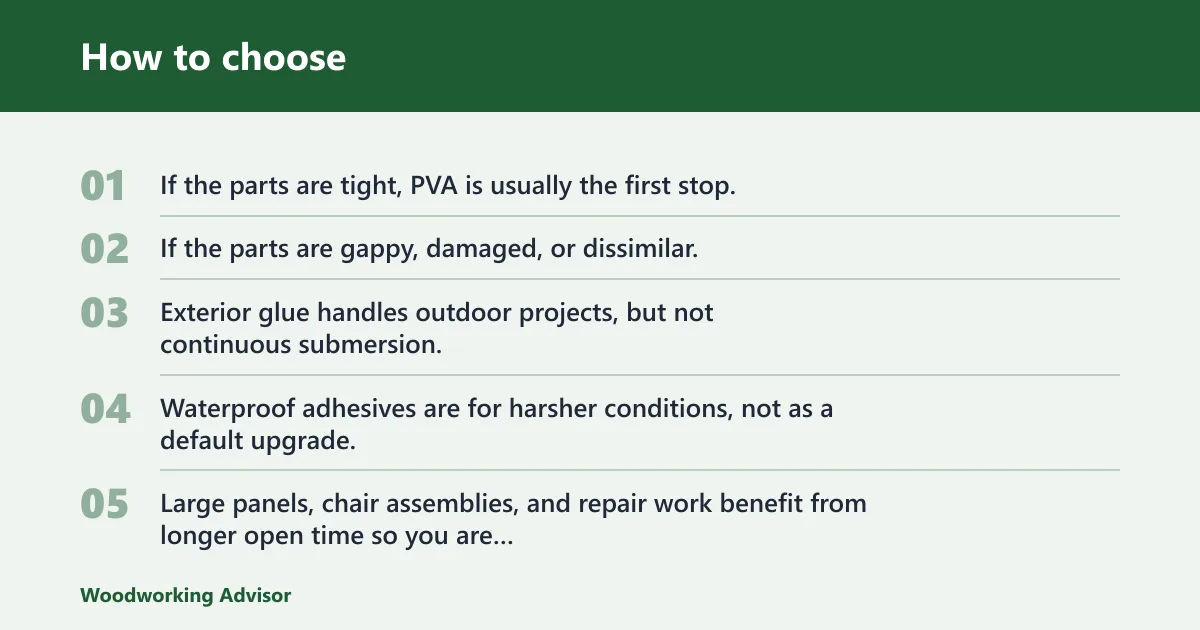
Start with fit. If the parts are tight, PVA is usually the first stop. If the parts are gappy, damaged, or dissimilar, shift to epoxy or polyurethane depending on exposure and material mix.
Then check exposure. Interior glue is not for outdoor use. Exterior glue handles outdoor projects, but not continuous submersion. Waterproof adhesives are for harsher conditions, not as a default upgrade.
Next, check working time. Small joints can use fast-setting glue. Large panels, chair assemblies, and repair work benefit from longer open time so you are not racing the clamps.
Finally, think about cleanup and storage. Old PVA can be affected by freezing and age. Stir it rather than shaking it, thin only up to 5 percent water if the label allows, and discard glue that turns stringy or clumpy.
Practical application tips
Use wax paper under steel bar clamps or pipe clamps to protect the clamps from drips and reduce dark spots on the wood. It is a simple barrier that saves cleanup later.
A flux brush works well on tight corner joints because it spreads glue into corners more cleanly than a fingertip or a scrap stick. It can be stored wet in water for a few days if you keep it clean.
For prefinished joints, apply masking tape before assembly so finish stays off the glue surfaces. No-bleed painter’s tape is the safer pick with water-based finishes.
Clamp pressure should hold parts together, not squeeze every bit of adhesive out of the joint. A good glue line needs contact, not starvation.
Why joints fail
Most failures come from one of four problems: poor fit, the wrong glue chemistry, contaminated surfaces, or rushed clamp-up. Dust, wax, oil, and finish residues block bond formation. A tight joint with the right glue is far safer than a vague “strong” adhesive on a bad fit.
Picture a chair rail with finish left on one edge. The glue bonds to the finish instead of the wood, and the joint lets go under load. Or suppose a tabletop edge is overclamped until the bead disappears; the joint starves and the seam opens later.
Frequently asked questions
what is the best wood glue for woodworking
For most woodworking, a quality PVA is the best starting point because it is made for raw wood-to-wood joinery, cleans up easily, and gives strong bonds on tight joints. Choose an exterior PVA when the project will live outdoors, and move to epoxy or polyurethane only when the joint needs gap filling or waterproof mixed-material bonding.
what is the strongest wood glue for woodworking
There is no single strongest glue for every wood joint. A tight PVA joint can be stronger than the wood itself, while epoxy, polyurethane, and exterior PVA solve different failure modes. The stronger choice is the one that matches the fit, moisture exposure, and clamp schedule of the actual joint.
which adhesive is best for joining wood
For standard wood-to-wood joinery, PVA is usually the best adhesive because it penetrates wood fibers and works well on clean, tight parts. If the joint is exterior, use a water-resistant or waterproof formula as needed. If the joint has gaps or nonwood materials, epoxy or polyurethane is a better match.
what to use to glue wood together
Use PVA for most raw wood-to-wood assembly, yellow exterior glue for outdoor projects, liquid hide glue for repair work that needs more open time, polyurethane for waterproof mixed-material bonds, and epoxy for gaps. The right answer depends on joint fit, moisture, and how long you need before clamping is complete.
Is regular wood glue enough for joinery?
Yes, regular wood glue is enough for many joinery jobs when the parts fit tightly and the project stays indoors. It is the best default for raw wood-to-wood work. It is not enough for outdoor exposure, large gaps, or repairs that need a longer working time or special bond behavior.
When should I use waterproof wood glue instead of PVA?
Use waterproof or exterior-rated glue when the joint will see repeated moisture, weather, or outdoor use. That is different from interior PVA, which belongs indoors. If the joint will be submerged, permanently soaked, or exposed to mixed materials, move beyond standard PVA to polyurethane or epoxy.
Sponsored / affiliate links. As an Amazon Associate I earn from qualifying purchases. I may earn additional commission from eligible campaigns.