5 Best Cordless Drills for Woodworking Beginners: research shows
For most woodworking beginners, the best cordless drill is a 12V brushless model with a 1/2-inch chuck and at least 18 clutch settings; choose 18V only if you regularly drill 3/8-inch holes or larger. Choosing the wrong drill can make pilot holes wander, increase the chance of splitting stock, and slow down pocket-hole work. This guide matches drill type to woodworking tasks, bit sizes, and starter-kit features.
This guide is part of our Woodworking saws: tools, types, and uses series.
Quick comparison
| Product | Badge | Best for | Price | ||
|---|---|---|---|---|---|
 |
Dewalt DCD794B 20V MAX ATOMIC COMPACT SERIES BrushlessDEWALT | Budget pick | Compact 1/2" cordless drill | $100.25
Price as of 10 Oct 2026
|
View |
 |
Makita XFD131 18V LXT® Lithium-Ion Brushless Cordless 1/2"Makita | Our pick | 1/2" 18V brushless drill-driver kit | $179.00
Price as of 10 Oct 2026
|
View |
 |
Milwaukee Electric – M12 Fuel. 1/2 Hammer Drill-DriverMilwaukee | Upgrade pick | 1/2" hammer drill-driver for heavy tasks | $83.25
Price as of 10 Oct 2026
|
View |
 |
20V Cordless Drill Set,Electric Power Drill Cordless,PowerRivlox | Also great | 20V cordless drill with accessories | $25.99
Price as of 10 Oct 2026
|
View |
 |
CRAFTSMAN V20 MAX Cordless Drill and Impact Driver, 2CRAFTSMAN | Our pick | $137.57
Price as of 12 Oct 2026
|
View |
Use the comparison table to match the drill to the kind of woodworking you plan to do, not the voltage on the box. A small bench setup and repeated 1/2-inch drilling call for different tools, and pocket-hole assembly asks for different bit support than light screwdriving.
How we chose
The ranking looks at how each drill fits pilot holes, countersinking, pocket holes, and screwdriving. It also weighs beginner-friendly controls such as clutch range, keyless chuck design, LED light placement, and the value of the starter kit, including batteries, charger, and essential bits.
Weight and size matter too. A lighter drill driver is easier to control at arm’s length, while a bigger 18V class tool is better when you expect larger holes, thicker stock, or longer sessions with a Forstner bit.
Best cordless drill for woodworking beginners: top pick
The top pick is the DEWALT DCD771C2. It is the most durable model in this group, it includes two lithium-ion batteries, and it has an LED light plus a 1/2-inch chuck, which makes it the best fit for a beginner who wants one drill for pilot holes, countersinks, and general screwdriving. (thisoldhouse.com)
The main tradeoff is size. At 3.6 pounds, it is not the lightest option here, so a very small-space user may prefer a lighter 12V class drill driver instead.
Quick picks
| Best for | Model | Key spec | Starter use case |
|---|---|---|---|
| Mixed beginner woodworking | DEWALT DCD771C2 | 18V, 1/2-inch chuck, 1,500 RPM, 3.6 lb | Pilot holes, countersinks, pocket holes, general fastening |
| Lightweight handling | Avid Power model | 18V, 3/8-inch chuck, 550 RPM, 2.2 lb | Small screws, light drilling, overhead or tight-area work |
| Budget kit with accessories | Rivlox 20V drill set | 2-speed settings, LED light, 34 accessories | Starter hole-making and general home-shop setup |
| Battery runtime value | BLACK+DECKER LD120VA | 18V, 3/8-inch chuck, 750 RPM, 4.2 lb | Longer beginner sessions where the kit matters more than speed |
| Drill plus driver setup | CRAFTSMAN V20 MAX combo | Drill and impact driver, 2 batteries | Assembly-heavy projects and fastener driving |
Best cordless drill for woodworking beginners by use case
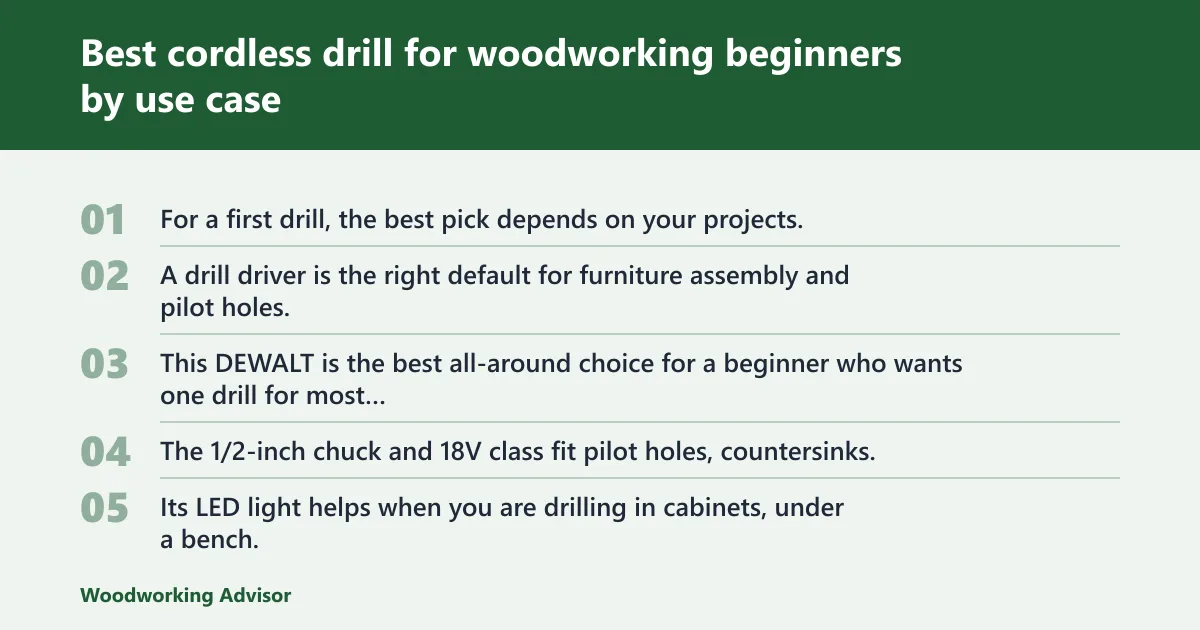
For a first drill, the best pick depends on your projects. A drill driver is the right default for furniture assembly and pilot holes, a compact model makes sense for light cabinet work, and a budget kit can be enough if you are buying starter bits at the same time.
Best overall: DEWALT DCD771C2 for mixed beginner woodworking
This DEWALT is the best all-around choice for a beginner who wants one drill for most woodworking tasks. The 1/2-inch chuck and 18V class fit pilot holes, countersinks, and larger twist bits better than many smaller budget drills, and the included two lithium-ion batteries reduce downtime during assembly.
Its LED light helps when you are drilling in cabinets, under a bench, or near layout lines. The drawback is weight and bulk relative to a compact 12V option, so it is a better first drill for versatility than for all-day overhead work.
Best lightweight pick: Avid Power for compact handling
This Avid Power model is the most lightweight pick in the group, and that matters when you are drilling one-handed into narrow rails or working above shoulder height. Based on the spec sheet and reviews, its compact 3/8-inch chuck and lower 550 RPM ceiling suit light screwdriving and small pilot holes more than larger hole-making.
The tradeoff is clear: a 3/8-inch chuck narrows bit compatibility, and the lighter build is not the best match for Forstner bits or harder stock. If you expect mostly furniture assembly and small shop fixes, though, it keeps the tool easy to control.
Best value pick: BLACK+DECKER LD120VA for battery life
This BLACK+DECKER is the budget-friendly choice for beginners who want an included kit and better battery-life value. The 18V class, 3/8-inch chuck, and 750 RPM output make it usable for everyday drilling and screwdriving, while the broader starter package can reduce the need for extra first-purchase accessories.
The downside is that the 3/8-inch chuck limits larger woodworking bits, and the 4.2-pound weight is not especially light for a small drill. It makes the most sense if the kit price matters more than fast drilling or larger bit compatibility.
What size chuck do you need for woodworking?
For many beginner woodworking tasks, a 1/2-inch chuck is often the safer buy because it accepts a wider range of larger bits and leaves more room to grow into Forstner bits, countersinks, and bigger twist bits. A 3/8-inch chuck can be enough for lighter drill-driver work, but it narrows your options sooner.
3/8-inch chuck: when it is enough
A 3/8-inch chuck fits light drilling, small pilot holes, and general furniture assembly. It is common on budget and compact drills, and it can be fine if you mostly use small twist bits and driver bits. It is less ideal once your work shifts toward larger hole drilling or thicker stock.
1/2-inch chuck: when larger bits matter
A 1/2-inch chuck is the better long-term choice for woodworking because it handles a wider set of bits. It is the standard pick when you want to move from small pilot holes into Forstner bits, countersinks, and larger diameter twist bits without replacing the drill too soon.
How chuck size affects Forstner bits, countersinks, and larger twist bits
Chuck size does not change the bit itself, but it limits what you can clamp securely. A 1/2-inch chuck gives you more flexibility with woodworking bits that need a firmer hold, while a 3/8-inch chuck is more likely to push you toward smaller hole sizes and lighter-duty work.
Best cordless drill by woodworking task
Match the drill to the task first. That keeps you from buying extra power you do not need, and it helps you avoid common beginner mistakes such as forcing a small drill through a large Forstner bit or running screws in too fast with the clutch set too high.
Pilot holes and countersinking
For pilot holes and countersinking, a compact drill driver with a 1/2-inch chuck is the cleanest first choice. Use a lower clutch setting at the start, then step up only until the screw or bit cuts without chatter. That reduces split-out in pine and thin hardwood edges.
Furniture assembly and pocket holes
For furniture assembly and pocket holes, a drill driver is enough for most beginners. An impact driver is better only when you are driving lots of long screws or dealing with stubborn fasteners, because the impact action is not as helpful for drilling precise holes or controlling pocket-hole depth.
Forstner bits and larger hole drilling
Forstner bits and larger hole drilling push you toward a 1/2-inch chuck and a drill with better low-speed control. A higher-RPM tool is not automatically better here; what matters is enough torque at lower speed so the bit does not stall or scorch the wood.
When to stop and choose a drill press or corded drill
If you routinely need repeated straight holes, a drill press becomes the better next buy. If you need long continuous drilling, a corded electric drill makes more sense because it does not depend on battery runtime. That is often the cheaper route for fixed-shop use.
Beginner woodworking drill selector table
Use this selector as a first-purchase map. Start with your most common task, then match chuck size, voltage, speed range, clutch setting, and a starter bit kit that fits that job instead of buying by brand headline alone.
| Task | Recommended chuck size | Voltage | RPM range to target | Clutch starting point | Starter bit kit |
|---|---|---|---|---|---|
| Pilot holes in softwood | 3/8-inch or 1/2-inch | 12V or 18V/20V max | 0–800 RPM | Low, around 5–8 | Twist bits in common pilot sizes |
| Driving screws in furniture parts | 3/8-inch or 1/2-inch | 12V or 18V/20V max | 0–1,200 RPM | Mid-range, around 8–12 | Driver bits and countersink bit |
| Countersinks for screw heads | 1/2-inch preferred | 12V or 18V/20V max | 0–1,000 RPM | Low to mid, around 6–10 | Countersink bit plus pilot bits |
| Pocket holes | 1/2-inch preferred | 18V/20V max | 0–1,500 RPM | Mid, around 10–14 | Pocket-hole drill bit and driver bit |
| Forstner bits and larger holes | 1/2-inch | 18V/20V max | 0–1,500 RPM | Low, around 3–7 | Forstner set and backing board |
For the first purchase, aim for the row that matches your most common task, not the hardest one. A beginner who mostly builds shelves should prioritize pilot holes and countersinks; someone who expects pocket-hole assembly should move up to a 1/2-inch chuck and a kit with the right bits from day one.
Which one should you buy?
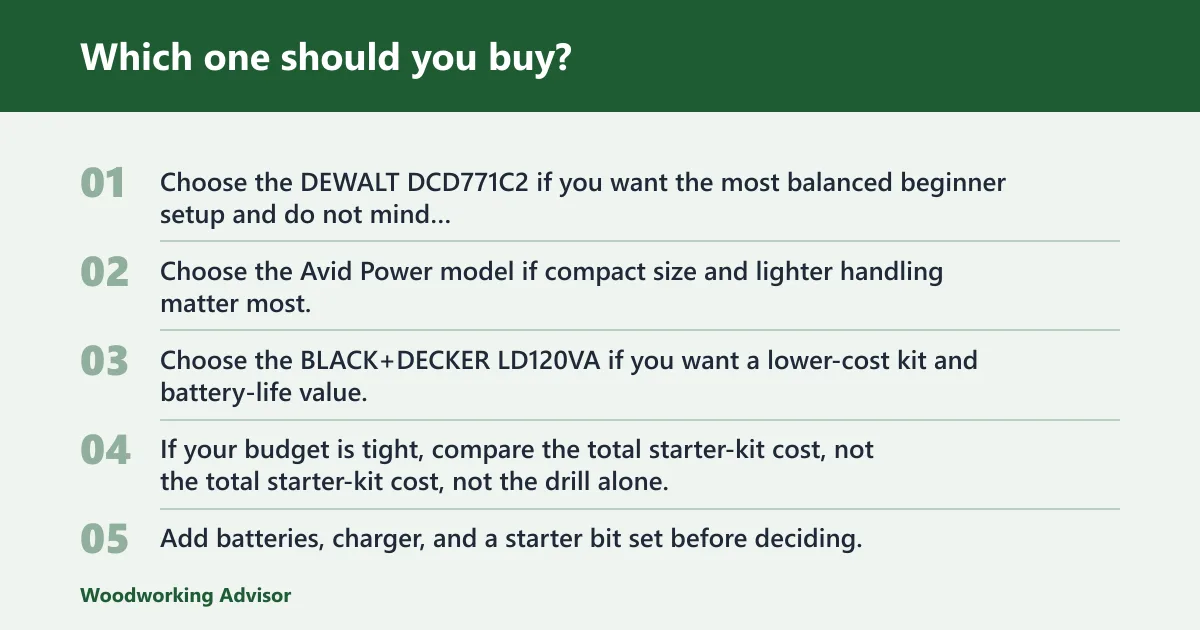
Choose the DEWALT DCD771C2 if you want the most balanced beginner setup and do not mind extra weight. Choose the Avid Power model if compact size and lighter handling matter most. Choose the BLACK+DECKER LD120VA if you want a lower-cost kit and battery-life value, and choose the CRAFTSMAN combo only if you know you also want an impact driver.
Choose by budget
If your budget is tight, compare the total starter-kit cost, not the drill alone. Add batteries, charger, and a starter bit set before deciding. A cheap tool with no useful bits can cost more in the end than a slightly higher-priced kit that is ready for pilot holes and countersinks.
Choose by project type
If you build furniture, pick a drill driver first. If you expect mostly assembly and pilot holes, a compact model is enough. If your work includes 3/8-inch holes or larger on a regular basis, move to an 18V or 20V max class drill with a 1/2-inch chuck.
Choose by battery platform if you already own tools
Lithium-ion battery compatibility matters because the battery platform can save money on future tools. If you already own packs and a charger in the same system, it can be smarter to stay with that platform than to chase a slightly better spec sheet on a different brand.
When a corded drill is the better buy
A corded electric drill makes more sense if you drill for long stretches, work at one bench, or want the lowest up-front cost. You give up cordless freedom, but you gain continuous power without watching battery runtime or planning around spare packs.
Say your first project is a pine bookcase with 1/8-inch pilot holes and countersunk screws. A 12V or light 18V drill driver with a clutch set low is enough. Suppose you later switch to oak shelves and 1-1/4-inch Forstner holes; that is the point where a 1/2-inch chuck and stronger low-speed control matter.
What is the best cordless drill for woodworking beginners?
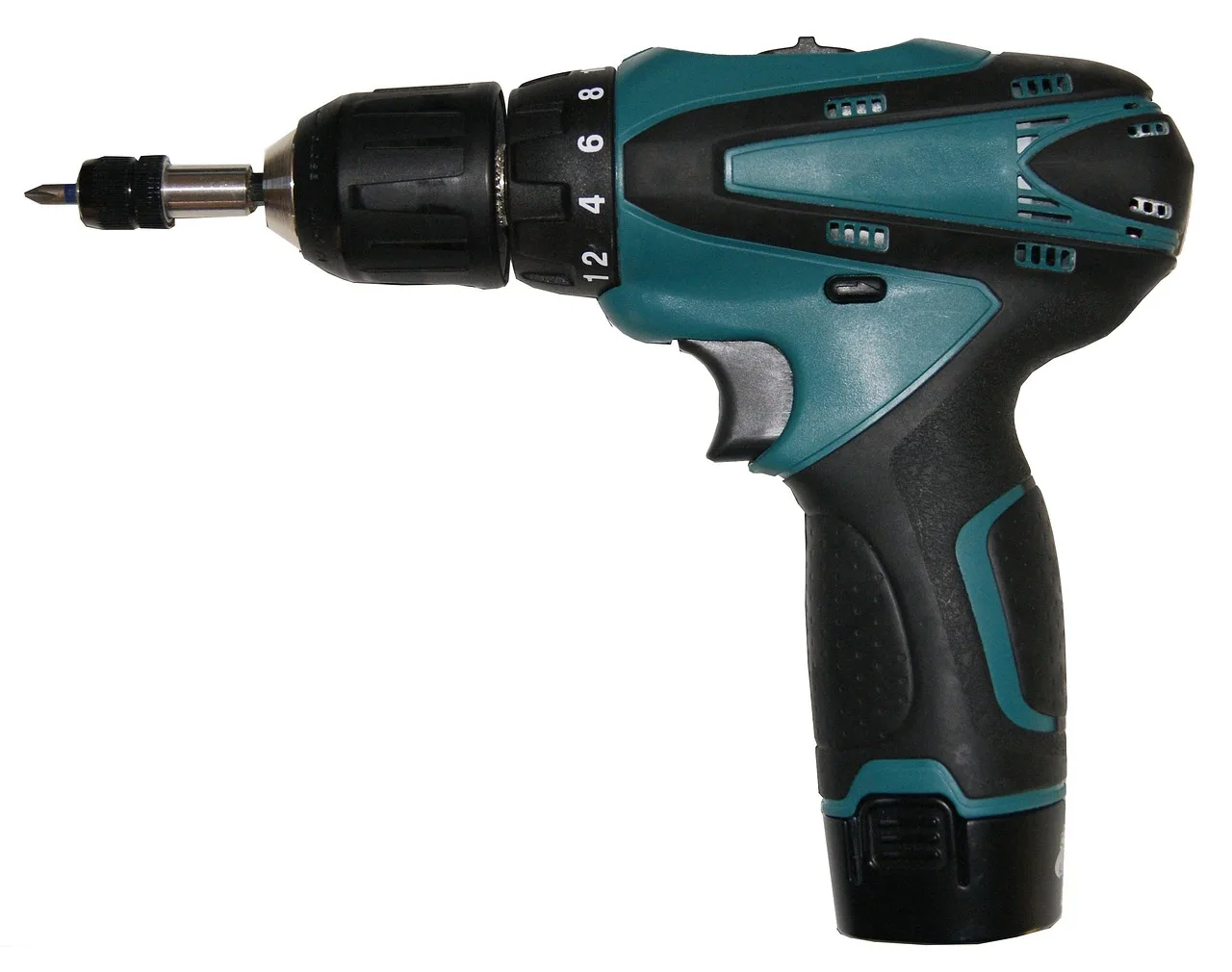
The best cordless drill for woodworking beginners is usually a drill driver with a 1/2-inch chuck, a clutch with plenty of settings, and an LED light. For most buyers, the DEWALT DCD771C2 is the strongest all-around choice here because it balances bit compatibility, battery support, and basic woodworking flexibility.
What size chuck do I need for woodworking?
A 1/2-inch chuck is the better choice for most woodworking because it handles a wider range of bits, including larger twist bits and many Forstner setups. A 3/8-inch chuck is fine for smaller pilot holes and light assembly, but it limits your room to grow as projects get bigger.
Is 18V enough for beginner woodworking projects?
Yes, 18V is enough for most beginner woodworking projects. It is a practical class for pilot holes, screwdriving, countersinking, and many pocket-hole tasks. You usually need more attention to chuck size, clutch control, and bit quality than to chasing a bigger voltage number.
Do I need a drill driver or an impact driver for woodworking?
For woodworking, start with a drill driver. It is the better choice for pilot holes, countersinks, and most furniture assembly because it gives you better control over bit speed and clutch settings. An impact driver is a useful second tool for long screws, but it does not replace a drill driver.
What features should I look for in a cordless drill for woodworking?
Look for a keyless chuck, an LED light, variable speed, and enough clutch settings to start low and adjust up. A lithium-ion battery system matters because runtime and spare battery planning affect how often you stop mid-project. Weight matters too, especially if you work in cabinets or overhead.
How much should a beginner spend on a cordless drill?
A beginner should budget for the whole starter kit: tool, batteries, charger, and basic bits. Tool-only pricing can look low, but a complete setup often gives better value if it includes two batteries or a useful accessory bundle. The cheapest drill is not a bargain if it cannot handle the task list.
Should I buy a brushless cordless drill for woodworking?
A brushless cordless drill is a solid buy for woodworking because it usually gives better runtime per charge and efficient power delivery. That said, a brushed drill can still be enough for a beginner if the price is lower and the kit has the right chuck size, clutch control, and batteries.
What battery and torque specs matter most for beginner woodworking?
Battery type, included batteries, and platform compatibility matter most because they affect runtime and future tool costs. For torque, beginners should focus less on headline numbers and more on low-speed control, clutch range, and whether the drill can hold speed without stalling during common tasks like pilot holes or countersinks.
Sponsored / affiliate links. As an Amazon Associate I earn from qualifying purchases. I may earn additional commission from eligible campaigns.