How Much Does a Table Saw Cost?
Expect roughly $300 to $700 for a basic benchtop saw, about $700 to $2,000 for a jobsite or contractor saw, and around $2,000 to $6,000+ for a cabinet saw; a common rule of thumb is to add about $100 to $1,500 for setup, delivery, and electrical work. Skip those costs, and a low sticker price can turn into a higher total than a better machine. This guide breaks down purchase price, delivery, setup, wiring, accessories, and first-year operating costs for new and used saws.
Prices by saw class and power needs


Table saw prices vary by class, power, and the amount of shop prep they need. A benchtop or jobsite saw can run on 120V household power, while a cabinet saw often needs 220V/240V and stronger support. The purchase tag is only part of the bill.
Benchtop and jobsite saw price range
Benchtop saws usually sit at the low end because they are small, lighter, and built for portability. Jobsite saws often cost more because they add better fences, sturdier stands, and more stable rip capacity. Most jobsite saws run on standard 115V/120V power and almost always use a 15 amp or smaller motor.
A realistic new-price range is about $300 to $700 for a basic benchtop saw and about $400 to $1,200 for a jobsite saw. Used prices can drop sharply, but missing guards, worn fence rails, bent arbors, and damaged tops can wipe out the savings fast.
Contractor, hybrid, and cabinet saw price range
Contractor saws often land between portable and permanent machines. They can be rewired for 220V/240V, and their purchase price commonly overlaps the upper jobsite range. Hybrid saws usually cost more than contractor models because they borrow some cabinet-saw structure without going to full industrial weight.
Cabinet saws are the most expensive class because they use larger motors, heavier trunnions, and more mass. That extra build usually means better performance on thick hardwoods, but it also raises shipping and installation costs. A common range is about $2,000 to $6,000+ new, with used pricing depending heavily on condition and completeness.
New vs used pricing differences
Used saws are not automatically bargains. A clean fence, intact blade guard, working riving knife, flat cast-iron top, and original accessories can justify a higher used price. Missing guards, rusty tables, or a weak fence should reduce the offer because replacement parts and tune-up time add cost.
Resale value tends to hold better when the saw has a known brand, a strong fence system, 120V portability for jobsite use, or full 220V/240V cabinet capability with original safety parts. Aftermarket add-ons rarely return full value unless they solve a common problem, such as a better fence or mobile base.
What drives the total price?
The saw body matters, but motor size, fence quality, and base design often change the true cost more than buyers expect. A lighter saw may look cheaper on the shelf, then need accessories, stands, blades, and electrical work that push the total past a more capable machine.
Motor size, fence quality, and cast-iron mass
Motor size affects both cutting capacity and circuit planning. Benchtop table saws generally draw 1,200–1,800 watts. Contractor table saws generally draw 1,500–2,000 watts. Cabinet table saws can use 2,000–3,000+ watts. A 120V saw drawing 15 amps uses 1,800 watts.
Fence quality also matters because a weak fence slows work and can spoil cuts. Cast-iron mass adds stability and dampens vibration, but it raises shipping and delivery costs. That extra weight often makes a fixed-shop saw more expensive even before installation begins.
Portable versus stationary designs
Portable saws are simpler to move, store, and set up. Stationary saws may cost more up front, and they often need delivery by freight or a local mover. If the shop space is tight, a smaller saw can save money by fitting the room you already have.
Say your shop is a one-car garage and you only rip 3/4-inch plywood on weekends. A jobsite saw on 120V power may be the better total-cost choice, because it avoids wiring work and heavy freight. The cheaper cabinet saw becomes expensive if it forces electrical upgrades you do not need.
Features that affect resale value
- Original guard and riving knife included
- Fence locks square and slides smoothly
- Table top is flat and rust-free
- Motor starts cleanly without unusual noise
- All knobs, miter gauge parts, and throat plates are present
- For cabinet saws, 220V/240V wiring is intact and labeled
Table saw power and voltage
Voltage determines where the saw can plug in, while amperage and wattage determine how hard it pulls on that circuit. Most small saws run on household power. Larger cabinet saws often need 220V/240V and a dedicated circuit, which can change the real purchase decision more than the catalog price.
When 120V is enough
120V is usually enough for benchtop and jobsite saws, especially if you need portability and only cut sheet goods or lighter stock. For many woodworkers, that means no electrician and no panel work. A standard outlet may be all you need.
That said, a 120V saw still needs enough amperage headroom. If the circuit also feeds lights, a vacuum, or chargers, nuisance trips become more likely. Dedicated use is safer and more predictable than sharing the same circuit with other tools.
When 240V becomes necessary
Cabinet saws with larger motors run on 220V/240V by default. Contractor saws can be rewired for 220V/240V. If the saw is built for heavy ripping or all-day use, 240V helps reduce strain on the circuit and gives the motor more breathing room.
Startup surge also matters. Startup surge can reach 1.5–2 times running wattage, so a saw that seems manageable on paper may still trip a weak circuit during startup. That is one reason amperage matters as much as horsepower claims.
Wattage, amperage, and startup surge
For planning, use the saw’s running wattage, then allow for surge at startup. Benchtop saws generally draw 1,200–1,800 watts. Contractor saws generally draw 1,500–2,000 watts. Cabinet saws can use 2,000–3,000+ watts. Higher numbers usually mean better cutting on thick hardwoods, but they also mean more demanding wiring.
Suppose a saw draws 1,800 watts while running on a 120V, 15A circuit. That is already near the edge of what the circuit can support continuously, and startup surge can push demand higher for a moment. In practice, that is why a saw may trip a breaker even if it runs fine on paper.
How much does installation add?
Installation costs depend on whether you already have the right outlet and circuit. A simple plug-in saw may need nothing. A cabinet saw may need a new outlet, a dedicated circuit, or a sub-panel. That can add as much as a midrange saw’s shipping bill.
240V outlet cost
The lower end usually covers a straightforward run to an existing panel. The higher end often shows up when the electrician has to add new wiring, upgrade capacity, or work farther from the panel.
Dedicated circuit and sub-panel work
A dedicated circuit is a strong choice for any larger saw. It reduces nuisance trips and keeps the saw from sharing power with dust collection or other tools. If the main panel lacks space or capacity, a sub-panel can add to the bill quickly.
What a contractor should confirm first
- Voltage required by the saw
- Amperage rating on the nameplate
- Whether the shop already has a free breaker slot
- Distance from the panel to the saw location
- Whether a dedicated circuit is needed
- Whether a 240V outlet, plug, or hardwire is specified by the manufacturer
How much does shipping cost?
Shipping depends on size, weight, distance, and whether the seller can send the saw as parcel or freight. Small portable saws are easier to move, but cabinet and heavier contractor saws often require freight. The shipping charge can change the final price more than a sale discount does.
Parcel versus freight
Parcel shipping works for many jobsite saws because they are compact enough for standard carriers. In a cited example, UPS Ground was $107.64. Freight is more common for 100–400 lb contractor and cabinet saws, which are too heavy for standard parcel service.
Packed weight and box size
A jobsite table saw packs to roughly 30 × 26 × 16 inches and commonly weighs 50–70 lb when boxed. Those dimensions help explain why delivery is often manageable by parcel. Larger saws are a different story; the crate size and pallet handling push them into freight territory.
Local pickup versus delivered pricing
Local pickup can save money, but only if you have a way to load and secure the saw safely. Freight may look expensive, yet it can be the cheaper choice once you factor in time, truck rental, and risk of damage during a do-it-yourself move. Distance still matters.
Table saw cost worksheet
This worksheet treats the saw as an all-in purchase. It separates price, shipping, electrical setup, and first-year operating cost so you can compare a “cheap” saw with a better machine on equal footing. The totals below use budget, mid-range, and pro-shop scenarios.
| Saw class | Purchase price range | Delivery/shipping range | Electrical setup range | First-year operating/consumables | Budget total | Mid-range total | Pro-shop total |
|---|---|---|---|---|---|---|---|
| Benchtop | $300–$500 | $0–$80 | $0 | $80–$150 | $380 | $615 | $730 |
| Jobsite | $400–$1,200 | $0–$120 | $0 | $100–$200 | $500 | $850 | $1,520 |
| Contractor | $700–$2,000 | $75–$250 | $0–$900 | $120–$250 | $895 | $1,515 | $3,400 |
| Hybrid | $1,200–$2,500 | $150–$350 | $0–$1,200 | $150–$300 | $1,500 | $2,325 | $4,050 |
| Cabinet | $2,000–$6,000+ | $200–$500 | $700–$1,500+ | $200–$400 | $3,100 | $4,350 | $8,400 |
Those totals are planning figures, not retail quotes. They show how a cheaper saw can outgrow its sticker price once delivery and wiring enter the picture. A cabinet saw may cost more at checkout, yet it can still be the simpler buy if the shop already has 240V service.
What does a table saw cost to run?
Running cost is usually small compared with the purchase price. A table saw uses electricity based on wattage, time, and local rate. Blade changes, throat plates, wax, and occasional inserts often matter more than the power bill, especially for light weekend use.
kWh use and electricity rate
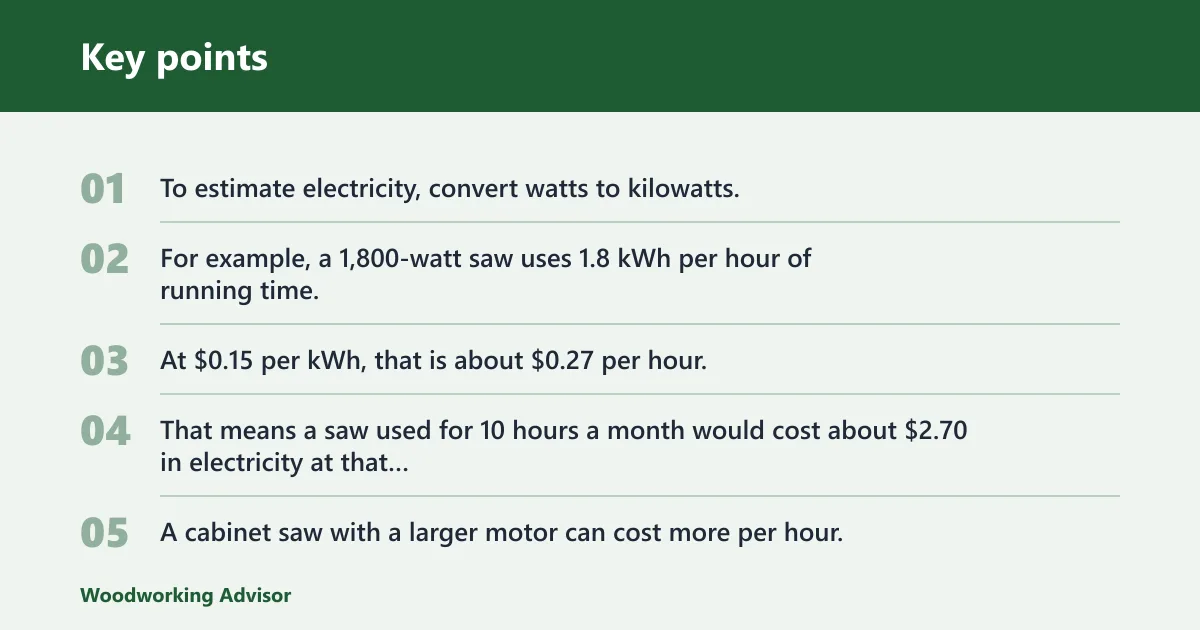
To estimate electricity, convert watts to kilowatts, then multiply by hours of use and your electricity rate. For example, a 1,800-watt saw uses 1.8 kWh per hour of running time. At $0.15 per kWh, that is about $0.27 per hour.
That means a saw used for 10 hours a month would cost about $2.70 in electricity at that rate. A cabinet saw with a larger motor can cost more per hour, but the monthly total is still usually modest for typical woodworking schedules.
Monthly operating cost estimate
For a hobbyist, monthly electricity can stay in the low single digits. For a pro shop that runs the saw daily, the bill grows with hours, not just motor size. Start with the kWh figure, then add your local utility rate and average monthly runtime.
First-year blades and consumables
First-year costs often include at least one quality blade, replacement inserts if needed, wax for the table, and small setup items such as cleaner or rust protection. A new blade alone can cost more than a month of electricity. That is why first-year ownership should include consumables, not just power.
How much does a table saw cost?
For most buyers, the real answer is a range, not one number. A basic saw may cost a few hundred dollars, but setup can add enough to make a higher-tier model cheaper over the first year. The right total depends on voltage, shipping, and the shop you already have.
Picture a buyer choosing between a $450 jobsite saw and a $1,150 cabinet saw. If the cabinet saw also needs freight and a $1,000 electrical job, the total jumps fast. If the shop already has 240V service, the cabinet saw may be the cleaner long-term purchase.
Frequently asked questions
How much does a beginner table saw cost?
A beginner table saw usually costs about $300 to $800, depending on whether you choose a benchtop or jobsite model. The lower end suits light trim and occasional crosscutting. If you want a better fence, more table area, and a safer setup, move toward the middle of that range.
How much does it cost to install a 240V outlet for a table saw?
If the panel has room and the run is short, the bill can stay nearer the low end. New wiring, a sub-panel, or a long run will push the total higher.
How much electricity does a table saw use?
It depends on wattage and runtime. A saw drawing 1,800 watts uses 1.8 kWh for each hour of use. At a $0.15 per kWh rate, that is about $0.27 per hour. For most woodworkers, electricity is a minor operating cost.
Why are table saws so dangerous?
They expose a fast-moving blade and can throw stock back toward the operator during kickback. Missing guards, a poorly set riving knife, and bad feed technique raise the risk. Training matters because the saw’s power can turn a small mistake into a serious injury quickly.
How much does it cost to ship a table saw?
Shipping ranges from low-cost parcel service to much higher freight charges. A jobsite saw may ship in a box around 30 × 26 × 16 inches and 50–70 lb, which can qualify for parcel delivery. Heavier 100–400 lb saws usually require freight.
Where should I buy a table saw?
Buy where the total cost is clearest. That may be a local dealer for setup help, a trusted used listing for a clean contractor saw, or a retailer that shows delivery charges up front. Compare the saw price, shipping, and electrical needs before deciding.
Sponsored / affiliate links. As an Amazon Associate I earn from qualifying purchases. I may earn additional commission from eligible campaigns.