Best Glue to Laminate Plywood: 7 Compared (Coverage & Cost, 2026)
The best glue to laminate plywood is Titebond II Extend Wood Glue — its 15-minute open assembly time is the longest of any PVA glue built for this job, giving you enough time to spread, align and clamp a full 4×8 panel before it starts to set, at roughly $0.40 per square foot of bonded surface. Below, 7 real adhesives are compared by three numbers that actually decide a panel glue-up: coverage per container, open/clamp time, and cost per square foot — all pulled from manufacturer technical data sheets, not marketing copy.
Plywood-Laminating Adhesive Comparison Table: Coverage, Time & Cost per Sq Ft
| # | Adhesive | Price | Usable Coverage | Open Time | Clamp / Cure | Cost per Sq Ft |
|---|---|---|---|---|---|---|
| 1 | Titebond II Extend (16 oz) | $12.39 | 31.2 sq ft | 15 min | 20-25 min set / 24 hr cure | $0.40 |
| 2 | Titebond III Ultimate (16 oz) | $9.58 | 31.2 sq ft | 8-10 min | 30 min clamp / 24 hr cure | $0.31 |
| 3 | 3M Hi-Strength 90 Spray (17.6 oz) | $25.69 | 13.0 sq ft¹ | 1-10 min bond window | Hand pressure only | $1.98 |
| 4 | DAP Weldwood Contact Cement (16 oz) | $18.95 | 13.5 sq ft¹ | Up to 2 hr | No clamp / 7-day max strength | $1.40 |
| 5 | Gorilla Original Polyurethane (18 oz) | $23.99 | 22.0-54.9 sq ft² | 5-10 min | 1-4 hr clamp / 24 hr cure | $0.44-$1.09 |
| 6 | West System G/flex 655 (2×4.5 oz) | $46.86 | Not published³ | 45-75 min | 7-10 hr workable / 24 hr full | n/a³ |
| 7 | Loctite PL Premium (10 fl oz) | $7.38 | 30.6 linear ft bead&sup4; | 15-20 min | 24 hr mechanical support | n/a&sup4; |
¹ 3M and DAP both instruct coating both mating surfaces (3M’s own application guidance: “for best results apply Spray 90 Adhesive to both bonding surfaces”; DAP’s TDS: “spray a coat of cement on both surfaces to be bonded”). Their published one-side spread rate (3M: 23.6 sq ft/lb at 2.5 g/ft²; DAP: 216 sq ft/gal) is halved here to show the sq ft of panel you actually end up with bonded, not the sq ft of adhesive sprayed. ² Gorilla’s TDS gives a glue-consumption range of 100-250 g/m² depending on wood porosity, so its coverage and cost/sq ft are shown as a range, not a single number. ³ West System does not publish a coverage rate for G/flex 655 — it’s a thickened gel sold to fill bond-line gaps, so how far a unit goes depends entirely on gap size, not a fixed spread rate; we’re not guessing a number that doesn’t exist. &sup4; Loctite PL Premium is bead-applied with a caulking gun, not spread across a full face, so its coverage is published in linear feet of bead, not square feet — not directly comparable to the spread-adhesive rows above.
The one number that matters: once you account for the fact that spray adhesive and contact cement both need coating on two surfaces to form a bond, plain PVA wood glue costs about a quarter of what they do per square foot of actual bonded plywood — $0.31-$0.40/sq ft for Titebond versus $1.40-$1.98/sq ft for contact cement and spray adhesive. Their per-bottle sticker prices look close; their per-panel cost doesn’t.
Best Glues to Laminate Plywood
1. Titebond II Extend Wood Glue (16 oz) — #1 Best Overall
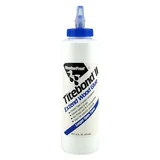
Price: $12.39 · Check current price on Amazon →
- Open assembly time: 15 minutes (70°F/50% RH) — longest of any PVA glue tested here
- Coverage: 250 sq ft/gallon (6-mil spread) — 31.2 sq ft from a 16 oz bottle
- ANSI/HPVA Type II water-resistant
- Required clamping pressure: 30-80 psi for HPL, 100-250 psi for solid wood by species
- Cost per sq ft: $0.40
This is Franklin International’s purpose-built answer to the exact problem a full-sheet plywood glue-up creates: regular PVA glue starts tacking up in 4-5 minutes, which isn’t enough time to spread glue across a 4×8 panel, get a second sheet aligned, and get clamps or cauls on before the working edge skins over. Extend stretches that window to 15 minutes and the total assembly time to 20-25 minutes, which is why it’s the one Titebond specifically markets for large face-gluing jobs rather than small joinery.
It’s not waterproof-rated the way Titebond III is (Type II, not Type I), so it’s the right call for interior cabinet backs, shelving, and built-up panels — not exterior doors or anything that sees standing water. For that trade-off you get the longest working time and, at $0.40 per square foot of actual bonded panel, one of the two cheapest options in this whole comparison.
Pros:
- Longest open time of any PVA glue here — enough to spread and align a full 4×8 sheet before tack-up
- Cheapest-per-container of the three PVA options and still near the bottom on cost per sq ft
- Sands cleanly, unaffected by finishes, easy soap-and-water cleanup
Cons:
- Type II rating only — not rated for continuous water submersion like Titebond III
- Still needs real clamping pressure and squared cauls for a flat panel, unlike contact cement
- Not for structural or load-bearing joints per Franklin’s own limitations
Main drawback: At Type II, it’s not rated for continuous wet exposure — for outdoor panels, step up to Titebond III below.
2. Titebond III Ultimate Wood Glue (16 oz) — Best Waterproof for Exterior Panels
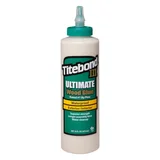
Price: $9.58 · Check current price on Amazon →
- Open assembly time: 8-10 minutes (70°F/50% RH)
- Coverage: 250 sq ft/gallon — 31.2 sq ft from a 16 oz bottle
- Passes ANSI/HPVA Type I water-resistance — the top rating for a one-part wood glue
- Bond strength: 4,000 psi at room temperature (ASTM D-905, hard maple)
- Cost per sq ft: $0.31 — the cheapest in this entire comparison
Titebond III is the glue to reach for the moment a laminated panel is going anywhere near weather or standing water — it’s the only wood glue in this comparison that clears the ANSI/HPVA Type I bar, one step above Extend’s Type II. The trade-off for that waterproof formula is open time: 8-10 minutes instead of Extend’s 15, which is workable on a single panel but tight if you’re gluing up multiple sheets in one session.
The number that stands out in the dataset is cost: at $0.31 per square foot of bonded panel, Titebond III is the cheapest adhesive in this whole comparison, cheaper even than its own Extend sibling, because the two glues share the same 250 sq ft/gallon spread rate but this one costs less per bottle. If your panels are staying indoors, Extend’s extra open time is worth the few extra cents; if they’re not, Titebond III wins on both waterproofing and price.
Pros:
- Cheapest cost per square foot of bonded panel of any adhesive tested, including its own PVA sibling
- Type I waterproof rating — safe for exterior panels, outdoor furniture, and anything that gets rained on
- FDA approved for indirect food contact, so it’s fine for cutting-board and countertop lamination too
Cons:
- Open time is barely half of Extend’s — 8-10 minutes isn’t much runway on a full sheet
- Not for continuous submersion or below-the-waterline use despite the waterproof rating
- Like all PVA, still needs real clamp pressure — no contact-bond shortcut
Main drawback: 8-10 minutes of open time is tight for a full 4×8 sheet if you’re not set up and moving fast.
3. 3M Hi-Strength 90 Spray Adhesive (17.6 oz) — Best for Large-Surface Spray Coverage (Veneer & Laminate)
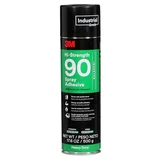
Price: $25.69 · Check current price on Amazon →
- Coverage: 23.6 sq ft per lb at 2.5 g/ft² spread — 26 sq ft one-side, 13 sq ft bonded (both sides coated)
- Bonding range: 1-10 minutes after spraying both surfaces
- Dry (tack-free) time: 1 minute
- Bonds laminate, wood, MDF, concrete, metal and plastic per 3M’s own use list
- Cost per sq ft: $1.98 — the most expensive per square foot in this comparison
This is the adhesive laminate shops actually spray onto plywood before pressing high-pressure laminate (HPL/Formica) or veneer onto it — not a bottle-and-roller glue like the Titebond picks above. 3M’s own application guidance calls for spraying both mating surfaces, letting them go tacky, then pressing them together for a bond that sets in seconds rather than minutes.
That speed comes at a real cost: because both faces need a coat, a 17.6 oz can only nets about 13 usable square feet of actually-bonded panel, and at $25.69 a can that works out to $1.98 per square foot — roughly five times what Titebond III costs per square foot. It earns its place here for veneer and thin laminate work where a rigid PVA glue-line or an hour of clamping isn’t practical, not as a general-purpose plywood-to-plywood adhesive.
Pros:
- Fastest bonding window of any adhesive here — usable 30 seconds after spraying, full initial strength in 2-3 minutes
- No clamps, no cauls, no drying overnight — ideal for veneer and thin laminate sheets
- Even, controllable spray coverage across large flat surfaces beats trying to roll glue edge to edge
Cons:
- By far the priciest adhesive per square foot of bonded panel in this dataset
- Aerosol overspray means real ventilation and masking requirements indoors
- Bonding window is short once both surfaces are sprayed — not for panels that need repositioning
Main drawback: At nearly $2/sq ft of bonded surface, it’s the most expensive way to laminate a full sheet in this comparison.
4. DAP Weldwood Original Contact Cement (16 oz) — Best for Face Lamination (No Clamps Required)
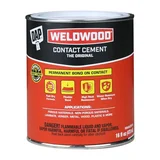
Price: $18.95 · Check current price on Amazon →
- Coverage: approximately 216 sq ft/gallon one-side — 13.5 sq ft bonded from a 16 oz can (both sides coated)
- Open time: up to 2 hours after both surfaces are coated and dry to the touch
- No clamping required — bonds permanently on contact with 25 psi of hand or roller pressure
- Reaches maximum holding strength in 7 days; service range -40°F to 180°F once cured
- Cost per sq ft: $1.40
Contact cement solves a completely different problem than a PVA glue-up: instead of spreading glue and clamping for 20+ minutes, you coat both surfaces, let them flash off to tacky (15-20 minutes), and press — the bond is instant and permanent with no clamps at all. That’s why it’s the standard trade adhesive for bonding HPL and veneer to plywood substrates, and DAP’s own coverage figure of 216 sq ft/gallon (halved here to 108 sq ft/gallon of actually-bonded panel, since both faces get coated) confirms it spreads a long way.
The catch, and it’s a real one: DAP’s own technical sheet says this contact cement “should not be used for structural applications.” That’s fine for laminating a decorative face or a non-load-bearing panel, but it’s the wrong adhesive for anything that needs to carry weight the way a PVA or epoxy glue-line does. At $1.40 per bonded square foot it’s cheaper than spray adhesive but still more than 3× the cost of Titebond III.
Pros:
- Longest true open time of any adhesive here — up to 2 hours between coating and bonding
- Zero clamps, cauls, or overnight drying — press it and it’s structurally set for use
- Purpose-built for exactly this job: DAP’s own use list leads with high-pressure laminate and wood/plastic veneers
Cons:
- DAP’s own literature says not to use it for structural applications
- Once surfaces touch, there’s no repositioning — alignment has to be right the first time
- Solvent odor and flammability mean real ventilation is not optional
Main drawback: Not rated for structural use by DAP’s own datasheet — fine for facing a panel, wrong for load-bearing lamination.
5. Gorilla Original Waterproof Polyurethane Glue (18 oz) — Best Gap-Filling for Uneven or Warped Panels
Price: $23.99 · Check current price on Amazon →
- Glue consumption: 100-250 g/m² depending on wood type (manufacturer TDS)
- Coverage: 22.0-54.9 sq ft from an 18 oz (510 g) bottle depending on porosity
- Open assembly time: 5-10 minutes; closed/pressing time 1-4 hours by wood type
- Full cure: 24 hours; expands as it cures, which is what gives it gap-filling ability
- Cost per sq ft: $0.44-$1.09 depending on how porous the panel faces are
Polyurethane glue works on a different mechanism than PVA: it cures by reacting with moisture in the wood and the air, expanding as it goes. That expansion is exactly what makes it useful for panels that aren’t perfectly flat — slightly warped plywood, or faces with small voids — where a PVA glue line alone won’t fill the gap. Gorilla’s own datasheet is upfront that glue consumption swings from 100 to 250 grams per square meter depending on the wood, which is why its cost per square foot is shown as a range here rather than a single number; forcing a fake precise figure would hide that real variability.
The trade-off is mess and pressing time: 1-4 hours of clamp pressure versus 20-30 minutes for the PVA picks, and squeeze-out that foams up along every seam and has to be trimmed or sanded off once it’s cured enough to cut cleanly. It earns its spot here specifically for panels that aren’t dead flat, not as a first choice for clean, well-fitted sheet stock. For the full breakdown of set versus full-cure timing, see how long Gorilla Glue actually takes to dry and cure.
Pros:
- Expands into gaps and slightly uneven surfaces that a thin PVA glue line can’t fill
- Genuinely waterproof once cured — rated to EN 204/205-D4, comparable performance to ANSI Type I
- Bonds more than just wood, useful if a laminated panel also needs a metal or plastic edge attached
Cons:
- Foams and expands during cure, which means real squeeze-out cleanup before it hardens
- Coverage isn’t a fixed number — the manufacturer’s own range is 2.5× wide depending on wood porosity
- Needs moisture in the wood to cure properly; very dry stock may need misting first per the TDS
Main drawback: Cured squeeze-out foams up along every seam and has to be trimmed off — expect real cleanup time.
6. West System G/flex 655 Epoxy Adhesive (2×4.5 oz) — Best for High-Stress Structural Panel Bonds
Price: $46.86 · Check current price on Amazon →
- Mix ratio: 1:1 by volume, toughened two-part epoxy gel
- Pot life: 45 minutes; working time: 75 minutes at 72°F
- Initial cure: 3-4 hours; workable cure 7-10 hours; wait 24 hr before full structural load
- Tensile strength: 3,440 psi; flexural strength: 5,190 psi (cured, per TDS)
- Coverage: not published — gel thickness depends on gap size, not a fixed spread rate
G/flex is a different category of product from everything else in this comparison: a toughened, gap-filling structural epoxy rather than a wood glue or contact adhesive. It’s the pick for laminated panels that will actually carry load — a workbench top, a structural shelf, or bonding plywood to a dissimilar material like metal or fiberglass — situations where the DAP contact cement above is explicitly not rated to go.
West System doesn’t publish a coverage-per-container figure for G/flex 655, and that’s not an oversight we’re papering over: it’s a thickened gel meant to fill whatever gap exists between two surfaces, so how far a kit goes depends entirely on how tight your panels fit, not a fixed spread rate the way a sprayable or brushable adhesive has. Budget for testing a small assembly first if you’re trying to figure out how many kits a big job needs.
Pros:
- Genuinely structural — rated with real tensile/flexural/compression numbers, unlike the contact adhesives above
- Longest true working time of any adhesive here (75 minutes) once mixed, for complex multi-panel assemblies
- Toughened formula flexes rather than cracking under stress, and bonds difficult woods and dissimilar materials
Cons:
- By far the most expensive container price in this comparison at $46.86
- No published coverage rate, so it’s genuinely hard to budget material cost per panel in advance
- Two-part mixing and a 24-hour full cure make it slower to work with than any glue pick above
Main drawback: No published coverage rate and the highest sticker price here — reserve it for panels that genuinely need structural strength.
7. Loctite PL Premium Polyurethane Construction Adhesive (10 fl oz) — Best for Doubling Up Plywood Panels (Subfloor & Workbench Builds)
Price: $7.38 · Check current price on Amazon →
- Coverage: a 1/4 in bead extrudes ≈30.6 linear ft per 10 fl oz cartridge (Henkel TDS)
- Open time: 15-20 minutes; repositioning window 30-45 minutes
- Clamping/mechanical support: 24 hours; full cure 24-48 hours
- Compression shear strength (Douglas fir plywood, dry lumber bond): 638 psi per TDS
- Meets ASTM D3498 — the same spec APA references for glued floor systems
PL Premium isn’t built to laminate a full plywood face the way the Titebond or 3M picks are — it’s a bead-applied polyurethane construction adhesive, the kind used to glue subfloor panels to joists or to double up two sheets of 3/4 in plywood into one stiff panel for a workbench top or a beefed-up subfloor. That second use case is a genuine, common form of “laminating plywood,” which is why it earns a spot here even though its coverage number (linear feet of bead) can’t be compared apples-to-apples against the sq-ft-spread adhesives above.
At $7.38 it’s the cheapest container in the whole lineup, and Henkel’s own compression shear data (638 psi dry, up to 890 lbs in the APA AFG-01 test) backs up real structural use between two layers of plywood. The 24-hour mechanical-support requirement means you still need screws, weight, or clamps holding the panels together while it cures — this isn’t a contact-cement shortcut.
Pros:
- Cheapest container price in this whole comparison at $7.38 per cartridge
- Purpose-rated for exactly one common plywood-lamination job: doubling up two sheets for a stiffer subfloor or bench top
- Caulking-gun bead application is faster to lay down over framing than spreading glue across a whole face
Cons:
- Applied in beads, not spread — not a substitute for a full-face glue-up on veneer or laminate work
- 24-hour clamping/mechanical support requirement is the longest of any adhesive here except the epoxy
- Coverage is published in linear feet of bead, not square feet, so it isn’t directly comparable to the spread adhesives above
Main drawback: Bead application means it’s not a fit for full-face veneer or laminate work — it’s built for doubling up panels, not facing them.
How We Picked These
We have not physically tested these 7 adhesives against each other in a shop — this is a Tier C, spec-and-data comparison, not a hands-on review, and we’re saying so plainly rather than implying otherwise. Every number in the table above — coverage, open time, clamp/cure time, and the resulting cost per square foot — was pulled directly from each manufacturer’s own technical data sheet (Titebond/Franklin International, 3M, DAP, Gorilla Glue, West System/Gougeon Brothers, and Henkel/Loctite) fetched live for this comparison, not copied from a competitor’s article or estimated from memory. Where a manufacturer’s own instructions required a computed step — like halving 3M’s and DAP’s one-side spread rate because both specify coating two surfaces, or converting Gorilla’s metric g/m² figure to square feet — the formula and source are shown in the table notes so you can check the arithmetic yourself. Where a manufacturer genuinely doesn’t publish a number (West System’s coverage, either product’s star rating), we labeled it “not published” instead of inventing one. Prices and product availability were verified live via the Amazon Creators API on the day this article was last updated. This comparison focuses specifically on large-surface panel lamination; for general joinery and furniture glue-ups, see our full wood glue comparison, which ranks adhesives by bond type and cure speed instead.
What to Consider When Buying Glue to Laminate Plywood
Open Time for Large Panel Glue-Ups
A full 4×8 sheet takes longer to spread, align, and clamp than a small joint, and regular PVA glue’s 4-5 minute open time simply isn’t enough. That’s the entire reason Titebond II Extend exists — 15 minutes instead of the standard formula’s 4-5. If you’re gluing more than one panel per session, budget extra time or use a longer-open-time adhesive like contact cement (up to 2 hours) or epoxy (75 minutes). This matters even more on premium sheet goods — check current Baltic birch plywood pricing before you risk a glue-up you can’t redo.
Coverage Per Container (How Much You’ll Actually Need)
A 16 oz bottle of PVA glue covers about 31 sq ft — enough for one side of a 4×8 sheet (32 sq ft) with almost nothing left over. Contact cement and spray adhesive need both surfaces coated, which roughly halves the usable panel area you get from the same-size container — factor that in before you buy, or you’ll be making a second trip mid-project.
Clamping Pressure and Clamp Time
PVA and epoxy need real clamp pressure and time (20 minutes to several hours) to form a strong bond; contact cement needs none at all once pressed. If you don’t have enough clamps or cauls to cover a full sheet evenly, that alone can push you toward contact cement or spray adhesive regardless of cost.
Waterproof Rating: ANSI Type I vs Type II
Type I (Titebond III, tested here) passes water-resistance testing after full water submersion cycles; Type II (Titebond II Extend) resists moisture and humidity but isn’t rated for the same submersion test. For exterior panels, cutting boards, or anything near a sink, Type I is the safer call — and it’s worth knowing how a basic Elmer’s glue compares on waterproofing before assuming any white or yellow glue is interchangeable with these picks.
Contact Cement vs Spreadable Glue for Face Lamination
Contact cement and spray adhesive bond instantly on contact with no clamping, which is why they’re the standard for facing plywood with HPL laminate or veneer. Spreadable PVA and epoxy need clamp time but generally cost far less per square foot and, unlike contact cement, several are rated for structural use.
Gap-Filling Ability for Warped or Uneven Panels
Perfectly flat, well-fitted plywood works fine with a thin PVA glue line. Slightly warped or uneven panels need an adhesive that expands or fills gaps — polyurethane glue (Gorilla) or a thickened epoxy (West System G/flex) — or the joint can starve for glue in the low spots. It’s usually still worth flattening a badly warped sheet first, since no adhesive fully substitutes for a flat starting point.
Cost Per Square Foot vs Cost Per Container
A $9.58 bottle and a $46.86 epoxy kit look worlds apart until you check what they actually cover. Compare cost per square foot of bonded panel, not sticker price per container — our dataset above shows a 6× spread between the cheapest and most expensive adhesive per square foot, not per bottle.
Application Temperature and Working Conditions
Every adhesive in this comparison has a minimum application temperature — 40°F for the epoxy, 45-47°F for the Titebond glues, 60°F for Extend specifically, 65°F for the contact cement. An unheated garage or shop in winter can knock out several options before cost even enters the decision.
Structural vs Non-Structural Bonds
DAP’s own datasheet says its contact cement isn’t for structural applications; the PVA glues and West System epoxy are. If the laminated panel will bear real load — a shelf, a bench top, a structural subfloor — rule out contact cement and spray adhesive regardless of how convenient the no-clamp bond is.
How to Laminate Plywood
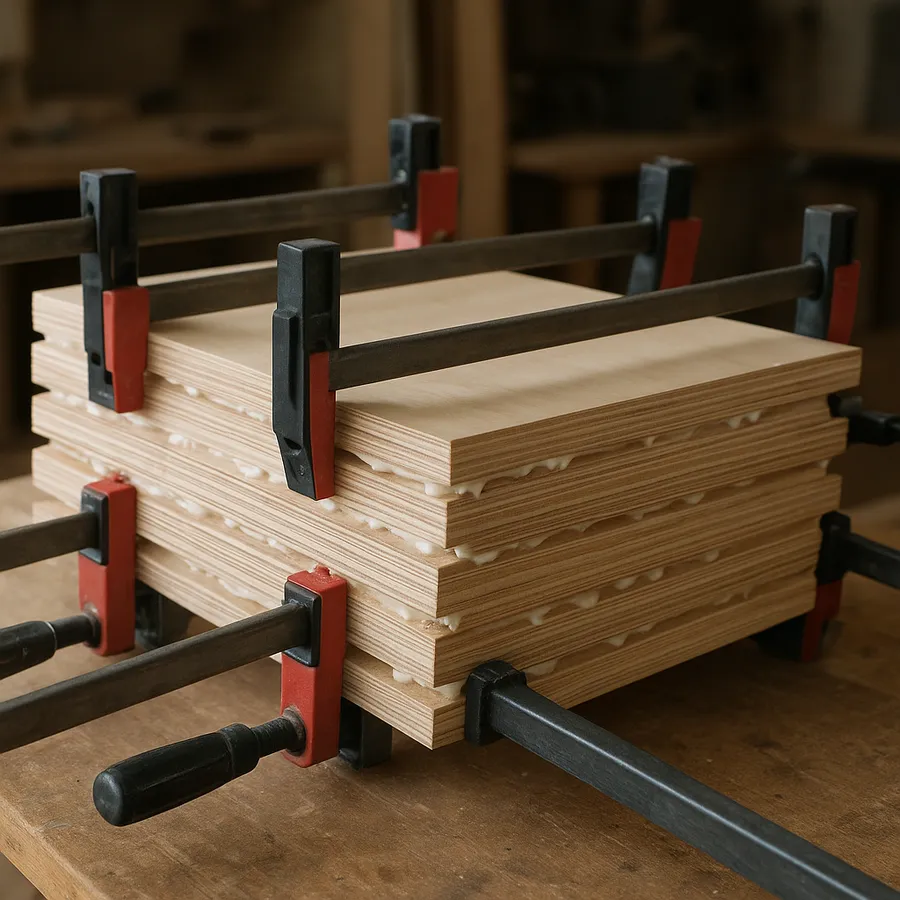
The exact steps shift slightly by adhesive type, but the sequence below covers a standard face-to-face plywood lamination with a spreadable glue (PVA, polyurethane, or epoxy). For contact cement or spray adhesive, skip the clamping step entirely — press and you’re done. If you want a shorter walkthrough focused just on the mechanics, see our guide to gluing plywood together.
- Dry-fit the panels first. Stack and align the sheets without glue to confirm edges match and clamps or cauls will reach every corner.
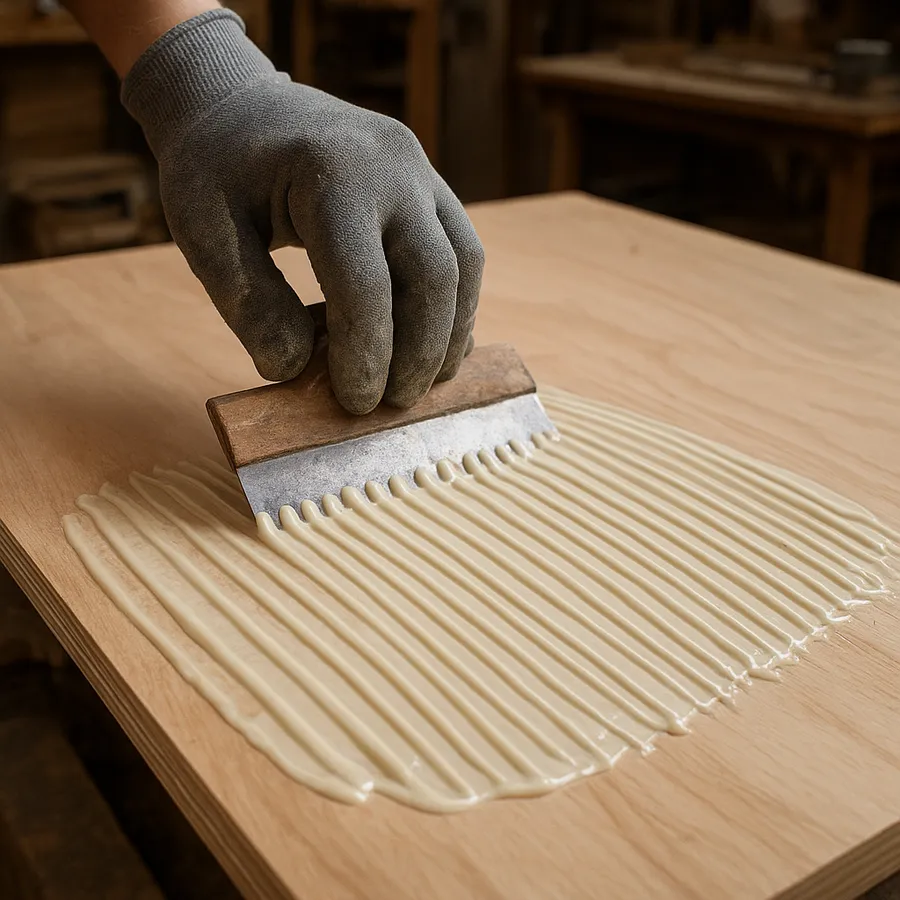
- Choose your spread method. A notched trowel or roller gives the most even coat for PVA and polyurethane; contact cement and spray adhesive go on with a brush, roller, or the can’s own sprayer.
- Apply adhesive within your open-time budget. Work fast enough that the first section spread isn’t skinning over by the time you finish the last — this is where a longer-open-time glue like Extend earns its keep on big panels.
- Align and press or clamp immediately. Contact cement and spray adhesive bond on contact, so alignment has to be right the first time. PVA and epoxy give you a short repositioning window — use it, then don’t move the panel again.
- Apply the correct clamping pressure for the full clamp time. Under-clamping is the single most common cause of a weak glue-up — use enough cauls or clamps to spread even pressure across the whole panel, not just the edges.
- Let it reach full cure before machining or loading it. Most of these adhesives set enough to trim in a few hours but need 24 hours (or 7 days for contact cement’s maximum strength) before the joint is at full strength.
Frequently Asked Questions
What is the best glue for laminating plywood?
Titebond II Extend Wood Glue is the best all-around choice for laminating plywood — its 15-minute open assembly time is the longest of any PVA glue, giving you enough time to spread, align, and clamp a full sheet before it sets, at about $0.40 per square foot of bonded panel. For exterior or wet-area panels, Titebond III’s Type I waterproof rating is the better call.
Can I use contact cement to laminate plywood panels together?
Yes, for facing a panel with laminate or veneer — contact cement bonds instantly with no clamping and has up to 2 hours of open time. But DAP’s own technical data sheet for Weldwood Original Contact Cement explicitly says it should not be used for structural applications, so it’s the wrong choice for load-bearing panel lamination.
How much open time do I need to glue a full 4×8 plywood sheet?
Standard PVA wood glue gives you only 4-5 minutes, which is tight for a full sheet. Titebond II Extend stretches that to 15 minutes specifically for this reason. Contact cement (up to 2 hours) and epoxy (45-75 minutes) give you far more working time if you need it.
Do I need to clamp plywood panels after gluing, or is contact cement enough?
It depends on the adhesive and the job. PVA glue and epoxy both need real clamping pressure for 20 minutes to several hours to form a strong bond. Contact cement needs no clamps at all — it bonds permanently on contact with hand or roller pressure — but per DAP’s own datasheet, that convenience comes with a non-structural rating.
Is Titebond II Extend or Titebond III better for laminating plywood?
Titebond II Extend has almost double the open time (15 minutes vs. 8-10 minutes), which matters more on large panels. Titebond III is Type I waterproof versus Extend’s Type II, and per our cost-per-sq-ft calculation, it’s actually the cheaper of the two. Choose Extend for interior panels where working time matters most; choose Titebond III for anything that will see moisture.
How much wood glue do I need to cover a sheet of plywood?
A standard 4×8 plywood sheet is 32 sq ft. Based on Titebond’s published spread rate of 250 sq ft per gallon, a single 16 oz bottle (31.2 sq ft of coverage) is just about enough for one full sheet face, with very little margin for a heavier spread or a second coat.
What’s the cheapest way to laminate two sheets of plywood together?
By cost per square foot of actually-bonded panel, Titebond III Ultimate Wood Glue is the cheapest option in this comparison at $0.31/sq ft, followed closely by Titebond II Extend at $0.40/sq ft. Spray adhesive and contact cement cost 3.5 to 5 times more per square foot once you account for coating both surfaces.
Final Thoughts
For most plywood-laminating jobs, Titebond II Extend Wood Glue is the right default: its 15-minute open time is the longest of any PVA glue here, it costs $0.40 per square foot of bonded panel, and it’s rated for the interior panel work most DIY and shop projects actually involve. Step up to Titebond III the moment a panel will see real moisture — it’s both more waterproof and, per our dataset, actually cheaper per square foot. Reach for contact cement or spray adhesive only for facing work (laminate, veneer) where no-clamp speed matters more than the roughly 4-5× higher cost per square foot, and save the epoxy for panels that genuinely need structural strength. For more on working with sheet goods, browse our other plywood guides.
Sponsored / affiliate links. As an Amazon Associate I earn from qualifying purchases. I may earn additional commission from eligible campaigns.