Best Woodworking Glue: 7 Compared by Bond Type & Cure (2026)
The best woodworking glue overall is Titebond III Ultimate Wood Glue — it’s the only glue in this comparison rated ANSI/HPVA Type I (fully waterproof) and backed by a 4,000 psi bond strength figure from Franklin International’s own test data, stronger than the wood it joins. But Type I isn’t always the right call: the table below compares all 7 picks by bond type, open/clamp/cure time, real water-resistance rating, and current cost per fluid ounce, so you can match the glue to the joint instead of guessing.
“Wood glue” isn’t one product — it’s shorthand for at least four genuinely different adhesive chemistries (PVA, polyurethane, epoxy, and hide glue) that don’t perform the same way on cure time, water resistance, or cost. Most roundups treat every bottle on a shelf labeled “wood glue” as interchangeable and rank them on brand recognition. This one pulls the actual technical data sheet (TDS) numbers from each manufacturer and puts them in one table, so the differences that actually matter to a glue-up — not just the sticker price — are visible before you buy.
Wood Glue Comparison Table: Bond Type, Cure Time & Cost
Every figure below comes from each manufacturer’s own technical data sheet (TDS) or FAQ page, pulled and cross-checked this session — not copied from a competitor’s roundup. Cost per fluid ounce is a computed cell: current Amazon buy-box price ÷ bottle size, verified live. Elmer’s Carpenter’s Wood Glue Max is currently the most expensive PVA glue per ounce in this lineup — more than double Titebond II’s cost per ounce — which runs against the usual assumption that Elmer’s is the budget option.
| Glue | Bond Type | Open / Clamp Time | Full Cure | Water Resistance | Cost / fl oz | Verdict |
|---|---|---|---|---|---|---|
| Titebond III Ultimate | PVA (cross-linking aliphatic) | 10 min / 30–60 min | 24 hr | ANSI/HPVA Type I (waterproof) | $0.60 | #1 Best Overall |
| Titebond II Premium | PVA (aliphatic resin) | 3–5 min / 30 min | 24 hr | ANSI/HPVA Type II | $0.44 | Best for Outdoor Furniture |
| Gorilla Wood Glue (PVA) | PVA (cross-linking) | 5–10 min / 20–30 min | 24 hr (80% @ 1–2 hr) | ANSI/HPVA Type II | $0.55 | Best for Fast Assembly |
| Titebond Liquid Hide Glue | Hide glue (animal protein) | ~10 min / 30–60 min | 24 hr | Not water-resistant (reversible by design) | $1.05 | Best for Antique Restoration |
| Gorilla Original Polyurethane | Polyurethane (moisture-cured) | 20–30 min / 1–4 hr | 24 hr | 100% waterproof (mfr.); EN 204/205-D4 — not ANSI/HPVA-tested | $1.25 | Best for Outdoor & Mixed-Material Bonding |
| Gorilla 2 Part Epoxy (Clear) | Epoxy (2-part resin/hardener) | 5 min working time | 24 hr | Water-resistant (mfr.); not ANSI/HPVA-tested | $7.02* | Best for Structural Repairs & Gap-Filling |
| Elmer’s Carpenter’s Wood Glue Max | PVA (wood-fiber enhanced) | 10–15 min / 20–30 min | 24 hr | Waterproof per retailer listing† | $1.00 | Best for Beginners |
*Epoxy is dispensed by the drop for small repairs, not by the ounce for whole glue-ups — its cost per ounce is included for reference only and isn’t a like-for-like comparison against bulk PVA/polyurethane pricing. †Elmer’s own spec page (elmers.com) returned a bot-block (403) to direct fetch this session; the waterproof/Type-I-equivalent claim is sourced from current retailer listings (Amazon, Lowe’s), not independently confirmed against Elmer’s own TDS.
A correction worth knowing: ANSI/HPVA Type I/II/III water-resistance ratings are a PVA-specific standard — they don’t apply across every adhesive type. Polyurethane and epoxy glues are routinely marketed as “waterproof” without ever being tested against this scale, so a Type I PVA claim and a polyurethane’s “100% waterproof” claim aren’t measured the same way, even though both sound equally strong on the label.
Best Wood Glues
1. Titebond III Ultimate Wood Glue — #1 Best Overall
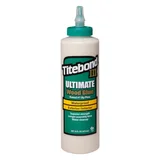
Price: $9.58 (16 oz) · See current price on Amazon
- ANSI/HPVA Type I — the only fully waterproof rating in this comparison
- 4,000 psi bond strength, 57% wood failure (ASTM D-905, hard maple, room temp — Franklin International TDS)
- 10-minute open assembly time, 30–60 minute clamp time, 24-hour full cure
- FDA-approved for indirect food contact; safe for cutting boards
- Conforms to ASTM D4236 (non-toxic)
Titebond III is the wood glue Franklin International built to replace epoxy for most exterior and high-moisture joints, and the TDS numbers back that up: it’s the only glue here rated Type I, meaning it passed the strictest ANSI/HPVA water-resistance test rather than the lighter Type II soak-and-bake cycle. The tradeoff for that rating is a longer open assembly window (10 minutes vs. Titebond II’s 3–5) and a slightly tan dried color that shows more on light woods than Titebond II’s near-invisible line.
Who it’s for: anyone building furniture, cutting boards, or outdoor-adjacent projects who wants one glue that covers nearly every situation without swapping bottles. It’s also the safe default choice when you’re not sure how a piece will be used down the road — Type I coverage means you won’t have guessed wrong.
Main drawback: at $0.60 per fluid ounce it’s not the cheapest PVA here, and Franklin’s own limitations notice says it’s not for continuous submersion or structural/load-bearing use — “waterproof” means it survives weather and splashes, not permanent underwater service.
2. Titebond II Premium Wood Glue — Best Wood Glue for Outdoor Furniture
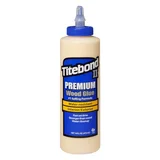
Price: $6.99 (16 oz) · See current price on Amazon
- ANSI/HPVA Type II — the first one-part wood glue to pass this exterior-use spec
- 3,750 psi bond strength, 72% wood failure (ASTM D-905, hard maple, room temp — Franklin International TDS)
- 3–5 minute open assembly time, fastest of any glue in this table
- $0.44 per fluid ounce — the lowest cost per ounce of all 7 picks
- FDA-approved for indirect food contact
Franklin’s own TDS names outdoor furniture, birdhouses, mailboxes, planters and picnic tables directly as Titebond II’s intended use case, and the numbers explain why: Type II passes a real soak-then-bake test cycle (four hours submerged, 19 hours at 120°F, repeated three times) without the joint delaminating, which covers rain and humidity exposure that a purely interior glue can’t handle.
Who it’s for: outdoor furniture builds, garden boxes, mailboxes, and anything else that lives under weather but not underwater. Its fast 3–5 minute open time also makes it a good choice for glue-ups with a lot of pieces to position before the glue starts to skin over.
Main drawback: Type II is water-resistant, not waterproof — it’s not rated for continuous wet exposure or submersion the way Titebond III is. It’s also, at current Amazon pricing, the cheapest glue per ounce in this whole comparison, which is worth knowing since it isn’t marketed as the budget pick.
3. Gorilla Wood Glue (PVA) — Best Wood Glue for Fast Assembly
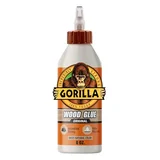
Price: $4.37 (8 oz) · See current price on Amazon
- 20–30 minute clamp time, the shortest clamp window of any PVA in this table
- ANSI/HPVA Type II and EN204/205-D3 water resistance
- 3,900–4,000 psi shear strength (ASTM D905, Gorilla Glue TDS)
- Dries a natural, near-invisible color line
- $0.55 per fluid ounce, the second-cheapest option here
Gorilla’s PVA formula (not to be confused with Gorilla’s brown polyurethane Original Glue lower on this list) is built around speed: 20–30 minutes of clamp time is the shortest of any PVA glue in this comparison, and it reaches 80% of full strength in just 1–2 hours per the manufacturer’s own assembly guidelines. For a woodworker doing several glue-ups in one shop session, that turnaround matters more than the extra 500 psi Titebond III offers on paper.
Who it’s for: shop sessions with several glue-ups in a row, or any project where you want to unclamp and move to the next step within the hour rather than planning your whole session around a longer Titebond clamp window.
Main drawback: like Titebond II, it’s Type II water-resistant, not Type I waterproof — fine for a project that lives indoors or under cover, not for permanent outdoor exposure.
4. Titebond Liquid Hide Glue — Best Wood Glue for Antique Furniture Restoration
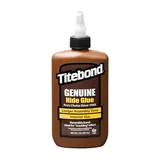
Price: $8.39 (8 oz) · See current price on Amazon
- Reversible with heat and moisture — the only glue in this comparison designed to be undone cleanly
- ~10 minute open time, 30–60 minute clamp, 24-hour full cure
- Not rated water-resistant — that’s the tradeoff for reversibility
- Ideal for fine furniture and antique repair per Franklin International
- Slow-set formula allows precise assembly of complex joints
Hide glue is the traditional adhesive of pre-20th-century furniture, and it’s still the right call any time a repair needs to be reversible — a broken chair rail, a veneer patch, or any antique piece a future restorer might need to disassemble without destroying the wood. Heat and moisture release the bond cleanly, which no PVA, polyurethane, or epoxy on this list can do.
Who it’s for: furniture restorers, luthiers, and anyone repairing a piece that a future owner might need to take apart again. It’s also a traditional favorite for veneer work, where a reversible bond means a mistake can be steamed apart and redone instead of destroying the veneer.
Main drawback: that same reversibility means it has no water resistance rating at all — a humid basement or an outdoor project will eventually soften the joint. This is a glue for furniture and repair work, not exterior builds.
5. Gorilla Original Polyurethane Glue — Best Wood Glue for Outdoor & Mixed-Material Bonding
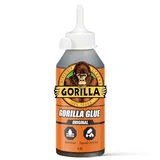
Price: $9.98 (8 oz) · See current price on Amazon
- Bonds wood to metal, stone, ceramic, foam, glass and concrete — not just wood-to-wood
- Expands 3x into the material as it cures, filling small gaps a PVA glue can’t
- 100% waterproof per manufacturer; EU TDS lists EN 204/205-D4 (weather- and boil-resistant, the highest EN class)
- 1–4 hour clamp/pressing time depending on wood type, 24-hour full cure
- Requires moisture to activate — dampen one surface before gluing dry wood
Polyurethane is the pick for a joint that mixes materials — wood to metal hardware, a stone inlay, a foam-and-wood assembly — or one that needs real gap-filling, since it expands into the joint as it cures rather than staying flat like PVA. It’s not tested under the ANSI/HPVA scale that PVA glues use, but its EU technical sheet lists EN 204/205-D4, the classification for exterior, weather- and boil-resistant bonds, so the “100% waterproof” marketing claim has real technical backing behind it.
Who it’s for: outdoor builds mixing wood with metal brackets or stone, or any joint that isn’t a tight, flat mate — the foaming expansion fills small gaps a liquid PVA glue would just run out of.
Main drawback: the foaming action that fills gaps also means messy squeeze-out that hardens like a hard foam and has to be chiseled or sanded off, and the amber/brown dried color shows on light woods.
6. Gorilla 2 Part Epoxy — Best Wood Glue for Structural Repairs & Gap-Filling
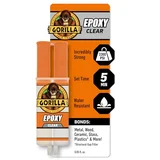
Price: $5.97 (0.85 oz syringe) · See current price on Amazon
- 5-minute working time (clear formula), 24-hour full cure
- 3,300 psi tensile strength (clear version, manufacturer-published)
- True gap-filler — bonds uneven, vertical or damaged surfaces a liquid glue can’t span
- Bonds wood, metal, ceramic, stone, glass and most plastics
- Dries clear — the only glue here with no visible glue line
Epoxy earns its own category here because it isn’t really competing with the other six on price or coverage — it’s the pick for a structural repair a PVA glue physically can’t do: a split that’s missing wood, a crack that needs to be filled and bonded in one step, or a joint where the two surfaces don’t mate cleanly. The 5-minute working time is short by design, giving enough time to position a repair before the epoxy sets.
Who it’s for: a split chair leg, a chipped tabletop corner, a crack that’s actually missing material — the kind of repair where clamping two clean surfaces together isn’t an option because the surfaces themselves aren’t clean or flat.
Main drawback: at roughly $7 per fluid ounce it’s by far the most expensive glue in this comparison per ounce, though that number is misleading on its own — a 0.85 oz syringe is meant to cover a handful of small repairs, not a whole project, so it’s dispensed by the drop rather than the ounce.
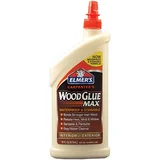
7. Elmer’s Carpenter’s Wood Glue Max — Best Wood Glue for Beginners
Price: $15.94 (16 oz) · See current price on Amazon
- Widely available at every major hardware store and big-box retailer
- Real wood fiber added to the formula for better sanding, staining and paint acceptance per Elmer’s marketing
- 10–15 minute open time, 20–30 minute clamp (retailer-sourced — see note below)
- Marketed as waterproof for interior/exterior use
- Non-toxic, easy water cleanup while wet
Elmer’s is the glue most beginners already have in a junk drawer, and the Max formula is a real step up from plain Elmer’s Glue-All — it’s built specifically for wood, with added fiber for better sanding and stain acceptance. It’s an easy, forgiving glue to learn on before moving to a Titebond product.
Who it’s for: a first wood glue purchase, a kid’s school project, or a one-off household repair where you don’t want to think about ANSI ratings or open time windows — it behaves forgivingly and is sold everywhere from hardware stores to grocery stores.
Main drawback, stated plainly: on current Amazon pricing it’s the most expensive glue in this entire comparison per fluid ounce — $1.00/oz, more than double Titebond II’s $0.44/oz, despite not out-performing either Titebond product on any published spec. Its own manufacturer page (elmers.com) also returned a bot-block to direct verification this session, so its waterproof claim here is sourced from retailer listings, not confirmed against Elmer’s own technical sheet.
How We Picked These
This is a research-and-compare roundup, not a hands-on lab test — no product on this list was physically purchased and tested for this article, and we’re saying that plainly rather than dressing it up. Here’s exactly what the picks and numbers above are built from:
- Manufacturer technical data sheets (TDS) for open time, clamp time, full cure time, bond strength (ASTM D-905/D905) and ANSI/HPVA water-resistance rating — pulled directly from Franklin International (Titebond) and Gorilla Glue’s own published PDFs this session, not copied from another site’s roundup.
- Live Amazon pricing and buy-box availability via the Amazon Creators API, checked the same day this article was published — every price and every product link was confirmed live before publishing.
- A direct teardown of the current top-ranking wood glue roundups (This Old House, Bob Vila, BestReviews) to confirm what they cover and what they leave out — namely, a real cross-brand spec table and a disclosed water-resistance-standard distinction.
- What we could NOT verify: Amazon’s own customer-review data returned empty for every ASIN checked this session, so no star ratings or review counts appear anywhere in this article — we’d rather show nothing than invent a number.
If you’ve used one of these glues yourself and your real-world experience contradicts something above, that’s useful information — the picks here are built from published data, not a lab bench.
The seven picks themselves were chosen to span the real axis of choice in this category — not just seven PVA glues in different bottles. Each of the four bond-type chemistries that show up in a woodworking shop (PVA, polyurethane, epoxy, hide glue) gets at least one representative, and within PVA, the three picks (Titebond III, Titebond II, Gorilla, plus Elmer’s) span the full price-and-rating range from Type I waterproof down to an entry-level big-box option, rather than three near-identical bottles competing on brand name alone.
What to Consider When Buying Wood Glue
Bond Type: PVA vs. Polyurethane vs. Epoxy vs. Hide Glue
PVA (yellow/aliphatic resin) glue is the default for most woodworking — fast, strong, easy cleanup, and it’s what Titebond and Gorilla’s wood-specific formulas are built on. It bonds wood to wood only, stays flat rather than expanding, and is by far the easiest to sand and finish once cured.
Polyurethane trades some of that ease of use for versatility: it bonds a wider range of materials (wood to metal, stone, ceramic, foam, glass, concrete) and gap-fills as it expands, at the cost of messy foaming squeeze-out that has to be caught before it cures. Epoxy is the only option that structurally fills real gaps in damaged or ill-fitting wood, and bonds almost anything, but it’s priced and dispensed for small repairs, not whole glue-ups — nobody is epoxying an entire cabinet carcass together. Hide glue is the only reversible option of the four, which matters specifically for furniture restoration and antique repair, and essentially nowhere else in modern woodworking.
Is Wood Glue Strong Enough for Outdoor Furniture?
Only if it’s rated Type I or Type II. Titebond III (Type I) and Titebond II (Type II) are both designed for exterior use per their own manufacturer literature; a plain interior PVA glue with no ANSI/HPVA rating will eventually fail outdoors as humidity cycles the joint.
Open Time vs. Clamp Time vs. Full Cure — What’s the Difference?
- Open time is how long you have to apply the glue and position the joint before it starts to skin over — as short as 3–5 minutes on Titebond II, as long as 20–30 minutes on Gorilla’s polyurethane.
- Clamp time is the minimum the joint needs to sit under pressure before it can hold its own weight — typically 20–60 minutes across every glue in this comparison.
- Full cure is when the joint reaches its published bond strength and can be safely stressed — 24 hours for every glue tested here, PVA, polyurethane, epoxy and hide glue alike.
Water Resistance: What Type I, II and III Actually Mean
ANSI/HPVA HP-1 defines three tiers for PVA wood glues specifically. Type I passes the most aggressive test cycle and is considered fully waterproof — suitable for exterior joinery and continuous weather exposure. Type II passes a lighter soak-and-bake cycle (repeated 4-hour soak / 19-hour 120°F bake, three times) and is water-resistant, not waterproof — fine for sheltered outdoor furniture or a kitchen cutting board, not for permanent wet exposure. Type III is not considered water-resistant at all. Polyurethane and epoxy glues aren’t tested against this PVA-specific scale, so their own “waterproof” claims run on a different standard entirely — see the correction note under the comparison table above.
Cost Per Ounce vs. Sticker Price
A $15.94 bottle isn’t automatically worse value than a $6.99 one if it’s twice the size — but in this comparison, it genuinely is: Elmer’s Carpenter’s Wood Glue Max and Titebond II Premium are both 16 oz bottles, and Elmer’s costs $0.996 per ounce against Titebond II’s $0.437. Always divide price by container size before assuming a bigger bottle or a familiar brand name is the cheaper option, and check the actual size on the listing — the same product line is frequently sold in 4, 8, 16, and 32-ounce bottles at prices that don’t scale evenly per ounce as the size goes up.
Indoor vs. Outdoor Projects
Match the water-resistance rating to where the piece will actually live, not just what’s on the shelf. An interior bookshelf doesn’t need Type I waterproofing; a garden planter or an outdoor bench does. It’s also worth thinking about the difference between “outdoor and covered” (a porch swing, a pergola bench) and “outdoor and exposed” (a planter that sits in open rain and snow) — the first is a reasonable fit for a Type II glue like Titebond II or Gorilla PVA, while the second is where Titebond III’s Type I rating or Gorilla’s polyurethane earns its keep.
Dried Color and Visible Glue Lines
Titebond II dries a translucent honey color that nearly disappears on most woods; Gorilla’s PVA dries natural-colored with no foaming. Polyurethane dries amber-to-brown and foams as it cures, which shows on light woods unless the squeeze-out is cleaned up before it sets. Epoxy dries clear.
Working with Treated or Oily Woods
Franklin International’s own Titebond II documentation specifically flags exotic and oily woods like teak and ipe as needing a test glue-up first — the natural oils can interfere with any PVA glue’s bond, not just this one.
Cedar is a common example of this — see our dedicated comparison of exterior wood glue for cedar for picks and real-world test reports specific to cedar’s oils.
Shelf Life and Storage
PVA glue doesn’t last forever once opened. Titebond III lists a 12-month storage life in a tightly closed container at 75°F; Titebond II is rated for 24 months under the same conditions; Gorilla’s PVA formula claims up to 2 years and can survive up to 5 freeze-thaw cycles if it’s allowed to acclimate to room temperature and is shaken back to its original form before use. None of these glues should be stored below freezing long-term, and any bottle that’s thickened, separated, or won’t restore with vigorous shaking belongs in the trash, not on a load-bearing joint.
Sandability and Finish Compatibility
This matters more than most buying guides mention. Titebond II’s own product literature specifically calls out “excellent sandability” as a feature, and both Titebond formulas are described as “unaffected by finishes” — stain and topcoat go on evenly over a glue line that’s been sanded flush. Polyurethane is the opposite case: its foam residue doesn’t sand to a clean, flat surface the way PVA does, and any residue left on the wood surface (not just in the joint) can visibly resist stain, showing up as a blotchy patch after finishing. Hide glue is famously finish-friendly — it’s part of why it stayed the standard for fine furniture as long as it did — and epoxy, once fully cured, sands but doesn’t generally take stain at all, so it’s typically left as-is or painted over rather than stained to match wood.
Cleanup: Wet Squeeze-Out vs. Dried Glue
Every PVA and hide glue on this list cleans up with a damp cloth while it’s still wet — wipe it before it skins over and there’s nothing to sand later. Once any of these glues dries, cleanup means scraping and sanding, and it gets harder the longer it sits. Polyurethane is the outlier: its foam squeeze-out is genuinely difficult to remove once cured and is far easier to catch with a chisel or damp rag in the first 10–15 minutes than to sand off a hardened bead later. Epoxy is the easiest to plan around since it’s applied in small, controlled amounts to begin with.
Related Wood Glue Guides
- Not sure which type of wood glue fits your project? See the full wood glue buying guide.
- Gluing glass to wood instead? That needs a different adhesive — see our best glue for glass to wood picks.
- Curious about CA (super) glue instead of PVA for small parts? Read CA glue and activator, explained.
- Want the deep dive on what PVA glue actually is? See PVA wood glues explained.
- Comparing two specific brands head-to-head? Read Titebond vs. Elmer’s wood glue or Gorilla wood glue vs. Titebond.
How to Use Wood Glue
- Dry-fit the joint first. Clamp the pieces together without glue to confirm they mate cleanly — glue can’t fix a bad-fitting joint.
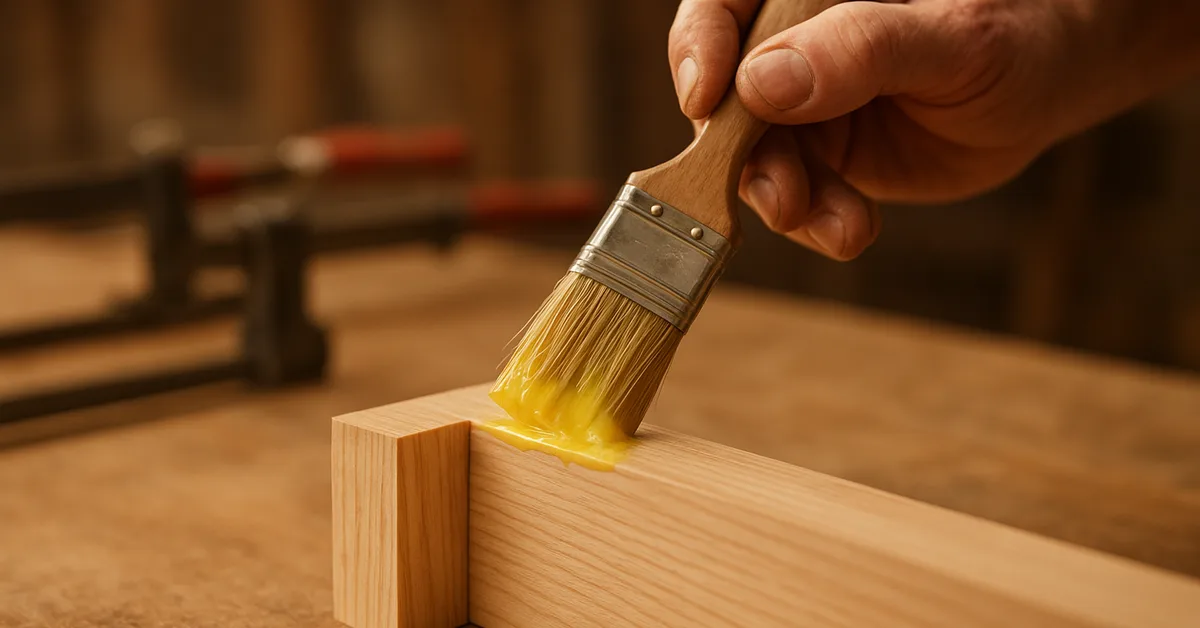
- Apply glue to both surfaces in a thin, even layer. A glue roller or brush spreads it more evenly than squeezing straight from the bottle.
- Assemble within the open time listed for your glue — as short as 3–5 minutes for Titebond II, up to 20–30 minutes for polyurethane.
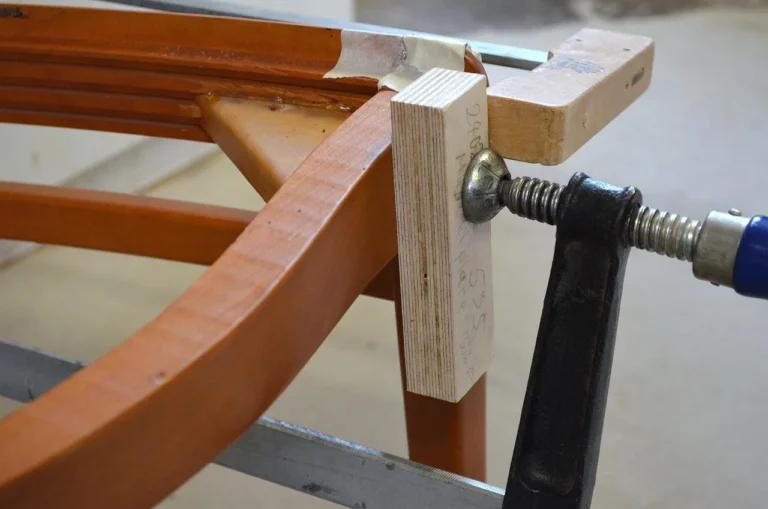
- Clamp with even pressure — Franklin International’s own spec calls for roughly 100–150 psi on softwoods and up to 250 psi on hardwoods, enough to bring the joint tightly together without starving it of glue.
- Wipe squeeze-out immediately with a damp cloth while the glue is still wet; dried PVA squeeze-out has to be scraped or sanded off, and dried polyurethane foam is worse.
- Leave the clamps on for the minimum clamp time for your specific glue (see the comparison table above), then let the joint sit undisturbed for the full 24-hour cure before sanding, machining, or stressing it.
Frequently Asked Questions
What is the best glue for woodworking?
Titebond III Ultimate Wood Glue is the best overall pick in this comparison — it’s the only glue here rated ANSI/HPVA Type I (fully waterproof) and carries a published 4,000 psi bond strength figure. For a cheaper option or an exterior-only project, Titebond II Premium is Type II-rated and costs less per ounce.
What is the strongest glue for wood?
By published shear/bond strength in this comparison, Titebond III leads at 4,000 psi (57% wood failure, ASTM D-905), just ahead of Gorilla Wood Glue PVA at 3,900–4,000 psi. For raw tensile strength on a damaged or gapped joint, epoxy can outperform any liquid PVA glue, though it’s tested on a different scale (tensile psi, not ASTM D-905 shear).
Is wood glue strong enough for outdoor furniture?
Only if it carries an ANSI/HPVA Type I or Type II rating. Titebond III (Type I) and Titebond II (Type II) are both manufacturer-rated for exterior use; an unrated interior PVA glue will eventually fail as outdoor humidity cycles the joint.
Is PVA glue the same as wood glue?
Most modern wood glue is a PVA (polyvinyl acetate) formula, but not all PVA glue is wood glue — craft PVA (like standard Elmer’s Glue-All) isn’t cross-linked or rated for structural wood joints the way Titebond and Gorilla’s wood-specific PVA formulas are.
How long does wood glue need to be clamped?
Every glue in this comparison needs roughly 20 to 60 minutes of clamp time before the clamps can safely come off, and a full 24 hours before the joint should be stressed or machined — that holds across PVA, polyurethane, epoxy and hide glue alike, per each manufacturer’s own technical data sheet.
Does wood glue expire?
Yes. Titebond’s PVA formulas carry a published storage life of 12–24 months in a tightly closed container at 75°F; Gorilla’s PVA lists up to 2 years under proper storage. Glue that’s thickened or separated well past that window should be replaced rather than thinned and reused on a load-bearing joint.
Is epoxy stronger than wood glue?
For a clean, well-fitted wood-to-wood joint, no — Titebond III’s 4,000 psi shear rating meets or beats typical epoxy bond figures on solid wood. Epoxy wins on damaged, gapped, or mixed-material joints that a liquid PVA glue physically can’t fill or bond.
Can you use wood glue outdoors in cold weather?
Check the minimum application temperature on the label before gluing outdoors in cold weather — Titebond III’s TDS specifies application above 47°F, Titebond II above 55°F, and Gorilla’s PVA above 50°F. Gluing below those thresholds, even with a Type I or Type II rated product, can produce a weak or incomplete bond regardless of how waterproof the cured glue eventually becomes.
Final Thoughts
Titebond III Ultimate Wood Glue is the best overall pick in this comparison — it’s the only glue here that’s both ANSI/HPVA Type I waterproof-rated and backed by a published 4,000 psi bond strength figure. But the single most useful fact in this whole roundup might be the cost-per-ounce table: Elmer’s Carpenter’s Wood Glue Max, at $0.996 per fluid ounce on current Amazon pricing, is more than double the cost of Titebond II Premium’s $0.437 per ounce, despite Titebond II out-specifying it on every published number. Check the comparison table above before assuming the familiar name is the cheaper choice.
Looking for something adjacent to standard wood glue? See our full glue & adhesives category for CA glue, epoxy fillers, and specialty adhesive guides. If you’re bonding full plywood panels rather than joinery, our plywood-lamination adhesive comparison covers coverage, open time, and cost per square foot instead.
Sponsored / affiliate links. As an Amazon Associate I earn from qualifying purchases. I may earn additional commission from eligible campaigns.