Best Hardwood Floor Cleaner for Pet Urine Stains
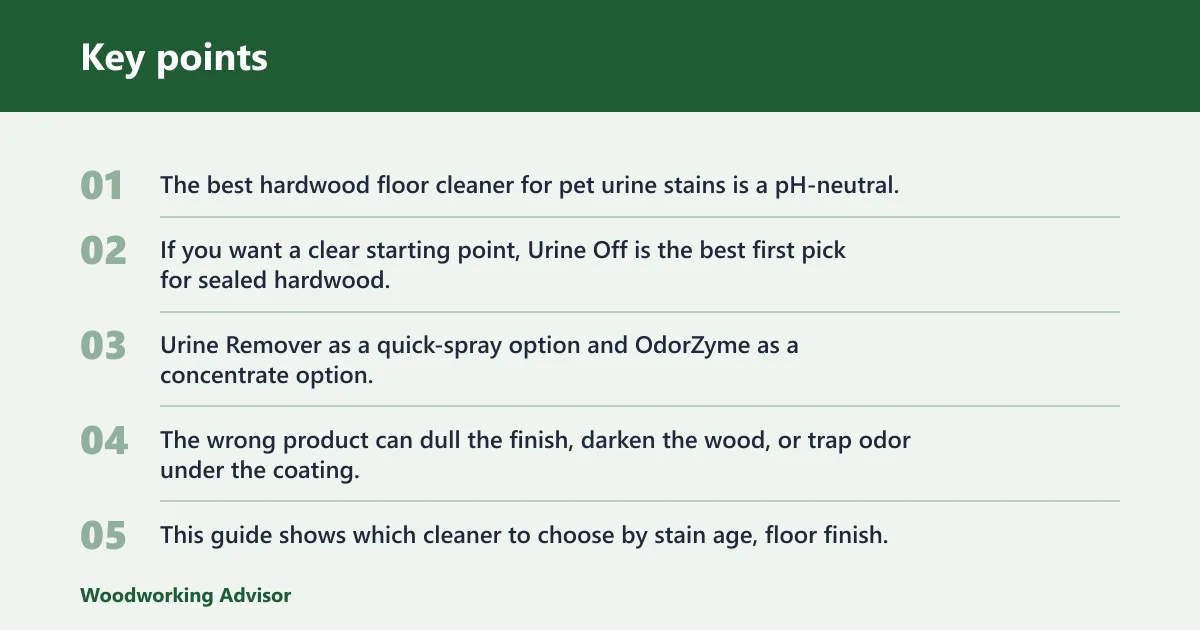
The best hardwood floor cleaner for pet urine stains is a pH-neutral, hardwood-safe enzymatic cleaner for fresh marks; for older stains or lingering odor, use a urine-specific enzymatic cleaner and a separate wood-safe odor treatment labeled for hardwood. If you want a clear starting point, Urine Off is the best first pick for sealed hardwood, with Out! Urine Remover as a quick-spray option and OdorZyme as a concentrate option. The wrong product can dull the finish, darken the wood, or trap odor under the coating. This guide shows which cleaner to choose by stain age, floor finish, and whether the smell remains after the spot is gone.
Why hardwood needs special urine cleanup


What makes hardwood different from carpet
Hardwood is not a fabric pad. Urine can sit on the finish, seep through worn spots, or move into seams, which changes both the stain and the cleanup risk. A product that works on carpet can still leave a cloudy film, soften wax, or push moisture into the wood.
That is why floor finish matters first. Sealed polyurethane usually gives you the best margin for cleaning, while oiled, waxed, unfinished, and older antique floors need slower handling and extra caution.
Why odor can return after the stain fades
Pet urine can leave visible discoloration and a hidden odor source. If uric acid crystals remain in the wood, finish, or seams, the smell can return when humidity rises or the area gets damp again. That is why a spot can look clean and still smell later.
Enzyme-based urine removers are often the first option for hard surfaces because they help break down uric acid crystals and the bacteria around them. They are described as safe to use around pets and people, but they still need the right surface and proper use.
What the best cleaner must do on wood
For wood, the cleaner must do three things: reach the contamination, stay in contact long enough to work, and avoid harming the finish. For enzyme products, that means applying enough to wet the affected area without soaking the boards, following the label, and letting the product sit until dry. Dried urine may need repeated applications before the enzymes finish dissolving crystals.
Fresh accidents are simpler. General directions for fresh urine say to remove as much urine as possible first, then treat the spot. On hardwood, that also means avoiding puddles that can swell edges or leave residue haze.
How do you find dried urine on hardwood?
A UV flashlight or black light can help locate fresh or dried urine, including around hidden drips and splashes. It works well when the visible stain is small but the smell is broader than the spot. Mark every glowing area before you clean so you do not miss the edges. Keep in mind that many cleaners, finishes, and other organic residues can also fluoresce, so treat UV marks as clues rather than proof.
Use the light in a dim room and scan slowly across the floor. Dried urine often shows up away from the obvious center of the accident. You may find small specks near seams, under chairs, or where a pet turned before stepping away.
Urine Off’s Find It, Treat It kit includes an LED UV light, which is useful if you want a single kit for locating and treating spots. A separate black light works too.
Checking edges, baseboards, and furniture lines
Look where pets tend to pause or turn: along baseboards, near cabinet toe kicks, beside litter areas, and under furniture edges. Hidden splashes can wick under trim or collect along grain lines. Those edge stains often keep odor active even when the center mark looks faint.
Suppose a dog accident happened beside a sofa leg and the floor looks fine in daylight. Under UV light, you may see a narrow trail extending 18 inches toward the wall. Treat the full trail, not just the most obvious spot.
Marking spots before you clean
Use painter’s tape, a removable marker, or small paper notes to mark each area before you add liquid. On hardwood, that helps you keep the treatment focused and prevents over-wetting the same board twice. It also makes rechecks easier after drying.
Urine cleaner decision table
This hardwood-only table matches cleaner type to stain age, finish, and odor persistence. It is meant to narrow your options before you buy or apply anything.
| Stain age | Floor finish | Recommended cleaner type | Dwell time range | Repeat-application trigger | Do-not-use warnings |
|---|---|---|---|---|---|
| Fresh, still damp | Sealed polyurethane | Hardwood-safe enzymatic cleaner | Until dry, per label | Visible odor after drying or a damp edge remains | Do not soak the boards or leave standing liquid |
| Fresh, still damp | Oiled or waxed | Minimal moisture treatment, spot test first | Shortest label time possible | Any haze, darkening, or softening appears | Do not flood the surface or use strong oxidizers without label approval |
| Old, dried, odor remains | Sealed polyurethane | Urine-specific enzymatic cleaner | Until dry, then recheck after ventilation | Smell returns when the area warms up or gets humid | Do not use abrasives or wax-stripper products on the finish |
| Old, dried, odor remains | Unfinished wood | Enzymatic treatment only if label allows deep use | As directed on label | Stain keeps spreading or odor persists after drying | Do not assume surface cleaning will reach deeper fibers |
| Any age, finish damaged | Swollen, softened, or antique wood | Stop cleaning and assess for repair | None | Surface feels raised, dull, or sticky after a light pass | Do not keep rewetting; it can worsen finish failure |
When to stop and call a pro: if the boards swell, cup, soften, or the stain has entered unfinished wood, repeated cleaning can do more harm than good. A finish repair or refinish step may be the safer next move, especially on antique floors or engineered wood with a thin wear layer.
Which cleaner type fits your floor finish?
The right cleaner depends less on the pet and more on the floor. Sealed polyurethane can usually handle a labeled enzymatic product. Oiled, waxed, unfinished, and antique floors need more caution because liquid can migrate farther and leave residue or finish failure.
Enzyme-based urine remover
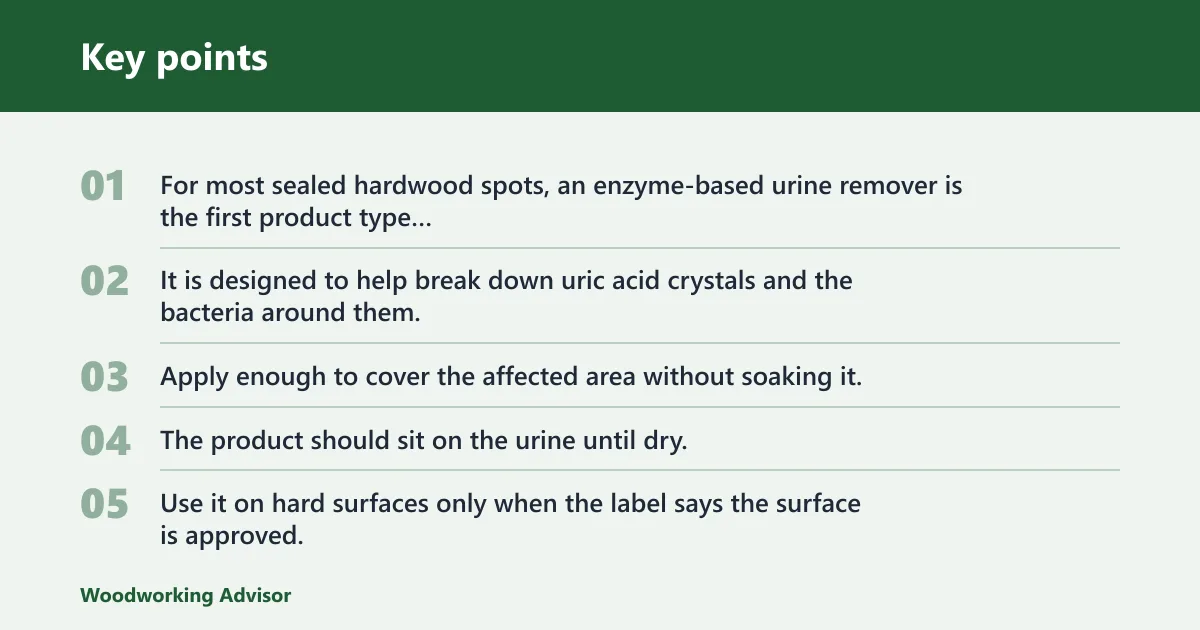
For most sealed hardwood spots, an enzyme-based urine remover is the first product type to consider. It is designed to help break down uric acid crystals and the bacteria around them, which matters when odor keeps returning after the stain lightens. Apply enough to cover the affected area without soaking it, because a light mist is usually not enough.
Follow manufacturer directions closely. The product should sit on the urine until dry, and some dried spots need more than one cycle. Use it on hard surfaces only when the label says the surface is approved.
Concentrates versus ready-to-use sprays
Ready-to-use sprays are convenient for small, fresh accidents. Concentrates can cost less per use on larger or repeated cleanups, but only if you mix them exactly as directed. For pet owners treating several spots, the bottle size and how many treatments it yields often matter more than the shelf price.
That said, a concentrate is a poor bargain if the label calls for careful dilution and you need only one small treatment. Overmixing can leave residue, while undermixing can leave odor behind.
Two-step powder-and-solution systems
Some products use a two-step process. Urine Erase is sold as a two-step system with a dry enzyme powder mixed with water, then a hydrogen peroxide and water solution. That can be useful for stubborn staining, but peroxide-based steps need extra caution on wood finishes because strong oxidizing products can alter color or sheen if the label does not fit your floor.
Use this type only when the product directions clearly fit your floor finish and stain type. On unfinished or waxed wood, the risk of visible change is higher.
Emergency remedies that only buy time
Baking soda and white distilled vinegar still show up as emergency remedies, but they are Band-Aid fixes, not the main answer. They can help with immediate odor control or blotting, yet they do not replace a urine-specific enzyme treatment when crystals remain in the wood or seams.
White vinegar may help with a fresh odor on a sealed floor, but it should not be treated as a universal hardwood cleaner. On waxed, oiled, or unfinished boards, vinegar can dull or disturb the surface. Baking soda can also leave dusty residue if it is not fully removed.
Do enzyme cleaners damage hardwood floors?
Enzyme cleaners can be safe for hardwood when the label allows hard surfaces and you use them correctly, but they are not harmless on every floor finish. The main risk comes from too much liquid, not enough ventilation, or using the wrong product on waxed, oiled, unfinished, or already damaged wood.
How saturation helps and hurts
Coverage is necessary because the product must reach the contamination. That is the tradeoff. If you underapply, the enzymes may not reach the uric acid crystals. If you overapply, the floor can swell, the finish can haze, or liquid can seep into seams and subfloor gaps.
Use enough product to wet the spot fully, but stop before you leave standing liquid. On sealed polyurethane, a targeted wetting is usually safer than a broad flood. On unfinished wood, even a careful application may be too aggressive if the stain has gone deep.
Rinse or no rinse after treatment
In most cases, do not rinse an enzyme cleaner unless the label says to. Rinsing too soon can remove the active product before it finishes working. Let the treated area sit until dry, then check for residue, odor, or color change.
If the label instructs a wipe-down, use a barely damp cloth and remove only the leftover film. Avoid soaking the floor after treatment, because extra water can create a new problem even if the odor is improving.
What to avoid on unfinished or waxed wood
Do not treat unfinished or waxed wood like sealed hardwood. Those surfaces absorb faster and are more likely to show dark spots, finish loss, or fiber swelling. Strong vinegar mixtures, heavy peroxide use, and repeated wet cycles are especially risky there.
A common first-timer mistake is to keep spraying because the smell lingers. That often spreads the urine deeper into the board edges. Treat once, ventilate, let it dry, then recheck before deciding on another round.
Product picks for hardwood urine stains
These products fit different cleanup needs. The best choice depends on whether you need detection, a single-use spray, a concentrate, or a two-step stain treatment. None of them is a universal fix for every finish.
Urine Off
Urine Off is a bio-enzyme product that comes as an easy-to-apply liquid. The Find It, Treat It kit includes an LED UV light, which helps if you want one package for spotting and treating hidden accidents. It fits well when you need a straightforward enzymatic option for sealed hardwood.
Out! urine Remover
Out! Urine Remover comes in ready-to-use and concentrate versions. That makes it a practical choice if you want a quick spray for small spots or a lower-cost larger-format bottle for repeated cleanup. Match the format to the size of the affected area, not just the brand name.
Urine Erase
Urine Erase uses a two-step process: dry enzyme powder mixed with water, then a hydrogen peroxide and water solution. It is the most process-heavy option here, so it fits better when you are dealing with stubborn residue and you can follow instructions carefully. Check the label carefully before using it on wood finish.
OdorZyme
OdorZyme is a concentrate formula for odor removal. Concentrates can make sense for recurring spots or broader odor work, but they require accurate mixing. Use it only where the finish can handle the product and where the label supports the floor type.
How do you get old pet urine smell out of wood floors?
For old odor, start with detection, then treat the full marked area with a urine-specific enzyme cleaner, ventilate the room, wait until the area dries, and recheck under normal room conditions. Old urine often needs repeat applications because crystals remain after the visible stain fades.
- Scan the floor with a UV light and mark every spot.
- Remove loose debris and blot any remaining surface moisture.
- Apply the enzyme cleaner until the affected area is fully covered, per label.
- Let it sit until dry.
- Ventilate the room and recheck the area after it dries.
- Repeat only if the odor persists and the label allows another cycle.
Do not rush this part. Odor that returns after drying usually means the first treatment did not reach every crystal pocket. If the finish turns cloudy or the wood darkens after a round or two, stop and reassess instead of pushing harder.
Frequently asked questions
What is the best cleaner for pet urine on hardwood floors?
A pH-neutral, hardwood-safe enzymatic cleaner is the best first choice for fresh pet urine on sealed hardwood. For older stains or odor that keeps returning, use a urine-specific enzyme cleaner and follow with a wood-safe odor strategy if needed. Finish type and stain age matter more than brand name.
Will enzyme cleaner damage hardwood floors?
It can, if you use too much liquid, choose the wrong product, or apply it to unfinished, waxed, or already damaged wood. On sealed polyurethane, a label-approved enzymatic cleaner is often the safest practical option. Always keep the wet area tight and stop if the finish changes.
Can I use vinegar on hardwood floors with pet urine?
White distilled vinegar can be used as a temporary Band-Aid remedy on some sealed hardwood spots, but it is not the main fix. It should not be used as a default cleaner on waxed, oiled, or unfinished floors. It may help with surface odor, not deep urine residue.
How do I find dried pet urine stains on hardwood floors?
Use a UV flashlight or black light in a dim room and scan slowly along seams, baseboards, and furniture lines. Dried urine often shows hidden drips and splashes beyond the obvious stain, though other cleaners, finishes, and residues may also glow. Mark each spot before cleaning so you treat the full affected area.
Do I need to rinse hardwood floors after using an enzyme cleaner?
Usually no, unless the product label says to. Most enzyme cleaners are meant to sit until dry so the enzymes can work on uric acid crystals and bacteria. Rinsing too soon can cut the treatment short and leave odor behind. Follow the label for any wipe-off step.
Why does pet urine keep coming back on my hardwood floor?
The smell returns when uric acid crystals remain in the wood, seams, or finish layers. Humidity and heat can bring the odor back even after the spot looks clean. That is why old stains often need repeat enzyme treatment, better ventilation, or, in severe cases, floor repair.
Sponsored / affiliate links. As an Amazon Associate I earn from qualifying purchases. I may earn additional commission from eligible campaigns.