How Much Does Bamboo Floor Refinishing Cost?
Bamboo floor refinishing is commonly reported at about $3 to $8 per square foot, but only solid or strand-woven bamboo with enough wear thickness can usually be sanded. If you refinish the wrong product, you can burn through the surface and turn a repair into replacement. This guide explains which bamboo floors can be refinished, when screening and recoating is enough, and how refinishing compares with full replacement.
Can bamboo floors be refinished?
Yes, some bamboo floors can be refinished, but not all of them. Solid bamboo and many strand-woven products can usually be sanded if the finish and wear thickness allow it. Engineered bamboo and floating click-lock floors need a closer check because the top layer may be too thin or the locking system may not tolerate sanding.
Solid bamboo versus engineered bamboo
Solid bamboo is often the safest starting point for refinishing because the wear surface is the same material throughout the plank. Engineered bamboo has a bamboo top layer over a core, so the usable sanding depth depends on that top layer thickness. If the veneer is thin, sanding may expose the core and end the floor’s service life.
Strand-woven bamboo limits
Can strand-woven bamboo be refinished? Often yes, but the answer depends on the product thickness and factory finish. Strand-woven bamboo is denser than horizontal or vertical bamboo planks, so it can be harder on abrasives and may need a careful sanding plan. A contractor should confirm how much material can be removed before any sanding starts.
Floating click-lock and factory-finished floors
Floating click-lock bamboo floors are the most likely to be poor candidates for aggressive sanding. If the floor is factory-finished and the wear layer is thin, screening and recoating may be the better choice. If planks are moving, gapping, or showing edge damage, replacement often makes more sense than sanding a floating system.
What affects bamboo refinishing cost
Refinishing cost depends on square footage, surface condition, labor, and the finish system you choose. The typical refinishing price range is about $1,098 to $2,653, with an average around $1,869 and a commonly reported per-square-foot range of about $3 to $8. Smaller jobs often cost more per square foot because contractors still have to cover setup, travel, and minimum service fees.
Square footage and minimum job fees
Square footage changes the budget fast. A 120-square-foot bedroom can hit a minimum charge even when the material area is small, while a 900-square-foot main level can spread setup costs across more flooring. Labor often takes the largest share, so the same finish work can price very differently in a small office and a full first floor.
Surface damage and prep work
Deep scratches, dents, fading, stains, splintering, and worn finish all add prep time before the topcoat goes on. Cupping and loose boards are separate problems. They may need repair first, and severe movement can stop the project entirely. Furniture moving, baseboard masking, gap filling, and nail setting are common add-ons.
Regional labor pricing and contractor add-ons
Labor rates change by city and state, and bamboo often needs more judgment because it can be harder than many wood floors. Contractors may charge more for stain matching, dust control, furniture handling, or extra sanding passes. The sanding portion alone can run $0.50 to $3 per square foot, while staining can add $1 to $3 per square foot.
Bamboo refinishing cost by room size
Room size is one of the easiest ways to estimate the budget. Small rooms may land near the high end of the per-square-foot range because of minimum charges. Larger spaces usually spread those fixed costs out, but damage, sanding depth, and finish choice still matter. The figures below are rough planning numbers, not quotes.
Small-room pricing
A small room under about 200 square feet may still cost close to the project minimum. If the contractor charges a minimum service fee, your effective cost per square foot can rise well above the base rate. That is common when only one room needs sanding, stain, and a topcoat.
Medium-room pricing
A medium room of roughly 300 to 500 square feet often lands in the middle of the national range. If the floor only needs screening and recoating, the total can stay lower than a full sand-and-refinish job. If scratches are deep enough to require sanding, the budget moves toward the higher end.
Whole-home pricing
A whole-home project can cost more in total, but the per-square-foot price may improve because setup is spread over more area. Add-ons like dustless sanding, furniture moving, stain changes, and premium topcoats can push the final number higher. Wide open plans also take more time because finish work must stay consistent across rooms.
| Floor type | Refinishable | Warning signs | Likely process | Rough cost driver |
|---|---|---|---|---|
| Solid horizontal bamboo | Yes | Scratches, fading, shallow dents | Sand, stain if needed, apply new topcoat | Standard sanding and finish coats |
| Solid vertical bamboo | Yes | Wear-through in traffic lanes, dull finish | Light to moderate sanding, then finish | Labor and finish selection |
| Strand-woven bamboo | Usually yes | Heavy wear, finish loss, surface scuffs | Careful sanding with wear-depth check | More abrasive wear and extra labor |
| Engineered bamboo | Sometimes | Thin wear layer, edge breakdown, core exposure risk | Screen and recoat or very limited sanding | Wear-layer thickness and caution |
| Floating click-lock bamboo | Often no | Loose joints, movement, factory finish wear-through | Usually replace; avoid aggressive sanding | Replacement is often safer than refinishing |
| Stop and replace | No | Deep damage, thin wear layer, cupping, splintering | Remove and replace affected planks or the floor | New material plus demolition and installation |
Sand, screen, or replace?
Choose sanding when the floor has enough wear thickness and the damage reaches beyond the finish. Choose screening and recoating when the surface is intact but dull or lightly scratched. Replace the floor when the wear layer is thin, the planks are moving, or the damage is structural. The wrong choice can shorten the floor’s remaining life.
When sanding is appropriate
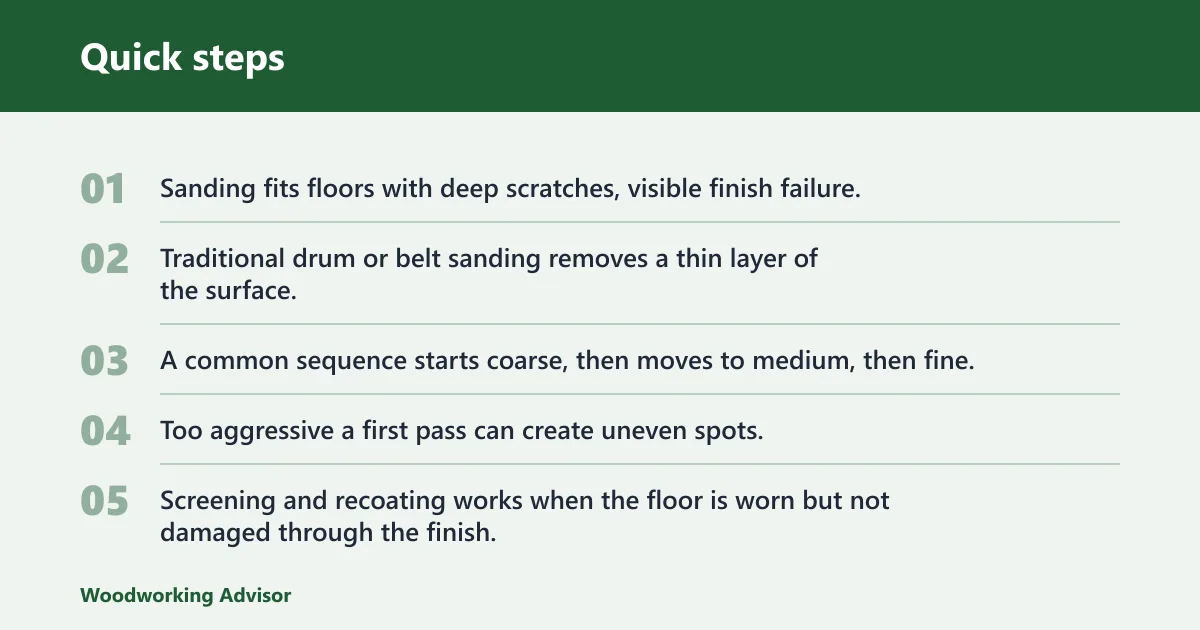
Sanding fits floors with deep scratches, visible finish failure, or color loss that a topcoat cannot fix. Traditional drum or belt sanding removes a thin layer of the surface, so the contractor has to match grit progression to the floor condition. A common sequence starts coarse, then moves to medium, then fine. Too aggressive a first pass can create uneven spots.
When screening and recoating is enough
Screening and recoating works when the floor is worn but not damaged through the finish. This process abrades the topcoat, then adds a new finish layer without removing much material. It is usually faster, less messy, and cheaper than full sanding. It is also the safer choice for engineered bamboo with limited wear thickness.
When to stop and replace
If the floor has cupping, splintering, deep staining, or a wear layer so thin that sanding would cut through it, stop and replace instead. A common mistake is assuming a faded bamboo floor always needs a full refinish when a screened-and-recoat service may cost far less. Say your 250-square-foot hallway has edge splintering and loose click-lock joints. Sanding may cost less up front, but replacement is often the better long-term fix.
What drives the finish price?
Finish choices can change both the material bill and the labor time. Stain adds color work and extra labor. Topcoat selection affects drying time, odor, and durability. Sheen level matters too, because some finishes need more careful blending to avoid lap marks or uneven shine across the room.
Stain and color changes
Staining hardwood floors costs between $1 and $3 per square foot, and the same planning logic applies to bamboo when a color change is requested. Natural bamboo tones may not accept stain like oak or maple, so a contractor should confirm compatibility first. If you want to keep the factory color, you may avoid this add-on entirely.
Water-based versus oil-based topcoat
Water-based finishes usually dry faster and have lower odor, while oil-based finishes can build a warmer tone and may offer a different sheen feel. The right choice depends on the room, the expected wear, and the owner’s tolerance for cure time and smell. Material and labor costs can rise if the finish system needs longer turnaround.
Sheen level and coat count
Matte, satin, and gloss sheens do not change the floor structure, but they change how defects and dust show up. Higher-sheen finishes can make scratches more visible. More coats usually mean more labor and longer drying time, which increases the project total even if the base sanding price stays the same.
Is dustless refinishing worth it?
Dustless refinishing can be worth it when the home has allergy concerns, finished rooms nearby, or a strict cleanup requirement. It does not eliminate dust entirely, but vacuum-attached sanding controls more of it. The tradeoff is cost: dustless refinishing can run $5 to $8 per square foot, which is above the standard $3 to $8 range.
Vacuum-attached sanding
Vacuum-assisted sanding captures a larger share of the fine particles created by sanding. That matters because bamboo is dense and can create a noticeable amount of fine dust during removal. The system adds equipment setup and can raise the contractor’s fee, especially on larger projects or rooms with difficult access.
Dust-sensitive homes
If you have occupants who are sensitive to dust, or if nearby rooms need to stay usable during the job, dustless sanding is often the cleaner choice. It still requires plastic barriers, floor protection, and cleanup. It simply reduces the amount of airborne material that escapes into the rest of the home.
Cost tradeoff versus standard sanding
Standard sanding costs less, but it can leave more cleanup behind. Dustless sanding costs more, but it can reduce disruption. Suppose a 400-square-foot living area needs a refinish. Standard sanding might fit the lower end of the project range, while dustless work can shift the bill upward because the contractor is bringing extra equipment and process time.
Frequently asked questions
How much does it cost to refinish bamboo floors?
How much it costs to refinish bamboo floors usually falls in the $3 to $8 per square foot range, with the national hardwood refinishing average at $1,869. Small rooms can cost more per square foot because of minimum job fees. Dustless sanding, stain, and furniture moving can raise the total.
Is bamboo cheaper to refinish than replace?
Usually, yes, if the floor is structurally sound and has enough wear thickness. Replacement brings new bamboo plank costs, demolition, and installation. Bamboo planks can cost $3 to $12 per square foot, and installation often adds $5 to $10 per square foot. If the wear layer is too thin, replacement may still be the safer option.
What affects bamboo floor refinishing cost
The biggest cost drivers are floor type, square footage, surface damage, sanding depth, stain choice, and contractor labor. Minimum service fees can matter on small jobs. Dustless sanding, furniture moving, prep work, and regional pricing also change the final bill. Engineered bamboo usually needs a more careful, and sometimes pricier, approach.
Can strand-woven bamboo be refinished?
Yes, strand-woven bamboo can often be refinished, but the floor still needs a wear-depth check before sanding. Because strand-woven bamboo is more expensive than horizontal or vertical bamboo planks, owners often want to preserve it if possible. A contractor should confirm how much material can be removed and whether screening is safer.
Should bamboo floors be sanded or screen-and-recoated?
Sand the floor when the finish is worn through, scratched deeply, or damaged beyond the topcoat. Screen and recoat when the surface is dull or lightly scuffed but the wear layer is still intact. If the floor is engineered, floating, or already thin, screening is often the safer first choice.
Sponsored / affiliate links. As an Amazon Associate I earn from qualifying purchases. I may earn additional commission from eligible campaigns.