How Much Does Professional Wood Floor Cleaning Cost?
Professional wood floor cleaning usually costs about $0.25 to $0.75 per square foot for cleaning only, while more restorative cleaning, screening, or recoating often runs about $1.50 to $4.00 per square foot, depending on floor condition and finish. Poor service can leave residue, dull boards, or hidden wear that shortens the life of the finish. This guide breaks down what you pay for, what each service includes, and how to compare quotes.
Professional wood floor cleaning costs
There is no fixed national price for professional hardwood floor cleaning. Pricing starts with square footage, then shifts with soil load, stains, finish wear, room layout, access, and local labor rates. Cleaning-only work sits at the low end. Restorative work costs more because it takes more time and equipment.
Typical price range by square foot
A common average for professional hardwood floor cleaning is $0.50 – $1.50 per square foot. That range can be lower for simple maintenance cleaning and much higher when the floor needs stain-focused work, degreasing, sanitizing, or a follow-up protective step. Some floors may require just basic cleaning. Some floors may require much deeper cleaning.
Room-size estimates help you translate a square-foot rate into a quote. A 10’x10′ room estimate was $250. A 20’x20′ room estimate was $400-$500. Whole-home pricing usually scales with total area, but the final number also reflects how many rooms need furniture moved, how many transitions and corners slow the crew, and whether any room needs special attention.
Room-size estimates versus whole-home pricing
| Floor area | Likely price band | What usually drives the total |
|---|---|---|
| 200 sq. ft. | around $80-$200 | Small job minimums, basic cleaning, easy access |
| 400 sq. ft. | around $200-$400 | Standard maintenance cleaning, moderate labor |
| 600 sq. ft. | around $400-$800 | More time on edges, furniture, and drying |
| 800 sq. ft. | around $800-$100 | Large-area labor, room congestion, added prep |
| 1000 sq. ft. | around $1,000-$1,200 | Whole-home cleaning, multiple rooms, more setup |
| 1400 sq. ft. | around $1,500-$2,000 | Big area, more moving time, higher labor load |
The spread in those estimates shows why quotes are often job-specific instead of fixed. A small but badly soiled room can cost more than a larger room in clean condition if the crew has to work around furniture, residue, or finish problems.
What shifts a quote from low to high
Low quotes usually reflect open floor plans, light soil, and a simple maintenance pass. High quotes usually reflect deeper cleaning, stain work, polishing, sealing, sanitizing, or degreasing. Regional pricing also matters, and high-cost or luxury markets often charge more because local labor rates are higher.
What a cleaning quote usually includes
A solid quote should spell out the floor area, the service level, the products or machines used, and any add-ons. It should also say whether the price includes furniture moving, stain treatment, dry time, and a final walkthrough. If those items are missing, the estimate may not match the invoice.
Inspection and measuring the floor area
Most professional jobs begin with measuring the floor area and checking the finish condition. That matters because the cost depends on the size of the floor, and the service should match the floor’s needs. A quote for 400 square feet should not be treated the same as one for 1,000 square feet, even if the rooms look similar.
Dry soil removal and cleaning steps
Basic professional cleaning often starts with dry soil removal, then a cleaner applied with commercial tools, then careful drying. Professional equipment is more effective than DIY tools on large or heavily soiled floors because it removes more soil, covers more area, and handles residue more consistently. Powered floor scrubbers and commercial cleaners can also reach edges and traffic paths more evenly.
Dry time and final walkthrough
Dry time should be part of the service plan, especially on sealed hardwood. A final walkthrough helps confirm that residue is gone, the finish still looks even, and no area needs a second pass. If the floor still feels sticky after drying, the cleaning chemistry or method was likely wrong for that finish.
What affects the price of hardwood floor cleaning?
Square footage is the main cost driver, but it is not the only one. Floor condition, wood type, finish wear, furniture moving, stairs, and tight access can all raise the bill. Location matters too, because local labor rates and regional demand change what crews charge for the same square footage.
Floor condition, stains, and residue
Soil load changes the amount of labor needed. Light dust is a fast maintenance job. Built-up residue, cooking grease, pet traffic, and dark stains take more time and sometimes a different chemistry. When floors have scratches or finish wear, cleaning can improve appearance, but it cannot erase damage that is into the finish or wood.
Wood type, finish wear, and sensitivity
Wood floor type affects the method. Softer wood species can mark more easily, so a crew may need gentler pads and less aggressive agitation. Worn finishes also need care because a strong cleaner or heavy scrub can make the wear more visible. If the finish is failing, cleaning alone may not be the right service.
Furniture moving, stairs, and tight access
Accessibility changes labor time. Moving sofas, tables, or media units adds minutes or hours, depending on the room. Stairs, narrow hallways, and crowded rooms slow setup and cleanup. If a company must work around too much furniture, expect the quote to rise.
Say your 200-square-foot dining room has light soil but a full set of furniture that has to be moved. The cleaning itself may be simple, yet the total can climb because the labor is not in the solution bottle. The quote should separate moving labor from cleaning labor.
Cleaning-only versus restorative service
Cleaning-only services remove dirt and residue. Restorative services try to correct dullness, light wear, or stubborn surface problems, and they cost more because the work is slower and more technical. If a quote includes polishing, sealing, or screening, you are no longer comparing pure cleaning prices.
Light maintenance clean
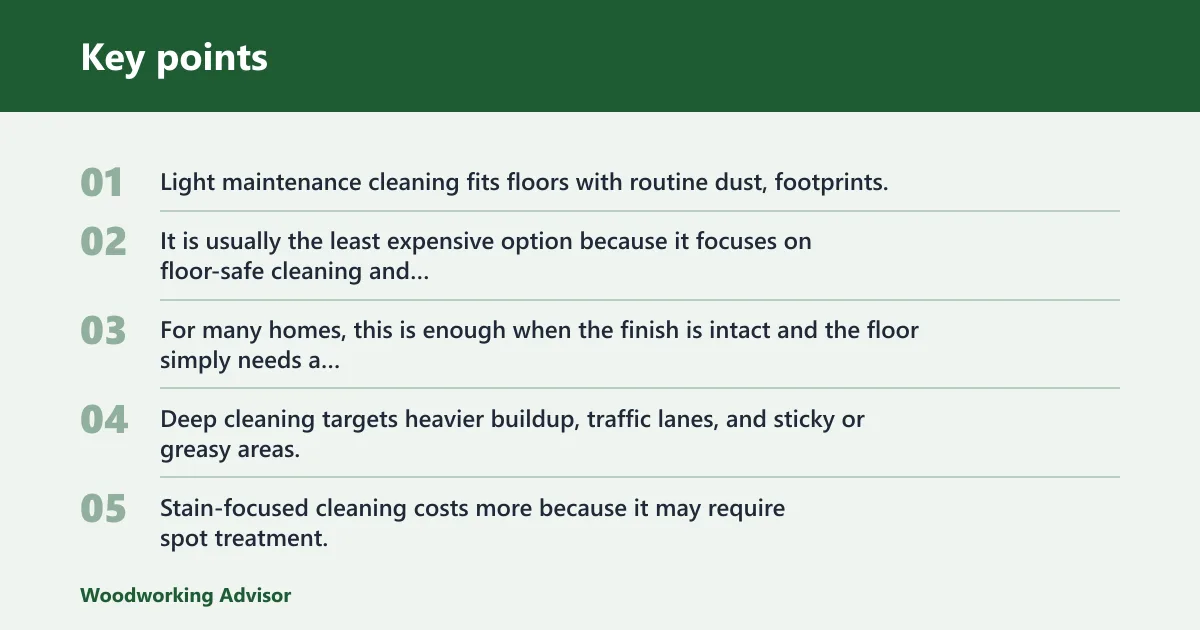
Light maintenance cleaning fits floors with routine dust, footprints, and light surface soil. It is usually the least expensive option because it focuses on floor-safe cleaning and quick drying. For many homes, this is enough when the finish is intact and the floor simply needs a reset.
Deep clean and stain-focused cleaning
Deep cleaning targets heavier buildup, traffic lanes, and sticky or greasy areas. Stain-focused cleaning costs more because it may require spot treatment, extra dwell time, or repeat passes. Even then, some stains will remain if they have penetrated the finish or the wood.
Cleaning plus polish or seal
Polishing and sealing sit above standard cleaning. These add-ons can improve sheen and add a short-term protective layer, but they are not a fix for deep scratches or failing finish. They make the most sense when the floor is sound, clean, and only needs cosmetic or light protective work.
When the job becomes screening or refinishing
If the quote starts to sound like sanding, screening, recoating, or refinishing, the floor has crossed out of cleaning territory. That usually happens when the finish is worn through, scratches are widespread, or stain damage is severe. At that point, a cleaning-only quote is the wrong benchmark.
Wood floor service cost matrix
This matrix helps you match common floor conditions to the likely service level and cost driver. It is not a flat price list. It is a decision aid for reading quotes and spotting when a job is still cleaning versus when it has shifted into restorative work.
| Floor condition | Likely service level | Typical price driver | Best fit |
|---|---|---|---|
| Light dust, footprints, routine soil | Light maintenance clean | Square footage and basic labor | Seasonal upkeep, post-guest cleanup, regular maintenance |
| Built-up residue, dull traffic lanes | Deep clean | Extra agitation, more dwell time, more drying | Floors that feel tacky or look gray in walk paths |
| Stains, odor, greasy spots | Stain-focused cleaning or degreasing | Spot treatment and repeated passes | Kitchens, entryways, pet zones, food prep areas |
| Dull finish, light wear, sound wood | Cleaning plus polish or seal | Added finish product and labor | Floors that need appearance help without sanding |
| Heavy scratches, worn-through finish, deep stains | Screening, recoating, or refinishing | Prep work and finish restoration | Floors where cleaning alone will not solve the problem |
A common first-timer mistake is asking for “deep cleaning” when the floor actually needs recoating. If the boards look gray in patches, feel rough, or show finish loss in high-traffic lanes, cleaning may improve the surface only briefly. A better quote should explain whether the problem is soil, residue, or finish wear.
Is professional hardwood floor cleaning worth it?
Professional cleaning is worth it when the floor needs more than a quick mop but less than refinishing. A pro can remove deeper soil, use commercial equipment, and clean more evenly than typical household tools. It is less useful when the real problem is damage, because cleaning cannot replace lost finish or repair deep scratches.
When a pro cleaner can do more than DIY tools
Professional equipment is useful on large areas, textured residue, and floors that need controlled moisture. A crew can also move through rooms faster, which matters when a homeowner wants consistent results without over-wetting the wood. For many homes, that makes the price easier to justify than repeated DIY attempts.
When cleaning is not the right fix
If the floor has finish failure, widespread scratches, or dark stains that sit below the surface, cleaning alone will not solve the problem. In those cases, the better move may be screening, recoating, or refinishing. That shift matters because it changes both cost and expectations.
Signs you need a higher-level service
- Traffic lanes stay dull after cleaning.
- Stains remain after spot treatment.
- The finish looks patchy or thin.
- Boards feel rough after drying.
Suppose a 10’x10′ bedroom has light dirt but one large dark spill mark near the doorway. A cleaning quote may still be appropriate if the stain is surface-level. If the mark stays after stain treatment, the next quote should move toward restoration instead of another cleaning pass.
How often should hardwood floors be professionally cleaned?
Most hardwood floors need professional cleaning every 1-3 years. Homes with light daily traffic often stay on the longer end of that range, while homes with pets, children, or heavy use may need service more often. Finish type matters too, because worn finishes need gentler care and may show soil sooner.
Homes with light daily traffic
If the floor sees light foot traffic and regular sweeping, a professional cleaning every couple of years may be enough. That timing helps reset grime before it bonds to the finish. It also keeps small maintenance jobs from becoming deeper, more expensive ones.
Homes with pets, kids, or heavy use
Busy homes often need more frequent service because grit, spills, and tracked-in soil build up faster. Entryways, kitchens, and family rooms usually wear first. If the floor looks dull before the calendar says it should, the interval should be shortened.
How finish type affects timing
Floors with tougher, intact finishes can often go longer between professional cleanings. Floors with thin or worn finish need more cautious care and may need restorative attention sooner. The goal is to clean before buildup turns into residue that is harder to remove.
Frequently asked questions
How much does professional wood floor cleaning cost per square foot?
Professional hardwood floor cleaning costs $0.50 – $1.50 per square foot on average for many jobs, with simpler cleaning lower and restorative work higher. Some pricing guides also place cleaning-only work below that range and screening or recoating above it. The floor’s condition usually decides where the quote lands.
What’s included in a professional wood floor cleaning service?
A standard service usually includes measuring the floor, dry soil removal, application of commercial cleaner, controlled agitation or machine cleaning, drying, and a final check. Some companies also include stain treatment or light furniture moving. Always confirm whether polish, sealant, or sanitizing is included or billed separately.
Do I need furniture moved before floor cleaning?
Not always, but it helps to ask in advance. Furniture moving often adds labor time and therefore cost, especially in tight rooms or crowded spaces. Some companies move light items only, while others charge extra for heavy pieces. A quote should say exactly what is included.
How much does deep cleaning cost for a small room?
A small room with deeper soil can cost more than its square footage suggests because minimum charges and labor setup matter. Heavy residue, stains, or difficult access can push a small-room quote upward.
When does hardwood floor cleaning become more expensive?
It becomes more expensive when the quote adds stain treatment, degreasing, polishing, sealing, furniture moving, or extra drying time. It also rises when the floor is hard to access, the rooms are congested, or the local market has higher labor rates. At that point, the job is no longer basic cleaning.
Sponsored / affiliate links. As an Amazon Associate I earn from qualifying purchases. I may earn additional commission from eligible campaigns.