Can Solid Stain Go Over Paint? A Proven, Essential Guide
Why Wood Stain Goes Bad in the First Place
Yes, you can apply solid stain over paint, but not directly. For lasting results, you must properly prepare the surface. This involves cleaning, scraping loose paint, sanding the entire surface to create a grip, and applying a high-quality adhesion-promoting primer before you apply the stain. Skipping these steps will cause peeling and failure.
Have you ever looked at a painted deck, fence, or piece of outdoor furniture and wished it had the rich, deep look of a solid stain? Maybe your paint is starting to peel, and you’re ready for a change. It’s a common dilemma! Many people think they have to spend days stripping every last bit of old paint off. I’m here to tell you there’s a better way. With the right preparation, you absolutely can put solid stain over a painted surface. In this guide, I’ll walk you through every step, making it simple and achievable. Let’s get started and give your project a beautiful, durable finish.
First, What’s the Real Difference Between Solid Stain and Paint?
Before we grab our tools, it’s incredibly helpful to understand what we’re working with. People often use the terms “paint” and “solid stain” interchangeably, but they are different products designed for different jobs. Knowing this difference is the key to understanding why surface preparation is so important.
Paint is designed to form a thick, protective film that sits entirely on top of the wood’s surface. It creates a solid barrier against moisture and UV rays. Think of it like a jacket for your wood—it covers everything completely, hiding the wood grain.
A solid color stain, sometimes called an opaque stain, is a bit of a hybrid. It contains a lot of pigment, just like paint, so it also hides the wood grain. However, it’s a much thinner formula. It’s designed to penetrate the wood’s surface just a little bit while also forming a film on top. This allows it to breathe more than paint, which helps prevent peeling and blistering caused by trapped moisture.
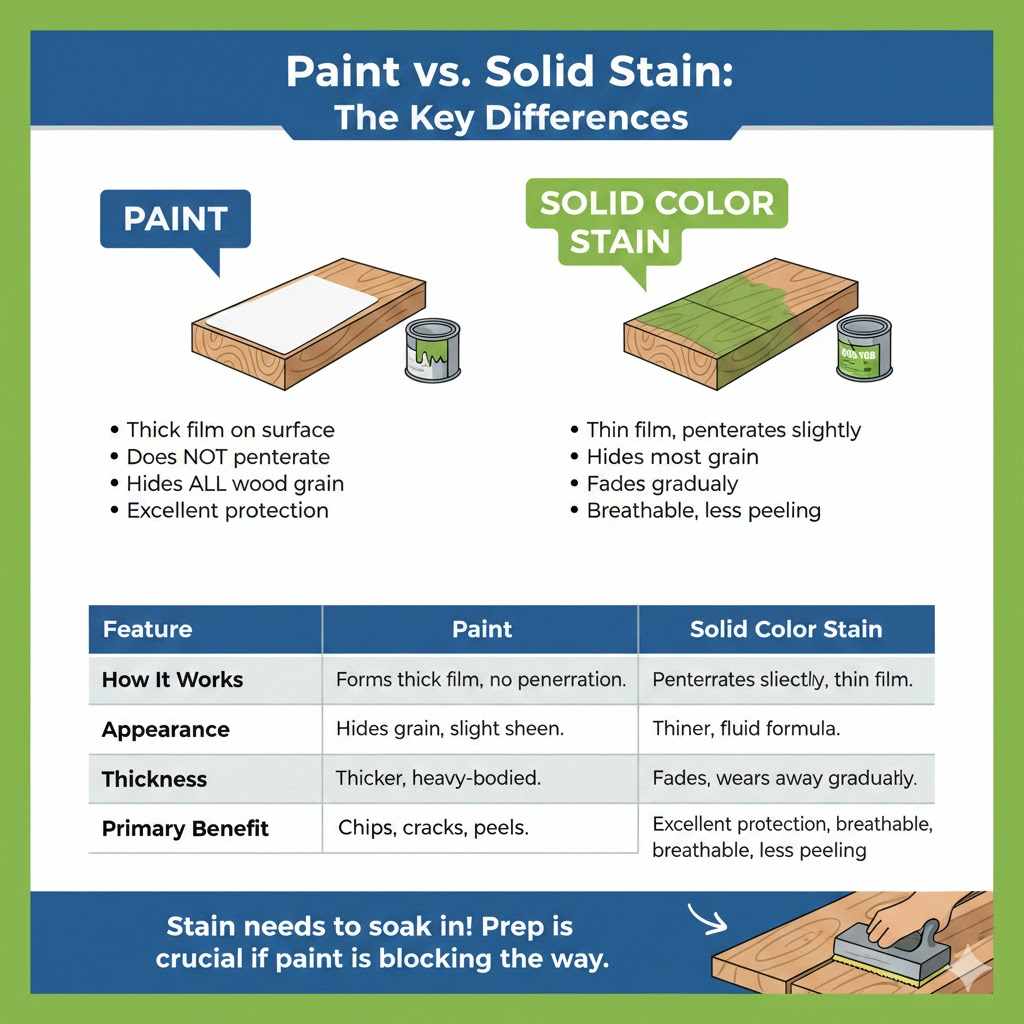
Here’s a simple table to break it down:
| Feature | Paint | Solid Color Stain |
|---|---|---|
| How It Works | Forms a thick film on top of the surface. Does not penetrate. | Penetrates slightly while also forming a thin film on top. |
| Appearance | Completely hides wood grain and texture, often with a slight sheen. | Hides wood grain but allows some wood texture to show through. Usually a flat or matte finish. |
| Thickness | Thicker, heavier-bodied formula. | Thinner, more fluid formula. |
| How It Fails | Tends to chip, crack, or peel off in sheets when it fails. | Tends to fade or wear away gradually over time. |
| Primary Benefit | Excellent surface protection and color variety. | Good protection, breathable, and less prone to peeling. |
Understanding this, you can see the challenge: a stain meant to soak into wood can’t do its job properly if a layer of paint is blocking the way. That’s why we need to create a perfectly prepared surface for it to stick to.
Why You Must Prep a Painted Surface Before Staining
You might be tempted to just clean the painted surface and apply the solid stain right on top. Please don’t! I’ve seen this mistake many times, and the results are always disappointing. If you apply a solid stain directly over old paint without proper preparation, you are setting yourself up for failure.
Here’s what will happen:
- Poor Adhesion: The solid stain has nothing to grip onto. Most paint finishes, especially semi-gloss or gloss, are smooth and non-porous. The stain will just sit on top and won’t form a strong bond.
- Peeling and Flaking: Within a few months (or even weeks!), the new stain will start to peel away, often taking patches of the old paint with it. All your hard work will be for nothing.
- Uneven Finish: The stain will not apply evenly. Some spots might look okay, while others will be weak and thin. You’ll end up with a blotchy, unprofessional-looking project.
The secret to success is creating a surface that the new coating can mechanically bond with. That means cleaning off all contaminants, removing any unstable old paint, and sanding the surface to give it microscopic “teeth” for the primer and stain to grab onto. Think of it like this: you can’t glue two smooth pieces of plastic together, but if you rough them up with sandpaper first, they’ll stick perfectly. It’s the same principle here.
The Proven Step-by-Step Guide to Applying Solid Stain Over Paint
Ready to get it done right? Follow these steps carefully, and I promise you’ll get a durable, beautiful finish that you can be proud of. Don’t skip any steps—each one is essential for a long-lasting result.
Step 1: Gather Your Tools and Materials
Having everything you need on hand before you start makes the process so much smoother. You don’t want to be running to the store covered in paint dust!
- Safety Gear: Safety glasses, dust mask, and gloves are a must.
- Cleaning Supplies: Stiff-bristled brush, bucket, and a good deck cleaner or a solution of TSP (Trisodium Phosphate) substitute. For mildew, a mix of one part household bleach to three parts water works well.
- Scraping & Sanding Tools: A pull scraper, a 5-in-1 tool, and a random orbital sander. Sandpaper in 80-grit and 120-grit.
- Repair Supplies: Exterior-grade wood filler or epoxy putty and a putty knife.
- Primer: A high-quality exterior oil-based or latex adhesion-promoting (bonding) primer.
- Solid Color Stain: Your choice of high-quality oil-based or water-based solid stain.
- Application Tools: Good quality paint brushes, rollers, and a paint tray.
Step 2: Clean the Surface Thoroughly
You can’t paint over dirt. Any grime, mildew, or chalky paint residue will prevent the primer and stain from sticking. This step is non-negotiable.
- Scrub the Surface: Mix your cleaner according to the manufacturer’s instructions. Apply it to the surface and scrub vigorously with a stiff brush to remove all dirt, grime, and loose organic matter.
- Address Mildew: If you see any black or green spots, you likely have mildew. It’s important to kill it, not just clean it. Use a bleach and water solution for this. For safe handling guidelines, you can check resources like the Environmental Protection Agency (EPA) guide on cleaning mold.
- Rinse Completely: Use a garden hose (or a pressure washer on a low setting, held far from the wood) to rinse the surface thoroughly. You want to remove all cleaning residue.
- Let It Dry Completely: This is critical. The wood must be bone dry before you move on to the next step. Depending on the weather, this can take 24-48 hours. Trapping moisture under your new finish is a recipe for peeling.
Step 3: Scrape and Sand Away All Loose Paint
This is where the real work begins, but it’s also the most important step for long-term success. Your new stain finish is only as good as the surface underneath it.
- Scrape: Use your paint scraper or 5-in-1 tool to aggressively remove any paint that is bubbling, cracking, or peeling. If a piece of paint comes off easily, it needs to go. Be thorough!
- Feather the Edges: You will now have areas of bare wood right next to areas of solid paint. To avoid a patchy look, you need to “feather” these edges. Use your random orbital sander with 80-grit sandpaper to smooth the transition between the paint and the wood.
- Scuff Sand the Entire Surface: Now, switch to 120-grit sandpaper and lightly sand everything—even the areas where the paint is in good shape. This is called scuff sanding. It dulls the old paint finish and creates that microscopic rough texture that your primer will bond to tightly. The goal is not to remove all the paint, just to give the entire surface a uniform, slightly gritty feel.
- Clean Up the Dust: Wipe the entire surface down with a tack cloth or a damp rag to remove all sanding dust.
Step 4: Make Any Necessary Repairs
Now that the surface is clean and sanded, you’ll be able to see any imperfections that need attention. Use your exterior-grade wood filler to fill any small cracks, holes, or gouges. Follow the product’s instructions for application and drying time. Once it’s fully cured, sand the repaired areas smooth so they are flush with the surrounding surface.
Step 5: Apply a High-Quality Bonding Primer
Primer is the magic ingredient that makes this whole process work. It is designed to stick to difficult surfaces (like old paint) and create a perfect, uniform base for your new topcoat (the solid stain) to stick to. Do not skip this!
- Choose the Right Primer: You need an exterior adhesion-promoting or bonding primer. An oil-based primer is often the best choice for ultimate adhesion and stain-blocking, especially if you have bare wood spots that might bleed tannins. However, modern water-based (latex) bonding primers are also excellent and offer easier cleanup.
- Apply an Even Coat: Using a brush or roller, apply a consistent coat of primer to the entire surface. Make sure to cover all the bare wood spots and the old, scuffed-up paint. Don’t apply it too thickly; a nice, even coat is what you’re looking for.
- Let It Cure: Check the can for the recommended drying and recoat times. It’s important to let the primer cure properly before moving on to the stain.
Step 6: Finally, Apply the Solid Stain
You’ve made it! The hard work is done. Now for the satisfying part. With your surface perfectly prepped and primed, applying the solid stain will be a breeze.
- Check the Weather: Plan to apply your stain on a day that is not too hot, not too cold, and not in direct sunlight. Most products have a recommended temperature range for application (usually between 50-90°F or 10-32°C).
- Apply the First Coat: Stir your stain thoroughly. Using a high-quality brush or roller, apply your first coat of solid stain. Work in manageable sections and maintain a “wet edge” to avoid lap marks. If you’re working on a large flat surface like a deck, a roller is efficient, but be sure to “back-brush”—go back over the rolled area with a brush to work the stain into the wood texture for a better bond and more uniform appearance.
- Let It Dry: Follow the manufacturer’s instructions for dry time between coats. Don’t rush this part.
- Apply the Second Coat (If Needed): Most projects will benefit from a second coat for better durability and richer color. Apply it in the same way you applied the first.
And that’s it! Let the final coat cure completely before putting furniture back or allowing heavy foot traffic. You’ve successfully transformed your old painted surface into a beautifully stained one that will last for years.
Choosing the Right Primer: A Quick Comparison
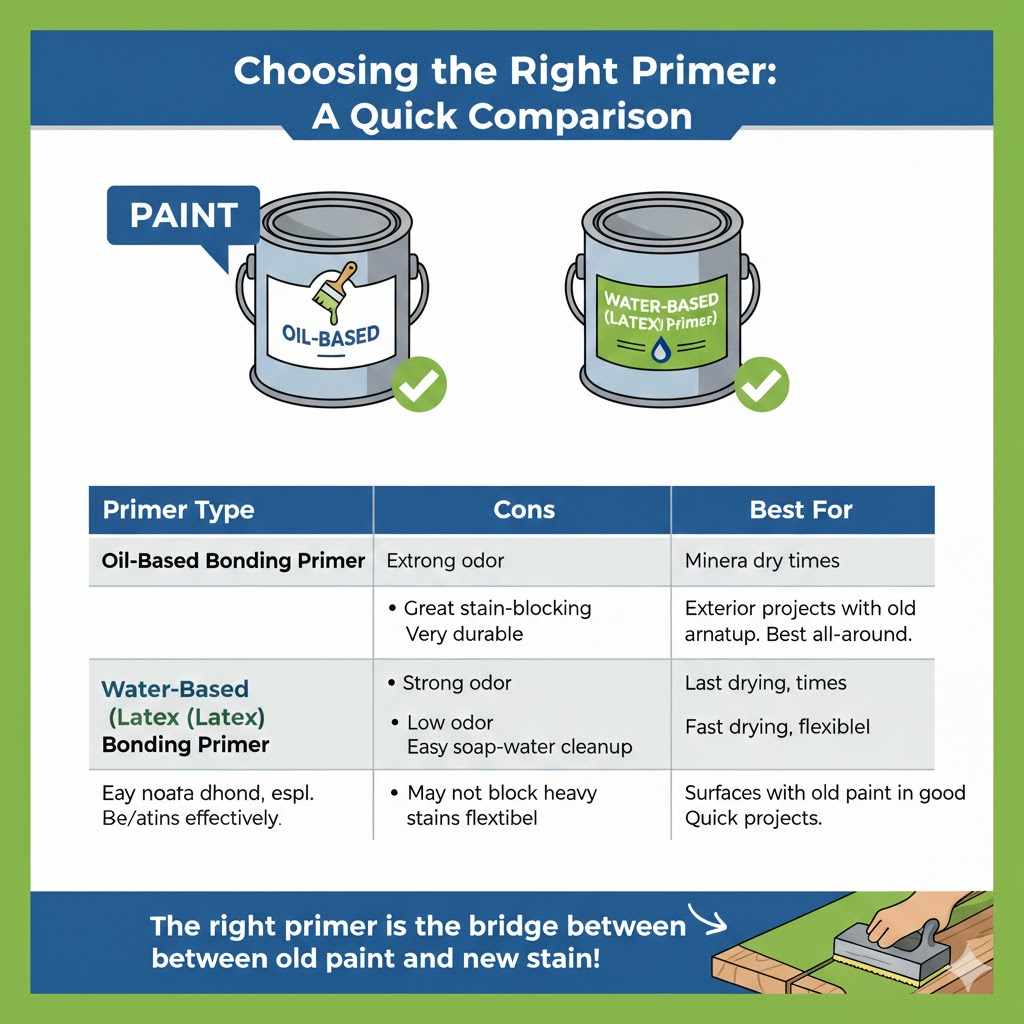
The primer you choose is your bridge between the old paint and the new stain. Here’s a quick breakdown to help you pick the best one for your project.
| Primer Type | Pros | Cons | Best For |
|---|---|---|---|
| Oil-Based Bonding Primer | Excellent adhesion, great stain-blocking (stops wood tannins from bleeding through), very durable. | Strong odor, requires mineral spirits for cleanup, longer dry times. | Exterior projects with a mix of old paint and bare wood, especially on woods like cedar or redwood that bleed tannins. The best all-around choice for this job. |
| Water-Based (Latex) Bonding Primer | Low odor, easy soap-and-water cleanup, fast drying, flexible. | May not block heavy stains as effectively as oil-based. | Surfaces where the old paint is in relatively good condition and tannin bleed is not a concern. Great for quick projects. |
Frequently Asked Questions (FAQ)
1. What is the difference between solid stain and paint again?
Think of it this way: paint sits completely on top of the wood like a thick coat. Solid stain is thinner and soaks into the wood a little bit while also forming a protective layer. This makes it more breathable and less likely to peel like paint does. It hides the wood grain like paint, but often lets the wood’s texture show through.
2. Do I have to remove all of the old paint before applying a solid stain?
No, and that’s the good news! You only need to remove the paint that is loose, peeling, or failing. The paint that is still firmly attached just needs to be cleaned and scuffed up with sandpaper so the new primer has something to grip onto.
3. Can I use a semi-transparent stain over paint?
No, you cannot. Semi-transparent stains are designed to be absorbed by bare wood to show the wood grain through the color. They have very little pigment and will not bond to a painted or primed surface. The result would be a sticky, uneven mess that would fail very quickly. You must use a solid (opaque) color stain for this project.
4. How long will a solid stain last over a properly prepared painted surface?
If you follow all the preparation steps correctly—especially the cleaning, sanding, and priming—your solid stain finish can last just as long as it would on a new wood surface. This typically means 3-5 years for horizontal surfaces like decks and 5-7 years or more for vertical surfaces like fences or siding, depending on your climate and exposure to the elements.
5. What kind of primer is the absolute best for this project?
For the most foolproof result, an exterior oil-based bonding primer is the gold standard. It provides the strongest adhesion and is the best at blocking stains from any bare wood areas from bleeding through your new finish. If you prefer easy cleanup, a high-quality water-based bonding primer from a reputable brand is also an excellent choice.
6. Is it okay to use a pressure washer to prepare the surface?
You can, but you must be very careful. A pressure washer is a powerful tool that can easily damage wood, leaving it fuzzy and splintered if you use too much pressure or hold the nozzle too close. Use it on a low-pressure setting (below 1500 PSI) with a fan tip, and always keep the nozzle moving. Its main job is to help with rinsing, not stripping paint.
7. Is solid stain more durable than paint?
It’s not about one being “more durable” overall, but how they perform. Paint offers a harder, more protective shell, but this can make it brittle and prone to cracking. Solid stain is more flexible and breathable, so it resists peeling. For outdoor wood that expands and contracts, many people find that the way a solid stain ages—by slowly fading rather than peeling—is easier to maintain and re-coat down the road.
Your Project, Your Success
Switching from paint to a solid stain might seem like a huge job, but now you see it’s completely manageable. It’s not about shortcuts; it’s about following a proven process. By taking the time to clean, sand, and prime your surface properly, you are guaranteeing that your new stain finish won’t just look great—it will stick, protect, and last for years to come.
Don’t be intimidated by the preparation work. Think of it as the foundation of your project. A strong foundation ensures a beautiful, lasting structure. Now you have the knowledge and the steps to confidently tackle this project and give your deck, fence, or furniture a fresh new life. Go ahead and get started—you’ve got this!