Can You Drill Into Granite? Yes, With the Right Diamond Bit and Water
Yes, you can drill into granite — but only with a diamond-tipped bit, not a regular twist bit or even a standard masonry bit. Granite is too hard for a cutting edge to bite into it; you need diamond abrasion, water to keep the bit from overheating, and a slow, steady hand.
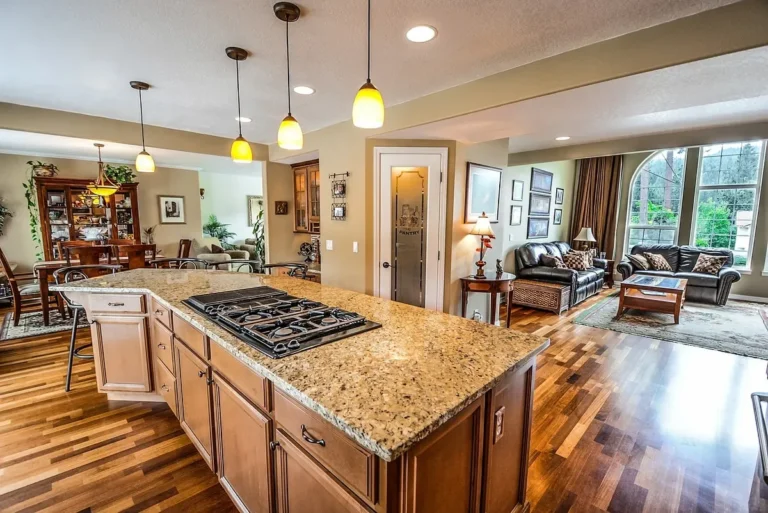
If you’re staring at a granite countertop or backsplash and want to add a soap dispenser, a faucet, a pot rack bracket, or an outlet cover, the good news is you don’t need to call a stone fabricator. A cordless drill, the right diamond bit, and a little patience will get you a clean hole without cracking a slab that can cost hundreds of dollars a square foot to replace. Here’s exactly what that looks like in practice: the tools that actually matter, the technique that keeps the stone from chipping, and the mistakes that cause most of the cracks people worry about.
What You Actually Need to Drill Into Granite
The single most important thing on this list is the bit. Everything else — the drill, the water, the tape — is there to support a diamond bit doing its job. Skip the diamond bit and none of the rest matters, because a regular bit simply won’t cut granite; it’ll just spin, heat up, and glaze over.
Best Pick for Granite & Stone Holes
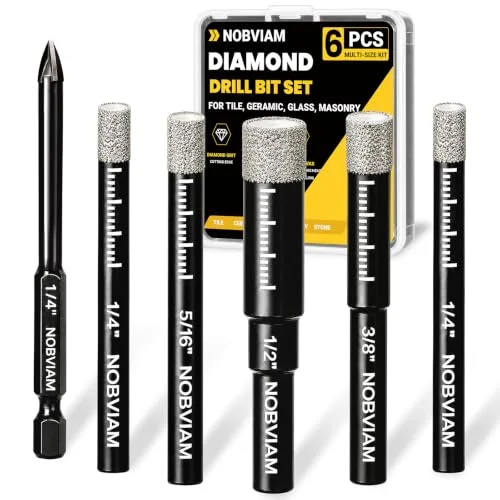 |
NOBVIAM 6-Piece Diamond Drill Bit Set – $8.58 This is the exact type of bit set this guide is built around — vacuum-brazed diamond hole saws in the common DIY sizes, plus one carbide starter bit, rated by the maker for granite, tile, and glass.
|
Beyond the bit itself, here’s the full kit:
- A drill: a cordless drill is fine for small holes. For bigger holes or thicker slabs, a hammer drill or rotary hammer gives you more torque — just run it in rotary-only mode, not hammer mode, on granite.
- A diamond-tipped or diamond core bit: look for a continuous-rim or turbo-rim bit for cleaner cuts, or a diamond hole saw for anything wider than about 1/2 inch.
- Water: a spray bottle, a slow trickle from a nearby faucet, or a small dam built from modeling clay or plumber’s putty around the drill spot so a shallow puddle stays put instead of running off the counter.
- Painter’s tape: a strip over your mark keeps the bit from skating around on the smooth surface before it bites in.
- Safety glasses and an N95 mask: granite dust contains crystalline silica, which is a real lung hazard if you’re breathing it regularly — don’t skip the mask, especially for a hole saw job that makes more dust.
- A backer board: a scrap of wood clamped or held underneath the drilling point if you’re going all the way through a thinner piece, so you’re not pressing the exit side of the hole against nothing but air.
Picking the Right Drill Bit Size
Match the bit to the actual hardware you’re installing, not a generic “standard” size. Measure the base of the fixture and pick a bit slightly larger — it’s easy to widen a hole a little, impossible to shrink one. Diamond bits for granite come in two shank styles: round shanks that fit any keyless chuck, and hex shanks that grip better in an impact driver but need a compatible chuck. Either works on granite; hex just resists slipping a bit better under torque.
| Typical Application | Recommended Bit Size | Notes |
|---|---|---|
| Wall anchors for hanging pot racks, hooks, shelves | 1/4″ – 1/2″ (6 – 12 mm) | Match to the anchor packaging — this is the size range in most DIY diamond bit kits. |
| Soap dispenser or lotion pump | 3/4″ – 1″ (19 – 25 mm) | A standard diamond bit is usually enough. |
| Faucet spout or sink base | 1.25″ – 1.5″ (32 – 38 mm) | Usually needs a diamond hole saw. Check your faucet’s spec sheet first. |
| Small wires or cable pass-throughs | 1/4″ (6 mm) or smaller | A basic diamond twist bit handles this. |
| New drain assembly | 1.25″ – 1.75″ (32 – 45 mm) | Confirm the drain pipe diameter before buying a hole saw. |
How to Drill Into Granite, Step by Step
The technique is less about strength and more about letting the diamond bit do the work while you manage heat. Here’s the sequence:
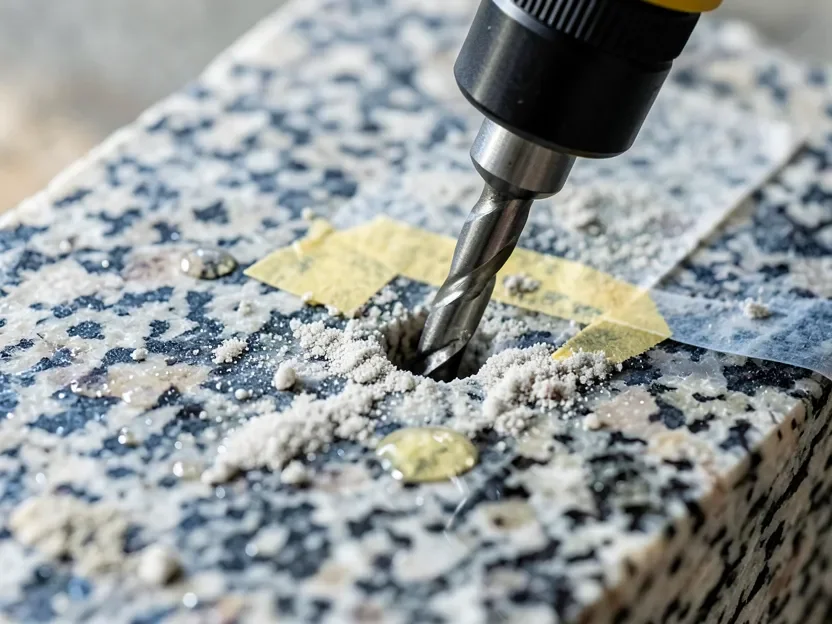
- Mark and tape the spot. Measure and mark your center point, then place a small piece of painter’s tape directly over it and re-mark the center on the tape. This gives the bit something to grip instead of skating on polished stone.
- Start at an angle, then straighten up. Begin the bit at roughly a 45-degree angle to the surface and gently rock it upright as it starts cutting a shallow dimple. Starting straight up on smooth granite is exactly when a bit tends to wander.
- Run the drill slow — and skip hammer mode. Most diamond bits for stone are rated for roughly 1,600–5,000 RPM depending on bit diameter (smaller bits run faster, larger hole saws run slower), in plain rotary mode. Hammer or impact mode is built for concrete and mortar; on granite it’s far more likely to chip the surface than to speed anything up.
- Keep it wet the entire time. Apply water before you start and keep it flowing or dribbling throughout — not just when you remember to. If you built a small clay dam around the spot, keep it topped up. If you see steam or smell anything hot, stop immediately and cool the bit down before continuing; that’s your sign the stone is close to a heat fracture.
- Lift the bit every 30 to 60 seconds. While it’s still spinning, pull it just clear of the hole to let fresh water flush in and ground-up stone dust flush out, then continue. A hole packed with dry slurry cuts slower and runs hotter.
- Ease off as you break through. The last few millimeters are where chipping happens, because the unsupported stone on the exit side can’t resist pressure the way the rest of the slab can. Slow down and lighten your grip as you feel the bit start to break free, and let it finish the last bit of material with almost no downward force.
- Flush and clean the hole. Rinse out the dust and slurry with water, wipe down the surrounding granite, and vacuum up the debris once it’s dry. A clean hole is what actually gives you a good fit for whatever hardware is going in it.
Mistakes That Actually Crack Granite
Granite doesn’t crack just because someone drilled into it — it cracks because of one of these specific mistakes:
- Using a non-diamond bit. A standard masonry or twist bit won’t cut granite. The temptation to push harder to force it through is what actually causes chips and cracks — the bit was never going to work regardless of pressure.
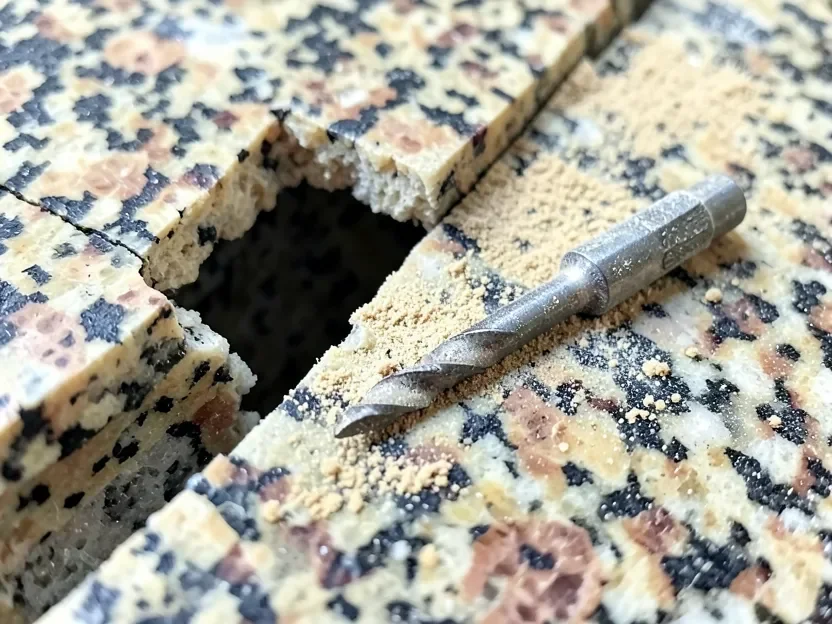
- Drilling dry. No water means no cooling. Heat buildup is the most common cause of hairline fractures spreading from a drilled hole, and it also glazes over and ruins the diamond bit faster.
- Running hammer mode. The oscillating impact that helps with concrete and mortar is too aggressive for granite’s crystalline structure and tends to chip the surface around the hole.
- Forcing it through at breakthrough. Pushing hard right as the bit exits the far side is the single most common place a chip happens, because that thin remaining layer has nothing behind it to resist pressure.
- Skipping the tape and rushing the start. A bit that skates across the surface before it bites in can scratch the polish or wander off your mark, especially near an edge.
Does the Technique Change for Countertops, Backsplashes, or Anchors?
The core method stays the same everywhere, but a few things shift depending on where you’re drilling:
- Countertops: this is the highest-stakes spot, since it’s both visible and expensive to replace. Have your water source set up before you start, reduce pressure well before breakthrough, and if you need multiple aligned holes for a faucet assembly, tape a paper or cardboard template down first so every hole lands exactly where it should.
- Backsplashes: usually thinner stone, which makes them easier to drill but also easier to crack if you rush. The same diamond bit, water, and slow-speed rules apply; for small holes like an outlet cover, a standard drill with careful technique can work, though a hammer drill in rotary mode is still faster and cleaner.
- Anchors and wall-mounted granite: smaller bits (1/4″ to 1/2″) and shallower holes make this the easiest category. Water cooling still helps the bit last, though it matters less for one or two quick holes than for a large hole saw cut.
Keeping Your Diamond Bits Cutting Longer
Diamond bits cut by abrasion, not by a sharpened edge, so they don’t dull the way a twist bit does — they get “glazed” when stone dust packs into the diamond grit and stops it from biting. A few habits keep them working:
- Never run one dry on stone. Heat is what kills a diamond bit fastest, even before it hurts the granite.
- Let the diamond do the cutting. Forcing the bit doesn’t cut faster; it just knocks diamond segments loose.
- Rinse it after every use. Stone slurry hardens onto the bit if you let it dry, which is harder to remove than if you just rinse it right away.
- Re-energize a glazed bit. If a bit that used to cut well starts skating and heating up fast, drill a few seconds into a scrap brick or concrete block — the more abrasive material exposes fresh diamond particles.
Frequently Asked Questions About Drilling Granite
Can a regular drill bit go through granite?
No. A regular twist bit, and even a standard masonry bit, can’t cut granite. Granite sits around 6–7 on the Mohs hardness scale, and it takes diamond abrasion — not a cutting edge — to grind through it. A regular bit will just spin in place, generate heat, and dull without making real progress.
Do I need a hammer drill to drill into granite?
Not necessarily. A hammer drill or rotary hammer can add helpful torque for bigger holes, but you should run it in rotary-only mode, not hammer/impact mode — that setting is built for concrete and tends to chip granite instead of helping. A cordless drill with good torque, run at roughly 1,600–5,000 RPM with a diamond bit, is enough for most DIY holes.
What size diamond bit do I need for a granite countertop?
It depends on what you’re installing, not a “standard” size: about 1/4″ to 1/2″ for anchors and hooks, 3/4″ to 1″ for a soap dispenser or lotion pump, and 1.25″ to 1.5″ — usually as a diamond hole saw — for a faucet or sink base. Always check the fitting’s spec sheet before you drill; you can widen a hole slightly, but you can’t shrink one.
Can drilling into granite crack a countertop?
Yes, but almost always from one of three avoidable mistakes: drilling dry without water cooling, using a non-diamond bit and pushing harder to compensate, or applying full pressure right as the bit breaks through the far side. Slow, water-cooled drilling with a diamond bit and light pressure at breakthrough is very unlikely to crack a granite countertop.
Drilling into granite isn’t a job that requires a professional — it just requires the right bit, water, and a willingness to go slow, especially in the last few seconds before you break through. Get those three things right and a granite hole is a 15-minute job, not a gamble on a countertop you can’t afford to replace.
Sponsored / affiliate links. As an Amazon Associate I earn from qualifying purchases. I may earn additional commission from eligible campaigns.