Can You Screw into Particle Board: Expert Tips and Techniques
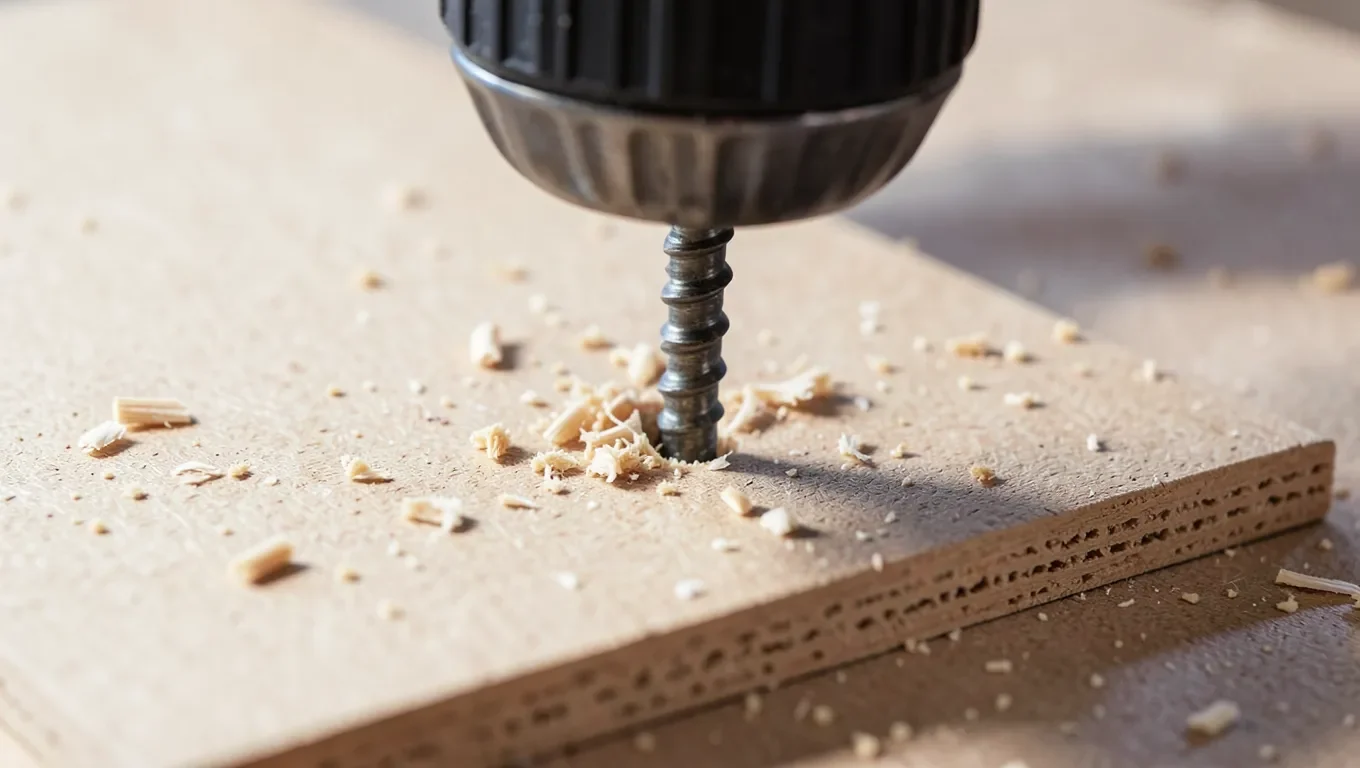
Yes, you can screw into particle board, but the wrong screw or technique splits it or strips the hole almost every time. Particle board is pressed wood chips and resin, not solid fiber, so it has far less holding strength than plywood or solid wood, and a screw driven in wrong can crush the material around it instead of biting into it. The fix is straightforward: the right screw type, a pilot hole sized correctly, and controlled torque. Here’s exactly how to get a screw to hold in particle board – and how to fix it when a hole has already stripped.
Why Particle Board Is Different
Solid wood and plywood have continuous wood fibers running through them, which is what a screw thread actually grips. Particle board is made of small wood chips and sawdust bonded with resin under heat and pressure – there’s no long fiber for a screw to bite into, just compressed particles held together by glue. That’s why particle board holds a screw less securely than plywood of the same thickness, and why the failure mode is different too: instead of the screw slowly working loose, the material around the threads crushes or crumbles, and the hole enlarges (“strips”) until the screw spins freely with no grip at all.
This is also why particle board splits so easily near edges and corners – there’s no wood grain to flex around a screw’s pressure, so stress concentrates and cracks straight through the resin-bonded chips.
Best Screws Made Specifically For Particle Board
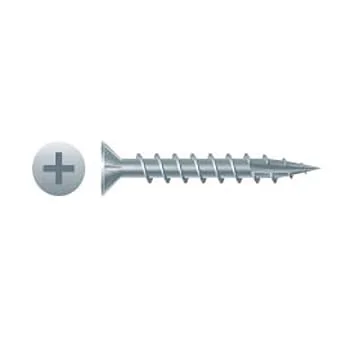 |
FASTENPOWER #8 x 1-1/4″ Particle Board Screws, 2lb Pack – $29.99 Type 17 self-drilling points with nibs under the head cut their own starter hole and countersink cleanly – purpose-built for particle board and MDF rather than a generic wood screw.
|
Choosing the Right Screws
Screw choice matters more in particle board than in solid wood:
- Coarse-thread screws, not fine-thread. Coarse threads displace more material per turn and grip the loose particle structure far better than fine threads, which are made for denser materials.
- Purpose-made particle board or chipboard screws (often labeled Type 17 point) have a self-drilling tip that scores its own pilot path, reducing the splitting a standard sharp-point screw can cause.
- Screw length: go deep enough to engage solid material but stop short of the opposite face – for 3/4-inch particle board, a 1-inch to 1.25-inch screw is typical.
- Screw gauge: #6 to #8 covers most furniture and shelving work. Going too thick for the material splits it; too thin doesn’t grip.
Pre-Drilling: The Step That Actually Matters
Pre-drilling is not optional in particle board the way it sometimes is in softwood. Drill a pilot hole about 70-80% of the screw’s root diameter – small enough that the threads still bite, large enough that the screw isn’t forcing its way through solid material and cracking it outward. Near an edge or corner, where particle board is weakest, drill the pilot hole even if you never would in plywood at the same spot.
Drive the screw straight and steady rather than fast. A slower drill speed with even pressure gives you a chance to feel the screw seat and stop before it starts crushing the surrounding material – the moment a screw feels like it’s spinning without advancing, stop immediately rather than forcing it, because that’s the hole beginning to strip.
Reinforcing Weak Spots Before You Screw
Edges and corners are the weakest points in any particle board panel. Before driving a screw near one, run a bead of wood glue into the pilot hole and along the edge, clamp, and let it cure fully. The glue soaks into the surrounding chips and effectively densifies that small area, giving the screw threads something more solid to grip than loose particle board alone.
Alternatives When a Screw Alone Won’t Hold
For joints under real load – shelving brackets, cabinet hardware, anything that will be stressed repeatedly – a screw driven straight into particle board is often the weakest link. Better options:
- Dowels and glue: drilling matched holes in two pieces and joining them with glued dowels distributes load across a much larger glue surface than a single screw thread.
- Cam locks and RTA (ready-to-assemble) hardware: the connectors used in flat-pack furniture are engineered specifically for particle board’s weaker holding strength and spread load differently than a screw.
- Threaded inserts: a brass or steel insert epoxied or pressed into a pre-drilled hole gives a machine-thread connection that can be assembled and disassembled repeatedly without wearing out the particle board itself – the standard fix for cabinet hardware that gets removed and reinstalled often.
- Brackets: a metal bracket spreads a joint’s load across several screws instead of one, reducing the stress any single screw hole has to bear.
Fixing a Stripped Screw Hole
A stripped hole in particle board is fixable, not fatal:
- Small fix: insert 2-3 wood golf tees or toothpicks coated in wood glue into the stripped hole, snap or trim them flush once the glue sets slightly, then re-drive the screw into the now-solid plug. This works because the glue-soaked wood gives the threads real material to grip again.
- Larger fix: pack the hole with epoxy-based wood filler, let it cure fully (this matters more than with regular wood filler, since it needs to actually hold a screw thread), then drill a fresh pilot hole through the cured filler.
- Best long-term fix: once repaired, don’t drive the new screw into the exact same spot’s center – offset it slightly so the threads engage material beyond the original stripped zone.
Conclusion
Particle board holds screws just fine when the technique matches the material: coarse-thread screws sized correctly, a proper pilot hole every time, controlled torque instead of driving to full power, and glue reinforcement at edges and corners. For anything that will bear real repeated load, dowels, threaded inserts, or brackets outperform a screw driven straight into the panel. Treat particle board’s lower strength as a design constraint to work around, not a defect to fight through with more force.
Frequently Asked Questions
Can you screw directly into particle board?
Yes, but pre-drill a pilot hole first and use a coarse-thread screw sized to the material’s thickness. Driving a screw directly with no pilot hole is the most common cause of splitting and stripped holes in particle board.
What screws are best for particle board?
Coarse-thread screws designed for particle board or chipboard, often with a Type 17 self-drilling point, hold significantly better than standard fine-thread wood screws because they displace more material per turn and grip the loose particle structure more securely.
Do you need to pre-drill holes in particle board?
Yes, almost always. Pre-drilling a pilot hole sized to about 70-80% of the screw’s root diameter prevents the splitting and cracking that particle board is prone to, especially near edges and corners where the material is weakest.
How do you strengthen particle board for screwing?
Add wood glue to the pilot hole and let it cure before driving the screw – the glue soaks into the surrounding particles and densifies that spot. For load-bearing joints, threaded inserts, dowels with glue, or metal brackets all outperform a screw driven straight into unreinforced particle board.
Sponsored / affiliate links. As an Amazon Associate I earn from qualifying purchases. I may earn additional commission from eligible campaigns.