Cedar Fencing vs Vinyl Fencing Cost and Lifespan Compared
Cedar usually costs less upfront, but vinyl often costs less over 20 years once staining, sealing, and repairs are included. Skip that math, and you can pay more later for upkeep or early replacement. This guide compares installed price, maintenance, lifespan, and 10- and 20-year ownership cost.
| Decision factor | Cedar Fencing | Vinyl Fencing | Winner |
|---|---|---|---|
| Upfront installed cost | Lower for most standard wood privacy jobs | Higher because PVC panels, posts, and hardware cost more | Cedar Fencing |
| Maintenance over 10 to 20 years | Staining or sealing, plus more repair work | Washing and occasional panel replacement | Vinyl Fencing |
| Lifespan in good conditions | Often long enough with maintenance, but more variable | Usually longer and more predictable if the product is thick and well installed | Vinyl Fencing |
| Wet or coastal performance | Can work, but rot risk rises if posts stay damp | Usually better in wet and salt-air settings | Vinyl Fencing |
| Wind and impact repair | More repairable board by board | Can be damaged in gusts and may need panel replacement | Cedar Fencing |
How much does cedar fencing cost installed?


Cedar fencing usually lands below vinyl on day one, especially for standard privacy layouts. Installed price depends on whether you are buying Western red cedar, another cedar species, or a cedar-name product, plus labor, gates, removal of the old fence, and local permit or disposal costs.
Materials vs labor
For cedar, the wood source matters. Western red cedar is the common premium choice because it has good natural durability for exterior use, while some products sold with a cedar label may be less durable species or mixed-content goods. Cedar wood and cedarwood oil are naturally repellent to moths, and cedar wood has an attractive, long-persistent scent.
A cedar fence also depends on fasteners and post detail. Use exterior-rated, corrosion-resistant screws or nails, because ordinary fasteners can stain wood and fail early. Labor tends to be lower than vinyl in many markets because wood components are simpler to cut, fit, and repair.
Gates, removal, and regional price differences
Gates add cost on both materials and labor. Removal of an old fence can also swing the total noticeably, especially if concrete footings must be broken out or hauled away. Prices rise in high-cost labor markets and in sites with poor access, rocky soil, or long runs of slope.
Regional climate also affects the spec you should buy. Wet climates usually push you toward better post protection and more frequent finish maintenance, while dry regions can tolerate longer intervals between recoats.
What changes the price per linear foot
Per-foot cost climbs when you choose taller privacy panels, more substantial posts, more gates, or a better finish grade. A tighter installation with deeper posts and better drainage can cost more at the start, but it can reduce rot at the ground line later.
📊 Cedars can grow to 30–40 metres tall, rarely to 65 metres. Source: Cedrus.
How much does vinyl fencing cost installed?
Vinyl fencing usually costs more to install because it is a PVC-based system with posts, rails, and panels that must fit together as a matched product. The higher first price often buys lower upkeep, longer service life, and less finishing work than wood.
Materials vs labor
Material cost carries more of the total with vinyl than with cedar. Labor can be efficient on straight runs, but installers need correct post depth, rigid footings, and careful layout so panels do not rack or bow under wind load.
Product thickness matters. Thicker vinyl parts, heavier posts, and better internal reinforcement usually cost more, but they also help resist flexing, cracking, and long-term sag.
Gates, removal, and regional price differences
Gates raise vinyl pricing for the same reason they raise cedar pricing: more hardware, more alignment work, and more failure points. Old-fence removal, steep grades, and difficult soil can add labor hours. Coastal labor markets and storm-prone regions often price stronger footing work higher.
How long does cedar fencing last compared with vinyl?
Cedar and vinyl both last longer when the posts are set correctly and water drains away from the base, but vinyl usually has the longer and more predictable lifespan. Cedar can perform well for many years, yet its lifespan changes more with species, finish upkeep, and soil conditions.
Typical lifespan range for cedar
With good material selection and regular maintenance, cedar fencing may often last roughly 15 to 25 years. Poor drainage, untreated post ends, and skipped finishing can shorten that window. Western red cedar typically outperforms lower-grade cedar-name products because not all “cedar” boards are equally durable.
Typical lifespan range for vinyl
Vinyl fencing can often last around 20 to 30 years when the product is thick enough, protected from abuse, and set on properly sized posts. UV exposure can fade color and make some products more brittle over time. Cold weather can also make weak vinyl more prone to cracking.
How climate and installation quality change both
A well-drained site matters for cedar posts, and the same principle applies to cedar fence posts: standing moisture at grade is a major failure trigger. Vinyl avoids rot, but wind exposure, poor footings, and thin panels can still shorten its life. Installation quality can move either fence up or down by years.
Which fence needs more maintenance over time?
Cedar needs more maintenance than vinyl in almost every normal home setting. Cedar must be stained or sealed at intervals if you want to slow moisture uptake, color loss, and surface checking. Vinyl mainly needs washing and occasional part replacement, but it is not maintenance-free.
Cedar staining or sealing cycles
A common maintenance pattern is re-staining or re-sealing every 2 to 4 years, depending on sun, rain, and product type. Water-repellent finishes, semi-transparent stains, and end-grain attention all help. Skip finish work, and the fence may weather faster and need repairs sooner.
Vinyl cleaning and repair needs
Vinyl usually needs periodic washing to remove dirt, mildew film, and pollen. Most cleaning is simple, but scratched or cracked panels may need replacement. UV fading, brittleness, and impact damage are the main long-term annoyances, not routine finish work.
Annualized maintenance cost
Over time, cedar maintenance spreads into labor and materials for cleaning, staining, sealing, and spot repair. Vinyl usually has lower annualized maintenance cost, but a single panel or post repair can spike the bill in a storm year. That is why 10-year and 20-year ownership cost matters more than first price.
What fails first in cedar and vinyl fences?
Cedar often fails first at the post line, where trapped moisture leads to rot, followed by warping, splitting, or corroded fasteners. Vinyl more often fails through cracking, brittleness, fading, or wind damage to larger panel sections. Both materials can fail early if the footing and drainage are wrong.
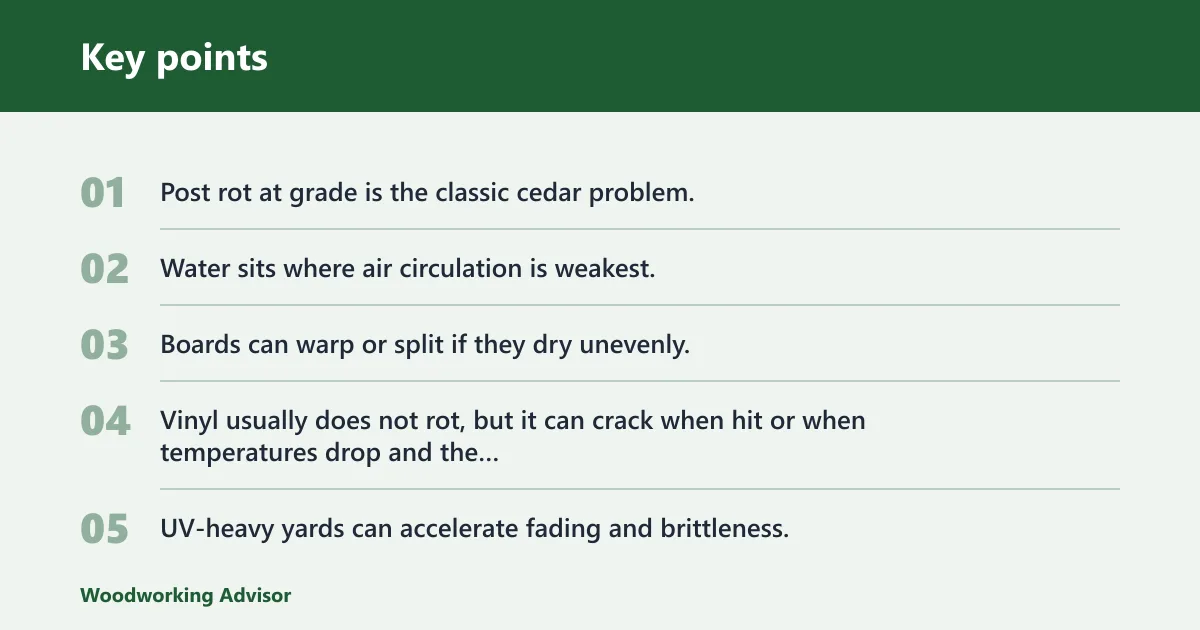
Cedar post rot, warping, splitting, and fastener corrosion
Post rot at grade is the classic cedar problem. Water sits where air circulation is weakest, and the post can decay even when the visible boards still look sound. Boards can warp or split if they dry unevenly, and fasteners can corrode if they are not exterior rated.
Vinyl cracking, fading, brittleness, and wind damage
Vinyl usually does not rot, but it can crack when hit or when temperatures drop and the material becomes less forgiving. UV-heavy yards can accelerate fading and brittleness. In gusty sites, a flexible or thin system may rack, separate, or lose sections.
Why soil drainage and footing depth matter
Soil drainage affects both fences because water around posts shortens service life. Deep, stable footings reduce movement from freeze-thaw cycles and wind uplift. On wet lots, a fence that looks fine on day one may fail early if the posts are set too shallow or packed into poor soil.
Suppose you fence a 120-foot side yard with one gate in a wet climate. A cedar fence that is left unsealed for years can start showing darkened post bases and loose boards before year 10, while a thicker vinyl system may still be sound but need a cracked panel after a storm.
Which fence is better in your climate?
Climate often decides the winner. Cedar is more sensitive to moisture management and finish upkeep, while vinyl tends to do better in wet or coastal settings but can suffer in very cold or very sunny sites if the product is light-duty. Wind exposure also changes the answer fast.
Wet and coastal sites
Vinyl is usually the safer pick near coastal salt air, sprinkler overspray, or poorly drained soil, because it avoids rot. Cedar can still work if posts are well protected, but ground contact, splashback, and constant dampness raise the risk of early failure.
Freeze-thaw climates
Both materials need deeper, correctly set posts in freeze-thaw regions. Cedar can move, swell, and split as moisture cycles through the wood. Vinyl can become more brittle in cold weather, so impact resistance and post depth matter more than usual.
High-UV yards and windy lots
Strong sun can age vinyl faster if the product lacks adequate UV protection, while wind exposes weak panel systems on both materials. Cedar can be easier to repair after a single damaged board, but vinyl can be the better long-run choice if the fence is thick, well braced, and properly anchored.
10-year and 20-year ownership worksheet
This worksheet shows why low upfront cost does not always mean low total cost. The numbers below are a planning model, not a quote. They use simple ownership assumptions so you can compare installed cost, maintenance, repair risk, and replacement exposure by climate zone.
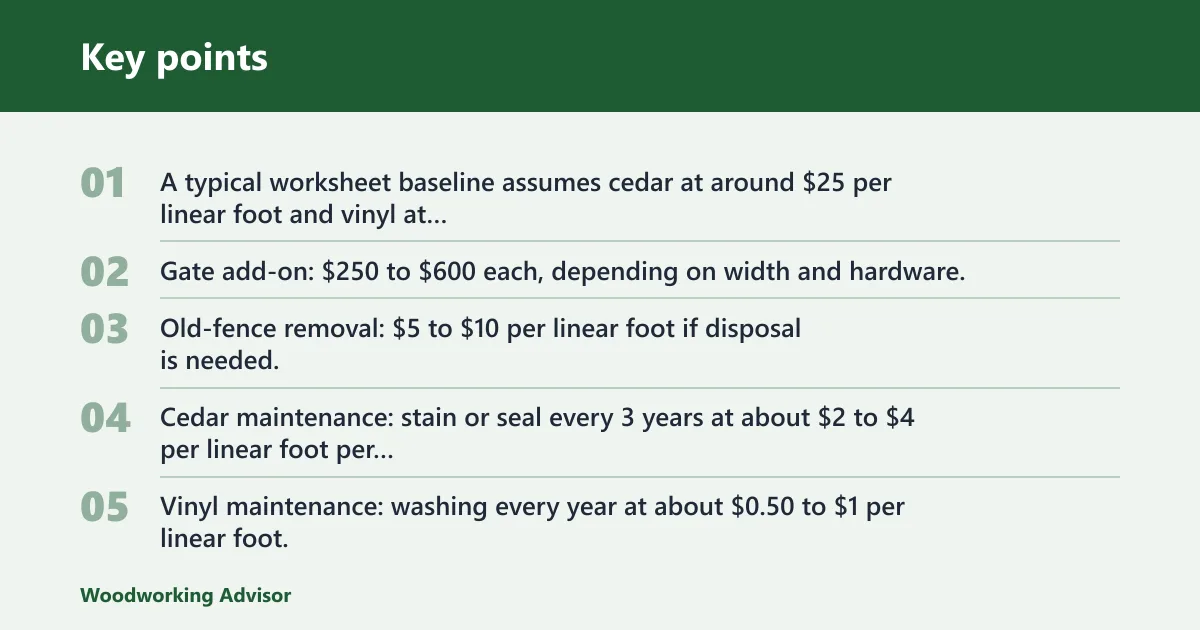
Worksheet assumptions
- A typical worksheet baseline assumes cedar at around $25 per linear foot and vinyl at around $35 per linear foot for a privacy fence, before gates and removal.
- Gate add-on: $250 to $600 each, depending on width and hardware.
- Old-fence removal: $5 to $10 per linear foot if disposal is needed.
- Cedar maintenance: stain or seal every 3 years at about $2 to $4 per linear foot per cycle.
- Vinyl maintenance: washing every year at about $0.50 to $1 per linear foot, plus spot repairs as needed.
- Repair contingency: cedar $3 to $8 per linear foot over 20 years; vinyl $2 to $10 per linear foot depending on wind and UV exposure.
| Climate zone | Fence | 10-year ownership estimate | 20-year ownership estimate | Main contingency |
|---|---|---|---|---|
| Dry / moderate | Cedar Fencing | $31 to $37 per linear foot | $38 to $52 per linear foot | Finish upkeep and a few board repairs |
| Dry / moderate | Vinyl Fencing | $39 to $44 per linear foot | $44 to $56 per linear foot | Washing and isolated panel replacement |
| Wet / coastal | Cedar Fencing | $34 to $41 per linear foot | $45 to $62 per linear foot | Higher rot risk at posts and bases |
| Wet / coastal | Vinyl Fencing | $39 to $46 per linear foot | $46 to $60 per linear foot | Cleaner upkeep, lower rot exposure |
| Hot / high-UV | Cedar Fencing | $32 to $39 per linear foot | $41 to $58 per linear foot | More frequent stain cycles |
| Hot / high-UV | Vinyl Fencing | $40 to $48 per linear foot | $47 to $63 per linear foot | Fading and brittleness risk |
By year 10, cedar can still look cheaper on paper if the fence is dry, shaded, and maintained on schedule. By year 20, vinyl often catches up or pulls ahead because cedar usually needs more finish cycles and more repair work, especially in wet or high-sun locations. A fence that must be replaced early changes the math even more.
Choose cedar fencing if… / Choose vinyl fencing if…
Choose cedar fencing if you want lower upfront cost, like real wood grain, and are willing to stain or seal on schedule. Choose vinyl fencing if you want lower maintenance, are comparing total cost over 20 years, or need better resistance to wet or coastal conditions.
Best fit for privacy fences
Cedar is a strong choice for privacy fences when appearance, repairability, and a lower entry price matter most. Vinyl makes sense when you want fewer finish chores and a more consistent look over time. If the yard stays damp, vinyl usually has the edge.
Best fit for pool fences
Vinyl often fits pool areas better because it avoids rot and cleans easily after splash and sunscreen residue. Cedar can work if local code allows it and the finish is maintained, but moisture exposure around pools makes wood upkeep less forgiving.
Best fit for high-wind yards
Cedar can be easier to patch after wind damage because individual boards or sections are often replaceable. Vinyl can still work in windy yards, but only with strong posts, proper footing depth, and a product built for lateral load. Thin vinyl in gusty sites is a bad bet.
Frequently asked questions
Is cedar fencing cheaper than vinyl fencing?
Usually yes, at least at the time of installation. Cedar often has the lower upfront price because the material is less expensive than PVC-based vinyl and the system is simpler to buy and build. Over time, though, staining, sealing, and repair costs can erase that early savings.
What does cedar fencing cost per linear foot installed?
Installed cedar often falls in the lower range of residential fence pricing, but the exact number depends on height, gate count, removal work, and region. A planning estimate of about $25 per linear foot is a common baseline before extras. Premium Western red cedar and complex layouts cost more.
What does vinyl fencing cost per linear foot installed?
Vinyl usually costs more than cedar installed because the material and matched components are more expensive. A planning baseline of about $35 per linear foot is a reasonable starting point for comparison, with thicker panels, better posts, gates, and removal work pushing the total higher.
Which fence needs more maintenance, cedar or vinyl?
Cedar needs more maintenance. It usually requires stain or sealant every few years, along with inspections for rot, warping, and fastener issues. Vinyl mainly needs washing, but it can still need panel replacement if a section cracks, fades badly, or takes storm damage.
Does cedar fencing rot or warp over time?
Yes, it can. The most common cedar failure is post rot at ground level, especially where drainage is poor or the fence stays wet. Boards can also warp or split if moisture cycles are severe or if the wood is left unprotected too long.
Is vinyl fencing worth the higher upfront cost?
It often is if you plan to keep the fence for 20 years or more and want lower upkeep. Vinyl usually wins on total ownership cost in wet, coastal, or high-maintenance settings. If you only need a shorter-term solution, cedar may be easier to justify.
Which fence is better in wet or windy climates?
Vinyl is usually better in wet climates because it does not rot, but only if the posts and panels are sturdy enough for wind. In very windy areas, either material needs proper footing depth and bracing. Cedar repairs more easily, yet it is less forgiving of constant dampness.
Sponsored / affiliate links. As an Amazon Associate I earn from qualifying purchases. I may earn additional commission from eligible campaigns.