Redwood vs White Oak: Which Is Better for an Outdoor Bench?
Redwood is usually the better choice for an outdoor bench if you want lower weight and easier upkeep. Choose White Oak only if you want more strength and can accept heavier parts and more sealing attention. Pick the wrong wood, and the bench can check, stain, swell, or become hard to move. This guide compares rot resistance, weight, fastener behavior, finish needs, and the failure points that matter most outdoors.
| Factor | Redwood | White Oak | Winner |
|---|---|---|---|
| Rot resistance | Class 1 decay resistance | Class 2 decay resistance | Redwood |
| Dent resistance | 450 lbf Janka hardness | 1,360 lbf Janka hardness | White Oak |
| Weight | Lighter softwood; easier to move | About 47 lbs/ft³ | Redwood |
| Movement and stability | More likely to dent and wear at edges | Tyloses help seal pores, but the wood still moves with moisture | Tie |
| Fastener compatibility | Works well with exterior-grade hardware | Needs stainless steel or hot-dipped galvanized hardware | Redwood |
| Maintenance interval | Seal for color retention and extra protection; similar recoat pace if finished | Exterior waterproofing sealer, with reapplication every couple of years | Redwood |
| Cost per board foot | Usually lower than white oak | Usually higher than redwood | Redwood |
| Likely failure mode | Surface checking, denting, and softer edge wear | End-grain splitting, fastener staining, and heavier handling damage | Redwood |
Rot resistance and durability comparison
Redwood wins the decay-resistance side of the comparison. White Oak is a strong exterior choice, but the benchmark data places it at Class 2, while Redwood is Class 1. That matters on an outdoor bench, where the first damage often starts at end grain, slat ends, and hardware holes rather than in the middle of a board.
Janka hardness and what it means on a bench
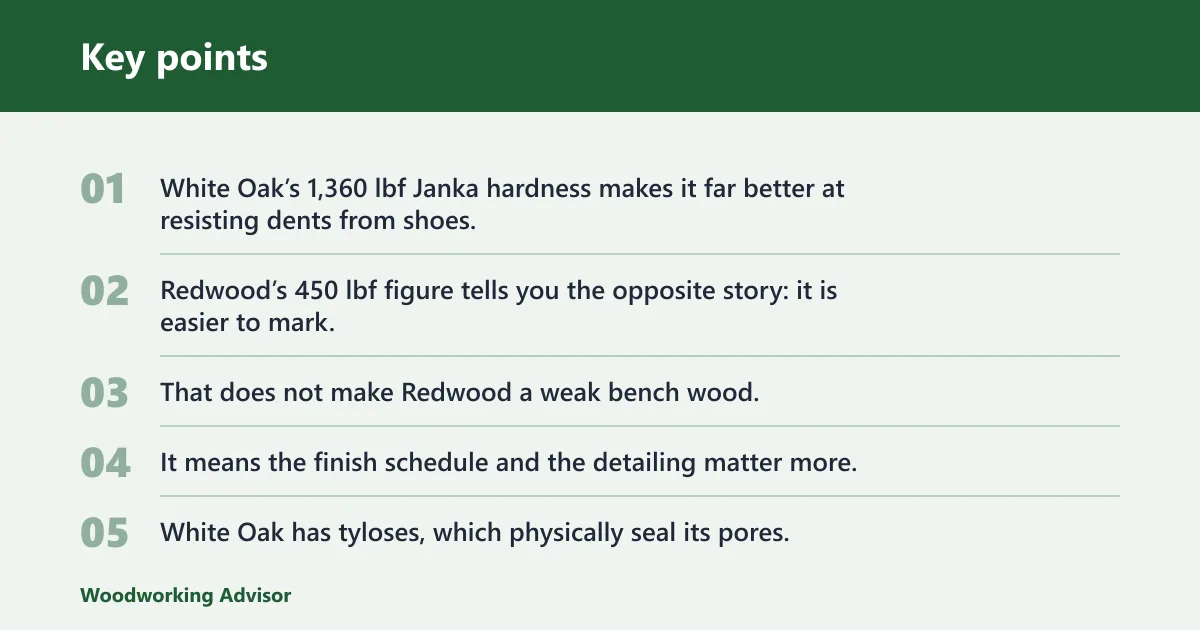
White Oak’s 1,360 lbf Janka hardness makes it far better at resisting dents from shoes, dropped tools, and rough use. Redwood’s 450 lbf figure tells you the opposite story: it is easier to mark, so the seat edge and the front corners will show wear sooner.
That does not make Redwood a weak bench wood. It means the finish schedule and the detailing matter more, especially if the bench uses narrow slats with exposed ends.
Tyloses, pores, and moisture resistance
White Oak has tyloses, which physically seal its pores. That is why it behaves much better outdoors than red oak, whose open grain drinks water more readily. The sealed pores are also why White Oak has long been used where moisture resistance matters, including barrels and shipbuilding.
On a bench, that structure helps with rain exposure, but it does not remove the need to seal end grain and protect joinery.
How do they compare on durability?
White Oak is tougher under impact, while Redwood is better at resisting rot. For outdoor benches, the better material depends on which failure you want to avoid first: dents and wear, or added weight and handling trouble. White Oak’s hardness helps with public-style use; Redwood’s decay resistance helps with easier upkeep.
Checking, splitting, and water traps
Bench parts fail in places broad lumber charts ignore. Wide seats can check on the top face, end grain can split at slat ends, and apron joints can trap water where parts overlap. Those problems show up fastest when the bench is left unfinished or when the end grain is not sealed.
Say your bench uses 1×4 slats with 3/4-inch gaps and exposed ends at the arm supports. If those ends are left raw, water enters there first, then the checks begin near the ends instead of the center of the board. White Oak resists wear better, but both woods need the same attention at the cut ends.
Outdoor bench finish and hardware

An exterior sealer is the safest default for both woods outdoors. White Oak should be sealed or oiled for exterior use, and the guidance in the comparison data calls for reapplication every couple of years. Redwood also benefits from finish if you want color retention and extra protection, especially under rain and UV exposure.
Penetrating oil, sealer, and paint
Penetrating oil can be a practical maintenance choice when you want an easy recoat cycle and a natural look. Exterior sealer gives more weather control, especially for White Oak. Film finishes are a poor fit for most outdoor benches because movement, standing water, and UV exposure tend to crack or lift them at the edges.
Paint can work if you are willing to treat the bench like a painted exterior project, with careful priming and maintenance. For a natural-wood bench, it is usually a different category of solution.
Hardware and fastener cautions
White Oak needs stainless steel hardware or hot-dipped galvanized fasteners. Its tannins can black-stain ordinary fasteners and the surrounding wood, which becomes most obvious around bolt heads, screw heads, and wet joints. Redwood is less demanding here, but exterior-grade hardware is still the right choice.
Picture a movable patio bench with exposed bolts at the leg stretcher. If those bolts are not stainless on White Oak, dark stains can spread around the fastener and make the joinery look older than it is.
Which wood is cheaper for an outdoor bench, redwood or white oak?
Redwood is usually the cheaper choice, while White Oak usually costs more per board foot. That cost gap matters more on a bench than it does on a small side table because benches use longer stock, more joinery, and more waste from careful grain selection. If the budget is fixed, Redwood usually stretches farther.
Availability also matters. In many yards, White Oak is easier to find in standard hardwood inventory, but Redwood may be simpler to source in the sizes and grades that suit outdoor furniture.
Which wood is easier to work with for a DIY outdoor bench?
Redwood is easier to machine and faster to assemble because it is lighter and softer. White Oak is harder on cutters and heavier to handle, so layout, clamping, and dry fitting matter more. If you are building alone, the weight difference is often obvious at the glue-up and assembly stage.
That said, White Oak’s hardness can be useful on a bench that will see heavy use. It holds up better where people slide across the seat or where the front edge gets kicked and scuffed.
Does white oak last longer than redwood outdoors?
Not in a simple, universal way. Redwood has the stronger decay-resistance rating in the provided comparison data, while White Oak has higher hardness and better dent resistance. So White Oak can stay serviceable longer in high-wear seating, but Redwood can age better against rot if the bench is maintained and kept drained.
The real divider is where the bench fails first. White Oak is more likely to stay crisp at the edges but needs more attention to hardware and sealing. Redwood is more forgiving on weight and upkeep, but it dents and checks sooner.
Is redwood strong enough for a bench seat and frame?
Yes, Redwood is strong enough for a bench seat and frame when the design is sensible. It is commonly used in outdoor benches and patio furniture, but it performs best when the span is reasonable and the seat slats are not overly thin. The softwood nature means design matters more than brute material strength.
If the bench is long, use enough support points under the seat to limit flex. That reduces checking and helps the slats last longer at the fasteners.
Should you use redwood or white oak for a fixed garden bench?
For a fixed garden bench, Redwood is usually the cleaner choice. It is lighter to install, naturally rot resistant, and less demanding to move during finishing or maintenance. If the bench will stay in one place and weather in place, Redwood’s lower weight and easier upkeep are hard to ignore.
White Oak still works, especially if the bench will see heavy use or you want a stiffer feel. But a fixed bench gives Redwood one of its biggest advantages: you do not have to move 47-lbs/ft³ stock every time you service it.
Should you use redwood or white oak for a movable patio bench?
For a movable patio bench, Redwood is usually the better pick unless impact resistance matters more than handling. White Oak’s weight becomes a drawback once the bench needs to be dragged, lifted, or shifted for storage. A bench that is too heavy gets left in place, which makes seasonal care harder.
If the bench will be moved often, Redwood reduces the burden on both the frame and the person handling it. White Oak makes more sense when the bench needs a stiffer, denser feel and will stay put most of the time.
Choose Redwood if… / Choose White Oak if…
Choose Redwood if you want the lighter bench, lower maintenance burden, and better decay-resistance rating. It fits fixed garden benches, movable patio benches, and projects where easier handling matters more than dent resistance.
Choose White Oak if the bench will see hard use, you want higher dent resistance, and you are willing to seal it, use stainless hardware, and accept the extra weight. That makes it the better pick for a stout, long-lived bench that does not need frequent moving.

Frequently asked questions
Is redwood or white oak better for an outdoor bench?
Redwood is usually better if you want lower weight and simpler upkeep. White Oak is better if dent resistance and a harder seat edge matter more. For most DIY bench projects, Redwood is the easier outdoor choice; for a heavier-duty bench that stays put, White Oak earns consideration.
Do I need to seal white oak for an outdoor bench?
Yes. White Oak should be sealed or oiled for exterior use, and exterior waterproofing sealer is the safer choice for bench parts exposed to rain, humidity, and UV. Reapplication every couple of years is the practical maintenance pace given in the benchmark guidance.
Will redwood or white oak dent, split, or warp less outdoors?
White Oak dents less because it has the higher Janka hardness. Redwood can check and dent sooner, especially at edges and end grain. Both woods can split or move if water gets into joints, so sealed end grain and well-drained details matter more than the species alone.
What finish should I use on redwood or white oak for outdoor furniture?
Use an exterior sealer for either species if you want better weather protection and color retention. Penetrating oil is a workable maintenance finish, but film finishes are usually a poor fit outdoors because they crack or peel as the wood moves. White Oak needs the more careful sealing schedule.
Sponsored / affiliate links. As an Amazon Associate I earn from qualifying purchases. I may earn additional commission from eligible campaigns.